Is Mountain Dew Citrus Soda Safe During Pregnancy? (Updated 2026 Guide)
Updated September 9, 2026
Mountain Dew Citrus Soda
Mtn Dew
Mountain Dew Citrus Soda is best limited to an occasional small drink during pregnancy rather than an everyday choice. Its C- grade reflects ingredient based concerns about caffeine, added sugar, and Yellow 5—not proof that an occasional serving causes harm.
You can use this, but maybe don't make it your everyday go to. Not the end of the world if you've used it. Consult your OBGYN or midwife if you have concerns.
Pregnancy Safe is 100% independent and research driven. No companies pay to promote or sponsor products.
Stress Less This Pregnancy
Check your soda in the app

What Ingredients Are in Mountain Dew Citrus Soda?
Mountain Dew Citrus Soda has 12 ingredients. We flagged 3 ingredients to use with caution.
caffeine
CAUTION
Caffeine is a natural stimulant found in coffee, tea, and various plants that temporarily boosts alertness and reduces fatigue. During pregnancy, count this soda's caffeine toward a total below 200 mg per day from all foods, drinks, supplements, and medicines.
high fructose corn syrup
CAUTION
High fructose corn syrup is a sweet, liquid sweetener made from corn starch, commonly used in processed foods and beverages. Occasional food amounts are not a known pregnancy teratogen concern, but frequent sugary drinks warrant limiting, especially with gestational diabetes.
yellow 5
CAUTION
Yellow 5 is a synthetic food dye used to impart a bright yellow color to various processed foods and beverages. Human pregnancy data for Yellow 5 are limited, and animal or children's neurobehavioral findings do not prove harm from occasional regulated dietary exposure.
sodium benzoate
LIKELY SAFE
Sodium benzoate is a preservative commonly used to inhibit microbial growth in food and beverage products. Sodium benzoate is generally low concern at regulated beverage levels, although direct human pregnancy data are limited and benzene formation depends on formulation and storage.
calcium disodium edta
SAFE
Calcium disodium EDTA is a chelating agent used to bind and remove metal ions, often as a preservative or stabilizer in food and pharmaceutical products. Evidence about dietary calcium does not directly establish pregnancy safety or nutritional benefit for calcium disodium EDTA used as a soda additive.
carbonated water
SAFE
Carbonated water is water infused with carbon dioxide gas, creating a fizzy, bubbly sensation. Water from a safe drinking source supports pregnancy hydration, but the carbonated water in this soda does not offset its caffeine or added sugar.
citric acid
SAFE
Citric acid is a natural organic acid commonly used as a preservative and flavor enhancer in food and beverages. Citric acid is generally compatible with pregnancy at ordinary food amounts, although acidic drinks may worsen reflux or dental irritation.
sodium citrate
SAFE
Sodium citrate is a salt commonly used as a food additive and buffering agent to regulate acidity and stabilize emulsions. Sodium citrate is generally compatible with pregnancy at ordinary food additive amounts, though the acidic drink itself may aggravate reflux.
concentrated orange juice
SAFE
Concentrated orange juice is a thick, flavorful liquid made by removing most of the water from fresh orange juice, often used as a base for beverages and recipes. Concentrated orange juice is unflagged in this soda, but that does not establish ingredient specific pregnancy safety at a particular intake.
erythorbic acid
SAFE
Erythorbic acid is a synthetic antioxidant commonly used to preserve the color and freshness of processed foods. Erythorbic acid is unflagged, but its combination with benzoate can allow benzene formation in some beverages under heat or light, without establishing contamination in this product.
gum arabic
SAFE
Gum arabic is a natural, edible gum derived from the sap of acacia trees, commonly used as a stabilizer, emulsifier, and thickening agent in food and beverage products. Gum arabic is unflagged as a soda stabilizer, but direct pregnancy evidence is insufficient here to establish a specific safe intake.
natural flavor
SAFE
Natural flavor refers to flavoring agents derived from natural sources such as plants, fruits, or spices, used to enhance the taste of food and beverages. Natural flavor is unflagged, but the unspecified flavoring mixture does not support a specific pregnancy safety conclusion.
Answering Your Questions
How much Mountain Dew Citrus Soda is safe during pregnancy?
Choose a small portion and check the caffeine and added sugar listed for the amount you actually drink. Keep your total caffeine below 200 mg per day, counting coffee, tea, chocolate, medicines, and other sources too. ACOG
Can you use Mountain Dew Citrus Soda daily while pregnant?
Keep Mountain Dew occasional rather than making it your daily hydration drink. Choose water most often, and follow your care team's carbohydrate guidance if you have gestational diabetes.
Why does Mountain Dew receive a C- pregnancy grade?
The C- comes from ingredient based scoring, with caffeine, high fructose corn syrup, and Yellow 5 flagged for caution. Caffeine requires a daily intake limit, frequent sugary drinks raise dietary and metabolic concerns, and Yellow 5 has limited human pregnancy evidence. Sodium benzoate is also considered in the scoring but is rated likely safe at ordinary food levels.
How should I count Mountain Dew toward my pregnancy caffeine limit?
Check the caffeine amount for your exact container and adjust for how much you drink; do not assume every bottle is one serving. Add that amount to all your other caffeine sources and keep the day's total below 200 mg. ACOG
Is the sugar in Mountain Dew harmful during pregnancy?
High fructose corn syrup is an added sugar, not a known cause of birth defects at occasional food amounts. The concern is frequent high intake of sugary drinks, which can displace nutrient rich foods and is associated with gestational diabetes and metabolic risk. If you have gestational diabetes, ask your care team how this drink fits your carbohydrate plan.
Is diet or caffeine free soda a better alternative?
Caffeine free soda removes the caffeine concern, while a sugar free option removes added sugar; neither change automatically addresses the other ingredients. Check the full label rather than assuming a different version shares this product's assessment. Plain water or unsweetened, caffeine free sparkling water avoids both caffeine and added sugar.
Can I drink Mountain Dew while breastfeeding?
An occasional small serving can fit within a breastfeeding diet, but count its caffeine alongside your other sources. Caffeine passes into breast milk in small amounts, and low to moderate maternal intake usually does not adversely affect infants; that does not make this sugary soda an ideal daily drink. CDC
Does Yellow 5 mean an occasional Mountain Dew will harm my baby?
No its caution rating does not establish harm from an occasional regulated food exposure. Human pregnancy data are limited, and findings from animal studies or children's behavior research do not directly show what happens with ordinary soda intake during pregnancy. Choosing dye free drinks is an option if you want to reduce that uncertainty.
What Are Pregnancy Safe Alternatives to Mountain Dew Citrus Soda?
Here are some solid alternatives. Everything below has an A or B grade, meaning no flagged ingredients in our database.
| Grade | Product | Brand | Type |
|---|---|---|---|
| A | Poppi Cranberry Fizz Prebiotic Soda | Poppi | soda |
| A | Poppi Cherry Lime Prebiotic Soda - 4Pk/12 Fl Oz Cans | Poppi | soda |
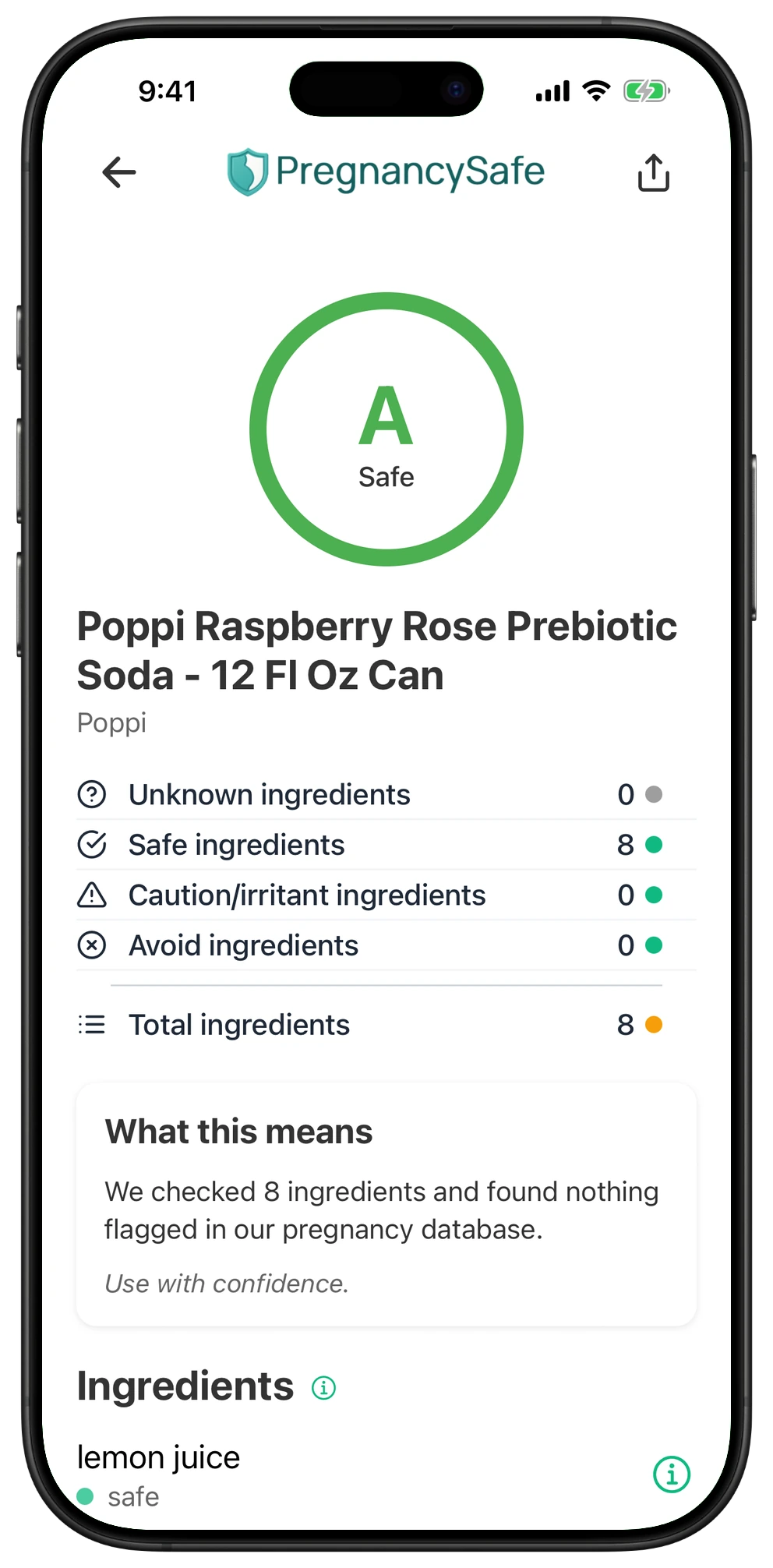
| A | Poppi Raspberry Rose Prebiotic Soda | Poppi | soda |
| B+ | Sprite Zero Lemon-Lime Soda 6Pk | Sprite Zero | soda |
Are Other Mtn Dew Products Safe During Pregnancy?
We looked at 10 other Mtn Dew products. 0 are pregnancy safe (A or B grade), while 10 need a closer look.
| Grade | Product | Type |
|---|---|---|
| C- | Baja Blast Tropical Lime Flavor Energy Drink, Lime | energy drink |
| C- | Baja Blast Tropical Lime Zero Sugar Soda, Baja Blast | soda |
| C- | Baja Caribbean Splash Soda, Guava | soda |
| C- | Baja Flash Soda With A Blast Of Pineapple Coconut, Baja Flash | soda |
How Does Mountain Dew Citrus Soda Compare to Other Sodas?
We graded 3,107 Sodas for pregnancy safety. Here's how they stack up:
Mountain Dew Citrus Soda earns a C- grade, placing it among the majority of Sodas. Only 13% of products in this category get an A grade, so it pays to choose carefully.
How Do We Score Products for Pregnancy Safety?
We analyze each product's ingredients and category to flag known risks and provide cautionary notices for general category safety concerns.
A - Safe
Excellent choice! All ingredients are considered safe during pregnancy.
What to do: Use with confidence.
B - Likely Safe
Pretty much safe with very minimal risk. Some ingredients may have limited pregnancy studies, but no significant safety concerns have been identified.
What to do: Use with confidence.
C - Limit
Contains ingredients with some pregnancy considerations. Research shows these ingredients may have limited safety data, potential for minor hormonal effects, or require caution based on animal studies.
What to do: Use sparingly and consider safer alternatives when available.
D - Caution
Similar to C grade but contains multiple cautionary ingredients. The combination increases overall concern.
What to do: Try to avoid if that makes you feel better. If you've already used it, no need to panic.
F - Avoid
Contains an ingredient Pregnancy Safe recommends avoiding during pregnancy. This may reflect an established risk or a precaution based on limited evidence; check the ingredient guidance and exposure context.
What to do: Do not use during pregnancy. If you've already used it, don't worry - contact your OBGYN if concerned.
People Also Checked
References
- https://www.acog.org/clinical/clinical-guidance/committee-opinion/articles/2010/08/moderate-caffeine-consumption-during-pregnancy
- https://www.acog.org/womens-health/experts-and-stories/ask-acog/how-much-coffee-can-i-drink-while-pregnant
- https://www.ncbi.nlm.nih.gov/books/NBK582613/
- https://www.who.int/tools/elena/interventions/caffeine-pregnancy
- https://www.fda.gov/consumers/consumer-updates/spilling-beans-how-much-caffeine-too-much
- https://pubmed.ncbi.nlm.nih.gov/25179792/
- https://pubmed.ncbi.nlm.nih.gov/25238871/
- https://cdn.realfood.gov/DGA.pdf
- https://www.dietaryguidelines.gov/sites/default/files/2021-12/DGA_Pregnancy_FactSheet-508c.pdf
- https://www.acog.org/womens-health/faqs/healthy-eating-during-pregnancy
- https://www.cdc.gov/nutrition/php/data-research/added-sugars.html
- https://www.cdc.gov/diabetes/about/gestational-diabetes.html
- https://www.who.int/publications/i/item/9789241549028
- https://nesr.usda.gov/2025-dietary-guidelines-advisory-committee-systematic-reviews/dietary-patterns_gestational-diabetes
- https://www.ecfr.gov/current/title-21/chapter-I/subchapter-B/part-184/subpart-B/section-184.1733
- https://apps.who.int/food-additives-contaminants-jecfa-database/Home/Chemical/1098
- https://www.inchem.org/documents/jecfa/jecmono/v83je01.pdf
- https://efsa.onlinelibrary.wiley.com/doi/10.2903/j.efsa.2016.4433
- https://www.fda.gov/food/environmental-contaminants-food/questions-and-answers-occurrence-benzene-soft-drinks-and-other-beverages
- https://pubmed.ncbi.nlm.nih.gov/29243541/
- https://ec.europa.eu/health/ph_risk/committees/04_sccp/docs/sccp_o_015.pdf
- https://hfpappexternal.fda.gov/scripts/fdcc/index.cfm?id=FDCYellow5&set=ColorAdditives
- https://www.ecfr.gov/current/title-21/chapter-I/subchapter-A/part-74#74.705
- https://www.fda.gov/food/color-additives-information-consumers/tracking-food-industry-pledges-remove-petroleum-based-food-dyes
- https://www.fda.gov/food/nutrition-food-labeling-and-critical-foods/food-allergies
- https://apps.who.int/food-additives-contaminants-jecfa-database/Home/Chemical/3885
- https://efsa.onlinelibrary.wiley.com/doi/10.2903/j.efsa.2009.1331
- https://oehha.ca.gov/risk-assessment/report/health-effects-assessment-potential-neurobehavioral-effects-synthetic-food-dyes-children
- https://pubmed.ncbi.nlm.nih.gov/1628860/
- https://pmc.ncbi.nlm.nih.gov/articles/PMC7023231/
- https://pmc.ncbi.nlm.nih.gov/articles/PMC6354951/
- https://ods.od.nih.gov/factsheets/Pregnancy-HealthProfessional/
- https://ods.od.nih.gov/factsheets/Calcium-HealthProfessional/
- https://ods.od.nih.gov/factsheets/Iron-HealthProfessional/
- https://www.who.int/tools/elena/interventions/calcium-pregnancy
- https://www.ncbi.nlm.nih.gov/books/NBK56056/
- https://www.cochrane.org/evidence/CD001059_taking-calcium-supplements-during-pregnancy-effective-way-prevent-blood-pressure-disorders-and
- https://www.acog.org/womens-health/experts-and-stories/ask-acog/how-much-water-should-i-drink-during-pregnancy
- https://www.cdc.gov/healthy-weight-growth/water-healthy-drinks/index.html
- https://www.cdc.gov/heat-health/hcp/clinical-overview/heat-and-pregnant-women.html
- https://www.cdc.gov/drinking-water/about/index.html
- https://www.cdc.gov/yellow-book/hcp/family-travel/pregnant-travelers.html
- https://www.epa.gov/privatewells/protect-your-homes-water
- https://www.fda.gov/consumers/consumer-updates/bottled-water-everywhere-keeping-it-safe
- https://www.nationalacademies.org/read/10925/chapter/6
- https://hfpappexternal.fda.gov/scripts/fdcc/index.cfm?id=CITRICACID&set=FoodSubstances
- https://www.ecfr.gov/current/title-21/chapter-I/subchapter-B/part-184/subpart-B/section-184.1033
- https://apps.who.int/food-additives-contaminants-jecfa-database/chemical.aspx?chemID=3594
- https://www.inchem.org/documents/jecfa/jeceval/jec_436.htm
- https://pmc.ncbi.nlm.nih.gov/articles/PMC7448088/
- https://www.fao.org/fileadmin/user_upload/jecfa_additives/docs/monograph16/additive-135-m16.pdf