Best Pregnancy Safe Milk (Updated 2026 Guide)
Updated September 9, 2026
The Answer
Pasteurized milk is generally compatible with pregnancy; avoid raw or unpasteurized milk because of foodborne infection risks. Choose a milk that fits your nutritional needs and tolerance, checking pasteurization and the current label rather than relying on an ingredient grade.
The main pregnancy consideration is pasteurization and proper storage, not whether milk has a short ingredient list. Food level vitamin A and D fortification is not equivalent to high dose supplements, while frequent high added sugar intake is worth limiting. Plant based drinks, herbal lactation supplements, and milk named skincare products need separate consideration: they are not interchangeable with drinking milk.
Pregnancy Safe is 100% independent and research driven. No companies pay to promote or sponsor products.
Stress Less This Pregnancy
Check your exact milk in the app

✓ What's Safe
- • Check for an explicit pasteurized or ultra pasteurized statement; ultra filtered alone does not confirm pasteurization.
- • Compare protein, calcium, and vitamin D per serving, especially when choosing a plant based drink to replace dairy milk.
- • Choose plain or unsweetened formulations for everyday use, and compare added sugars on flavored versions.
- • Read refrigeration instructions; only store unopened milk at room temperature when the label identifies it as shelf stable.
- • Match the formulation to your dietary needs, checking lactose free labeling and relevant milk, soy, or nut allergens.
- • Confirm that the item is a food beverage, not a lactation supplement or cosmetic with milk in its name.
✗ What to Avoid
- • Avoid raw or unpasteurized milk, regardless of organic, local, or farm fresh claims.
- • Limit frequent servings high in added sugars, including high fructose corn syrup; occasional food exposure is not a known birth defect risk.
- • If reducing nonessential dyes, choose drinks without red 40, fd c red 40, blue 1, red 3, or artificial color. These flags do not establish fetal harm from occasional food exposure.
- • Avoid making drinks containing kombu seaweed a daily iodine source without checking the iodine amount; kombu can supply highly variable, excessive iodine.
- • Avoid concentrated medicinal fennel preparations unless your clinician recommends them; ordinary culinary flavoring amounts are a different exposure.
- • Do not choose oral products containing aloe barbadensis leaf juice or herbal supplements containing organic goat's rue as routine milk replacements without clinician review.
Most Common Ingredients in Milk Products
We analyzed 4,985 milk products. Here are the most common ingredients, ranked by how often they appear:
Ingredients to Watch Out For in Milk
These are the most common flagged ingredients across 4,985 milk products we analyzed.
high fructose corn syrup
Caution
High fructose corn syrup is a sweet, liquid sweetener made from corn starch, commonly used in processed foods and beverages.
Is not a known teratogen at occasional food amounts, but high added sugar intake can displace nutrients and raise gestational diabetes and metabolic concerns.
This is an added sweetener in some flavored milk drinks. Limit frequent high intake as part of your overall added sugar intake; occasional food amounts are not treated as a pregnancy teratogen.
Flagged in 111 of 4,985 products (2%)
Caution
Red 40 is a synthetic food dye commonly used to add vibrant red color to candies, beverages, and processed foods.
Has limited human pregnancy data and is allowed at regulated food additive levels, but child neurobehavior concerns and high dose animal findings make frequent high dye intake worth limiting.
This synthetic red dye can appear in flavored milk drinks. Human pregnancy data are limited; child behavior findings and high dose animal studies do not establish fetal harm from occasional regulated food exposure.
Flagged in 24 of 4,985 products (0%)
artificial color
Caution
Artificial color is a synthetic dye added to foods and products to enhance or alter their visual appearance.
Has limited pregnancy specific outcome data; regulated incidental exposure is generally low concern but some dyes have child behavior allergy or regulatory caveats.
This broad label term does not identify a specific dye in a milk drink. Check the exact color where possible, particularly if you have a known sensitivity; regulated incidental exposure is generally low concern, not proven pregnancy harm.
Flagged in 11 of 4,985 products (0%)
blue 1
Caution
Blue 1 is a synthetic blue dye commonly used to add vibrant color to foods, beverages, and cosmetics.
Has limited human pregnancy data; regulated food use is not shown to cause fetal harm, but high dose animal neurobehavior findings and child sensitivity concerns support minimizing frequent exposure.
Blue 1 is a synthetic blue food dye that may color specialty milk drinks. Pregnancy specific evidence is very limited, and ordinary regulated food use has not been shown to cause fetal harm; choosing an uncolored drink reduces nonessential exposure.
Flagged in 8 of 4,985 products (0%)
kombu seaweed
Caution
Kombu seaweed is a nutrient rich, dark green kelp commonly used in Japanese cuisine to enhance umami flavor and make broths.
Can contain highly variable iodine, with high dose brown seaweed or kelp products and hijiki arsenic exposure requiring caution in pregnancy.
Kombu in some soy drinks can contribute highly variable iodine. Frequent intake of a high iodine formulation is different from an occasional serving; check iodine content before using it as your daily milk replacement.
Flagged in 8 of 4,985 products (0%)
fd c red 40
Caution
FD&C Red 40 is a synthetic red dye commonly used to add vibrant color to foods, beverages, and cosmetics.
Has limited human pregnancy data and is allowed at regulated food additive levels, but child neurobehavior concerns and high dose animal findings make frequent high dye intake worth limiting.
This is another label spelling for Red 40, not a separate dye or additional hazard. In flavored milk, the concern is limited pregnancy evidence and frequent dye exposure, not established fetal harm from an occasional serving.
Flagged in 7 of 4,985 products (0%)
red 3
Caution
Red 3 is a synthetic red dye commonly used to add vibrant color to food and beverages.
Has limited human pregnancy outcome data and is being phased out of U.S. foods and ingested drugs after high dose male rat thyroid tumor findings.
Red 3, also called erythrosine, is a red dye being phased out of U.S. foods after high dose male rat thyroid tumor findings. Those findings do not establish harm from ordinary milk drink exposure during pregnancy; avoiding unnecessary intake is reasonable.
Flagged in 7 of 4,985 products (0%)
fennel
Caution
Fennel is a crunchy, aromatic vegetable with a bulbous base, feathery fronds, and a mild, sweet anise flavor often used in salads, soups, and Mediterranean dishes.
Is generally low concern at normal culinary amounts but should be avoided as concentrated medicinal tea, essential oil, or supplement during pregnancy because safety data are limited and estrogenic or uterine concerns exist.
Fennel used in ordinary culinary amounts to flavor a drink is low concern. Concentrated medicinal teas, extracts, oils, and supplements have limited pregnancy safety data and should not be treated like ordinary milk flavoring.
Flagged in 4 of 4,985 products (0%)
Types of Milk
How Do Milk Products Stack Up?
Our catalog contains ratings for 4,985 milk products. These are database grades, not independent safety certifications.
Grades are ingredient scores, not clinical verdicts or measurements of pathogens, dose, preparation or current package contents. Cohorts include unreviewed catalog records and counts are not independently verified safe-product totals.
Best Pregnancy Safe Milk
Popular options from our catalog, prioritizing A and B ingredient grades, with C grade options used to fill remaining places. Within each group, products are ordered by searches in Pregnancy Safe, not retail sales. Read the cautions and guidance above; grades do not verify a complete current label or guarantee pregnancy safety.
| Grade | Product | Brand |
|---|---|---|
| B+ | Fairlife Lactose-Free Whole Milk | Fairlife |
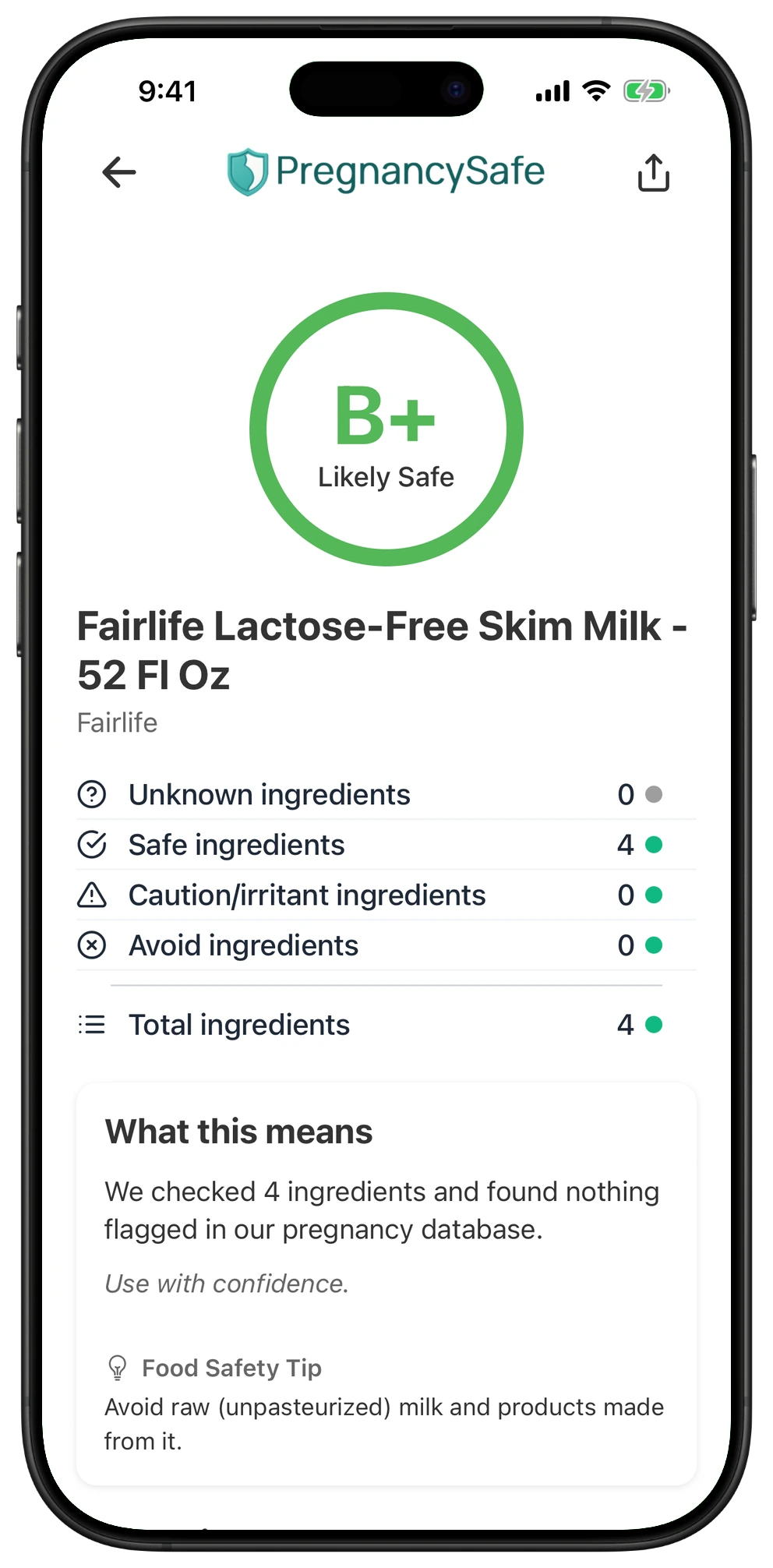
| B+ | Fairlife Lactose-Free Skim Milk | Fairlife |
| B+ | Fairlife Lactose-Free 2% Chocolate Milk | Fairlife |
| B+ | Horizon Organic 2% Reduced Fat Dha Omega-3 Milk | Horizon |
| A | Whole Milk | Great Value |
Your Questions Answered
Why can't you drink milk while pregnant?
You generally can drink pasteurized milk while pregnant. The warning applies to raw or unpasteurized milk, which can carry Listeria and other harmful bacteria. Check the pasteurization statement and follow the package's storage instructions.
Which milk should be avoided during pregnancy?
Avoid raw or unpasteurized milk. Organic, farm fresh, and ultra filtered claims do not by themselves establish that milk is pasteurized. Also avoid drinking milk that has not been stored according to its label; a favorable ingredient grade does not measure contamination.
What milk is best during pregnancy?
Start with pasteurized milk that suits your nutritional needs and tolerance rather than a particular brand or grade. Compare protein, calcium, vitamin D, and added sugars per serving. If choosing a plant based alternative, check its actual nutrient panel rather than assuming it matches dairy milk. There is no single best formulation for everyone.
Are fortified and lactose free milks suitable during pregnancy?
Pasteurized fortified or lactose free milk can be an option during pregnancy. Vitamin A and D at food fortification levels should not be treated as equivalent to high dose supplements. Lactose intolerance and milk allergy are separate issues, so do not assume a lactose free label makes a product appropriate for a milk allergy.
Can I drink chocolate or other flavored milk during pregnancy?
Check that dairy based flavored milk is pasteurized, then compare added sugars and serving sizes. Frequent high added sugar intake is the main nutritional concern, rather than an occasional serving being a known pregnancy hazard. Dye free options can reduce nonessential additives, but limited pregnancy data and high dose animal findings do not establish harm from ordinary food exposure. If you have gestational diabetes, follow your care team's carbohydrate guidance.
Does an A grade mean a milk is verified safe during pregnancy?
No. Our catalog contains 4,985 products, including 1,543 with an A ingredient grade, but these are not independently verified safe product totals. Grades do not measure pathogens, serving amounts, storage, or current package contents, and incomplete records are not proof of harm. A listed product is a comparison point, not a safety guarantee; check your exact package.
How to Interpret These Ratings
Our ingredient and category rules generate letter grades from the information recorded in the catalog. Missing ingredients and broad category assignments can affect the result. These grades do not measure your dose, confirm a complete current label, or test a product for contamination.
A high grade is not a guarantee of pregnancy safety. A low grade is not, by itself, proof of harm from every use. Follow the product-specific guidance above, check the actual package, and ask your prenatal clinician about supplements, treatment decisions or uncertain exposures.
References
- https://www.cdc.gov/foodsafety/rawmilk/index.html
- https://www.cdc.gov/listeria/prevention/index.html
- https://www.nhs.uk/pregnancy/keeping-well/foods-to-avoid/
- https://cdn.realfood.gov/DGA.pdf
- https://www.dietaryguidelines.gov/sites/default/files/2021-12/DGA_Pregnancy_FactSheet-508c.pdf
- https://www.acog.org/womens-health/faqs/healthy-eating-during-pregnancy
- https://www.cdc.gov/nutrition/php/data-research/added-sugars.html
- https://www.cdc.gov/diabetes/about/gestational-diabetes.html
- https://www.who.int/publications/i/item/9789241549028
- https://nesr.usda.gov/2025-dietary-guidelines-advisory-committee-systematic-reviews/dietary-patterns_gestational-diabetes
- https://www.hfpappexternal.fda.gov/scripts/fdcc/index.cfm?id=FDCRed40&set=ColorAdditives
- https://www.ecfr.gov/current/title-21/chapter-I/subchapter-A/part-74/subpart-A/section-74.340
- https://www.fda.gov/food/color-additives-information-consumers/tracking-food-industry-pledges-remove-petroleum-based-food-dyes
- https://www.efsa.europa.eu/en/efsajournal/pub/1327
- https://www.efsa.europa.eu/en/efsajournal/pub/4007
- https://apps.who.int/food-additives-contaminants-jecfa-database/Home/Chemical/2361
- https://oehha.ca.gov/risk-assessment/report/health-effects-assessment-potential-neurobehavioral-effects-synthetic-food-dyes-children
- https://pubmed.ncbi.nlm.nih.gov/6636206/
- https://pubmed.ncbi.nlm.nih.gov/2613118/
- https://pubmed.ncbi.nlm.nih.gov/7940558/
- https://www.fda.gov/food/color-additives-information-consumers/color-additives-questions-and-answers-consumers
- https://www.fda.gov/food/food-ingredients-packaging/color-additives-information-consumers
- https://www.fda.gov/cosmetics/cosmetic-ingredient-names/color-additives-permitted-use-cosmetics
- https://www.fda.gov/industry/color-additives/fdc-red-no-3
- https://pubmed.ncbi.nlm.nih.gov/35233072/
- https://pubmed.ncbi.nlm.nih.gov/35484553/
- https://pubmed.ncbi.nlm.nih.gov/35106984/
- https://www.hfpappexternal.fda.gov/scripts/fdcc/index.cfm?id=FDCBlue1&set=ColorAdditives
- https://www.ecfr.gov/current/title-21/chapter-I/subchapter-A/part-74
- https://efsa.onlinelibrary.wiley.com/doi/10.2903/j.efsa.2010.1853
- https://apps.who.int/food-additives-contaminants-jecfa-database/Home/Chemical/3309
- https://pubmed.ncbi.nlm.nih.gov/23208798/
- https://pubmed.ncbi.nlm.nih.gov/24257113/
- https://journals.sagepub.com/doi/10.1177/10507256261445624
- https://ods.od.nih.gov/factsheets/Iodine-HealthProfessional/
- https://www.foodstandards.gov.au/consumer/nutrition/pregnancy/iodine-and-pregnancy
- https://www.foodstandards.gov.au/consumer/prevention-of-foodborne-illness/arseniciodine
- https://inspection.canada.ca/en/food-safety-consumers/fact-sheets/specific-products-and-risks/chemical-hazards/inorganic-arsenic
- https://pubmed.ncbi.nlm.nih.gov/35947162/
- https://pubmed.ncbi.nlm.nih.gov/20919974/
- https://pubmed.ncbi.nlm.nih.gov/30632947/
- https://pmc.ncbi.nlm.nih.gov/articles/PMC8077470/
- https://www.federalregister.gov/documents/2025/01/16/2025-00830/color-additive-petition-from-center-for-science-in-the-public-interest-et-al-request-to-revoke-color
- https://efsa.onlinelibrary.wiley.com/doi/10.2903/j.efsa.2011.1854
- https://pubmed.ncbi.nlm.nih.gov/2824305/
- https://pubmed.ncbi.nlm.nih.gov/2177442/
- https://pubmed.ncbi.nlm.nih.gov/8296313/
- https://pubmed.ncbi.nlm.nih.gov/8386132/
- https://pmc.ncbi.nlm.nih.gov/articles/PMC9368057/
- https://hfpappexternal.fda.gov/scripts/fdcc/index.cfm?id=FENNELCOMMON&set=FoodSubstances
- https://www.ema.europa.eu/en/documents/herbal-monograph/final-european-union-herbal-monograph-foeniculum-vulgare-miller-subsp-vulgare-var-dulce-mill-batt-trab-fructus-revision-1_en.pdf
- https://webprod.hc-sc.gc.ca/nhpid-bdipsn/dbImages/mono_fennel-sweet_english.pdf
- https://www.swissmedic.ch/swissmedic/en/home/news/mitteilungen/fencheltee-fuer-schwangere-kinder-unter-4-jahren.html
- https://www.efsa.europa.eu/en/news/have-your-say-estragole-fennel-seed-preparations
- https://www.ncbi.nlm.nih.gov/books/NBK501793/
- https://pubmed.ncbi.nlm.nih.gov/30969204/
- https://pubmed.ncbi.nlm.nih.gov/32733750/
- https://pubmed.ncbi.nlm.nih.gov/23275017/
- https://www.utep.edu/herbal-safety/populations/herbs-to-avoid-during-pregnancy.html
- https://www.poison.org/articles/herbal-abortion
- https://www.drugs.com/npp/rue.html
- https://pubmed.ncbi.nlm.nih.gov/36924751/
- https://pubmed.ncbi.nlm.nih.gov/12807304/
- https://pubmed.ncbi.nlm.nih.gov/15639078/
- https://www.mdpi.com/1422-0067/22/5/2380
- https://www.ema.europa.eu/en/documents/mrl-report/ruta-graveolens-summary-report-committee-veterinary-medicinal-products_en.pdf
- https://www.utep.edu/herbal-safety/herbal-facts/herbal%20facts%20sheet/rue.html
- https://www.nccih.nih.gov/health/aloe-vera
- https://webprod.hc-sc.gc.ca/nhpid-bdipsn/dbImages/mono_aloe--oral_english.pdf
- https://www.ema.europa.eu/en/documents/herbal-monograph/final-european-union-herbal-monograph-aloe-barbadensis-mill-and-aloe-various-species-mainly-aloe-ferox-mill-and-its-hybrids-folii-succus-siccatus_en.pdf
- https://www.federalregister.gov/documents/2002/05/09/02-11510/status-of-certain-additional-over-the-counter-drug-category-ii-and-iii-active-ingredients
- https://pubmed.ncbi.nlm.nih.gov/33164294/
- https://pubmed.ncbi.nlm.nih.gov/28139161/
- https://journals.sagepub.com/doi/10.1080/10915810701351186