Is Coconut Milk Safe During Pregnancy? (Updated 2026 Guide)
Updated September 9, 2026
The Answer
Yes commercially processed coconut milk can fit into your pregnancy diet in ordinary food amounts when you follow storage directions. Our catalog contains mostly A ingredient scores, but those scores do not establish food safety or nutritional suitability.
The main considerations are safe handling and nutrition: use intact commercially processed packaging, follow opening and refrigeration instructions, and distinguish canned cooking milk from coconut beverages. Neither automatically replaces dairy's protein, calcium or iodine. Cosmetic fragrance and sunscreen ingredient concerns do not establish a risk from drinking ordinary coconut milk; oral aloe additions also require a different assessment from coconut itself.
Pregnancy Safe is 100% independent and research driven. No companies pay to promote or sponsor products.
Stress Less This Pregnancy
Check your exact coconut milk in the app

✓ What's Safe
- • Choose coconut milk clearly labeled as food or a beverage, rather than a coconut scented personal care product.
- • Buy commercially processed coconut milk in intact, sealed cans or cartons.
- • Match the form to your use: culinary canned coconut milk for recipes, or a coconut beverage intended for drinking.
- • If replacing dairy, check the nutrition label for protein, calcium and iodine rather than assuming nutritional equivalence.
- • Read storage instructions before opening, and note when the package must be refrigerated and used.
✗ What to Avoid
- • Avoid packages with broken seals, leaks or other damage that compromises their integrity.
- • Do not leave opened coconut milk unrefrigerated when its label requires refrigeration.
- • Do not use coconut milk beyond the package's stated after opening storage period.
- • Avoid treating canned cooking coconut milk as a nutritionally equivalent replacement for dairy.
- • Do not ingest cosmetic products labeled or scented with coconut milk.
- • Avoid oral aloe latex, whole leaf or laxative additions during pregnancy; do not assume a coconut based blend has the same considerations as plain coconut milk.
Most Common Ingredients in Coconut Milk Products
We analyzed 327 coconut milk products. Here are the most common ingredients, ranked by how often they appear:
Ingredients to Watch Out For in Coconut Milk
These are the most common flagged ingredients across 327 coconut milk products we analyzed.
aloe barbadensis leaf juice
Caution
Aloe barbadensis leaf juice is a soothing, hydrating extract derived from the aloe vera plant's leaves, commonly used in skincare for its moisturizing and healing properties.
Is low concern on skin but oral latex, whole leaf, laxative, supplement, or juice forms may stimulate uterine contractions and cause laxative related fluid or electrolyte imbalance.
Flagged in 1 of 327 products (0%)
benzyl salicylate
Caution
Benzyl salicylate is a fragrant compound commonly used as a UV filter and scent ingredient in perfumes and cosmetics.
Has limited pregnancy specific human data and weak endocrine mode signals, but regulated low dose cosmetic use has wide safety margins compared with high dose oral salicylates.
Flagged in 1 of 327 products (0%)
butyl methoxydibenzoylmethane
Caution
Butyl methoxydibenzoylmethane is a chemical compound commonly used as a UVA sunscreen agent to protect the skin from ultraviolet radiation.
Has limited pregnancy specific outcome data and systemic absorption under high use testing, making mineral sunscreen filters the lower uncertainty option when practical.
Flagged in 1 of 327 products (0%)
color tartrazine
Caution
Tartrazine is a synthetic yellow dye commonly used to add bright, vibrant color to foods and beverages.
Has limited human pregnancy data, rare hypersensitivity labeling concerns, and animal/children's neurobehavior signals despite regulated dietary use under ADI based limits.
Flagged in 1 of 327 products (0%)
colors fd c yellow 5
Caution
Colors FD&C Yellow 5 is a synthetic food dye used to impart a bright yellow hue to various edible products.
Has limited human pregnancy data, rare hypersensitivity labeling concerns, and animal/children's neurobehavior signals despite regulated dietary use under ADI based limits.
Flagged in 1 of 327 products (0%)
ethylhexyl methoxycinnamate
Caution
Ethylhexyl methoxycinnamate is a chemical compound commonly used as a UV filter in sunscreens to protect the skin from harmful ultraviolet rays.
Has measurable dermal absorption and endocrine active signals, with limited direct pregnancy outcome data, so mineral or lower absorption sunscreen filters are preferred when practical.
Flagged in 1 of 327 products (0%)
ethylhexyl salicylate
Caution
Ethylhexyl salicylate is a UV filter commonly used in sunscreens to protect the skin from harmful ultraviolet rays.
Has limited pregnancy specific safety data and measurable systemic absorption after large area sunscreen use, though normal topical sunscreen exposure is not comparable to oral salicylates.
Flagged in 1 of 327 products (0%)
fragrance
Caution
A fragrant substance used to add a pleasant aroma to products or environments.
Can hide product specific mixtures and has been associated with higher DEP metabolite exposure in some pregnancy studies; fragrance allergens and VOCs may also irritate sensitive skin or airways.
Flagged in 1 of 327 products (0%)
Coconut Milk Products We've Analyzed
Our catalog contains ratings for 327 coconut milk products. These are database grades, not independent safety certifications.
Grades are ingredient scores, not clinical verdicts or measurements of pathogens, dose, preparation or current package contents. Cohorts include unreviewed catalog records and counts are not independently verified safe-product totals.
Pregnancy Safe Coconut Milk Products
Popular options from our catalog, prioritizing A and B ingredient grades, with C grade options used to fill remaining places. Within each group, products are ordered by searches in Pregnancy Safe, not retail sales. Read the cautions and guidance above; grades do not verify a complete current label or guarantee pregnancy safety.
| Grade | Product | Brand |
|---|---|---|
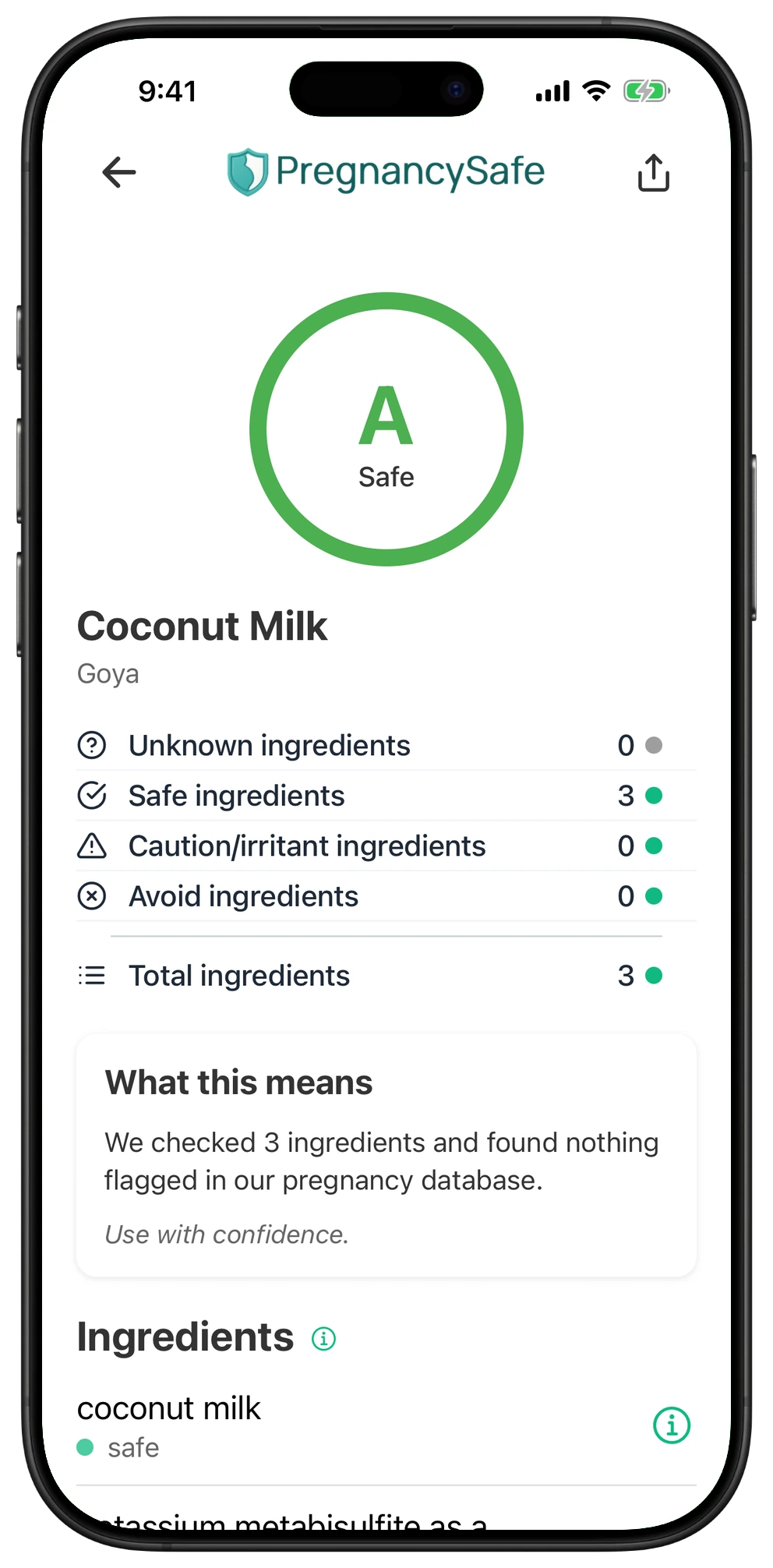
| A | Coconut Milk | Goya |
| A | Coconut Milk | Chaokoh |
| A | Geisha Original Coconut Milk | Geisha |
| A | Thai Kitchen Organic Unsweetened Coconut Milk | Simply Asia |
| A | Lait De Coco Biologique | Cha'S Organics |
Your Questions Answered
Is coconut milk ok to drink while pregnant?
Yes, commercially processed coconut milk can be part of your diet in ordinary food amounts. Choose a product intended for drinking or cooking, check the packaging, and follow its storage directions. A coconut beverage and canned cooking milk have different uses and nutrition, so check which one you are buying.
Can I drink coconut milk every day while pregnant?
Consider how it fits into your overall diet rather than treating it as a pregnancy supplement. There is no specific pregnancy serving limit established here, and canned milk and drinking beverages are not interchangeable. If it replaces dairy regularly, check what protein, calcium and iodine you receive from the rest of your diet. A prenatal clinician or dietitian can help if you are excluding several food groups.
Is canned coconut milk the same as a fortified coconut beverage?
No canned culinary coconut milk and coconut beverages have different nutrition and intended uses. A simple coconut and water cooking milk is not automatically fortified. Check the exact nutrition label rather than relying on the words coconut milk. Fortification also does not automatically make a beverage equivalent to dairy for protein or iodine.
How should I store coconut milk after opening?
Follow the exact package's refrigeration and after opening use instructions. Shelf stable packaging before opening does not mean the contents remain shelf stable afterward. Note the opening date so you can follow the stated storage period. Do not use a product if its packaging integrity or storage history is in doubt.
Do coconut milk ingredient warnings mean the drink is unsafe?
Not necessarily the ingredient, product type and exposure route matter. Coconut milk can also appear in names of cosmetics, but fragrance and sunscreen assessments are not evidence about ordinary coconut milk as food. Oral aloe latex or whole leaf additions have separate pregnancy concerns and should not be treated as plain coconut milk. Tartrazine and FD&C Yellow 5 are names for the same dye; limited pregnancy data and indirect developmental findings do not prove harm from occasional regulated dietary exposure.
Does an A grade guarantee coconut milk is safe during pregnancy?
No grades are ingredient scores, not clinical verdicts or checks for pathogens, storage conditions or current package contents. Our catalog contains 327 records, including 289 with A scores, but these are not counts of independently verified safe foods. Records can also include non food products with coconut milk in their names. Check the exact product's intended use, label and handling directions regardless of its grade.
How to Interpret These Ratings
Our ingredient and category rules generate letter grades from the information recorded in the catalog. Missing ingredients and broad category assignments can affect the result. These grades do not measure your dose, confirm a complete current label, or test a product for contamination.
A high grade is not a guarantee of pregnancy safety. A low grade is not, by itself, proof of harm from every use. Follow the product-specific guidance above, check the actual package, and ask your prenatal clinician about supplements, treatment decisions or uncertain exposures.
People Also Checked
Chocolate Milk
321 products
Soy Milk
242 products
Almond Milk
344 products
Coconut
22 products
Coconut Water
771 products
See our full guide to milk during pregnancy.
References
- https://www.nhs.uk/pregnancy/keeping-well/foods-to-avoid/
- https://ods.od.nih.gov/factsheets/Pregnancy-HealthProfessional/
- https://www.fda.gov/food/people-risk-foodborne-illness/cooking-food-safety-moms-be
- https://www.nccih.nih.gov/health/aloe-vera
- https://webprod.hc-sc.gc.ca/nhpid-bdipsn/dbImages/mono_aloe--oral_english.pdf
- https://www.ema.europa.eu/en/documents/herbal-monograph/final-european-union-herbal-monograph-aloe-barbadensis-mill-and-aloe-various-species-mainly-aloe-ferox-mill-and-its-hybrids-folii-succus-siccatus_en.pdf
- https://www.utep.edu/herbal-safety/populations/herbs-to-avoid-during-pregnancy.html
- https://www.federalregister.gov/documents/2002/05/09/02-11510/status-of-certain-additional-over-the-counter-drug-category-ii-and-iii-active-ingredients
- https://pubmed.ncbi.nlm.nih.gov/33164294/
- https://pubmed.ncbi.nlm.nih.gov/28139161/
- https://journals.sagepub.com/doi/10.1080/10915810701351186
- https://health.ec.europa.eu/system/files/2023-11/sccs_o_277.pdf
- https://eur-lex.europa.eu/legal-content/EN/TXT/HTML/?uri=OJ%3AL_202600909
- https://pmc.ncbi.nlm.nih.gov/articles/PMC10955127/
- https://pubmed.ncbi.nlm.nih.gov/29410076/
- https://www.cir-safety.org/sites/default/files/bensal042019FR.pdf
- https://health.ec.europa.eu/system/files/2023-06/sccs_o_268.pdf
- https://www.fda.gov/drugs/understanding-over-counter-medicines/sunscreen-how-help-protect-your-skin-sun
- https://www.fda.gov/drugs/understanding-over-counter-medicines/questions-and-answers-fda-posts-deemed-final-order-and-proposed-order-over-counter-sunscreen
- https://www.aad.org/public/everyday-care/skin-care-secrets/routine/pregnancy-skin-care
- https://www.aad.org/media/stats-sunscreen
- https://mothertobaby.org/baby-blog/screening-your-sunscreen-during-pregnancy/
- https://pmc.ncbi.nlm.nih.gov/articles/PMC6990686/
- https://pubmed.ncbi.nlm.nih.gov/40910486/
- https://pmc.ncbi.nlm.nih.gov/articles/PMC11984416/
- https://pmc.ncbi.nlm.nih.gov/articles/PMC12317922/
- https://hfpappexternal.fda.gov/scripts/fdcc/index.cfm?id=FDCYellow5&set=ColorAdditives
- https://www.ecfr.gov/current/title-21/chapter-I/subchapter-A/part-74#74.705
- https://www.fda.gov/food/color-additives-information-consumers/tracking-food-industry-pledges-remove-petroleum-based-food-dyes
- https://www.fda.gov/food/nutrition-food-labeling-and-critical-foods/food-allergies
- https://apps.who.int/food-additives-contaminants-jecfa-database/Home/Chemical/3885
- https://efsa.onlinelibrary.wiley.com/doi/10.2903/j.efsa.2009.1331
- https://oehha.ca.gov/risk-assessment/report/health-effects-assessment-potential-neurobehavioral-effects-synthetic-food-dyes-children
- https://pubmed.ncbi.nlm.nih.gov/1628860/
- https://pmc.ncbi.nlm.nih.gov/articles/PMC7023231/
- https://pmc.ncbi.nlm.nih.gov/articles/PMC6354951/
- https://health.ec.europa.eu/document/download/3166a978-06de-4526-b25e-8d5a66943a2e_en?filename=sccs_o_294.pdf
- https://www.tga.gov.au/sites/default/files/2025-04/safety-review-seven-active-sunscreen-ingredients.pdf
- https://pubmed.ncbi.nlm.nih.gov/31961417/
- https://pubmed.ncbi.nlm.nih.gov/15191542/
- https://www.ncbi.nlm.nih.gov/books/NBK581587/
- https://pubmed.ncbi.nlm.nih.gov/32108942/
- https://pubmed.ncbi.nlm.nih.gov/40212279/
- https://health.ec.europa.eu/publications/sccs-opinion-ethylhexyl-methoxycinnamate-ehmc-cas-no-5466-77-383834-59-7-ec-no-226-775-7629-661-9_en
- https://www.federalregister.gov/documents/2019/02/26/2019-03019/sunscreen-drug-products-for-over-the-counter-human-use
- https://pubmed.ncbi.nlm.nih.gov/26151237/
- https://pubmed.ncbi.nlm.nih.gov/31195281/
- https://pubmed.ncbi.nlm.nih.gov/35767664/
- https://pubmed.ncbi.nlm.nih.gov/15833384/
- https://pubmed.ncbi.nlm.nih.gov/21059369/
- https://ec.europa.eu/health/scientific_committees/consumer_safety/opinions/sccnfp_opinions_97_04/sccp_out26_en.htm
- https://www.cir-safety.org/sites/default/files/salicy042019FAR.pdf
- https://pmc.ncbi.nlm.nih.gov/articles/PMC11402844/
- https://pmc.ncbi.nlm.nih.gov/articles/PMC5744631/
- https://mothertobaby.org/baby-blog/national-safety-month-can-beauty-products-in-my-bathroom-be-bad-for-baby/
- https://www.fda.gov/cosmetics/cosmetic-ingredients/fragrances-cosmetics
- https://www.fda.gov/cosmetics/cosmetic-ingredients/phthalates-cosmetics
- https://www.fda.gov/cosmetics/cosmetic-ingredients/allergens-cosmetics
- https://pmc.ncbi.nlm.nih.gov/articles/PMC3110684/
- https://pmc.ncbi.nlm.nih.gov/articles/PMC4016195/
- https://pmc.ncbi.nlm.nih.gov/articles/PMC4097177/
- https://pmc.ncbi.nlm.nih.gov/articles/PMC8453372/
- https://pmc.ncbi.nlm.nih.gov/articles/PMC10999525/
- https://www.epa.gov/indoor-air-quality-iaq/volatile-organic-compounds-impact-indoor-air-quality
- https://health.ec.europa.eu/system/files/2021-08/sccs_o_195_0.pdf
- https://ec.europa.eu/growth/tools-databases/cosing/details/28157
- https://journals.sagepub.com/doi/10.3109/10915819009078737
- https://link.springer.com/article/10.1007/s00204-024-03938-5
- https://www.sfda.gov.sa/en/warnings/1156
- https://www.industrialchemicals.gov.au/sites/default/files/Ethanol%2C%202-phenoxy-_Human%20health%20tier%20II%20assessment.pdf
- https://hero.epa.gov/reference/2857875
- https://books.publisso.de/sites/default/files/documents/series/mak/dam/Vol2019/Iss1/Alt006/mb12299kske6319_w.pdf