Is Soy Milk Safe During Pregnancy? (Updated 2026 Guide)
Updated September 9, 2026
The Answer
Yes ordinary soy milk can fit into your pregnancy diet; choose a commercially treated beverage, follow storage instructions, and check its nutrients. Our catalog contains mostly A and B+ ingredient scores, but these are not pregnancy safety guarantees.
Ordinary soy milk is different from concentrated isoflavone supplements and is not routinely forbidden during pregnancy. Safe handling and nutritional suitability matter: check protein, calcium, vitamin D and iodine rather than assuming every carton replaces dairy nutritionally. Added kombu seaweed can provide variable, potentially high iodine, while tea flavored versions require caffeine accounting; soy allergy and thyroid medication timing need personal advice.
Pregnancy Safe is 100% independent and research driven. No companies pay to promote or sponsor products.
Stress Less This Pregnancy
Check your exact soy milk in the app

✓ What's Safe
- • Choose a commercially heat treated soy beverage with clear storage and after opening instructions.
- • Check the exact carton's protein, calcium, vitamin D and iodine amounts, especially if it replaces dairy regularly.
- • Prefer unsweetened options for everyday drinking, and compare added sugar per serving.
- • Check whether you are buying a drinking beverage, cooking preparation or concentrated supplement; these are not interchangeable.
- • Read flavored versions for tea, seaweed and alcohol ingredients, and check amounts with the manufacturer when needed.
- • Follow refrigeration and use after opening directions, including for cartons sold unrefrigerated.
✗ What to Avoid
- • Avoid untreated soy drinks when processing and safe handling cannot be confirmed.
- • Avoid drinking from cartons stored outside their labeled conditions or kept beyond their after opening instructions.
- • Avoid assuming an unfortified soy and water recipe supplies the calcium, vitamin D or iodine you would get from other milk choices.
- • Avoid making kombu seaweed containing drinks a frequent iodine source without knowing their iodine content.
- • Avoid soy drinks mixed with rum or other beverage alcohol; an unclear alcohol ingredient needs clarification rather than an assumed dose.
- • Avoid frequent high added sugar versions, including those with high fructose corn syrup, and do not overlook caffeine from black tea powder.
Most Common Ingredients in Soy Milk Products
We analyzed 242 soy milk products. Here are the most common ingredients, ranked by how often they appear:
Ingredients to Watch Out For in Soy Milk
These are the most common flagged ingredients across 242 soy milk products we analyzed.
kombu seaweed
Caution
Kombu seaweed is a nutrient rich, dark green kelp commonly used in Japanese cuisine to enhance umami flavor and make broths.
Can contain highly variable iodine, with high dose brown seaweed or kelp products and hijiki arsenic exposure requiring caution in pregnancy.
Flagged in 8 of 242 products (3%)
flax oil
Caution
Flax oil is a nutrient rich, plant based oil derived from flaxseeds, known for its high omega-3 fatty acid content and health benefits.
Has limited pregnancy specific safety data; normal food amounts are lower concern but concentrated supplements warrant caution.
Flagged in 2 of 242 products (1%)
alcohol
Caution
Alcohol is a volatile, colorless liquid commonly used as a solvent, disinfectant, or intoxicating beverage.
No amount of Alcohol is considered safe. Avoid alcohol beverages entirely. Be extremely careful when using in cooking or even with small percentages.
Flagged in 1 of 242 products (0%)
allura red ac
Caution
Allura Red AC is a synthetic red dye commonly used to add vibrant color to food and beverages.
Has limited human pregnancy data and is allowed at regulated food additive levels, but child neurobehavior concerns and high dose animal findings make frequent high dye intake worth limiting.
Flagged in 1 of 242 products (0%)
black tea powder
Caution
Black tea powder is a finely ground form of fermented black tea leaves, offering a rich, robust flavor and deep color.
Is generally compatible in normal servings but contributes to the pregnancy caffeine limit and may interfere with iron absorption if taken with meals or iron supplements.
Flagged in 1 of 242 products (0%)
high fructose corn syrup
Caution
High fructose corn syrup is a sweet, liquid sweetener made from corn starch, commonly used in processed foods and beverages.
Is not a known teratogen at occasional food amounts, but high added sugar intake can displace nutrients and raise gestational diabetes and metabolic concerns.
Flagged in 1 of 242 products (0%)
rum
Avoid
Rum is a distilled alcoholic beverage made from fermented sugarcane or molasses, known for its rich, sweet, and often spiced flavor.
Has no established safe amount in pregnancy and is linked to fetal alcohol spectrum disorders and other adverse pregnancy outcomes.
Flagged in 1 of 242 products (0%)
Soy Milk Products We've Analyzed
Our catalog contains ratings for 242 soy milk products. These are database grades, not independent safety certifications.
Grades are ingredient scores, not clinical verdicts or measurements of pathogens, dose, preparation or current package contents. Cohorts include unreviewed catalog records and counts are not independently verified safe-product totals.
Pregnancy Safe Soy Milk Products
Popular options from our catalog, prioritizing A and B ingredient grades, with C grade options used to fill remaining places. Within each group, products are ordered by searches in Pregnancy Safe, not retail sales. Read the cautions and guidance above; grades do not verify a complete current label or guarantee pregnancy safety.
| Grade | Product | Brand |
|---|---|---|
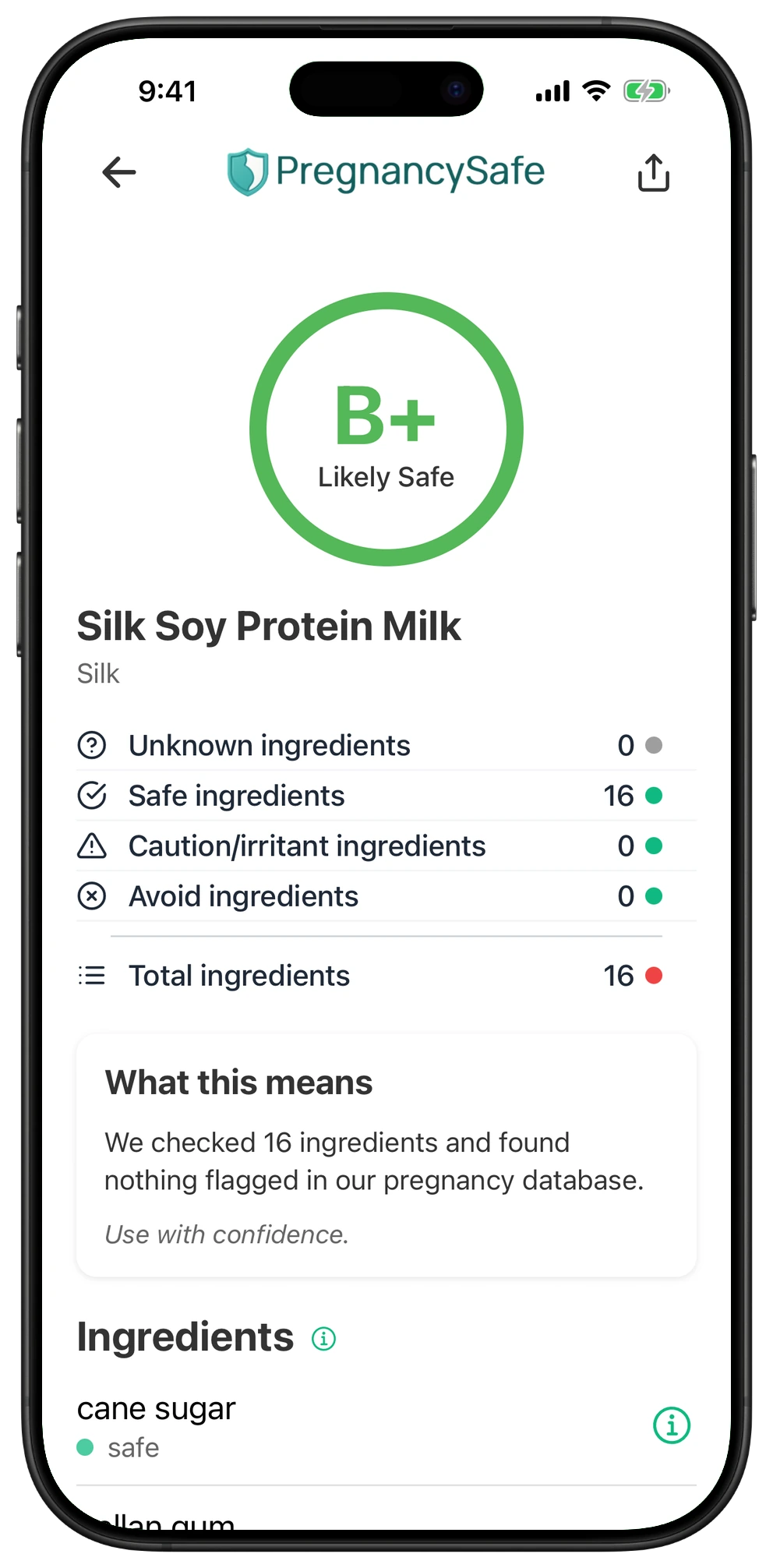
| B+ | Silk Soy Protein Milk | Silk |
| B+ | Silk Chocolate Soymilk | Silk |
| B+ | Silk Soymilk, Vanilla | Silk |
| B+ | Silk Original Soy Milk | Silk |
| B+ | Original Soymilk | Silk |
Your Questions Answered
Is soy milk ok to drink while pregnant?
Yes, ordinary soy milk can be part of your pregnancy diet and is not routinely forbidden. Choose a commercially treated beverage and follow its storage instructions. Check the exact label for nutrients and added ingredients rather than relying on the word milk or an ingredient grade. If you have a soy allergy or take thyroid medication, get advice specific to your situation.
How much soy is too much during pregnancy?
There is no single soy milk limit here that applies to every recipe and pregnancy. Use ordinary food servings within a varied diet rather than treating soy milk as a supplement or your only source of nutrition. Concentrated isoflavone supplements are a different exposure and should not be treated as equivalent to a glass of soy milk. Your clinician or dietitian can help with amounts if you rely heavily on soy drinks or have specific nutritional needs.
Can soy milk replace dairy milk during pregnancy?
It can be an option, but nutritional equivalence depends on the exact carton. Check protein, calcium, vitamin D and iodine rather than assuming they are present in comparable amounts. A simple soy and water recipe may be unfortified, even if it has a high ingredient score. If soy milk is your main milk replacement, plan how to cover any nutrient gaps elsewhere.
Do soy milk's isoflavones mean I should avoid it?
Ordinary soy foods and drinks are not routinely forbidden during pregnancy. They are not the same exposure as concentrated isoflavone supplements. Concerns about concentrated supplements should not be turned into a claim that an ordinary serving of soy milk harms your baby. Discuss supplement use separately with your pregnancy care team.
Should I avoid soy milk containing kombu seaweed or flax oil?
The amount and frequency matter more than the ingredient name alone. Kombu seaweed can supply highly variable iodine, so check the iodine content before drinking a kombu containing version regularly. Flax oil in ordinary food amounts is a different, lower concern exposure than capsules or spoonful dose supplements, for which pregnancy evidence is limited. Neither label entry alone establishes that a serving has caused harm.
Are sweetened or tea flavored soy drinks suitable during pregnancy?
Check the serving size, added sugars and caffeine content rather than treating all flavored drinks alike. Black tea powder contributes caffeine; keep your total from all sources below 200 mg per day. High fructose corn syrup is an added sugar, and the concern is frequent high intake rather than established fetal harm from an occasional serving. If you have gestational diabetes, follow your care team's individualized carbohydrate guidance.
Does an A grade mean a soy milk is verified safe for pregnancy?
No grades are ingredient scores, not clinical safety verdicts. Our catalog contains 242 products, including 50 graded A and 177 graded B+, but those counts are not independently verified safe product totals. Grades do not measure pathogens, storage, consumed amounts or current package contents. A lower grade or incomplete record also does not, by itself, prove a product is harmful.
How to Interpret These Ratings
Our ingredient and category rules generate letter grades from the information recorded in the catalog. Missing ingredients and broad category assignments can affect the result. These grades do not measure your dose, confirm a complete current label, or test a product for contamination.
A high grade is not a guarantee of pregnancy safety. A low grade is not, by itself, proof of harm from every use. Follow the product-specific guidance above, check the actual package, and ask your prenatal clinician about supplements, treatment decisions or uncertain exposures.
People Also Checked
Chocolate Milk
321 products
Coconut Milk
327 products
Almond Milk
344 products
Milk
4,985 products
Soy Sauce
382 products
Tofu
299 products
See our full guide to milk during pregnancy.
References
- https://ods.od.nih.gov/factsheets/Pregnancy-HealthProfessional/
- https://www.nhs.uk/pregnancy/keeping-well/foods-to-avoid/
- https://www.fda.gov/food/buy-store-serve-safe-food/what-you-need-know-about-juice-safety
- https://journals.sagepub.com/doi/10.1177/10507256261445624
- https://ods.od.nih.gov/factsheets/Iodine-HealthProfessional/
- https://www.foodstandards.gov.au/consumer/nutrition/pregnancy/iodine-and-pregnancy
- https://www.foodstandards.gov.au/consumer/prevention-of-foodborne-illness/arseniciodine
- https://inspection.canada.ca/en/food-safety-consumers/fact-sheets/specific-products-and-risks/chemical-hazards/inorganic-arsenic
- https://pubmed.ncbi.nlm.nih.gov/35947162/
- https://pubmed.ncbi.nlm.nih.gov/20919974/
- https://pubmed.ncbi.nlm.nih.gov/30632947/
- https://pmc.ncbi.nlm.nih.gov/articles/PMC8077470/
- https://www.nccih.nih.gov/health/flaxseed-and-flaxseed-oil
- https://webprod.hc-sc.gc.ca/nhpid-bdipsn/dbImages/858
- https://pubmed.ncbi.nlm.nih.gov/16579802/
- https://www.unlockfood.ca/en/Articles/Pregnancy/Keeping-Your-Baby-Healthy-During-Pregnancy.aspx
- https://www.ncbi.nlm.nih.gov/books/NBK501895/
- https://pmc.ncbi.nlm.nih.gov/articles/PMC10353157/
- https://www.hfpappexternal.fda.gov/scripts/fdcc/index.cfm?id=FDCRed40&set=ColorAdditives
- https://www.ecfr.gov/current/title-21/chapter-I/subchapter-A/part-74/subpart-A/section-74.340
- https://www.fda.gov/food/color-additives-information-consumers/tracking-food-industry-pledges-remove-petroleum-based-food-dyes
- https://www.efsa.europa.eu/en/efsajournal/pub/1327
- https://www.efsa.europa.eu/en/efsajournal/pub/4007
- https://apps.who.int/food-additives-contaminants-jecfa-database/Home/Chemical/2361
- https://oehha.ca.gov/risk-assessment/report/health-effects-assessment-potential-neurobehavioral-effects-synthetic-food-dyes-children
- https://pubmed.ncbi.nlm.nih.gov/6636206/
- https://pubmed.ncbi.nlm.nih.gov/2613118/
- https://pubmed.ncbi.nlm.nih.gov/7940558/
- https://www.acog.org/womens-health/experts-and-stories/ask-acog/how-much-coffee-can-i-drink-while-pregnant
- https://www.acog.org/clinical/clinical-guidance/committee-opinion/articles/2010/08/moderate-caffeine-consumption-during-pregnancy
- https://www.fda.gov/consumers/consumer-updates/spilling-beans-how-much-caffeine-too-much
- https://www.nhsinform.scot/ready-steady-baby/pregnancy/looking-after-yourself-and-your-baby/eating-well-in-pregnancy/
- https://www.mayoclinic.org/healthy-lifestyle/pregnancy-week-by-week/in-depth/pregnancy-nutrition/art-20043844
- https://pubmed.ncbi.nlm.nih.gov/10999016/
- https://pmc.ncbi.nlm.nih.gov/articles/PMC5998341/
- https://cdn.realfood.gov/DGA.pdf
- https://www.dietaryguidelines.gov/sites/default/files/2021-12/DGA_Pregnancy_FactSheet-508c.pdf
- https://www.acog.org/womens-health/faqs/healthy-eating-during-pregnancy
- https://www.cdc.gov/nutrition/php/data-research/added-sugars.html
- https://www.cdc.gov/diabetes/about/gestational-diabetes.html
- https://www.who.int/publications/i/item/9789241549028
- https://nesr.usda.gov/2025-dietary-guidelines-advisory-committee-systematic-reviews/dietary-patterns_gestational-diabetes
- https://www.cdc.gov/alcohol-pregnancy/about/index.html
- https://www.cdc.gov/fasd/about/index.html
- https://www.acog.org/womens-health/infographics/alcohol-and-pregnancy
- https://www.niaaa.nih.gov/publications/brochures-and-fact-sheets/alcohol-and-your-pregnancy
- https://mothertobaby.org/fact-sheets/alcohol-pregnancy/
- https://pubmed.ncbi.nlm.nih.gov/26482673/
- https://pmc.ncbi.nlm.nih.gov/articles/PMC9543418/