Is Soy Sauce Safe During Pregnancy? (Updated 2026 Guide)
Updated September 9, 2026
The Answer
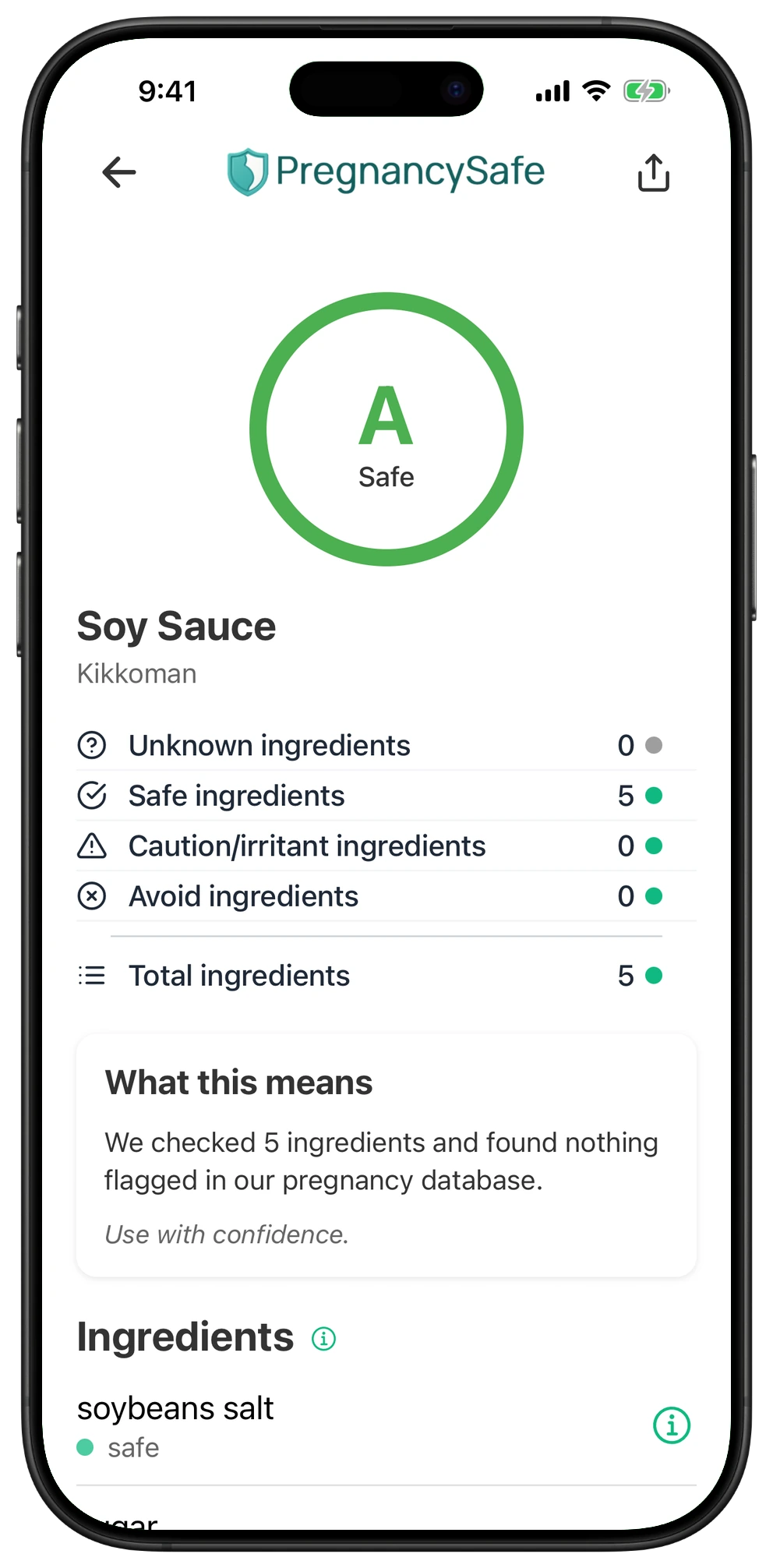
You can generally use ordinary soy sauce as a condiment during pregnancy; keep portions modest and check sodium, allergens, and storage instructions. Our catalog contains 215 A graded records among 382 products, but ingredient grades are not pregnancy safety guarantees.
The main practical considerations are soy sauce's potentially high sodium content and soy or wheat allergens, especially if you have individualized dietary advice. Fermented soy sauce is not an alcoholic drink, but alcohol content varies, so do not assume every version contains zero alcohol. Added sugars and kelp ingredients need portion specific consideration, not an assumption that an occasional serving causes fetal harm.
Pregnancy Safe is 100% independent and research driven. No companies pay to promote or sponsor products.
Stress Less This Pregnancy
Check your exact soy sauce in the app

✓ What's Safe
- • Compare sodium amounts using the same serving size, and choose a lower sodium version when it fits your dietary needs.
- • Measure a small amount for seasoning rather than pouring freely; include it when considering the sodium in your whole meal.
- • Read the exact package's full ingredient and allergen labels, particularly for soy and wheat.
- • Follow the bottle's storage and preparation instructions, including any refrigeration directions after opening.
- • Check the manufacturer’s alcohol information if you need to avoid residual alcohol; fermentation alone does not establish the amount present.
✗ What to Avoid
- • Avoid large, repeated pours that add substantial sodium, particularly if your care team has given you a sodium target.
- • Avoid soy or wheat ingredients if you are allergic to them; do not assume a different sauce style removes your allergen.
- • Avoid treating rice wine or other alcoholic cooking additions as interchangeable with ordinary soy sauce.
- • Avoid frequent generous servings of sweetened sauces without checking added sugars, including high fructose corn syrup, especially with gestational diabetes.
- • Avoid using sauces containing kelp extract or kombu as an iodine supplement; their iodine contribution cannot be determined from the ingredient name.
- • Avoid using a bottle contrary to its storage instructions or relying on a catalog grade instead of the label on your actual package.
Most Common Ingredients in Soy Sauce Products
We analyzed 382 soy sauce products. Here are the most common ingredients, ranked by how often they appear:
Ingredients to Watch Out For in Soy Sauce
These are the most common flagged ingredients across 382 soy sauce products we analyzed.
alcohol
Caution
Alcohol is a volatile, colorless liquid commonly used as a solvent, disinfectant, or intoxicating beverage.
No amount of Alcohol is considered safe. Avoid alcohol beverages entirely. Be extremely careful when using in cooking or even with small percentages.
Flagged in 47 of 382 products (12%)
high fructose corn syrup
Caution
High fructose corn syrup is a sweet, liquid sweetener made from corn starch, commonly used in processed foods and beverages.
Is not a known teratogen at occasional food amounts, but high added sugar intake can displace nutrients and raise gestational diabetes and metabolic concerns.
Flagged in 16 of 382 products (4%)
kelp extract
Caution
Kelp extract is a nutrient rich marine ingredient known for its mineral content and skin nourishing properties.
Can contain highly variable iodine, with high dose brown seaweed or kelp products and hijiki arsenic exposure requiring caution in pregnancy.
Flagged in 2 of 382 products (1%)
rice wine
Avoid
Rice wine is a traditional alcoholic beverage made from fermented polished rice, often used in cooking and for drinking in various Asian cuisines.
Has no established safe amount in pregnancy and is linked to fetal alcohol spectrum disorders and other adverse pregnancy outcomes.
Flagged in 2 of 382 products (1%)
bacillus culture fluid
Caution
Bacillus culture fluid is a liquid containing metabolites and enzymes produced by Bacillus bacteria, often used in skincare and agricultural applications for its beneficial properties.
Has strain specific safety with limited pregnancy specific data and includes species that can cause foodborne illness or carry toxin genes.
Flagged in 1 of 382 products (0%)
dried kelp extract
Caution
Dried kelp extract is a concentrated form of seaweed rich in minerals and antioxidants, commonly used to enhance flavor and provide nutritional benefits.
Can contain highly variable iodine, with high dose brown seaweed or kelp products and hijiki arsenic exposure requiring caution in pregnancy.
Flagged in 1 of 382 products (0%)
ethanol
Avoid
Ethanol is a clear, volatile, and flammable alcohol commonly used as a solvent, disinfectant, and in alcoholic beverages.
Has no established safe amount in pregnancy and is linked to fetal alcohol spectrum disorders and other adverse pregnancy outcomes.
Flagged in 1 of 382 products (0%)
fd c yellow 5 and 6
Caution
FD&C Yellow 5 and 6 are synthetic food colorings used to add bright yellow and orange hues to various edible products.
Has limited human pregnancy data, rare hypersensitivity labeling concerns, and animal/children's neurobehavior signals despite regulated dietary use under ADI based limits.
Flagged in 1 of 382 products (0%)
Soy Sauce Products We've Analyzed
Our catalog contains ratings for 382 soy sauce products. These are database grades, not independent safety certifications.
Catalog ingredient grades do not measure current-label completeness, pathogens, preparation, caffeine or clinical pregnancy suitability. These counts include unreviewed records and are not a percentage of independently verified safe products.
Pregnancy Safe Soy Sauce Products
Popular options from our catalog, prioritizing A and B ingredient grades, with C grade options used to fill remaining places. Within each group, products are ordered by searches in Pregnancy Safe, not retail sales. Read the cautions and guidance above; grades do not verify a complete current label or guarantee pregnancy safety.
| Grade | Product | Brand |
|---|---|---|
| A | Soy Sauce | Kikkoman |
| B+ | Soy Sauce | — |
| A | Reduced Sodium Soy Sauce | Food Club, Topco Associates Inc. |
| A | Kikkoman Traditionally Brewed Soy Sauce | Kikkoman |
| B+ | Less Sodium Soy Sauce | Kikkoman |
Your Questions Answered
How much soy sauce can I have during pregnancy?
Use soy sauce in modest condiment amounts rather than as a large part of your meal. There is no single pregnancy specific serving limit established here, and sodium content varies between formulations. Check the serving size and sodium on your bottle, and follow any individualized sodium advice from your care team.
Does soy affect pregnancy?
Ordinary soy containing foods are a different exposure from concentrated soy or isoflavone supplements. You do not need to treat a small serving of soy sauce as a high dose supplement exposure. For this condiment, focus on sodium, any soy or wheat allergy, and the exact formulation rather than assuming soy itself establishes fetal harm.
What sauces should I avoid when pregnant?
Avoid sauces made with raw or partly cooked eggs unless a suitable pasteurized option is used. Alcoholic additions such as rice wine require separate consideration from ordinary soy sauce used for seasoning. Also avoid ingredients you are allergic to, and follow storage and preparation instructions for each sauce.
Does soy sauce contain alcohol?
Some fermented soy sauces contain residual alcohol, and some formulations list alcohol as an ingredient. The ingredient list alone does not tell you the amount you will consume. A small condiment serving is a different exposure from drinking alcohol, but you should not assume every fermented sauce is alcohol free. Ask the manufacturer about the exact version if residual alcohol is a concern.
Is reduced sodium soy sauce a better choice during pregnancy?
A reduced sodium version can help you lower sodium intake when you use the same amount. It may still contribute substantial sodium, so compare the nutrition labels rather than relying on the front label claim alone. It does not automatically resolve soy or wheat allergies, added sugars, or other formulation differences.
Does an A grade mean a soy sauce is verified safe for pregnancy?
No. Our catalog contains 382 products, including 215 with an A ingredient grade, but those counts include unreviewed records. Grades do not establish current label completeness, measure contaminants or pathogens, or account for preparation and your individual needs. Check your actual package; an incomplete record or lower grade is not by itself proof that a sauce is harmful.
How to Interpret These Ratings
Our ingredient and category rules generate letter grades from the information recorded in the catalog. Missing ingredients and broad category assignments can affect the result. These grades do not measure your dose, confirm a complete current label, or test a product for contamination.
A high grade is not a guarantee of pregnancy safety. A low grade is not, by itself, proof of harm from every use. Follow the product-specific guidance above, check the actual package, and ask your prenatal clinician about supplements, treatment decisions or uncertain exposures.
People Also Checked
References
- https://www.nhs.uk/pregnancy/keeping-well/foods-to-avoid/
- https://www.fda.gov/food/people-risk-foodborne-illness/cooking-food-safety-moms-be
- https://cdn.realfood.gov/DGA.pdf
- https://www.dietaryguidelines.gov/sites/default/files/2021-12/DGA_Pregnancy_FactSheet-508c.pdf
- https://www.acog.org/womens-health/faqs/healthy-eating-during-pregnancy
- https://www.cdc.gov/nutrition/php/data-research/added-sugars.html
- https://www.cdc.gov/diabetes/about/gestational-diabetes.html
- https://www.who.int/publications/i/item/9789241549028
- https://nesr.usda.gov/2025-dietary-guidelines-advisory-committee-systematic-reviews/dietary-patterns_gestational-diabetes
- https://journals.sagepub.com/doi/10.1177/10507256261445624
- https://ods.od.nih.gov/factsheets/Iodine-HealthProfessional/
- https://www.foodstandards.gov.au/consumer/nutrition/pregnancy/iodine-and-pregnancy
- https://www.foodstandards.gov.au/consumer/prevention-of-foodborne-illness/arseniciodine
- https://inspection.canada.ca/en/food-safety-consumers/fact-sheets/specific-products-and-risks/chemical-hazards/inorganic-arsenic
- https://pubmed.ncbi.nlm.nih.gov/35947162/
- https://pubmed.ncbi.nlm.nih.gov/20919974/
- https://pubmed.ncbi.nlm.nih.gov/30632947/
- https://pmc.ncbi.nlm.nih.gov/articles/PMC8077470/
- https://www.cdc.gov/alcohol-pregnancy/about/index.html
- https://www.cdc.gov/fasd/about/index.html
- https://www.acog.org/womens-health/infographics/alcohol-and-pregnancy
- https://www.niaaa.nih.gov/publications/brochures-and-fact-sheets/alcohol-and-your-pregnancy
- https://mothertobaby.org/fact-sheets/alcohol-pregnancy/
- https://pubmed.ncbi.nlm.nih.gov/26482673/
- https://pmc.ncbi.nlm.nih.gov/articles/PMC9543418/
- https://pmc.ncbi.nlm.nih.gov/articles/PMC8308823/
- https://pmc.ncbi.nlm.nih.gov/articles/PMC5759212/
- https://pmc.ncbi.nlm.nih.gov/articles/PMC6811671/
- https://www.efsa.europa.eu/en/topics/topic/qualified-presumption-safety-qps
- https://www.fda.gov/files/food/published/GRAS-Notice-000660---Bacillus-coagulans-GBI-30--6086.pdf
- https://www.bccdc.ca/health-info/diseases-conditions/bacillus-cereus
- https://www.fda.gov/food/people-risk-foodborne-illness/food-safety-booklet-pregnant-women-their-unborn-babies-and-children-under-five
- https://hfpappexternal.fda.gov/scripts/fdcc/index.cfm?id=FDCYellow5&set=ColorAdditives
- https://www.ecfr.gov/current/title-21/chapter-I/subchapter-A/part-74#74.705
- https://www.fda.gov/food/color-additives-information-consumers/tracking-food-industry-pledges-remove-petroleum-based-food-dyes
- https://www.fda.gov/food/nutrition-food-labeling-and-critical-foods/food-allergies
- https://apps.who.int/food-additives-contaminants-jecfa-database/Home/Chemical/3885
- https://efsa.onlinelibrary.wiley.com/doi/10.2903/j.efsa.2009.1331
- https://oehha.ca.gov/risk-assessment/report/health-effects-assessment-potential-neurobehavioral-effects-synthetic-food-dyes-children
- https://pubmed.ncbi.nlm.nih.gov/1628860/
- https://pmc.ncbi.nlm.nih.gov/articles/PMC7023231/
- https://pmc.ncbi.nlm.nih.gov/articles/PMC6354951/