Is Sushi Safe During Pregnancy? (Updated 2026 Guide)
Updated September 9, 2026
The Answer
Yes, you can eat sushi during pregnancy when it is hygienically prepared with cooked low mercury seafood or vegetarian fillings; avoid raw or undercooked seafood. Cold pre cooked ready to eat prawns need heating until steaming hot, even when the label says cooked.
The main concerns are foodborne illness from raw seafood or unsafe handling, and mercury in certain fish not sushi as a whole. Choose cooked low mercury seafood or vegetarian fillings, prevent contact with raw fish, and follow storage and reheating instructions. Ingredient amounts also matter: modest nori portions differ from concentrated high iodine kelp, and normal horseradish condiment amounts differ from medicinal doses.
Pregnancy Safe is 100% independent and research driven. No companies pay to promote or sponsor products.
Stress Less This Pregnancy
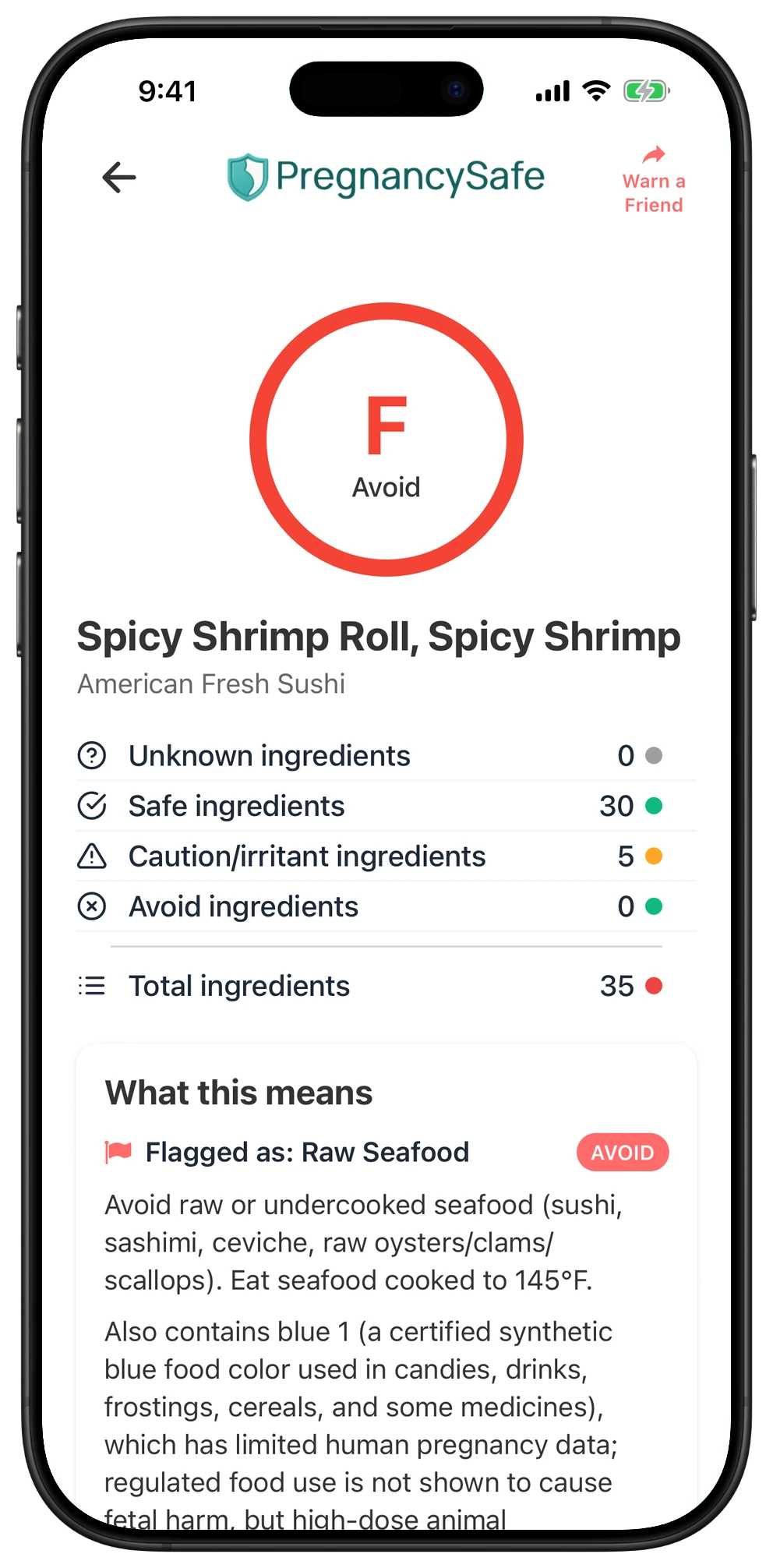
Check your exact sushi in the app

✓ What's Safe
- • Choose vegetarian fillings such as avocado or cucumber, prepared with clean utensils away from raw seafood.
- • Ask for fully cooked low mercury seafood, and confirm that toppings are cooked too.
- • Heat cold pre cooked ready to eat prawns until steaming hot, following NHS pregnancy guidance.
- • Check the complete package label, use by date, storage instructions and preparation directions rather than relying on the roll name.
- • Choose a source that can explain its refrigeration and how it prevents raw fish cross contamination.
- • Prefer modest portions of identified lower iodine seaweed such as nori rather than concentrated kelp additions.
✗ What to Avoid
- • Avoid raw or undercooked fish and shellfish, including raw toppings on otherwise cooked rolls.
- • Avoid high mercury fish such as bigeye tuna, king mackerel, marlin, orange roughy, shark, swordfish and Gulf tilefish.
- • Do not treat previously frozen raw fish as pregnancy safe: freezing does not reliably eliminate all harmful germs.
- • Avoid eating cold pre cooked ready to eat prawns without steaming hot reheating.
- • Skip sushi with uncertain refrigeration, expired use by dates or possible contact with raw seafood during preparation.
- • Avoid hijiki and concentrated kelp or high iodine seaweed products; these are different exposures from occasional modest nori portions.
Most Common Ingredients in Sushi Products
We analyzed 446 sushi products. Here are the most common ingredients, ranked by how often they appear:
Ingredients to Watch Out For in Sushi
These are the most common flagged ingredients across 446 sushi products we analyzed.
seaweed
Caution
Seaweed is a nutrient rich marine plant commonly used in culinary dishes for its umami flavor and health benefits.
Can contain highly variable iodine, with high dose brown seaweed or kelp products and hijiki arsenic exposure requiring caution in pregnancy.
Flagged in 297 of 446 products (67%)
alcohol
Caution
Alcohol is a volatile, colorless liquid commonly used as a solvent, disinfectant, or intoxicating beverage.
No amount of Alcohol is considered safe. Avoid alcohol beverages entirely. Be extremely careful when using in cooking or even with small percentages.
Flagged in 208 of 446 products (47%)
horseradish
Caution
Horseradish is a pungent root vegetable known for its sharp, spicy flavor often used to add heat to sauces and condiments.
Is generally compatible at normal condiment amounts but should be avoided in medicinal products or large regular doses due to limited pregnancy data and possible uterine and irritant effects.
Flagged in 63 of 446 products (14%)
spirulina
Caution
Spirulina is a nutrient rich blue green algae known for its high protein, vitamin, and antioxidant content, often used as a dietary supplement.
Has limited pregnancy safety data and product quality concerns because contaminated blue green algae supplements can contain microcystins, heavy metals, or pathogenic bacteria.
Flagged in 61 of 446 products (14%)
wasabi horseradish
Caution
Wasabi horseradish is a spicy, pungent root based condiment often used to add heat and flavor to sushi and Japanese dishes.
Is generally compatible at normal condiment amounts but should be avoided in medicinal products or large regular doses due to limited pregnancy data and possible uterine and irritant effects.
Flagged in 50 of 446 products (11%)
rice wine
Avoid
Rice wine is a traditional alcoholic beverage made from fermented polished rice, often used in cooking and for drinking in various Asian cuisines.
Has no established safe amount in pregnancy and is linked to fetal alcohol spectrum disorders and other adverse pregnancy outcomes.
Flagged in 26 of 446 products (6%)
blue 1
Caution
Blue 1 is a synthetic blue dye commonly used to add vibrant color to foods, beverages, and cosmetics.
Has limited human pregnancy data; regulated food use is not shown to cause fetal harm, but high dose animal neurobehavior findings and child sensitivity concerns support minimizing frequent exposure.
Flagged in 17 of 446 products (4%)
fd c yellow 5
Caution
FD&C Yellow 5 is a synthetic food dye used to add a bright yellow color to various edible products.
Has limited human pregnancy data, rare hypersensitivity labeling concerns, and animal/children's neurobehavior signals despite regulated dietary use under ADI based limits.
Flagged in 17 of 446 products (4%)
Sushi Products We've Analyzed
Our catalog contains ratings for 446 sushi products. These are database grades, not independent safety certifications.
Of these 446 catalog ratings, 445 retain an automatic raw-seafood category-rule F; one reviewed cooked-shrimp formula has a scoped C- rating. This is not confirmation that 445 products contain raw seafood or that the C- product is safe to eat cold. Preparation and handling still determine the relevant guidance.
Your Questions Answered
Why do you not eat sushi while pregnant?
The advice primarily concerns sushi containing raw or undercooked fish or shellfish, which can carry harmful bacteria and parasites. It does not mean that every type of sushi is off limits. Hygienically prepared vegetarian sushi or cooked low mercury seafood sushi is a different choice, although storage and cross contamination still matter.
Does freezing raw fish make sushi safe during pregnancy?
Freezing can reduce parasite risks, but it does not reliably kill all harmful germs. Previously frozen fish is therefore not equivalent to thoroughly cooked fish. Choose cooked seafood or vegetarian fillings rather than relying on a freezing claim.
Can you eat cooked sushi or California rolls while pregnant?
Cooked low mercury seafood sushi can be compatible with pregnancy when prepared and handled safely. A roll name alone does not confirm its ingredients, cooking or toppings, so check the actual label or ask the preparer. NHS guidance requires cold pre cooked ready to eat prawns to be heated until steaming hot. A catalog record is not a current purchase recommendation or proof of safe storage, and an assessment of one formula does not extend to others.
Is vegetarian sushi safe during pregnancy?
Vegetarian sushi is generally compatible with pregnancy when its ingredients are prepared hygienically and stored correctly. It avoids raw seafood exposure, but vegetables, rice and preparation surfaces still need safe handling. Ask for clean utensils and preparation away from raw fish, and follow package storage and use by instructions.
How much sushi can you eat while pregnant?
There is no universal safe number of rolls because fillings, fish species and serving sizes vary. FDA encourages 8–12 ounces of low mercury cooked seafood per week during pregnancy, counting seafood across all your meals. That amount refers to seafood, not the total weight of rice and other roll ingredients. It does not make raw seafood or high mercury fish suitable.
Should you avoid seaweed, wasabi or alcohol containing sushi seasonings?
Occasional modest portions of lower iodine nori differ from concentrated kelp or frequent high iodine seaweed exposure; avoid hijiki because of inorganic arsenic concerns. Horseradish based wasabi in normal condiment amounts is also different from medicinal preparations or large regular doses. Avoid drinking alcohol, and ask about rice wine or added alcohol in seasonings if you want to choose a formulation without them. An ingredient listing alone does not establish the residual alcohol dose or demonstrate harm from a small food exposure.
Do the sushi grades mean almost every product is unsafe?
No: the catalog contains 446 entries, with 445 F ratings and one C- rating, but the F ratings retain an automatic raw seafood category rule rather than confirming raw seafood or harm in each package. The C- rating applies to one reviewed cooked shrimp formula and does not establish that it is safe to eat cold. These entries describe catalog coverage, not a representative market sample or clinical verdicts. A catalog grade even an A elsewhere does not establish a complete verified label, safe storage or microbiological safety, so use preparation and handling details to guide your choice.
How to Interpret These Ratings
Our ingredient and category rules generate letter grades from the information recorded in the catalog. Missing ingredients and broad category assignments can affect the result. These grades do not measure your dose, confirm a complete current label, or test a product for contamination.
A high grade is not a guarantee of pregnancy safety. A low grade is not, by itself, proof of harm from every use. Follow the product-specific guidance above, check the actual package, and ask your prenatal clinician about supplements, treatment decisions or uncertain exposures.
People Also Checked
References
- https://www.acog.org/womens-health/experts-and-stories/ask-acog/can-i-eat-sushi-while-im-pregnant
- https://www.cdc.gov/food-safety/foods/pregnant-women.html
- https://www.fda.gov/food/consumers/advice-about-eating-fish
- https://www.fda.gov/food/buy-store-serve-safe-food/selecting-and-serving-fresh-and-frozen-seafood-safely
- https://www.nhs.uk/pregnancy/keeping-well/foods-to-avoid/
- https://www.foodsafety.gov/people-at-risk/pregnant-women
- https://www.cdc.gov/anisakiasis/about/index.html
- https://www.fda.gov/food/health-educators/listeria-food-safety-moms-be
- https://journals.sagepub.com/doi/10.1177/10507256261445624
- https://ods.od.nih.gov/factsheets/Iodine-HealthProfessional/
- https://www.foodstandards.gov.au/consumer/nutrition/pregnancy/iodine-and-pregnancy
- https://www.foodstandards.gov.au/consumer/prevention-of-foodborne-illness/arseniciodine
- https://inspection.canada.ca/en/food-safety-consumers/fact-sheets/specific-products-and-risks/chemical-hazards/inorganic-arsenic
- https://pubmed.ncbi.nlm.nih.gov/35947162/
- https://pubmed.ncbi.nlm.nih.gov/20919974/
- https://pubmed.ncbi.nlm.nih.gov/30632947/
- https://pmc.ncbi.nlm.nih.gov/articles/PMC8077470/
- https://webprod.hc-sc.gc.ca/nhpid-bdipsn/atReq?atid=horseradish.raifort&lang=eng
- https://inchem.org/documents/jecfa/jeceval/jec_71.htm
- https://hfpappexternal.fda.gov/scripts/fdcc/index.cfm?id=ALLYLISOTHIOCYANATE&set=FoodSubstances
- https://pmc.ncbi.nlm.nih.gov/articles/PMC13085108/
- https://pubmed.ncbi.nlm.nih.gov/22129740/
- https://www.drugs.com/npp/horseradish.html
- https://www.fda.gov/food/natural-toxins-food/blue-green-algae-products-and-microcystins
- https://www.ncbi.nlm.nih.gov/books/NBK548312/
- https://www.ncbi.nlm.nih.gov/books/NBK501849/
- https://pubmed.ncbi.nlm.nih.gov/21793723/
- https://journal.ugm.ac.id/v3/InaJBCS/article/view/23573
- https://doi.org/10.4236/ojog.2017.71016
- https://pubmed.ncbi.nlm.nih.gov/37317149/
- https://pubmed.ncbi.nlm.nih.gov/37368655/
- https://pubmed.ncbi.nlm.nih.gov/23036452/
- https://pubmed.ncbi.nlm.nih.gov/21842336/
- https://www.cdc.gov/alcohol-pregnancy/about/index.html
- https://www.cdc.gov/fasd/about/index.html
- https://www.acog.org/womens-health/infographics/alcohol-and-pregnancy
- https://www.niaaa.nih.gov/publications/brochures-and-fact-sheets/alcohol-and-your-pregnancy
- https://mothertobaby.org/fact-sheets/alcohol-pregnancy/
- https://pubmed.ncbi.nlm.nih.gov/26482673/
- https://pmc.ncbi.nlm.nih.gov/articles/PMC9543418/
- https://www.hfpappexternal.fda.gov/scripts/fdcc/index.cfm?id=FDCBlue1&set=ColorAdditives
- https://www.ecfr.gov/current/title-21/chapter-I/subchapter-A/part-74
- https://www.fda.gov/food/color-additives-information-consumers/tracking-food-industry-pledges-remove-petroleum-based-food-dyes
- https://efsa.onlinelibrary.wiley.com/doi/10.2903/j.efsa.2010.1853
- https://apps.who.int/food-additives-contaminants-jecfa-database/Home/Chemical/3309
- https://pubmed.ncbi.nlm.nih.gov/23208798/
- https://pubmed.ncbi.nlm.nih.gov/24257113/
- https://oehha.ca.gov/risk-assessment/report/health-effects-assessment-potential-neurobehavioral-effects-synthetic-food-dyes-children
- https://hfpappexternal.fda.gov/scripts/fdcc/index.cfm?id=FDCYellow5&set=ColorAdditives
- https://www.ecfr.gov/current/title-21/chapter-I/subchapter-A/part-74#74.705
- https://www.fda.gov/food/nutrition-food-labeling-and-critical-foods/food-allergies
- https://apps.who.int/food-additives-contaminants-jecfa-database/Home/Chemical/3885
- https://efsa.onlinelibrary.wiley.com/doi/10.2903/j.efsa.2009.1331
- https://pubmed.ncbi.nlm.nih.gov/1628860/
- https://pmc.ncbi.nlm.nih.gov/articles/PMC7023231/
- https://pmc.ncbi.nlm.nih.gov/articles/PMC6354951/
- https://cdn.realfood.gov/DGA.pdf
- https://www.dietaryguidelines.gov/sites/default/files/2021-12/DGA_Pregnancy_FactSheet-508c.pdf
- https://www.acog.org/womens-health/faqs/healthy-eating-during-pregnancy
- https://www.cdc.gov/nutrition/php/data-research/added-sugars.html
- https://www.cdc.gov/diabetes/about/gestational-diabetes.html
- https://www.who.int/publications/i/item/9789241549028
- https://nesr.usda.gov/2025-dietary-guidelines-advisory-committee-systematic-reviews/dietary-patterns_gestational-diabetes