Is Salmon Safe During Pregnancy? (Updated 2026 Guide)
Updated September 9, 2026
The Answer
Yes properly cooked salmon is a lower mercury choice during pregnancy; avoid raw or undercooked salmon and refrigerated smoked salmon unless cooked into a dish. Our catalog contains 58 A grade records among 72 products, but these ingredient scores do not verify cooking, handling, or contamination.
The main distinction is preparation: salmon is an FDA lower mercury Best Choice, but raw, undercooked, and refrigerated smoked forms have separate foodborne illness concerns. Shelf stable canned salmon and salmon that requires cooking need different handling, so check the package rather than relying on the product name. For flavored preparations, check for alcohol containing sauces; an ingredient listing alone cannot establish how much alcohol remains in a serving.
Pregnancy Safe is 100% independent and research driven. No companies pay to promote or sponsor products.
Stress Less This Pregnancy
Check your exact salmon in the app

✓ What's Safe
- • Choose fully cooked salmon rather than raw or undercooked portions.
- • Check whether the package is shelf stable canned salmon, refrigerated smoked salmon, or fish that requires cooking.
- • Choose refrigerated smoked salmon only when you will cook it into a dish.
- • Read the current package's cooking and storage instructions, even when the ingredient grade is A.
- • Choose sauces without added alcohol when the amount remaining in a bourbon or alcohol based preparation is unclear.
- • Include salmon within pregnancy guidance for lower mercury seafood, accounting for the other fish you eat.
✗ What to Avoid
- • Avoid raw or undercooked salmon, including raw salmon sushi.
- • Avoid eating refrigerated smoked salmon straight from the package; cook it into a dish instead.
- • Do not assume that curing or smoking makes salmon equivalent to fully cooked fish.
- • Do not use wild caught or farmed wording as proof of contaminant levels or safe preparation.
- • Avoid assuming all alcohol disappears during cooking or that a bourbon flavored product name tells you the actual exposure.
- • Do not treat an A grade as a ready to eat label, or an incomplete record or low grade as proof that a product is harmful.
Most Common Ingredients in Salmon Products
We analyzed 72 salmon products. Here are the most common ingredients, ranked by how often they appear:
Ingredients to Watch Out For in Salmon
These are the most common flagged ingredients across 72 salmon products we analyzed.
alcohol
Caution
Alcohol is a volatile, colorless liquid commonly used as a solvent, disinfectant, or intoxicating beverage.
No amount of Alcohol is considered safe. Avoid alcohol beverages entirely. Be extremely careful when using in cooking or even with small percentages.
Flagged in 3 of 72 products (4%)
bourbon
Avoid
Bourbon is a rich, amber colored American whiskey known for its sweet, smoky flavor with notes of caramel, vanilla, and oak.
Has no established safe amount in pregnancy and is linked to fetal alcohol spectrum disorders and other adverse pregnancy outcomes.
Flagged in 2 of 72 products (3%)
chicken liver
Avoid
Chicken liver is a nutrient rich, tender organ meat known for its rich flavor and versatility in various savory dishes.
Contains very high preformed vitamin A/retinol, which can exceed pregnancy upper limits and is advised against by several pregnancy food safety authorities.
Flagged in 1 of 72 products (1%)
kelp
Caution
Kelp is a nutrient rich, brown seaweed commonly used as a savory, mineral dense ingredient in soups, salads, and health supplements.
Can contain highly variable iodine, with high dose brown seaweed or kelp products and hijiki arsenic exposure requiring caution in pregnancy.
Flagged in 1 of 72 products (1%)
sodium nitrite and natural hardwood smoke
Caution
A curing agent that combines sodium nitrite with natural hardwood smoke to preserve and flavor meats.
Is regulated at low food additive levels, but frequent cured or processed meat intake has limited observational pregnancy concerns; cyanide antidote and contaminated water exposures are separate issues.
Flagged in 1 of 72 products (1%)
Salmon Products We've Analyzed
Our catalog contains ratings for 72 salmon products. These are database grades, not independent safety certifications.
Grades are ingredient scores, not clinical verdicts or measurements of pathogens, dose, preparation or current package contents. Cohorts include unreviewed catalog records and counts are not independently verified safe-product totals.
Pregnancy Safe Salmon Products
Popular options from our catalog, prioritizing A and B ingredient grades, with C grade options used to fill remaining places. Within each group, products are ordered by searches in Pregnancy Safe, not retail sales. Read the cautions and guidance above; grades do not verify a complete current label or guarantee pregnancy safety.
| Grade | Product | Brand |
|---|---|---|
| A | Atlantic’S Salmon | Kroger |
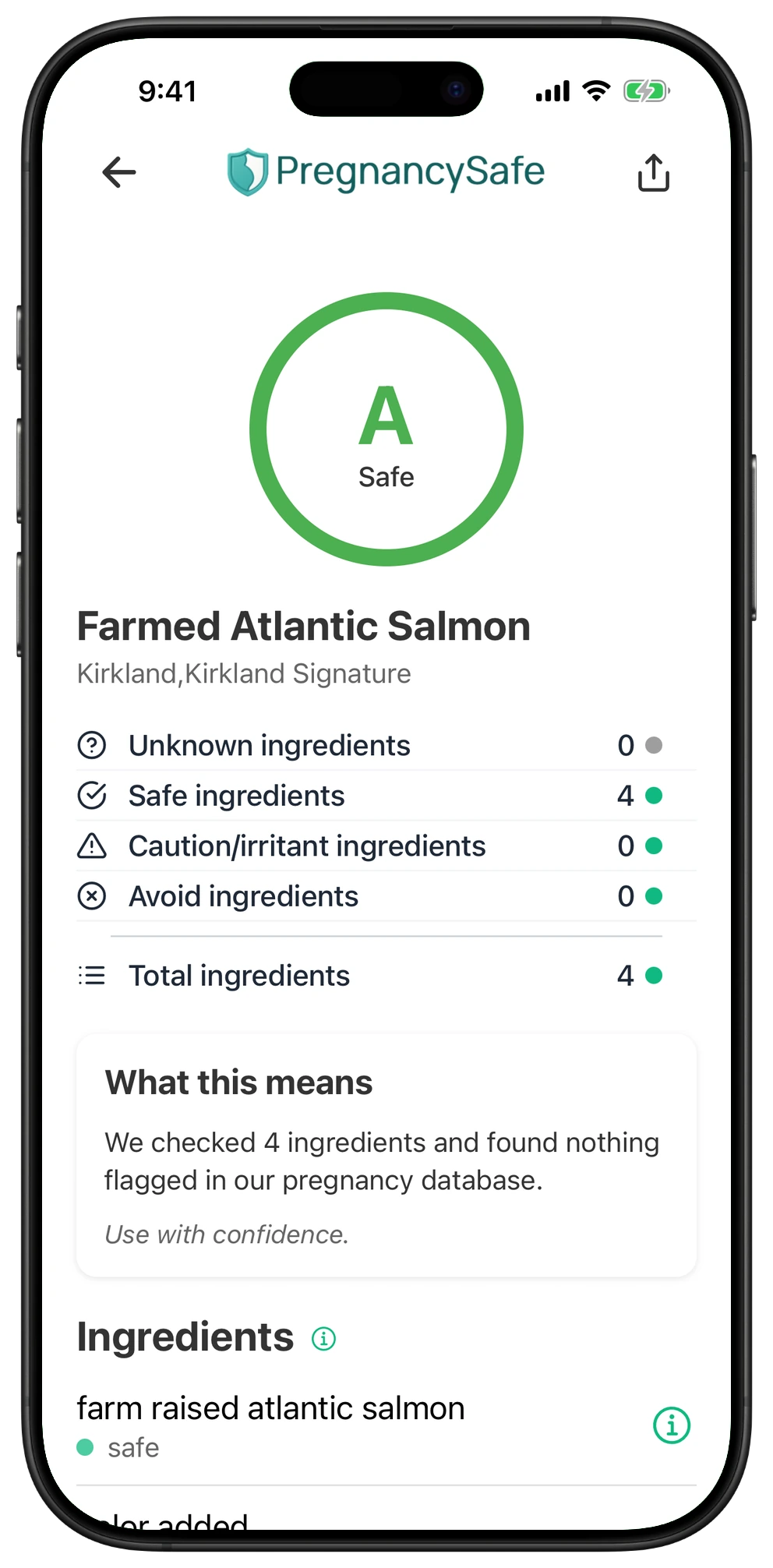
| A | Farmed Atlantic Salmon | Kirkland,Kirkland Signature |
| A | Kroger® California Garlic Farm-Raised Atlantic Salmon | Kroger |
| A | Coho Salmon | Quinault Pride |
| A | Blueback Sockeye Salmon | Quinault Pride |
Your Questions Answered
Can I eat salmon while pregnant?
Yes choose properly cooked salmon or an appropriately handled shelf stable canned form. Salmon is a lower mercury Best Choice within FDA pregnancy seafood guidance. Its mercury classification does not remove the separate foodborne illness concerns with raw, undercooked, or refrigerated smoked fish.
Can you eat raw salmon while pregnant?
Avoid raw or undercooked salmon during pregnancy, including raw salmon served in sushi. The concern here is pathogens, not just mercury. Choose a fully cooked salmon preparation instead, regardless of whether the fish is wild or farmed.
Can you eat smoked salmon during pregnancy?
Avoid refrigerated smoked salmon unless it is cooked into a dish. Do not assume that smoking alone makes it suitable to eat cold during pregnancy. Shelf stable canned salmon is a different form, so check the storage instructions and package type before deciding how to serve it.
Is canned salmon safe during pregnancy?
Shelf stable canned salmon can be a practical pregnancy option and differs from refrigerated smoked salmon. Confirm that the package is actually canned and shelf stable rather than assuming all packaged salmon is ready to eat. Follow the label's storage instructions, including those for after opening. Check the ingredients if you want to limit added salt; a short ingredient list does not necessarily mean salt free.
Can you have salmon roe during pregnancy?
Salmon roe is fish eggs, so do not automatically apply advice about cooked salmon fillets to it. Check whether the roe is raw, pasteurized, or cooked and how it must be stored. Do not assume that salting or curing makes raw roe equivalent to a cooked seafood dish. If its processing and handling are unclear, choose fully cooked salmon instead.
Is wild salmon safer than farmed salmon during pregnancy?
Wild or farmed wording alone does not establish that a particular package is safer during pregnancy. Neither label proves doneness or measures contaminants. Focus first on the product's form, proper cooking, and storage instructions rather than treating either source as a safety guarantee.
Do salmon ingredient grades tell me which products are safe?
No grades are ingredient scores, not clinical safety verdicts. Our catalog contains 72 products: 58 graded A, 6 B+, 4 C+, and 4 F. These counts are not independently verified safe product totals, and grades do not measure pathogens, preparation, serving exposure, or current package contents. Use the current label and preparation guidance rather than assuming every A product is safe to eat as sold or every F product is harmful.
How to Interpret These Ratings
Our ingredient and category rules generate letter grades from the information recorded in the catalog. Missing ingredients and broad category assignments can affect the result. These grades do not measure your dose, confirm a complete current label, or test a product for contamination.
A high grade is not a guarantee of pregnancy safety. A low grade is not, by itself, proof of harm from every use. Follow the product-specific guidance above, check the actual package, and ask your prenatal clinician about supplements, treatment decisions or uncertain exposures.
People Also Checked
References
- https://www.fda.gov/food/consumers/advice-about-eating-fish
- https://www.fda.gov/food/people-risk-foodborne-illness/cooking-food-safety-moms-be
- https://www.cdc.gov/listeria/prevention/index.html
- https://www.cdc.gov/alcohol-pregnancy/about/index.html
- https://www.cdc.gov/fasd/about/index.html
- https://www.acog.org/womens-health/infographics/alcohol-and-pregnancy
- https://www.niaaa.nih.gov/publications/brochures-and-fact-sheets/alcohol-and-your-pregnancy
- https://mothertobaby.org/fact-sheets/alcohol-pregnancy/
- https://pubmed.ncbi.nlm.nih.gov/26482673/
- https://pmc.ncbi.nlm.nih.gov/articles/PMC9543418/
- https://www.nhs.uk/pregnancy/keeping-well/foods-to-avoid/
- https://www.nhs.uk/conditions/vitamins-and-minerals/vitamin-a/
- https://cot.food.gov.uk/Lay%20Summary%20of%20the%20Statement%20on%20the%20effects%20of%20excess%20Vitamin%20A%20on%20maternal%20health
- https://pubmed.ncbi.nlm.nih.gov/38846679/
- https://ods.od.nih.gov/factsheets/VitaminA-HealthProfessional/
- https://www.canada.ca/en/public-health/services/publications/healthy-living/maternity-newborn-care-guidelines-chapter-3.html
- https://www.pregnancybirthbaby.org.au/foods-to-avoid-when-pregnant
- https://www.thewomens.org.au/images/uploads/fact-sheets/Food_safety_in_pregnancy_260316.pdf
- https://journals.sagepub.com/doi/10.1177/10507256261445624
- https://ods.od.nih.gov/factsheets/Iodine-HealthProfessional/
- https://www.foodstandards.gov.au/consumer/nutrition/pregnancy/iodine-and-pregnancy
- https://www.foodstandards.gov.au/consumer/prevention-of-foodborne-illness/arseniciodine
- https://inspection.canada.ca/en/food-safety-consumers/fact-sheets/specific-products-and-risks/chemical-hazards/inorganic-arsenic
- https://pubmed.ncbi.nlm.nih.gov/35947162/
- https://pubmed.ncbi.nlm.nih.gov/20919974/
- https://pubmed.ncbi.nlm.nih.gov/30632947/
- https://pmc.ncbi.nlm.nih.gov/articles/PMC8077470/
- https://hfpappexternal.fda.gov/scripts/fdcc/index.cfm?id=SODIUMNITRITE&set=FoodSubstances
- https://www.ecfr.gov/current/title-9/section-424.21
- https://www.ecfr.gov/current/title-21/section-172.175
- https://www.efsa.europa.eu/en/press/news/170615
- https://www.inchem.org/documents/jecfa/jecmono/v50je07.htm
- https://pubmed.ncbi.nlm.nih.gov/41248583/
- https://www.cdc.gov/food-safety/foods/pregnant-women.html
- https://publications.iarc.who.int/Book-And-Report-Series/Iarc-Monographs-On-The-Identification-Of-Carcinogenic-Hazards-To-Humans/Red-Meat-And-Processed-Meat-2018
- https://dailymed.nlm.nih.gov/dailymed/drugInfo.cfm?setid=52f01c6e-172a-47a9-98a6-9eab7651a032
- https://www.atsdr.cdc.gov/toxprofiles/tp204.pdf