Is Fish Roe Safe During Pregnancy? (Updated 2026 Guide)
Updated September 9, 2026
The Answer
Avoid raw, undercooked, or refrigerated fish roe with uncertain processing or handling during pregnancy. Properly cooked roe or a suitable commercially processed shelf stable product is a different option; check the exact preparation and storage instructions.
The main pregnancy concern is foodborne illness from raw or inadequately handled roe; salting does not remove that risk, and pasteurization does not replace proper cold storage. Ingredient flags for mirin, alcohol, dyes, or kelp extract require context about the amount eaten and do not establish the risk of a serving. Ingredient grades cannot confirm cooking, pathogen control, or pregnancy suitability.
Pregnancy Safe is 100% independent and research driven. No companies pay to promote or sponsor products.
Stress Less This Pregnancy
Check your exact fish roe in the app

✓ What's Safe
- • Choose roe cooked thoroughly to 145°F, rather than raw roe added after a dish is cooked.
- • For commercially processed options, verify that the exact product is shelf stable before opening; a sealed jar alone is not confirmation.
- • Check the exact label for pasteurization information and required storage conditions.
- • Follow refrigeration and after opening instructions, and choose sellers who can explain how the roe has been handled.
- • Read seasoning ingredients and serving information; a formulation without added alcohol avoids uncertainty about residual alcohol.
✗ What to Avoid
- • Avoid raw or undercooked roe, including uncooked roe used as a sushi topping.
- • Skip refrigerated roe when its processing or cold storage history cannot be confirmed.
- • Do not treat salted, cured, or smoked roe as proof that the product has been thoroughly cooked.
- • Avoid assuming that pasteurization, premium pricing, or a sealed container guarantees safety regardless of handling.
- • Do not use a small spoonful or a favorable ingredient score as a substitute for checking preparation and storage.
Most Common Ingredients in Fish Roe Products
We analyzed 6 fish roe products. Here are the most common ingredients, ranked by how often they appear:
Ingredients to Watch Out For in Fish Roe
These are the most common flagged ingredients across 6 fish roe products we analyzed.
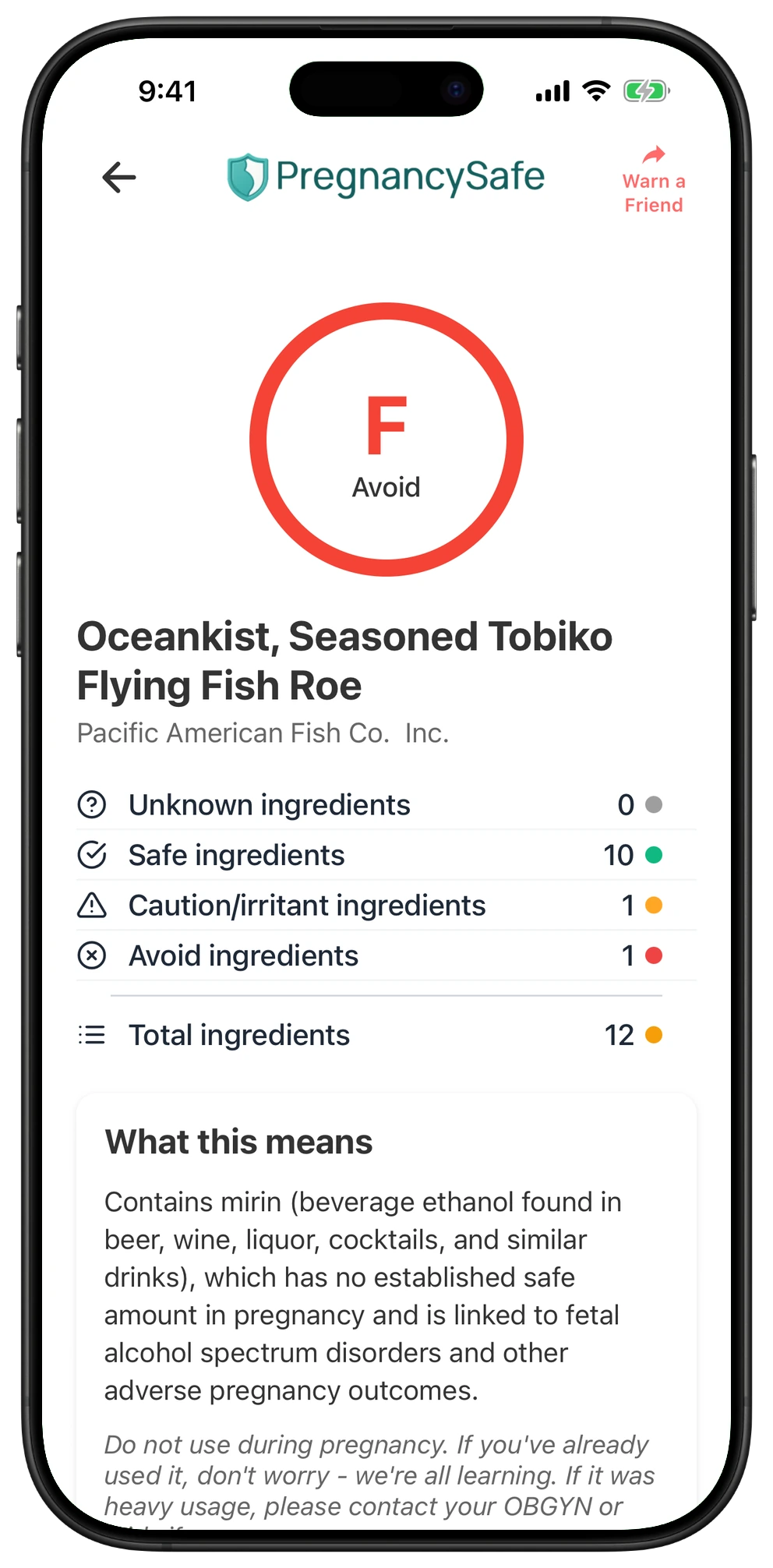
mirin
Avoid
Mirin is a sweet, lightly alcoholic Japanese rice wine used to add depth and subtle sweetness to dishes.
Has no established safe amount in pregnancy and is linked to fetal alcohol spectrum disorders and other adverse pregnancy outcomes.
Flagged in 2 of 6 products (33%)
alcohol
Caution
Alcohol is a volatile, colorless liquid commonly used as a solvent, disinfectant, or intoxicating beverage.
No amount of Alcohol is considered safe. Avoid alcohol beverages entirely. Be extremely careful when using in cooking or even with small percentages.
Flagged in 1 of 6 products (17%)
fd c natural green 3
Caution
Has limited human pregnancy data; regulated food color exposures are below JECFA's ADI, but high dose animal findings and current FDA phase out efforts support limiting frequent heavily dyed foods when easy.
Flagged in 1 of 6 products (17%)
fd c red no 3
Caution
Has limited human pregnancy outcome data and is being phased out of U.S. foods and ingested drugs after high dose male rat thyroid tumor findings.
Flagged in 1 of 6 products (17%)
kelp extract
Caution
Kelp extract is a nutrient rich marine ingredient known for its mineral content and skin nourishing properties.
Can contain highly variable iodine, with high dose brown seaweed or kelp products and hijiki arsenic exposure requiring caution in pregnancy.
Flagged in 1 of 6 products (17%)
Caution
Red 40 is a synthetic food dye commonly used to add vibrant red color to candies, beverages, and processed foods.
Has limited human pregnancy data and is allowed at regulated food additive levels, but child neurobehavior concerns and high dose animal findings make frequent high dye intake worth limiting.
Flagged in 1 of 6 products (17%)
Fish Roe Products We've Analyzed
Our catalog contains ratings for 6 fish roe products. These are database grades, not independent safety certifications.
Ingredient grades cannot establish dose, preparation, label completeness, efficacy or pregnancy suitability. An A score is not an endorsement, and counts include unreviewed catalog records.
Your Questions Answered
Can I eat fish roe while pregnant?
Preparation matters more than the type or price of the roe. Avoid raw or undercooked roe and refrigerated products with uncertain processing or handling. Properly cooked roe or a suitable commercially processed shelf stable option differs from raw chilled roe, but you still need to follow its storage instructions.
Is pasteurized fish roe safe during pregnancy?
Check that pasteurization is stated for the exact product rather than assuming all roe from a brand is pasteurized. Pasteurization does not replace proper refrigeration or careful handling after opening. If you cannot confirm processing and storage, skip that refrigerated product rather than relying on the word pasteurized alone.
Can I have tobiko or other roe on sushi?
Avoid it when the roe is raw or undercooked. A cooked sushi filling does not mean that roe sprinkled on top has also been cooked. Ask specifically about the roe's preparation, and leave it off if the restaurant cannot confirm an appropriate cooked preparation.
Does salting or smoking make fish roe safe?
Salting does not remove the foodborne risk associated with raw roe. A smoked description also does not establish that the roe was thoroughly cooked. Check the actual processing and storage requirements rather than treating cured or smoked as a pregnancy safety guarantee.
How much fish roe can I eat during pregnancy?
There is no universal safe spoonful that applies to every roe product. A small portion does not make raw or uncertain refrigerated roe an appropriate choice. Species, salt content, and processing vary, and you should not assume roe has the same mercury level as the adult fish of that species.
Should I worry about mirin, dyes, or kelp extract in seasoned roe?
These ingredients raise different questions from whether the roe was safely prepared. Mirin can contribute alcohol, but its presence alone does not reveal the residual amount in a serving or make that exposure equivalent to drinking alcohol. Human pregnancy evidence for the flagged dyes is limited, and high dose animal findings do not establish harm from an occasional food serving. Kelp extract can contribute variable iodine, but a seasoning amount should not be equated with a concentrated kelp supplement.
Do low ingredient grades mean all fish roe is unsafe?
No; our catalog contains six products, with five graded F and one graded C-, but these are ingredient grades rather than clinical verdicts. They cannot establish preparation, dose, label completeness, or pathogen control, and the counts include records that have not been independently label reviewed. Use verified cooking, processing, and handling information to guide your choice rather than interpreting every low grade as proof of harm.
How to Interpret These Ratings
Our ingredient and category rules generate letter grades from the information recorded in the catalog. Missing ingredients and broad category assignments can affect the result. These grades do not measure your dose, confirm a complete current label, or test a product for contamination.
A high grade is not a guarantee of pregnancy safety. A low grade is not, by itself, proof of harm from every use. Follow the product-specific guidance above, check the actual package, and ask your prenatal clinician about supplements, treatment decisions or uncertain exposures.
People Also Checked
References
- https://www.fda.gov/food/people-risk-foodborne-illness/eating-out-bringing-food-safety-moms-be
- https://www.fda.gov/food/consumers/advice-about-eating-fish
- https://www.fda.gov/food/people-risk-foodborne-illness/cooking-food-safety-moms-be
- https://www.cdc.gov/listeria/prevention/index.html
- https://www.cdc.gov/alcohol-pregnancy/about/index.html
- https://www.cdc.gov/fasd/about/index.html
- https://www.acog.org/womens-health/infographics/alcohol-and-pregnancy
- https://www.niaaa.nih.gov/publications/brochures-and-fact-sheets/alcohol-and-your-pregnancy
- https://mothertobaby.org/fact-sheets/alcohol-pregnancy/
- https://pubmed.ncbi.nlm.nih.gov/26482673/
- https://pmc.ncbi.nlm.nih.gov/articles/PMC9543418/
- https://www.hfpappexternal.fda.gov/scripts/fdcc/index.cfm?id=FDCGreen3&set=ColorAdditives
- https://www.ecfr.gov/current/title-21/part-74/section-74.203
- https://www.fda.gov/food/color-additives-information-consumers/tracking-food-industry-pledges-remove-petroleum-based-food-dyes
- https://apps.who.int/food-additives-contaminants-jecfa-database/Home/Chemical/1356
- https://www.inchem.org/documents/jecfa/jecmono/v75je01.pdf
- https://www.federalregister.gov/documents/2013/11/08/2013-26760/fdandc-green-no-3-exemption-from-the-requirement-of-a-tolerance
- https://pubmed.ncbi.nlm.nih.gov/5975245/
- https://pubmed.ncbi.nlm.nih.gov/27092991/
- https://pubmed.ncbi.nlm.nih.gov/40962213/
- https://www.fda.gov/industry/color-additives/fdc-red-no-3
- https://www.federalregister.gov/documents/2025/01/16/2025-00830/color-additive-petition-from-center-for-science-in-the-public-interest-et-al-request-to-revoke-color
- https://efsa.onlinelibrary.wiley.com/doi/10.2903/j.efsa.2011.1854
- https://pubmed.ncbi.nlm.nih.gov/2824305/
- https://pubmed.ncbi.nlm.nih.gov/2177442/
- https://pubmed.ncbi.nlm.nih.gov/8296313/
- https://pubmed.ncbi.nlm.nih.gov/8386132/
- https://pmc.ncbi.nlm.nih.gov/articles/PMC9368057/
- https://journals.sagepub.com/doi/10.1177/10507256261445624
- https://ods.od.nih.gov/factsheets/Iodine-HealthProfessional/
- https://www.foodstandards.gov.au/consumer/nutrition/pregnancy/iodine-and-pregnancy
- https://www.foodstandards.gov.au/consumer/prevention-of-foodborne-illness/arseniciodine
- https://inspection.canada.ca/en/food-safety-consumers/fact-sheets/specific-products-and-risks/chemical-hazards/inorganic-arsenic
- https://pubmed.ncbi.nlm.nih.gov/35947162/
- https://pubmed.ncbi.nlm.nih.gov/20919974/
- https://pubmed.ncbi.nlm.nih.gov/30632947/
- https://pmc.ncbi.nlm.nih.gov/articles/PMC8077470/
- https://www.hfpappexternal.fda.gov/scripts/fdcc/index.cfm?id=FDCRed40&set=ColorAdditives
- https://www.ecfr.gov/current/title-21/chapter-I/subchapter-A/part-74/subpart-A/section-74.340
- https://www.efsa.europa.eu/en/efsajournal/pub/1327
- https://www.efsa.europa.eu/en/efsajournal/pub/4007
- https://apps.who.int/food-additives-contaminants-jecfa-database/Home/Chemical/2361
- https://oehha.ca.gov/risk-assessment/report/health-effects-assessment-potential-neurobehavioral-effects-synthetic-food-dyes-children
- https://pubmed.ncbi.nlm.nih.gov/6636206/
- https://pubmed.ncbi.nlm.nih.gov/2613118/
- https://pubmed.ncbi.nlm.nih.gov/7940558/