Is Wasabi Safe During Pregnancy? (Updated 2026 Guide)
Updated September 9, 2026
The Answer
You can generally eat wasabi in small amounts as a condiment during pregnancy if you tolerate it; concentrated supplements and medicinal horseradish preparations are different exposures. Choose by the actual label, preparation and your tolerance not an ingredient grade alone.
Culinary wasabi can cause burning or reflux, which is different from evidence of fetal toxicity. Horseradish based blends are generally compatible in normal condiment amounts, while medicinal preparations or large regular doses warrant avoidance. Added color cautions reflect limited pregnancy evidence rather than established harm from occasional food exposure; follow the package’s preparation and storage instructions.
Pregnancy Safe is 100% independent and research driven. No companies pay to promote or sponsor products.
Stress Less This Pregnancy
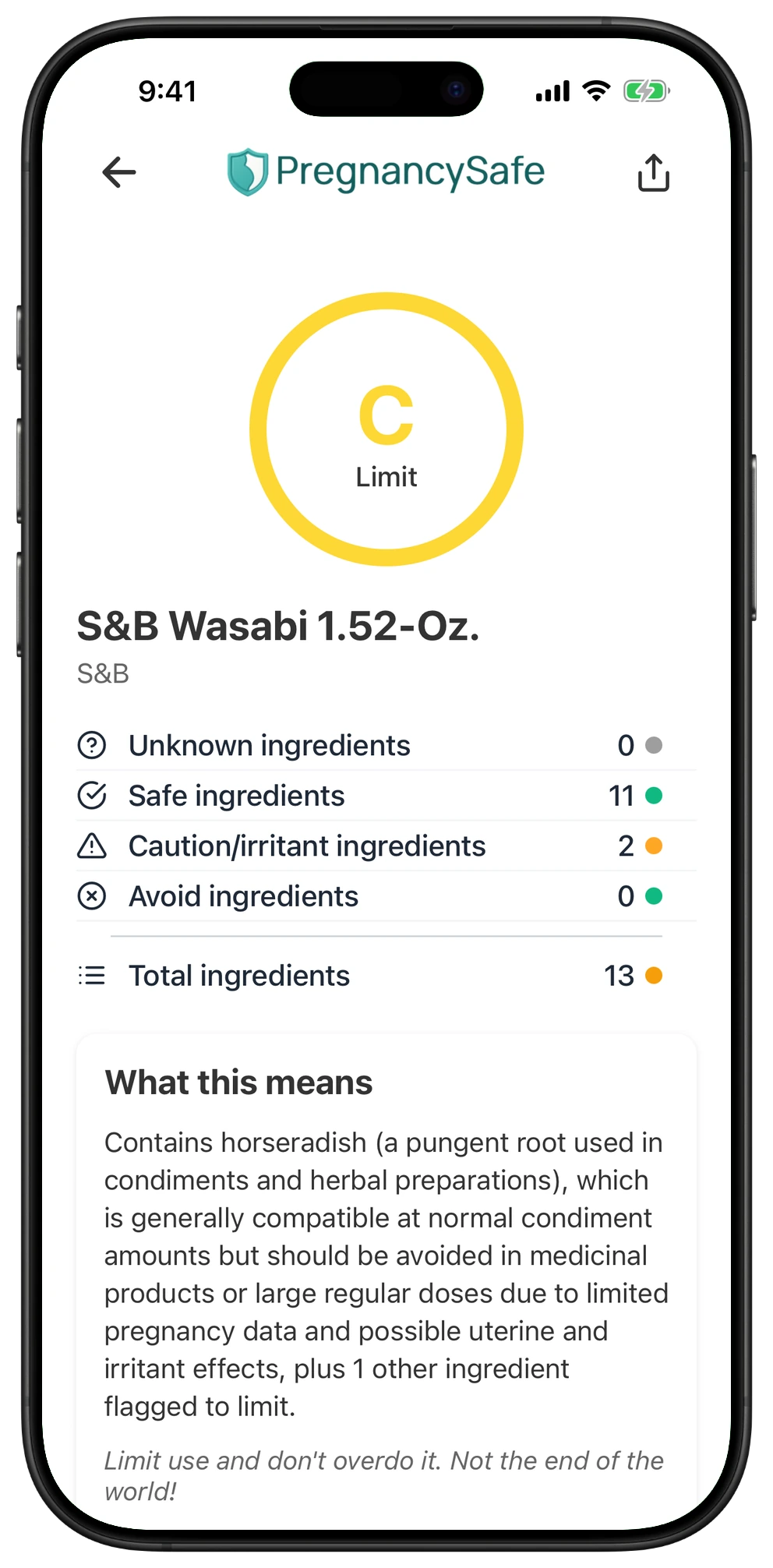
Check your exact wasabi in the app

✓ What's Safe
- • Use a small dab for flavor, and reduce or skip it if it triggers burning or reflux.
- • Read the actual package to distinguish real wasabi from horseradish and mustard blends and concentrated preparations.
- • Check the full ingredient and allergen label, especially if you have a mustard allergy or known dye sensitivity.
- • Follow the exact mixing, refrigeration and storage instructions for your powder or prepared paste.
- • When eating sushi, choose cooked seafood or vegetable fillings and pay attention to safe handling.
✗ What to Avoid
- • Avoid medicinal horseradish products and large regular doses; ordinary seasoning amounts are a different exposure.
- • Do not use concentrated wasabi extracts or supplements as substitutes for culinary wasabi without clinician advice.
- • Avoid increasing the portion or continuing to eat it when it causes uncomfortable burning or reflux.
- • Avoid raw or undercooked seafood accompaniments; adding wasabi does not replace safe cooking and handling.
- • Avoid assuming a familiar brand, green color or A grade guarantees the current package’s pregnancy suitability.
Most Common Ingredients in Wasabi Products
We analyzed 14 wasabi products. Here are the most common ingredients, ranked by how often they appear:
Ingredients to Watch Out For in Wasabi
These are the most common flagged ingredients across 14 wasabi products we analyzed.
horseradish
Caution
Horseradish is a pungent root vegetable known for its sharp, spicy flavor often used to add heat to sauces and condiments.
Is generally compatible at normal condiment amounts but should be avoided in medicinal products or large regular doses due to limited pregnancy data and possible uterine and irritant effects.
Flagged in 7 of 14 products (50%)
fd c blue 1
Caution
FD&C Blue 1 is a synthetic blue dye commonly used to add color to food, beverages, and pharmaceuticals.
Has limited human pregnancy data; regulated food use is not shown to cause fetal harm, but high dose animal neurobehavior findings and child sensitivity concerns support minimizing frequent exposure.
Flagged in 2 of 14 products (14%)
horseradish powder
Caution
Horseradish powder is a spicy, pungent ground seasoning made from dried horseradish root, commonly used to add heat and flavor to dishes.
Is generally compatible at normal condiment amounts but should be avoided in medicinal products or large regular doses due to limited pregnancy data and possible uterine and irritant effects.
Flagged in 2 of 14 products (14%)
alcohol
Caution
Alcohol is a volatile, colorless liquid commonly used as a solvent, disinfectant, or intoxicating beverage.
No amount of Alcohol is considered safe. Avoid alcohol beverages entirely. Be extremely careful when using in cooking or even with small percentages.
Flagged in 1 of 14 products (7%)
artificial color
Caution
Artificial color is a synthetic dye added to foods and products to enhance or alter their visual appearance.
Has limited pregnancy specific outcome data; regulated incidental exposure is generally low concern but some dyes have child behavior allergy or regulatory caveats.
Flagged in 1 of 14 products (7%)
artificial color fd c yellow 5
Caution
FD&C Yellow 5 is a synthetic food coloring used to impart a bright yellow hue to various edible products.
Has limited human pregnancy data, rare hypersensitivity labeling concerns, and animal/children's neurobehavior signals despite regulated dietary use under ADI based limits.
Flagged in 1 of 14 products (7%)
horseradish horseradish
Caution
Horseradish is a pungent root vegetable known for its spicy, tangy flavor often used to add heat to sauces and condiments.
Is generally compatible at normal condiment amounts but should be avoided in medicinal products or large regular doses due to limited pregnancy data and possible uterine and irritant effects.
Flagged in 1 of 14 products (7%)
horseradish oil
Caution
Horseradish oil is a pungent, aromatic oil extracted from horseradish roots, known for its spicy, fiery flavor and invigorating aroma.
Is generally compatible at normal condiment amounts but should be avoided in medicinal products or large regular doses due to limited pregnancy data and possible uterine and irritant effects.
Flagged in 1 of 14 products (7%)
Wasabi Products We've Analyzed
Our catalog contains ratings for 14 wasabi products. These are database grades, not independent safety certifications.
Catalog ingredient grades do not measure current-label completeness, pathogens, preparation, caffeine or clinical pregnancy suitability. These counts include unreviewed records and are not a percentage of independently verified safe products.
Pregnancy Safe Wasabi Products
Popular options from our catalog, prioritizing A and B ingredient grades, with C grade options used to fill remaining places. Within each group, products are ordered by searches in Pregnancy Safe, not retail sales. Read the cautions and guidance above; grades do not verify a complete current label or guarantee pregnancy safety.
| Grade | Product | Brand |
|---|---|---|
| A | Sushi Sonic Real Wasabi | Unknown |
| A | S&B Fresh Grated Wasabi In Tube | S&B Foods Inc. |
| A | Grated Wasabi | Kameya Foods Corporation |
| C | Hime Powdered Sushi Wasabi Catalog caution flags: horseradish, spirulina and turmeric. Read the category guidance above. | Jfc International Inc. |
| C+ | Sushi Wasabi, Sushi Catalog caution flags: fd c blue 1. Read the category guidance above. | Afc |
Your Questions Answered
Can I eat wasabi while pregnant?
Small amounts used as a condiment are generally compatible with pregnancy if you tolerate them. The practical concern is often burning or reflux, not established fetal toxicity from culinary use. Check the label because real wasabi, horseradish blends and concentrated extracts are not interchangeable.
Is it safe to eat wasabi sushi while pregnant?
A small dab of wasabi is a separate consideration from the safety of the sushi itself. Choose cooked seafood or vegetable fillings rather than raw or undercooked seafood, and pay attention to preparation and storage. Wasabi does not make unsafe handling or undercooked seafood safe.
What spices should be avoided during pregnancy?
Ordinary culinary seasoning should not be treated as equivalent to concentrated herbal products. For wasabi style condiments, the important distinction is normal food amounts versus medicinal horseradish preparations or large regular doses, which should be avoided. Check with your prenatal clinician before taking spice extracts or herbal supplements rather than eliminating culinary spices as a group.
Is imitation wasabi with horseradish unsafe?
Not simply because it contains horseradish. Normal condiment amounts are generally compatible with pregnancy; warnings about medicinal oral preparations and large regular doses do not establish harm from a small serving. Read the full label for mustard, other allergens and ingredients relevant to your individual needs.
Should I avoid artificial colors in wasabi?
Choosing a dye free version is an option if you want to reduce nonessential additives or have a known sensitivity. Human pregnancy evidence for Blue 1 and Yellow 5 is limited, but occasional regulated food exposure has not been shown to cause fetal harm. Animal findings and studies of children do not establish that a small portion of colored wasabi harms a pregnancy.
How much wasabi can I have during pregnancy?
There is no established pregnancy specific serving limit here, so a precise gram or teaspoon allowance would be misleading. Keep it to a small amount used for flavor rather than large regular servings or concentrated doses. Reduce or skip it if it worsens reflux, and follow any individualized dietary advice from your clinician.
Does an A grade mean a wasabi product is verified safe?
No. Our catalog contains 14 products, including 3 with A ingredient grades, but those are not counts of independently verified safe products. Ingredient grades do not establish current label completeness, safe preparation or absence of pathogens. Read your actual package and follow its storage instructions regardless of grade.
How to Interpret These Ratings
Our ingredient and category rules generate letter grades from the information recorded in the catalog. Missing ingredients and broad category assignments can affect the result. These grades do not measure your dose, confirm a complete current label, or test a product for contamination.
A high grade is not a guarantee of pregnancy safety. A low grade is not, by itself, proof of harm from every use. Follow the product-specific guidance above, check the actual package, and ask your prenatal clinician about supplements, treatment decisions or uncertain exposures.
People Also Checked
References
- https://www.nhs.uk/pregnancy/keeping-well/foods-to-avoid/
- https://www.fda.gov/food/people-risk-foodborne-illness/cooking-food-safety-moms-be
- https://webprod.hc-sc.gc.ca/nhpid-bdipsn/atReq?atid=horseradish.raifort&lang=eng
- https://inchem.org/documents/jecfa/jeceval/jec_71.htm
- https://hfpappexternal.fda.gov/scripts/fdcc/index.cfm?id=ALLYLISOTHIOCYANATE&set=FoodSubstances
- https://pmc.ncbi.nlm.nih.gov/articles/PMC13085108/
- https://pubmed.ncbi.nlm.nih.gov/22129740/
- https://www.drugs.com/npp/horseradish.html
- https://www.hfpappexternal.fda.gov/scripts/fdcc/index.cfm?id=FDCBlue1&set=ColorAdditives
- https://www.ecfr.gov/current/title-21/chapter-I/subchapter-A/part-74
- https://www.fda.gov/food/color-additives-information-consumers/tracking-food-industry-pledges-remove-petroleum-based-food-dyes
- https://efsa.onlinelibrary.wiley.com/doi/10.2903/j.efsa.2010.1853
- https://apps.who.int/food-additives-contaminants-jecfa-database/Home/Chemical/3309
- https://pubmed.ncbi.nlm.nih.gov/23208798/
- https://pubmed.ncbi.nlm.nih.gov/24257113/
- https://oehha.ca.gov/risk-assessment/report/health-effects-assessment-potential-neurobehavioral-effects-synthetic-food-dyes-children
- https://www.fda.gov/food/color-additives-information-consumers/color-additives-questions-and-answers-consumers
- https://www.fda.gov/food/food-ingredients-packaging/color-additives-information-consumers
- https://www.fda.gov/cosmetics/cosmetic-ingredient-names/color-additives-permitted-use-cosmetics
- https://www.fda.gov/industry/color-additives/fdc-red-no-3
- https://pubmed.ncbi.nlm.nih.gov/35233072/
- https://pubmed.ncbi.nlm.nih.gov/35484553/
- https://pubmed.ncbi.nlm.nih.gov/35106984/
- https://hfpappexternal.fda.gov/scripts/fdcc/index.cfm?id=FDCYellow5&set=ColorAdditives
- https://www.ecfr.gov/current/title-21/chapter-I/subchapter-A/part-74#74.705
- https://www.fda.gov/food/nutrition-food-labeling-and-critical-foods/food-allergies
- https://apps.who.int/food-additives-contaminants-jecfa-database/Home/Chemical/3885
- https://efsa.onlinelibrary.wiley.com/doi/10.2903/j.efsa.2009.1331
- https://pubmed.ncbi.nlm.nih.gov/1628860/
- https://pmc.ncbi.nlm.nih.gov/articles/PMC7023231/
- https://pmc.ncbi.nlm.nih.gov/articles/PMC6354951/
- https://journals.sagepub.com/doi/10.1177/10507256261445624
- https://ods.od.nih.gov/factsheets/Iodine-HealthProfessional/
- https://www.foodstandards.gov.au/consumer/nutrition/pregnancy/iodine-and-pregnancy
- https://www.foodstandards.gov.au/consumer/prevention-of-foodborne-illness/arseniciodine
- https://inspection.canada.ca/en/food-safety-consumers/fact-sheets/specific-products-and-risks/chemical-hazards/inorganic-arsenic
- https://pubmed.ncbi.nlm.nih.gov/35947162/
- https://pubmed.ncbi.nlm.nih.gov/20919974/
- https://pubmed.ncbi.nlm.nih.gov/30632947/
- https://pmc.ncbi.nlm.nih.gov/articles/PMC8077470/