Is Kimchi Safe During Pregnancy? (Updated 2026 Guide)
Updated September 9, 2026
The Answer
Kimchi can fit into your pregnancy diet when prepared cleanly and stored correctly; heating is a conservative option. Our catalog contains 107 A rated entries among 136 products, but ingredient grades cannot confirm food handling or pathogen safety.
The main consideration is foodborne illness: fermentation and acidity do not guarantee that kimchi is free of pathogens, so cold storage and clean preparation matter. Recipes can also contain fish or shellfish allergens, added sugars and kelp with variable iodine levels. Ingredient names alone do not establish a harmful dose, and trace fermentation alcohol is a different exposure from drinking alcohol.
Pregnancy Safe is 100% independent and research driven. No companies pay to promote or sponsor products.
Stress Less This Pregnancy
Check your exact kimchi in the app

✓ What's Safe
- • Choose commercially prepared kimchi with clear storage instructions, and follow them before and after opening.
- • Use clean utensils when serving, and keep refrigerated kimchi cold rather than leaving the jar out through meals.
- • Consider heating kimchi thoroughly as a conservative option instead of eating it cold.
- • Read the exact recipe and allergen statement for fish or shellfish if you have an allergy.
- • Compare added sugars per serving, and check for kelp or seaweed ingredients if you eat kimchi frequently.
✗ What to Avoid
- • Avoid spoiled kimchi or jars whose storage history is uncertain; do not use heating to rescue questionable food.
- • Skip home fermented batches when you cannot establish how they were prepared and stored.
- • Do not treat a sour taste, live culture claim or vegan label as proof that kimchi is free of pathogens.
- • Avoid frequent large portions of kelp containing kimchi as an iodine strategy; kelp base sauce and kelp extract do not disclose the iodine dose by name alone.
- • Limit frequent high added sugar intake, including high fructose corn syrup, rather than treating an occasional small serving as a fetal hazard.
Most Common Ingredients in Kimchi Products
We analyzed 136 kimchi products. Here are the most common ingredients, ranked by how often they appear:
Ingredients to Watch Out For in Kimchi
These are the most common flagged ingredients across 136 kimchi products we analyzed.
high fructose corn syrup
Caution
High fructose corn syrup is a sweet, liquid sweetener made from corn starch, commonly used in processed foods and beverages.
Is not a known teratogen at occasional food amounts, but high added sugar intake can displace nutrients and raise gestational diabetes and metabolic concerns.
Flagged in 3 of 136 products (2%)
kelp base sauce
Caution
A savory, umami rich sauce made from blended kelp, offering a natural oceanic flavor and depth to dishes.
Can contain highly variable iodine, with high dose brown seaweed or kelp products and hijiki arsenic exposure requiring caution in pregnancy.
Flagged in 3 of 136 products (2%)
sea vegetable
Caution
A nutrient rich marine plant commonly used in salads, soups, and sushi to add flavor and health benefits.
Can contain highly variable iodine, with high dose brown seaweed or kelp products and hijiki arsenic exposure requiring caution in pregnancy.
Flagged in 2 of 136 products (1%)
ethyl alcohol
Avoid
Ethyl alcohol is a colorless, volatile, and flammable organic compound commonly used as a solvent, disinfectant, and in alcoholic beverages.
Has no established safe amount in pregnancy and is linked to fetal alcohol spectrum disorders and other adverse pregnancy outcomes.
Flagged in 1 of 136 products (1%)
garlic ginger brown seaweed
Caution
A flavorful combination of garlic, ginger, and brown seaweed that adds depth and umami to dishes.
Can contain highly variable iodine, with high dose brown seaweed or kelp products and hijiki arsenic exposure requiring caution in pregnancy.
Flagged in 1 of 136 products (1%)
ginger brown seaweed
Caution
Ginger brown seaweed is a nutrient rich marine algae with a savory, slightly spicy flavor reminiscent of ginger, often used to enhance umami in culinary dishes.
Can contain highly variable iodine, with high dose brown seaweed or kelp products and hijiki arsenic exposure requiring caution in pregnancy.
Flagged in 1 of 136 products (1%)
grain alcohol
Avoid
Grain alcohol is a highly concentrated, neutral spirit distilled from fermented grains, often used in cocktails and as a base for homemade liqueurs.
Has no established safe amount in pregnancy and is linked to fetal alcohol spectrum disorders and other adverse pregnancy outcomes.
Flagged in 1 of 136 products (1%)
horseradish root
Caution
Horseradish root is a pungent, spicy root vegetable commonly used to add heat and flavor to sauces, condiments, and dishes.
Is generally compatible at normal condiment amounts but should be avoided in medicinal products or large regular doses due to limited pregnancy data and possible uterine and irritant effects.
Flagged in 1 of 136 products (1%)
Kimchi Products We've Analyzed
Our catalog contains ratings for 136 kimchi products. These are database grades, not independent safety certifications.
Grades are ingredient scores, not clinical verdicts or measurements of pathogens, dose, preparation or current package contents. Cohorts include unreviewed catalog records and counts are not independently verified safe-product totals.
Pregnancy Safe Kimchi Products
Popular options from our catalog, prioritizing A and B ingredient grades, with C grade options used to fill remaining places. Within each group, products are ordered by searches in Pregnancy Safe, not retail sales. Read the cautions and guidance above; grades do not verify a complete current label or guarantee pregnancy safety.
| Grade | Product | Brand |
|---|---|---|
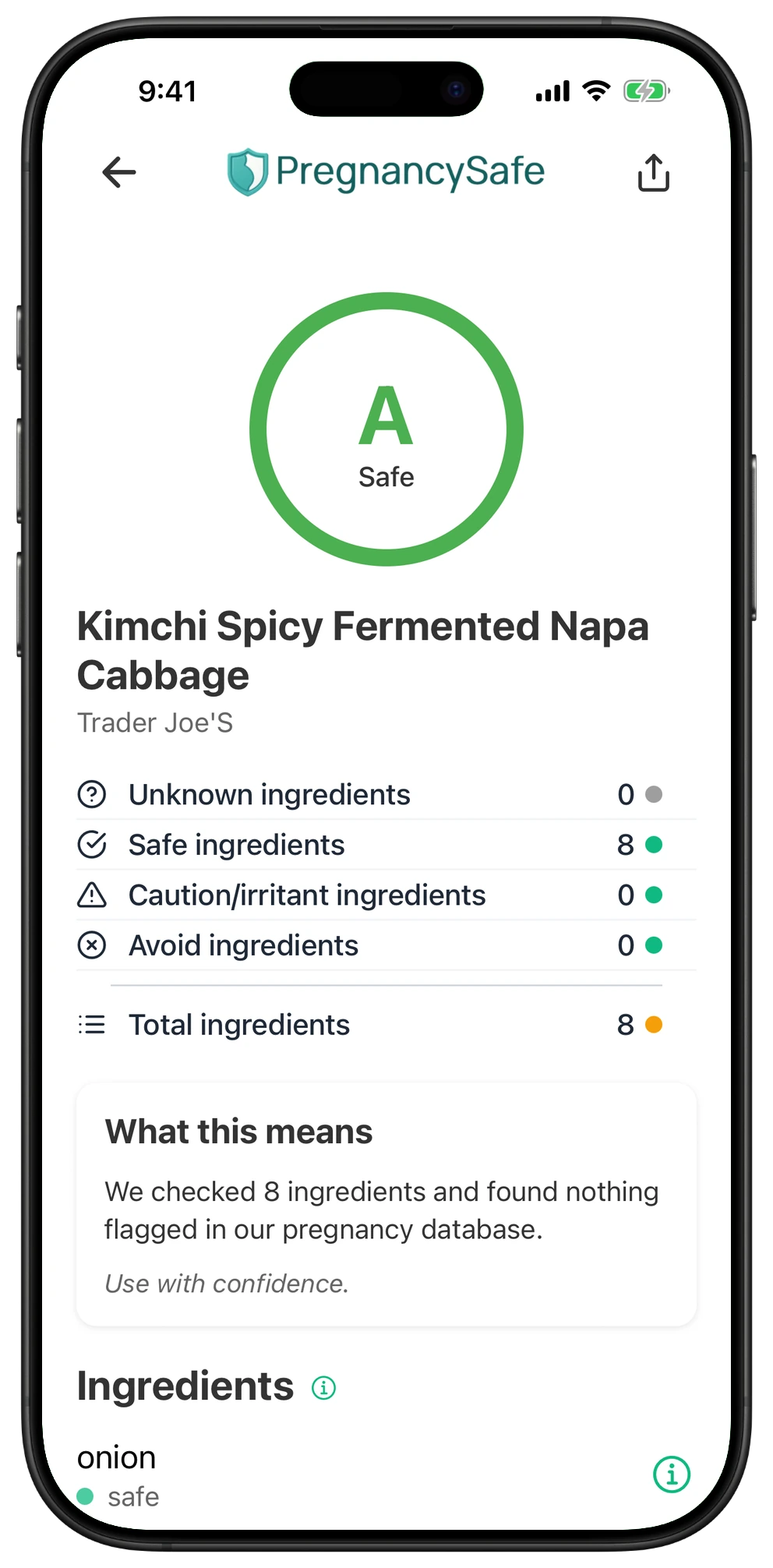
| A | Kimchi Spicy Fermented Napa Cabbage | Trader Joe'S |
| A | Kimchi | — |
| A | Sliced Kimchi | Hacco |
| A | Kimchi | Kimchi |
| A | Cucumber Kimchi | Jongga |
Your Questions Answered
Is it safe to eat kimchi during pregnancy?
Kimchi can be part of your diet, but safety depends on preparation and storage rather than fermentation alone. Choose a reliably handled product, follow its refrigeration instructions and use clean utensils. Heating is a conservative option. An ingredient grade does not tell you whether a particular jar contains pathogens.
Is cooked kimchi a safer option while pregnant?
Heating kimchi is a conservative way to reduce foodborne risk compared with eating the same food unheated. Start with properly stored kimchi and heat it thoroughly, rather than just warming its surface. Do not use cooking to salvage spoiled kimchi or a batch with uncertain handling.
Can I eat homemade or unpasteurized kimchi during pregnancy?
Avoid homemade kimchi when its fermentation process, cleanliness or storage is uncertain. Unpasteurized kimchi has not had a pasteurization step, and fermentation does not guarantee the absence of pathogens. Commercial preparation and reliable cold storage matter, but neither is a blanket safety guarantee. If you want a more conservative approach, heat properly stored kimchi before eating.
Does kimchi provide proven probiotic benefits during pregnancy?
Kimchi is a fermented food, not a pregnancy proven probiotic supplement. A live culture label does not establish a particular health benefit or confirm pathogen safety. You can choose it for taste and variety without relying on claims that it boosts immunity or improves pregnancy outcomes.
Should I avoid spicy kimchi or kimchi containing alcohol?
Culinary chili and garlic are not automatically fetal toxins. Trace alcohol associated with fermented food is a different exposure from drinking alcohol, which should be avoided during pregnancy. If ethyl alcohol or grain alcohol appears on the label, the name alone does not establish how much remains in a serving. Ask the manufacturer for clarification or choose a recipe without added alcohol if you prefer to avoid that uncertainty.
How much kimchi can I eat during pregnancy?
There is no single pregnancy specific portion limit established here. Use kimchi as a side dish within a varied diet, and consider the serving size and added sugars on the label. For recipes containing kelp or brown seaweed, frequent large portions deserve more caution because iodine content can vary substantially. If you have thyroid disease or gestational diabetes, ask your care team how it fits your individual dietary needs.
Does an A grade mean a kimchi product is pregnancy safe?
No grades are ingredient scores, not clinical verdicts or pathogen tests. Our catalog contains 136 products, including 107 A rated entries, but those are not independently verified safe product totals. Grades do not measure preparation, storage, dose or current package contents. A lower grade or incomplete record also does not, by itself, prove that a product is harmful.
How to Interpret These Ratings
Our ingredient and category rules generate letter grades from the information recorded in the catalog. Missing ingredients and broad category assignments can affect the result. These grades do not measure your dose, confirm a complete current label, or test a product for contamination.
A high grade is not a guarantee of pregnancy safety. A low grade is not, by itself, proof of harm from every use. Follow the product-specific guidance above, check the actual package, and ask your prenatal clinician about supplements, treatment decisions or uncertain exposures.
People Also Checked
References
- https://www.cdc.gov/listeria/prevention/index.html
- https://www.fda.gov/food/people-risk-foodborne-illness/cooking-food-safety-moms-be
- https://www.nhs.uk/pregnancy/keeping-well/foods-to-avoid/
- https://cdn.realfood.gov/DGA.pdf
- https://www.dietaryguidelines.gov/sites/default/files/2021-12/DGA_Pregnancy_FactSheet-508c.pdf
- https://www.acog.org/womens-health/faqs/healthy-eating-during-pregnancy
- https://www.cdc.gov/nutrition/php/data-research/added-sugars.html
- https://www.cdc.gov/diabetes/about/gestational-diabetes.html
- https://www.who.int/publications/i/item/9789241549028
- https://nesr.usda.gov/2025-dietary-guidelines-advisory-committee-systematic-reviews/dietary-patterns_gestational-diabetes
- https://journals.sagepub.com/doi/10.1177/10507256261445624
- https://ods.od.nih.gov/factsheets/Iodine-HealthProfessional/
- https://www.foodstandards.gov.au/consumer/nutrition/pregnancy/iodine-and-pregnancy
- https://www.foodstandards.gov.au/consumer/prevention-of-foodborne-illness/arseniciodine
- https://inspection.canada.ca/en/food-safety-consumers/fact-sheets/specific-products-and-risks/chemical-hazards/inorganic-arsenic
- https://pubmed.ncbi.nlm.nih.gov/35947162/
- https://pubmed.ncbi.nlm.nih.gov/20919974/
- https://pubmed.ncbi.nlm.nih.gov/30632947/
- https://pmc.ncbi.nlm.nih.gov/articles/PMC8077470/
- https://www.cdc.gov/alcohol-pregnancy/about/index.html
- https://www.cdc.gov/fasd/about/index.html
- https://www.acog.org/womens-health/infographics/alcohol-and-pregnancy
- https://www.niaaa.nih.gov/publications/brochures-and-fact-sheets/alcohol-and-your-pregnancy
- https://mothertobaby.org/fact-sheets/alcohol-pregnancy/
- https://pubmed.ncbi.nlm.nih.gov/26482673/
- https://pmc.ncbi.nlm.nih.gov/articles/PMC9543418/
- https://webprod.hc-sc.gc.ca/nhpid-bdipsn/atReq?atid=horseradish.raifort&lang=eng
- https://inchem.org/documents/jecfa/jeceval/jec_71.htm
- https://hfpappexternal.fda.gov/scripts/fdcc/index.cfm?id=ALLYLISOTHIOCYANATE&set=FoodSubstances
- https://pmc.ncbi.nlm.nih.gov/articles/PMC13085108/
- https://pubmed.ncbi.nlm.nih.gov/22129740/
- https://www.drugs.com/npp/horseradish.html