Is Tofu Safe During Pregnancy? (Updated 2026 Guide)
Updated September 9, 2026
The Answer
Yes ordinary food portions of tofu can fit into pregnancy meals when you follow package storage and preparation directions and avoid cross contamination. Our catalog contains 268 A graded entries among 299 tofu products, but ingredient grades are not pregnancy safety guarantees.
For tofu, safe storage and preparation matter more than concern about soy's naturally occurring phytoestrogens; ordinary soy foods are different from high dose isoflavone supplements. Check flavored varieties for alcohol containing sauces and kelp, where the amount consumed matters. Fennel and fennel seed in culinary amounts are low concern, unlike concentrated medicinal preparations, and routine additives or spices do not establish fetal harm.
Pregnancy Safe is 100% independent and research driven. No companies pay to promote or sponsor products.
Stress Less This Pregnancy
Check your exact tofu in the app

✓ What's Safe
- • Choose tofu with clear storage, preparation and after opening instructions, and follow the exact package directions.
- • Check that refrigerated tofu has been kept cold, and maintain cold storage when you bring it home.
- • Prepare tofu with clean hands, utensils and surfaces, keeping it separate from raw meat and its juices.
- • Choose plain tofu or sauces without added alcohol when you want to avoid uncertainty about alcohol exposure.
- • For seaweed seasoned tofu, check the seaweed type and any iodine information before making it a frequent meal.
✗ What to Avoid
- • Avoid eating tofu that has not been stored according to its package instructions, even if its ingredient grade is A.
- • Avoid skipping required cooking steps or putting prepared tofu on surfaces that held raw meat.
- • Avoid adding cooking wine or rice wine when an alcohol free sauce will work; an ingredient name alone does not tell you the amount of alcohol in a finished serving.
- • Avoid frequent large amounts of kelp seasoned tofu without checking iodine exposure; organic kelp is still kelp.
- • Avoid treating high dose isoflavone supplements or concentrated fennel preparations as equivalent to ordinary tofu meals.
Most Common Ingredients in Tofu Products
We analyzed 299 tofu products. Here are the most common ingredients, ranked by how often they appear:
Ingredients to Watch Out For in Tofu
These are the most common flagged ingredients across 299 tofu products we analyzed.
alcohol
Caution
Alcohol is a volatile, colorless liquid commonly used as a solvent, disinfectant, or intoxicating beverage.
No amount of Alcohol is considered safe. Avoid alcohol beverages entirely. Be extremely careful when using in cooking or even with small percentages.
Flagged in 6 of 299 products (2%)
cooking wine
Avoid
Cooking wine is a seasoned, often fortified wine used to enhance the flavor of dishes during the cooking process.
Has no established safe amount in pregnancy and is linked to fetal alcohol spectrum disorders and other adverse pregnancy outcomes.
Flagged in 2 of 299 products (1%)
ethyl alcohol
Avoid
Ethyl alcohol is a colorless, volatile, and flammable organic compound commonly used as a solvent, disinfectant, and in alcoholic beverages.
Has no established safe amount in pregnancy and is linked to fetal alcohol spectrum disorders and other adverse pregnancy outcomes.
Flagged in 2 of 299 products (1%)
fennel seed
Caution
Fennel seed is a aromatic spice with a sweet, licorice like flavor commonly used to enhance savory dishes and digestive remedies.
Is generally low concern at normal culinary amounts but should be avoided as concentrated medicinal tea, essential oil, or supplement during pregnancy because safety data are limited and estrogenic or uterine concerns exist.
Flagged in 2 of 299 products (1%)
rice wine
Avoid
Rice wine is a traditional alcoholic beverage made from fermented polished rice, often used in cooking and for drinking in various Asian cuisines.
Has no established safe amount in pregnancy and is linked to fetal alcohol spectrum disorders and other adverse pregnancy outcomes.
Flagged in 2 of 299 products (1%)
fd c yellow 5
Caution
FD&C Yellow 5 is a synthetic food dye used to add a bright yellow color to various edible products.
Has limited human pregnancy data, rare hypersensitivity labeling concerns, and animal/children's neurobehavior signals despite regulated dietary use under ADI based limits.
Flagged in 1 of 299 products (0%)
fennel
Caution
Fennel is a crunchy, aromatic vegetable with a bulbous base, feathery fronds, and a mild, sweet anise flavor often used in salads, soups, and Mediterranean dishes.
Is generally low concern at normal culinary amounts but should be avoided as concentrated medicinal tea, essential oil, or supplement during pregnancy because safety data are limited and estrogenic or uterine concerns exist.
Flagged in 1 of 299 products (0%)
kelp
Caution
Kelp is a nutrient rich, brown seaweed commonly used as a savory, mineral dense ingredient in soups, salads, and health supplements.
Can contain highly variable iodine, with high dose brown seaweed or kelp products and hijiki arsenic exposure requiring caution in pregnancy.
Flagged in 1 of 299 products (0%)
Tofu Products We've Analyzed
Our catalog contains ratings for 299 tofu products. These are database grades, not independent safety certifications.
Catalog ingredient grades do not measure current-label completeness, pathogens, preparation, caffeine or clinical pregnancy suitability. These counts include unreviewed records and are not a percentage of independently verified safe products.
Pregnancy Safe Tofu Products
Popular options from our catalog, prioritizing A and B ingredient grades, with C grade options used to fill remaining places. Within each group, products are ordered by searches in Pregnancy Safe, not retail sales. Read the cautions and guidance above; grades do not verify a complete current label or guarantee pregnancy safety.
| Grade | Product | Brand |
|---|---|---|
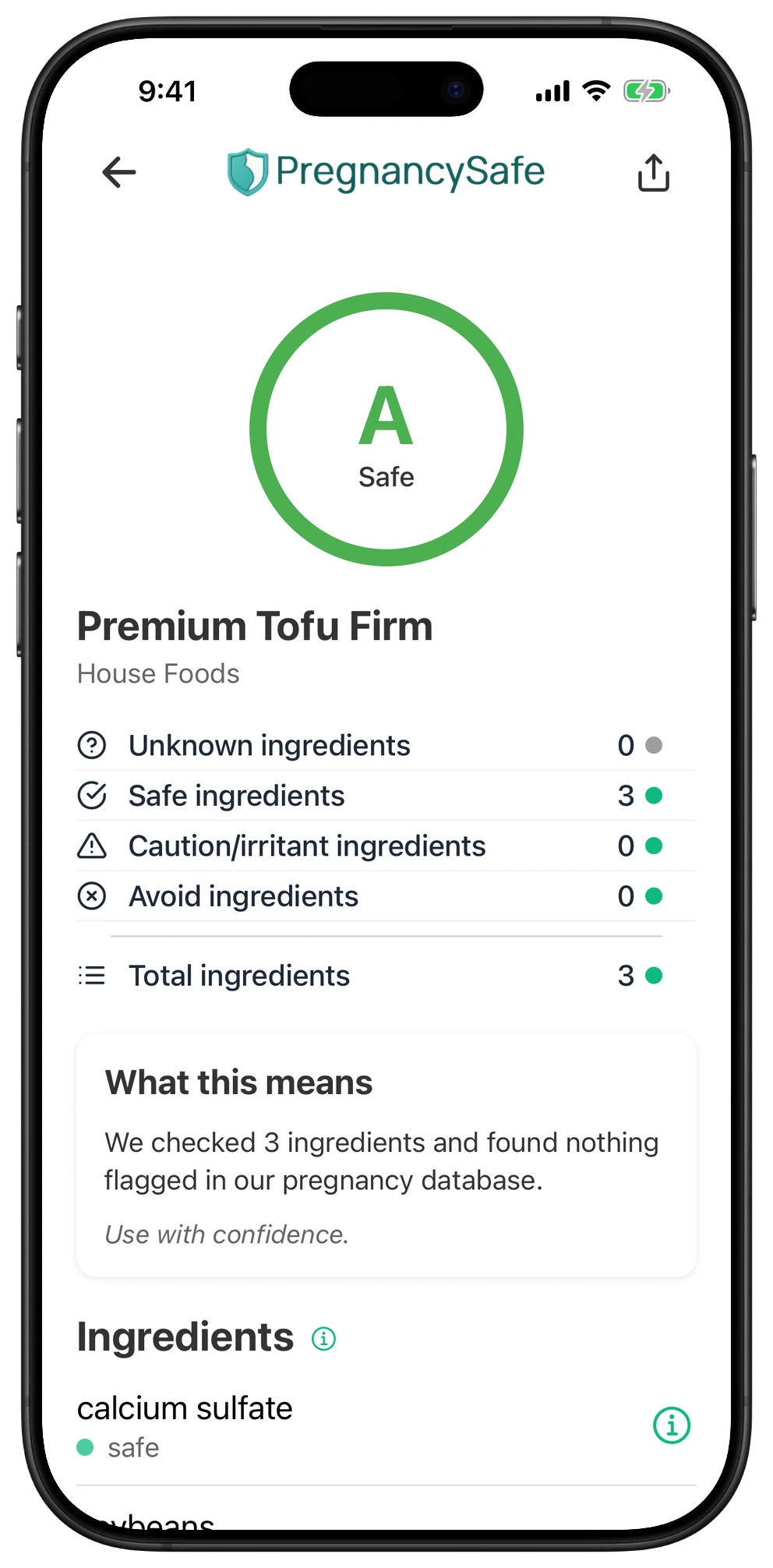
| A | Premium Tofu Firm | House Foods |
| A | Japanese Teriyaki Tofu | Hodo |
| A | Macro Silken Tofu | Macro |
| A | Firm Tofu | Trader Joe'S Organic |
| A | Sriracha Flavored Baked Tofu | Trader Joe'S |
Your Questions Answered
Is it okay to eat tofu when pregnant?
Yes, ordinary food portions of tofu can be part of your pregnancy diet. Soy is not routinely forbidden because it contains phytoestrogens, and eating tofu is not equivalent to taking concentrated isoflavone supplements. Follow the package's cold storage and preparation directions and prevent cross contamination. If you have a soy allergy, that is a separate reason to avoid soy based tofu.
Is most tofu pasteurized?
Most tofu in the United States is pasteurized, but that does not verify how an individual package was processed or handled. Check its label or ask the manufacturer if you need confirmation. Pasteurization does not replace proper storage or protect against contamination after opening. Follow the exact package's preparation instructions rather than assuming every tofu product is ready to eat.
Can I eat tofu without cooking it during pregnancy?
Check whether the exact product is intended to be eaten without further cooking. Do not skip cooking when the package requires it, and do not assume that silken, firm or baked tofu all have the same instructions. For tofu intended to be eaten cold, correct refrigeration and clean handling still matter. If preparation directions are unclear, ask the manufacturer rather than relying on the product name or ingredient grade.
How much tofu can I eat during pregnancy?
Use tofu in ordinary meal portions as part of a varied diet rather than treating it as a concentrated supplement. There is no single pregnancy specific serving limit established here, so a precise daily maximum would be misleading. The formulation also matters: frequent kelp containing portions may contribute variable amounts of iodine. Ask your clinician or dietitian for individualized advice if you have thyroid concerns or specific dietary restrictions.
Should I avoid flavored tofu during pregnancy?
Not automatically; check the complete label and how the tofu will be prepared. Alcohol, ethyl alcohol, cooking wine and rice wine relate to the same ethanol concern, but their presence alone does not quantify exposure from a serving or make it equivalent to drinking alcohol. Choosing a sauce without added alcohol avoids that uncertainty. Culinary fennel is low concern, while kelp deserves attention to iodine amount and frequency; limited pregnancy evidence for Yellow 5 does not establish harm from an occasional food exposure.
Does an A grade mean tofu is verified safe during pregnancy?
No an ingredient grade does not measure pathogens, storage conditions, preparation or current label completeness. Our catalog contains 299 tofu products, including 268 with an A grade, but these are not counts of independently verified safe products. A lower grade or incomplete record also does not by itself prove a product is harmful. Read the actual package and any product qualifications, and follow food handling precautions regardless of grade.
How to Interpret These Ratings
Our ingredient and category rules generate letter grades from the information recorded in the catalog. Missing ingredients and broad category assignments can affect the result. These grades do not measure your dose, confirm a complete current label, or test a product for contamination.
A high grade is not a guarantee of pregnancy safety. A low grade is not, by itself, proof of harm from every use. Follow the product-specific guidance above, check the actual package, and ask your prenatal clinician about supplements, treatment decisions or uncertain exposures.
People Also Checked
References
- https://www.nhs.uk/pregnancy/keeping-well/foods-to-avoid/
- https://www.fda.gov/food/people-risk-foodborne-illness/cooking-food-safety-moms-be
- https://www.cdc.gov/alcohol-pregnancy/about/index.html
- https://www.cdc.gov/fasd/about/index.html
- https://www.acog.org/womens-health/infographics/alcohol-and-pregnancy
- https://www.niaaa.nih.gov/publications/brochures-and-fact-sheets/alcohol-and-your-pregnancy
- https://mothertobaby.org/fact-sheets/alcohol-pregnancy/
- https://pubmed.ncbi.nlm.nih.gov/26482673/
- https://pmc.ncbi.nlm.nih.gov/articles/PMC9543418/
- https://hfpappexternal.fda.gov/scripts/fdcc/index.cfm?id=FENNELCOMMON&set=FoodSubstances
- https://www.ema.europa.eu/en/documents/herbal-monograph/final-european-union-herbal-monograph-foeniculum-vulgare-miller-subsp-vulgare-var-dulce-mill-batt-trab-fructus-revision-1_en.pdf
- https://webprod.hc-sc.gc.ca/nhpid-bdipsn/dbImages/mono_fennel-sweet_english.pdf
- https://www.swissmedic.ch/swissmedic/en/home/news/mitteilungen/fencheltee-fuer-schwangere-kinder-unter-4-jahren.html
- https://www.efsa.europa.eu/en/news/have-your-say-estragole-fennel-seed-preparations
- https://www.ncbi.nlm.nih.gov/books/NBK501793/
- https://pubmed.ncbi.nlm.nih.gov/30969204/
- https://pubmed.ncbi.nlm.nih.gov/32733750/
- https://pubmed.ncbi.nlm.nih.gov/23275017/
- https://www.utep.edu/herbal-safety/populations/herbs-to-avoid-during-pregnancy.html
- https://hfpappexternal.fda.gov/scripts/fdcc/index.cfm?id=FDCYellow5&set=ColorAdditives
- https://www.ecfr.gov/current/title-21/chapter-I/subchapter-A/part-74#74.705
- https://www.fda.gov/food/color-additives-information-consumers/tracking-food-industry-pledges-remove-petroleum-based-food-dyes
- https://www.fda.gov/food/nutrition-food-labeling-and-critical-foods/food-allergies
- https://apps.who.int/food-additives-contaminants-jecfa-database/Home/Chemical/3885
- https://efsa.onlinelibrary.wiley.com/doi/10.2903/j.efsa.2009.1331
- https://oehha.ca.gov/risk-assessment/report/health-effects-assessment-potential-neurobehavioral-effects-synthetic-food-dyes-children
- https://pubmed.ncbi.nlm.nih.gov/1628860/
- https://pmc.ncbi.nlm.nih.gov/articles/PMC7023231/
- https://pmc.ncbi.nlm.nih.gov/articles/PMC6354951/
- https://journals.sagepub.com/doi/10.1177/10507256261445624
- https://ods.od.nih.gov/factsheets/Iodine-HealthProfessional/
- https://www.foodstandards.gov.au/consumer/nutrition/pregnancy/iodine-and-pregnancy
- https://www.foodstandards.gov.au/consumer/prevention-of-foodborne-illness/arseniciodine
- https://inspection.canada.ca/en/food-safety-consumers/fact-sheets/specific-products-and-risks/chemical-hazards/inorganic-arsenic
- https://pubmed.ncbi.nlm.nih.gov/35947162/
- https://pubmed.ncbi.nlm.nih.gov/20919974/
- https://pubmed.ncbi.nlm.nih.gov/30632947/
- https://pmc.ncbi.nlm.nih.gov/articles/PMC8077470/