Is Hummus Safe During Pregnancy? (Updated 2026 Guide)
Updated September 9, 2026
The Answer
Hummus advice differs by region: UK NHS hospital guidance includes it as a pregnancy snack, while Food Standards Australia New Zealand advises pregnant people to avoid hummus and tahini. Our catalog contains 951 A rated entries among 1,149 products, but grades do not measure contamination risk or override local pregnancy guidance.
The main pregnancy consideration is foodborne illness, not proof that ordinary hummus ingredients are toxic. Where local guidance permits hummus, follow refrigeration, use by and after opening instructions, use clean utensils, and avoid dips with uncertain storage histories. Sesame allergy is a separate concern, and cautions about concentrated herbal oils or supplements should not be applied to small amounts of culinary seasoning.
Pregnancy Safe is 100% independent and research driven. No companies pay to promote or sponsor products.
Stress Less This Pregnancy
Check your exact hummus in the app

✓ What's Safe
- • Check your local pregnancy food guidance before choosing hummus or tahini containing dips.
- • Where hummus is permitted, choose containers with clear use by, refrigeration and after opening instructions.
- • Keep refrigerated hummus chilled during transport and storage, following the package directions.
- • Use clean utensils to serve a portion rather than repeatedly dipping into the container.
- • Choose pasteurized dips or spreads without tahini if following guidance that advises avoiding hummus.
- • Read the exact package label, including sesame allergens and any separately packed crackers or toppings.
✗ What to Avoid
- • Avoid hummus and tahini when your local pregnancy guidance advises against them, regardless of the product grade.
- • Skip buffet or deli hummus when you cannot confirm its refrigeration and handling.
- • Do not eat hummus past its use by date or the stated after opening period.
- • Avoid eating refrigerated hummus when its storage history is uncertain.
- • Do not treat homemade preparation or high pressure processing as a guarantee against contamination.
- • Avoid tahini containing hummus if you have a sesame allergy; tahini and sesame tahini both refer to sesame paste.
Most Common Ingredients in Hummus Products
We analyzed 1,149 hummus products. Here are the most common ingredients, ranked by how often they appear:
Ingredients to Watch Out For in Hummus
These are the most common flagged ingredients across 1,149 hummus products we analyzed.
flaxseed oil
Caution
Flaxseed oil is a nutrient rich oil derived from flaxseeds, known for its high omega-3 fatty acid content and health benefits.
Has limited pregnancy specific safety data; normal food amounts are lower concern but concentrated supplements warrant caution.
Flagged in 5 of 1,149 products (0%)
horseradish
Caution
Horseradish is a pungent root vegetable known for its sharp, spicy flavor often used to add heat to sauces and condiments.
Is generally compatible at normal condiment amounts but should be avoided in medicinal products or large regular doses due to limited pregnancy data and possible uterine and irritant effects.
Flagged in 3 of 1,149 products (0%)
yellow 5
Caution
Yellow 5 is a synthetic food dye used to impart a bright yellow color to various processed foods and beverages.
Has limited human pregnancy data, rare hypersensitivity labeling concerns, and animal/children's neurobehavior signals despite regulated dietary use under ADI based limits.
Flagged in 2 of 1,149 products (0%)
fennel seed
Caution
Fennel seed is a aromatic spice with a sweet, licorice like flavor commonly used to enhance savory dishes and digestive remedies.
Is generally low concern at normal culinary amounts but should be avoided as concentrated medicinal tea, essential oil, or supplement during pregnancy because safety data are limited and estrogenic or uterine concerns exist.
Flagged in 1 of 1,149 products (0%)
fenugreek
Caution
Fenugreek is a versatile herb and spice known for its slightly bitter, nutty flavor and its use in both culinary dishes and traditional medicine.
Is generally lower concern in normal food amounts but medicinal doses are not recommended in pregnancy due to limited data plus uterine stimulant and reproductive toxicity signals.
Flagged in 1 of 1,149 products (0%)
horseradish powder
Caution
Horseradish powder is a spicy, pungent ground seasoning made from dried horseradish root, commonly used to add heat and flavor to dishes.
Is generally compatible at normal condiment amounts but should be avoided in medicinal products or large regular doses due to limited pregnancy data and possible uterine and irritant effects.
Flagged in 1 of 1,149 products (0%)
Hummus Products We've Analyzed
Our catalog contains ratings for 1,149 hummus products. These are database grades, not independent safety certifications.
The grade does not measure contamination risk or override local advice about hummus and tahini. Formulas and snack-pack contents can differ; these are catalog counts, not an independently approved safe-products list.
Pregnancy Safe Hummus Products
Popular options from our catalog, prioritizing A and B ingredient grades, with C grade options used to fill remaining places. Within each group, products are ordered by searches in Pregnancy Safe, not retail sales. Read the cautions and guidance above; grades do not verify a complete current label or guarantee pregnancy safety.
| Grade | Product | Brand |
|---|---|---|
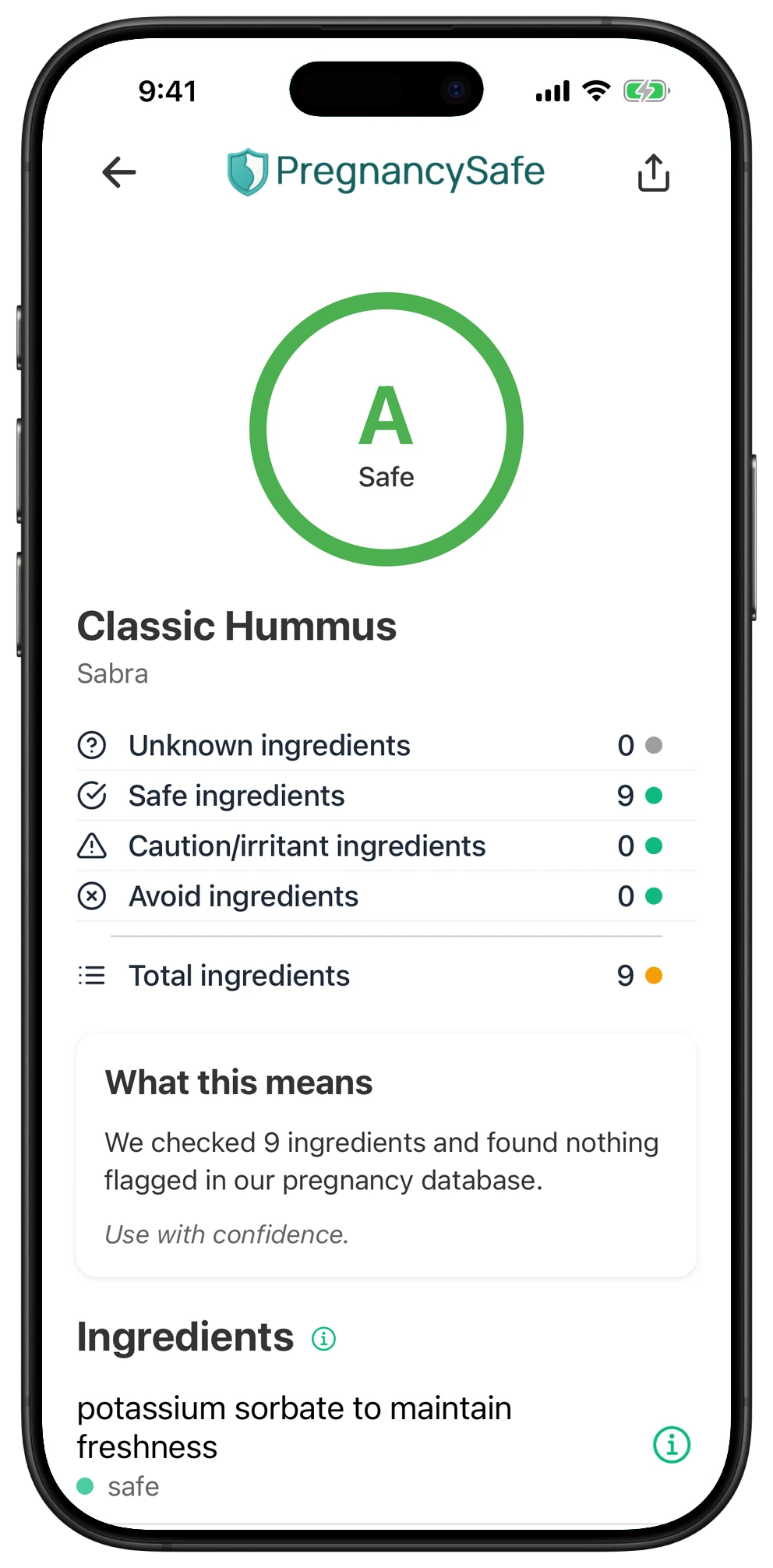
| A | Classic Hummus | Sabra |
| B+ | Sabra Classic Hummus Snacker With Pretzels | Sabra |
| A | Sabra Roasted Red Pepper Hummus | Sabra |
| B+ | Fresh Cravings Jalapeno Cilantro Hummus Plastic | Fresh Cravings |
| A | Sabra Roasted Pine Nuts Hummus | Sabra |
Your Questions Answered
Is hummus ok in the first trimester?
The first trimester does not remove the need to follow local pregnancy food guidance. UK NHS hospital guidance includes hummus as a snack, while Food Standards Australia New Zealand advises pregnant people to avoid hummus and tahini. Where it is permitted, careful refrigeration and handling remain important throughout pregnancy.
Should I avoid chickpeas during pregnancy?
Advice to avoid hummus is not a blanket recommendation to avoid chickpeas. The hummus concern centers on food hygiene and tahini containing dips, rather than evidence that chickpeas themselves are a pregnancy hazard. Consider chickpeas separately from the preparation, ingredients and storage of a ready to eat dip.
What dip is safe for pregnancy?
If you are following guidance that excludes hummus and tahini, choose pasteurized dips or spreads without tahini. Read the exact label rather than assuming a particular flavor or type meets that description. Follow refrigeration and use by instructions, because pasteurization does not replace safe handling.
Is homemade hummus safer than store bought hummus?
Homemade hummus is not automatically safer, and neither option is guaranteed free from contamination. Making it yourself lets you control ingredients and handling, but does not override advice to avoid hummus or tahini. Where local guidance permits hummus, use clean equipment and utensils and maintain appropriate refrigeration. High pressure processing on a commercial label is not a risk free guarantee either.
Does an A grade mean hummus is safe during pregnancy?
No: a catalog grade does not measure contamination risk or establish that a product is safe for you during pregnancy. Our catalog contains 1,149 products, including 951 rated A, but these are not counts of independently verified safe products. A listed product is not a clinical endorsement or a safety guarantee, and different sizes or versions can have different formulas. A low grade or incomplete record also does not, by itself, prove a product is harmful.
Should I avoid hummus containing dill, fennel or horseradish?
Small culinary amounts of these seasonings should not be portrayed as proven fetal hazards. Dill weed is a culinary herb, not cannabis; the word weed does not make cannabis evidence applicable to dill. Concerns about fennel or horseradish in concentrated medicinal preparations are different from their use as seasoning in hummus. For the dip itself, prioritize local hummus guidance, refrigeration and safe handling.
How to Interpret These Ratings
Our ingredient and category rules generate letter grades from the information recorded in the catalog. Missing ingredients and broad category assignments can affect the result. These grades do not measure your dose, confirm a complete current label, or test a product for contamination.
A high grade is not a guarantee of pregnancy safety. A low grade is not, by itself, proof of harm from every use. Follow the product-specific guidance above, check the actual package, and ask your prenatal clinician about supplements, treatment decisions or uncertain exposures.
People Also Checked
References
- https://www.foodstandards.gov.au/consumer/prevention-of-foodborne-illness/Food-safety-for-vulnerable-populations
- https://www.cuh.nhs.uk/patient-information/healthy-living-for-pregnancy/
- https://www.fda.gov/food/people-risk-foodborne-illness/ready-eat-foods-food-safety-moms-be
- https://www.nccih.nih.gov/health/flaxseed-and-flaxseed-oil
- https://webprod.hc-sc.gc.ca/nhpid-bdipsn/dbImages/858
- https://pubmed.ncbi.nlm.nih.gov/16579802/
- https://www.unlockfood.ca/en/Articles/Pregnancy/Keeping-Your-Baby-Healthy-During-Pregnancy.aspx
- https://www.ncbi.nlm.nih.gov/books/NBK501895/
- https://pmc.ncbi.nlm.nih.gov/articles/PMC10353157/
- https://webprod.hc-sc.gc.ca/nhpid-bdipsn/atReq?atid=horseradish.raifort&lang=eng
- https://inchem.org/documents/jecfa/jeceval/jec_71.htm
- https://hfpappexternal.fda.gov/scripts/fdcc/index.cfm?id=ALLYLISOTHIOCYANATE&set=FoodSubstances
- https://pmc.ncbi.nlm.nih.gov/articles/PMC13085108/
- https://pubmed.ncbi.nlm.nih.gov/22129740/
- https://www.drugs.com/npp/horseradish.html
- https://hfpappexternal.fda.gov/scripts/fdcc/index.cfm?id=FDCYellow5&set=ColorAdditives
- https://www.ecfr.gov/current/title-21/chapter-I/subchapter-A/part-74#74.705
- https://www.fda.gov/food/color-additives-information-consumers/tracking-food-industry-pledges-remove-petroleum-based-food-dyes
- https://www.fda.gov/food/nutrition-food-labeling-and-critical-foods/food-allergies
- https://apps.who.int/food-additives-contaminants-jecfa-database/Home/Chemical/3885
- https://efsa.onlinelibrary.wiley.com/doi/10.2903/j.efsa.2009.1331
- https://oehha.ca.gov/risk-assessment/report/health-effects-assessment-potential-neurobehavioral-effects-synthetic-food-dyes-children
- https://pubmed.ncbi.nlm.nih.gov/1628860/
- https://pmc.ncbi.nlm.nih.gov/articles/PMC7023231/
- https://pmc.ncbi.nlm.nih.gov/articles/PMC6354951/
- https://hfpappexternal.fda.gov/scripts/fdcc/index.cfm?id=FENNELCOMMON&set=FoodSubstances
- https://www.ema.europa.eu/en/documents/herbal-monograph/final-european-union-herbal-monograph-foeniculum-vulgare-miller-subsp-vulgare-var-dulce-mill-batt-trab-fructus-revision-1_en.pdf
- https://webprod.hc-sc.gc.ca/nhpid-bdipsn/dbImages/mono_fennel-sweet_english.pdf
- https://www.swissmedic.ch/swissmedic/en/home/news/mitteilungen/fencheltee-fuer-schwangere-kinder-unter-4-jahren.html
- https://www.efsa.europa.eu/en/news/have-your-say-estragole-fennel-seed-preparations
- https://www.ncbi.nlm.nih.gov/books/NBK501793/
- https://pubmed.ncbi.nlm.nih.gov/30969204/
- https://pubmed.ncbi.nlm.nih.gov/32733750/
- https://pubmed.ncbi.nlm.nih.gov/23275017/
- https://www.utep.edu/herbal-safety/populations/herbs-to-avoid-during-pregnancy.html
- https://www.nccih.nih.gov/health/fenugreek
- https://www.ncbi.nlm.nih.gov/books/NBK501779/
- https://www.ema.europa.eu/en/documents/herbal-report/assessment-report-trigonella-foenum-graecum-l-semen-revision-1_en.pdf
- https://www.ema.europa.eu/en/documents/herbal-monograph/european-union-herbal-monograph-trigonella-foenum-graecum-l-semen-revision-1_en.pdf
- https://webprod.hc-sc.gc.ca/nhpid-bdipsn/dbImages/mono_fenugreek--oral_english.pdf
- https://pubmed.ncbi.nlm.nih.gov/32421208/
- https://pubmed.ncbi.nlm.nih.gov/27498339/
- https://pubmed.ncbi.nlm.nih.gov/33722213/