Is Sauerkraut Safe During Pregnancy? (Updated 2026 Guide)
Updated September 9, 2026
The Answer
You can eat sauerkraut during pregnancy with attention to its source, storage, and preparation; heating is a conservative lower risk option. Our catalog contains 267 A grade records among 333 products, but ingredient grades do not establish pregnancy safety or freedom from contamination.
The main consideration is food handling: fermentation and live cultures do not guarantee freedom from contamination, so follow package storage instructions and avoid spoiled products or uncertain home fermentation. Check flavored varieties for added beer, white wine, or seaweed, where the amount eaten and remaining alcohol or iodine content matter. Ordinary culinary spices, salt, and routine additives should not be treated as proof of fetal harm.
Pregnancy Safe is 100% independent and research driven. No companies pay to promote or sponsor products.
Stress Less This Pregnancy
Check your exact sauerkraut in the app

✓ What's Safe
- • Choose commercially prepared sauerkraut with clear storage and preparation instructions.
- • Check that products labeled for refrigeration have been kept cold, and follow the after opening instructions.
- • Heat properly stored sauerkraut before eating if you want a conservative lower risk option.
- • Choose a version without added beer or white wine if you want to avoid uncertainty about remaining alcohol.
- • Check serving size and sodium on the label, particularly if your maternity team has given you individualized sodium advice.
✗ What to Avoid
- • Avoid home fermented sauerkraut when you cannot establish how it was prepared or stored.
- • Avoid spoiled sauerkraut; do not use heating as a way to rescue it.
- • Avoid eating refrigerated sauerkraut when its cold storage history is uncertain.
- • Avoid assuming that raw, organic, or live culture labeling guarantees safety or pregnancy benefits.
- • Avoid assuming that cooking a beer- or white wine flavored variety removes all alcohol; choose one without added alcohol when the remaining amount is unknown.
- • Avoid using kelp containing sauerkraut as an iodine supplement or eating large, frequent portions without knowing its iodine content.
Most Common Ingredients in Sauerkraut Products
We analyzed 333 sauerkraut products. Here are the most common ingredients, ranked by how often they appear:
Ingredients to Watch Out For in Sauerkraut
These are the most common flagged ingredients across 333 sauerkraut products we analyzed.
white wine
Avoid
White wine is a crisp, pale yellow alcoholic beverage made from fermented white grapes, often used to enhance the flavor of dishes or enjoyed on its own.
Has no established safe amount in pregnancy and is linked to fetal alcohol spectrum disorders and other adverse pregnancy outcomes.
Flagged in 3 of 333 products (1%)
beer
Avoid
Beer is a fermented alcoholic beverage made from malted barley, hops, yeast, and water, known for its diverse flavors and refreshing qualities.
Has no established safe amount in pregnancy and is linked to fetal alcohol spectrum disorders and other adverse pregnancy outcomes.
Flagged in 2 of 333 products (1%)
alcohol
Caution
Alcohol is a volatile, colorless liquid commonly used as a solvent, disinfectant, or intoxicating beverage.
No amount of Alcohol is considered safe. Avoid alcohol beverages entirely. Be extremely careful when using in cooking or even with small percentages.
Flagged in 1 of 333 products (0%)
dried arame seaweed
Caution
Can contain highly variable iodine, with high dose brown seaweed or kelp products and hijiki arsenic exposure requiring caution in pregnancy.
Flagged in 1 of 333 products (0%)
dulse seaweed
Caution
Dulse seaweed is a reddish, edible marine algae rich in vitamins, minerals, and umami flavor, often used as a nutritious snack or ingredient in soups and salads.
Can contain highly variable iodine, with high dose brown seaweed or kelp products and hijiki arsenic exposure requiring caution in pregnancy.
Flagged in 1 of 333 products (0%)
fennel
Caution
Fennel is a crunchy, aromatic vegetable with a bulbous base, feathery fronds, and a mild, sweet anise flavor often used in salads, soups, and Mediterranean dishes.
Is generally low concern at normal culinary amounts but should be avoided as concentrated medicinal tea, essential oil, or supplement during pregnancy because safety data are limited and estrogenic or uterine concerns exist.
Flagged in 1 of 333 products (0%)
fenugreek
Caution
Fenugreek is a versatile herb and spice known for its slightly bitter, nutty flavor and its use in both culinary dishes and traditional medicine.
Is generally lower concern in normal food amounts but medicinal doses are not recommended in pregnancy due to limited data plus uterine stimulant and reproductive toxicity signals.
Flagged in 1 of 333 products (0%)
horseradish
Caution
Horseradish is a pungent root vegetable known for its sharp, spicy flavor often used to add heat to sauces and condiments.
Is generally compatible at normal condiment amounts but should be avoided in medicinal products or large regular doses due to limited pregnancy data and possible uterine and irritant effects.
Flagged in 1 of 333 products (0%)
Sauerkraut Products We've Analyzed
Our catalog contains ratings for 333 sauerkraut products. These are database grades, not independent safety certifications.
Catalog ingredient grades do not measure current-label completeness, pathogens, preparation, caffeine or clinical pregnancy suitability. These counts include unreviewed records and are not a percentage of independently verified safe products.
Pregnancy Safe Sauerkraut Products
Popular options from our catalog, prioritizing A and B ingredient grades, with C grade options used to fill remaining places. Within each group, products are ordered by searches in Pregnancy Safe, not retail sales. Read the cautions and guidance above; grades do not verify a complete current label or guarantee pregnancy safety.
| Grade | Product | Brand |
|---|---|---|
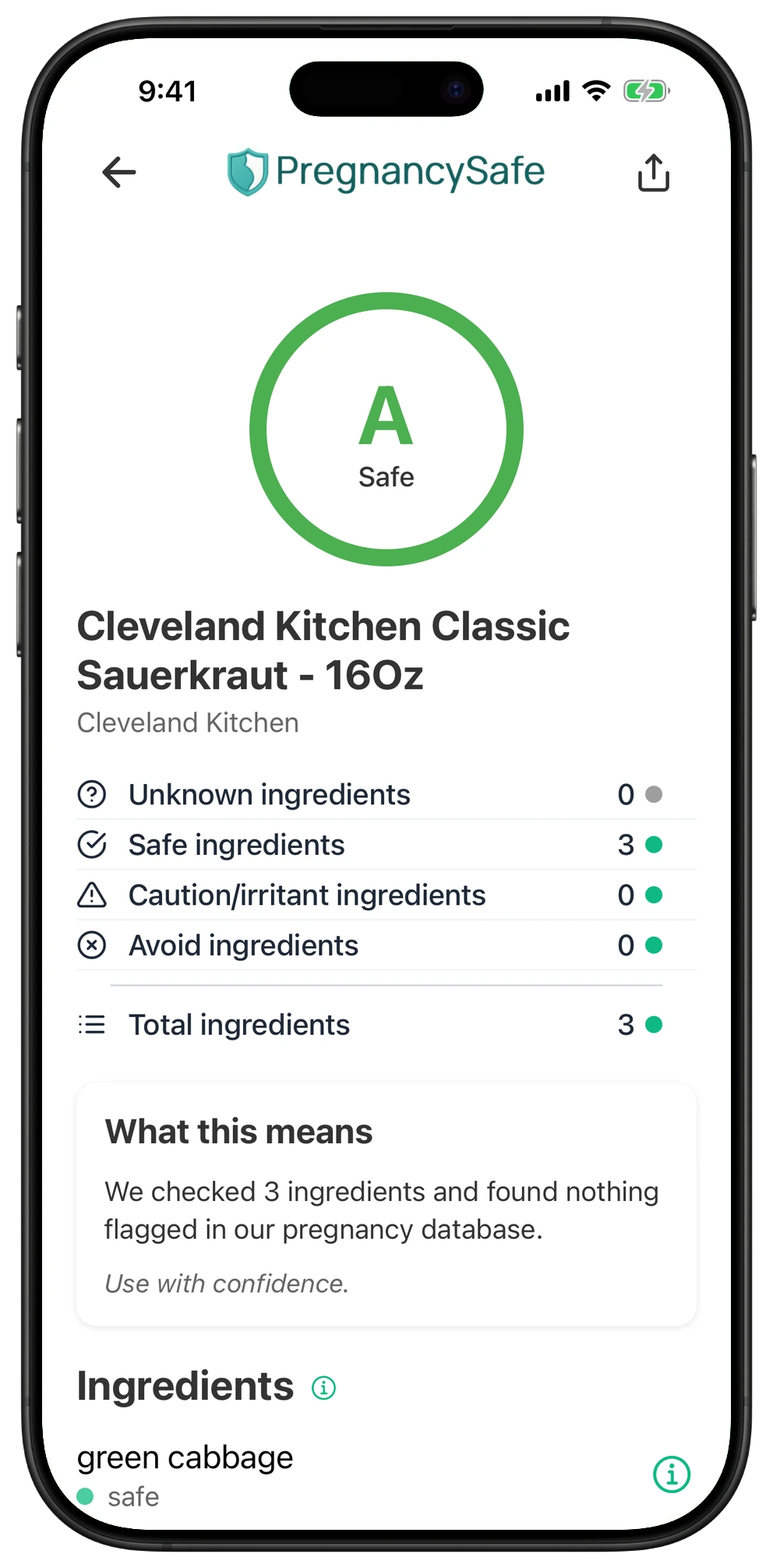
| A | Cleveland Kitchen Classic Sauerkraut | Cleveland Kitchen |
| A | Sauerkraut | Signature Kitchens |
| A | Shredded Sauerkraut | Silver Floss |
| A | H-E-B Organics Raw Sauerkraut | H-E-B |
| B+ | Boar'S Head, Sauerkraut | Boar'S Head |
Your Questions Answered
Can you eat fermented foods if pregnant?
Fermented foods are not all interchangeable, so consider the specific food and how it is prepared and stored. For sauerkraut, choose a commercial source, follow its storage instructions, and avoid spoiled products or uncertain home fermentation. Fermentation alone does not guarantee freedom from contamination. Heating properly stored sauerkraut is a conservative lower risk option.
Are there fermented foods to avoid during pregnancy?
Avoid spoiled fermented foods and products whose preparation or required refrigeration you cannot establish. With sauerkraut, uncertain home fermentation is a reason to choose another option. Alcoholic beverages are a separate exposure and should be avoided during pregnancy. The word fermented alone does not tell you whether a food is suitable.
Can I eat raw sauerkraut, or should I heat it?
A raw or live culture label does not establish that sauerkraut is free from contamination. If you choose it, pay close attention to commercial sourcing and package storage instructions. Heating properly stored sauerkraut is a conservative lower risk choice. Do not heat and eat a product that is spoiled or has an uncertain storage history.
How much sauerkraut can I eat while pregnant?
There is no established pregnancy specific portion limit here, so treat sauerkraut as a food rather than a supplement. Use the package serving size to understand how much sodium your portion provides. Follow individualized advice if your maternity team has recommended sodium changes. Seaweed containing varieties need additional attention because iodine content can vary substantially.
Is sauerkraut made with beer or white wine safe?
Beer or white wine on the ingredient list does not tell you how much alcohol remains in a serving. Guidance to avoid drinking alcohol should not be translated into a claim that every food containing a small amount causes harm. If the remaining alcohol is unknown, choosing sauerkraut without added alcohol avoids that uncertainty. Trace alcohol from fermentation is a different exposure from drinking an alcoholic beverage.
Should I avoid sauerkraut containing dill, fennel, or other spices?
Ordinary culinary seasoning should not be treated as equivalent to concentrated herbal products. Dill weed is a culinary herb, not cannabis; the shared word weed does not make them the same ingredient. Concerns about medicinal doses of fennel, fenugreek, or horseradish do not establish harm from normal seasoning amounts in sauerkraut. Check the exact label for your own allergies and distinguish food ingredients from added extracts or supplements.
Does an A grade mean sauerkraut is verified safe during pregnancy?
No. Our catalog contains 333 products, including 267 A grade records, but those grades assess ingredients rather than pathogens, storage, preparation, or clinical pregnancy suitability. The counts include unreviewed records and are not a count of independently verified safe products. Likewise, a lower grade or incomplete record does not by itself prove that a product is harmful.
How to Interpret These Ratings
Our ingredient and category rules generate letter grades from the information recorded in the catalog. Missing ingredients and broad category assignments can affect the result. These grades do not measure your dose, confirm a complete current label, or test a product for contamination.
A high grade is not a guarantee of pregnancy safety. A low grade is not, by itself, proof of harm from every use. Follow the product-specific guidance above, check the actual package, and ask your prenatal clinician about supplements, treatment decisions or uncertain exposures.
People Also Checked
References
- https://www.nhs.uk/pregnancy/keeping-well/foods-to-avoid/
- https://www.fda.gov/food/people-risk-foodborne-illness/cooking-food-safety-moms-be
- https://www.cdc.gov/alcohol-pregnancy/about/index.html
- https://www.cdc.gov/fasd/about/index.html
- https://www.acog.org/womens-health/infographics/alcohol-and-pregnancy
- https://www.niaaa.nih.gov/publications/brochures-and-fact-sheets/alcohol-and-your-pregnancy
- https://mothertobaby.org/fact-sheets/alcohol-pregnancy/
- https://pubmed.ncbi.nlm.nih.gov/26482673/
- https://pmc.ncbi.nlm.nih.gov/articles/PMC9543418/
- https://journals.sagepub.com/doi/10.1177/10507256261445624
- https://ods.od.nih.gov/factsheets/Iodine-HealthProfessional/
- https://www.foodstandards.gov.au/consumer/nutrition/pregnancy/iodine-and-pregnancy
- https://www.foodstandards.gov.au/consumer/prevention-of-foodborne-illness/arseniciodine
- https://inspection.canada.ca/en/food-safety-consumers/fact-sheets/specific-products-and-risks/chemical-hazards/inorganic-arsenic
- https://pubmed.ncbi.nlm.nih.gov/35947162/
- https://pubmed.ncbi.nlm.nih.gov/20919974/
- https://pubmed.ncbi.nlm.nih.gov/30632947/
- https://pmc.ncbi.nlm.nih.gov/articles/PMC8077470/
- https://hfpappexternal.fda.gov/scripts/fdcc/index.cfm?id=FENNELCOMMON&set=FoodSubstances
- https://www.ema.europa.eu/en/documents/herbal-monograph/final-european-union-herbal-monograph-foeniculum-vulgare-miller-subsp-vulgare-var-dulce-mill-batt-trab-fructus-revision-1_en.pdf
- https://webprod.hc-sc.gc.ca/nhpid-bdipsn/dbImages/mono_fennel-sweet_english.pdf
- https://www.swissmedic.ch/swissmedic/en/home/news/mitteilungen/fencheltee-fuer-schwangere-kinder-unter-4-jahren.html
- https://www.efsa.europa.eu/en/news/have-your-say-estragole-fennel-seed-preparations
- https://www.ncbi.nlm.nih.gov/books/NBK501793/
- https://pubmed.ncbi.nlm.nih.gov/30969204/
- https://pubmed.ncbi.nlm.nih.gov/32733750/
- https://pubmed.ncbi.nlm.nih.gov/23275017/
- https://www.utep.edu/herbal-safety/populations/herbs-to-avoid-during-pregnancy.html
- https://www.nccih.nih.gov/health/fenugreek
- https://www.ncbi.nlm.nih.gov/books/NBK501779/
- https://www.ema.europa.eu/en/documents/herbal-report/assessment-report-trigonella-foenum-graecum-l-semen-revision-1_en.pdf
- https://www.ema.europa.eu/en/documents/herbal-monograph/european-union-herbal-monograph-trigonella-foenum-graecum-l-semen-revision-1_en.pdf
- https://webprod.hc-sc.gc.ca/nhpid-bdipsn/dbImages/mono_fenugreek--oral_english.pdf
- https://pubmed.ncbi.nlm.nih.gov/32421208/
- https://pubmed.ncbi.nlm.nih.gov/27498339/
- https://pubmed.ncbi.nlm.nih.gov/33722213/
- https://webprod.hc-sc.gc.ca/nhpid-bdipsn/atReq?atid=horseradish.raifort&lang=eng
- https://inchem.org/documents/jecfa/jeceval/jec_71.htm
- https://hfpappexternal.fda.gov/scripts/fdcc/index.cfm?id=ALLYLISOTHIOCYANATE&set=FoodSubstances
- https://pmc.ncbi.nlm.nih.gov/articles/PMC13085108/
- https://pubmed.ncbi.nlm.nih.gov/22129740/
- https://www.drugs.com/npp/horseradish.html