Is Seafood Safe During Pregnancy? (Updated 2026 Guide)
Updated September 9, 2026
The Answer
Yes choose thoroughly cooked, lower mercury seafood, aiming for 8–12 ounces weekly from FDA Best Choices and varying the species. Ingredient grades alone cannot tell you whether seafood is suitable during pregnancy: mercury, storage and doneness matter.
Your main considerations are mercury exposure from the species and amount you eat, plus foodborne illness from raw, undercooked or improperly stored seafood. Seasonings and sauces need context: normal condiment amounts of horseradish differ from medicinal doses, and a white wine or mirin listing does not establish the alcohol amount in a finished dish. Neither a high ingredient grade nor a short ingredient list measures contamination or confirms safe preparation.
Pregnancy Safe is 100% independent and research driven. No companies pay to promote or sponsor products.
Stress Less This Pregnancy
Check your exact seafood in the app

✓ What's Safe
- • Identify the fish or shellfish species on the package or ask the seller, then check its FDA mercury category.
- • Plan 2–3 four ounce servings weekly from FDA Best Choices, totaling 8–12 ounces and varying species.
- • Choose thoroughly cooked seafood and follow FDA cooking directions alongside the package instructions.
- • Check storage instructions and choose seafood that has been kept appropriately chilled or frozen; maintain cold storage at home.
- • Read the actual package label for allergens, sauces and preparation requirements, even when the catalog grade is A.
✗ What to Avoid
- • Raw or undercooked fish and shellfish, even when the species is low in mercury.
- • Species in FDA Choices to Avoid; do not assume a broad label such as seafood establishes a low mercury level.
- • Applying the 2–3 weekly serving advice to every species rather than checking its mercury category.
- • Seafood with uncertain cold storage or handling, and any seafood containing an allergen you need to avoid.
- • Using an ingredient grade as permission to skip cooking instructions or current label checks.
- • Assuming white wine or mirin in a sauce means either no alcohol exposure or the same exposure as drinking wine; choose a preparation without added alcohol if the amount is unclear.
Most Common Ingredients in Seafood Products
We analyzed 1,350 seafood products. Here are the most common ingredients, ranked by how often they appear:
Ingredients to Watch Out For in Seafood
These are the most common flagged ingredients across 1,350 seafood products we analyzed.
sodium nitrite
Caution
Sodium nitrite is a chemical compound commonly used as a preservative and color fixative in processed meats.
Is regulated at low food additive levels, but frequent cured or processed meat intake has limited observational pregnancy concerns; cyanide antidote and contaminated water exposures are separate issues.
Flagged in 25 of 1,350 products (2%)
horseradish
Caution
Horseradish is a pungent root vegetable known for its sharp, spicy flavor often used to add heat to sauces and condiments.
Is generally compatible at normal condiment amounts but should be avoided in medicinal products or large regular doses due to limited pregnancy data and possible uterine and irritant effects.
Flagged in 23 of 1,350 products (2%)
high fructose corn syrup
Caution
High fructose corn syrup is a sweet, liquid sweetener made from corn starch, commonly used in processed foods and beverages.
Is not a known teratogen at occasional food amounts, but high added sugar intake can displace nutrients and raise gestational diabetes and metabolic concerns.
Flagged in 19 of 1,350 products (1%)
white wine
Avoid
White wine is a crisp, pale yellow alcoholic beverage made from fermented white grapes, often used to enhance the flavor of dishes or enjoyed on its own.
Has no established safe amount in pregnancy and is linked to fetal alcohol spectrum disorders and other adverse pregnancy outcomes.
Flagged in 17 of 1,350 products (1%)
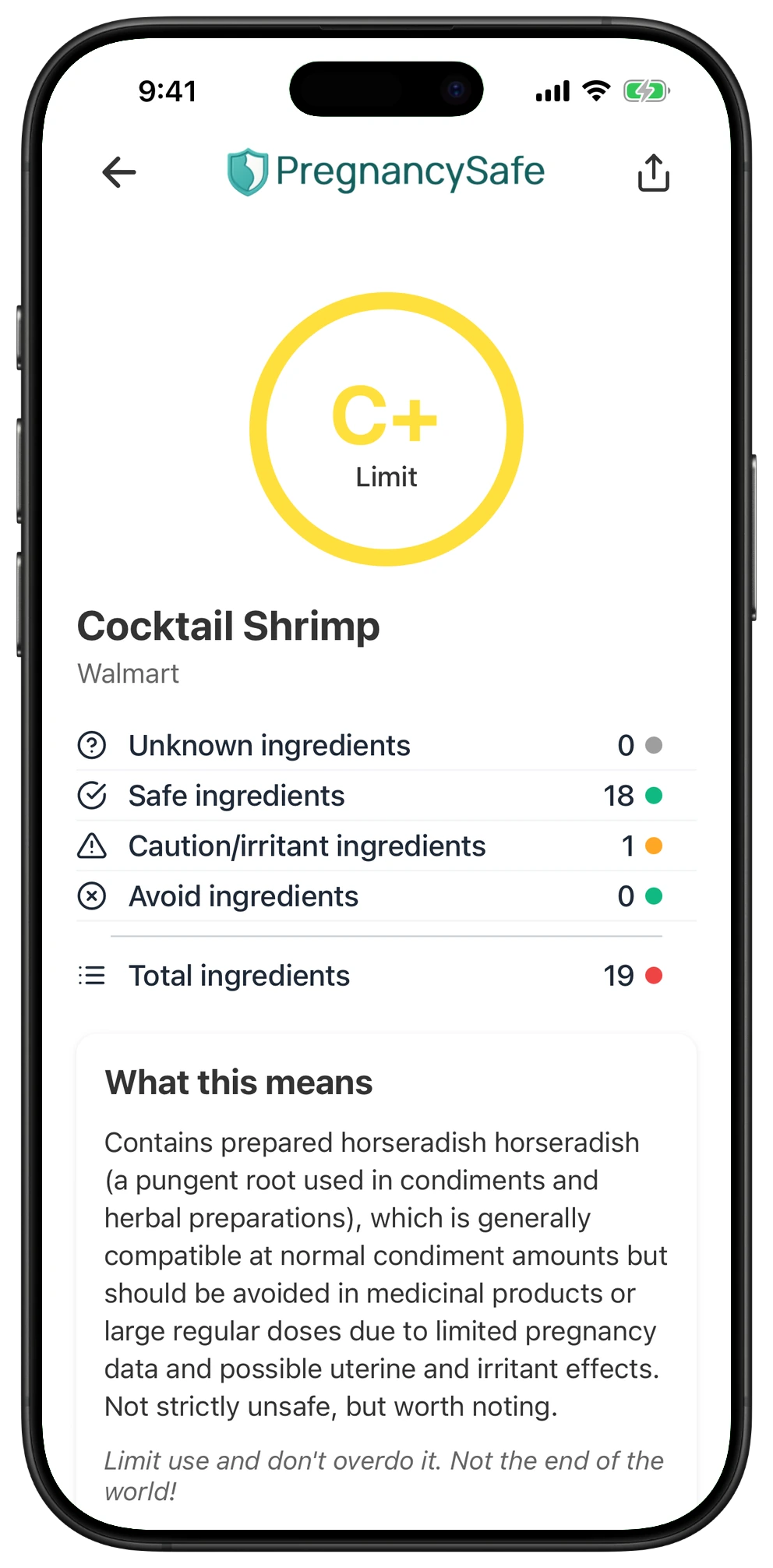
prepared horseradish horseradish
Caution
Prepared horseradish is a spicy, tangy condiment made from grated horseradish root mixed with vinegar and salt.
Is generally compatible at normal condiment amounts but should be avoided in medicinal products or large regular doses due to limited pregnancy data and possible uterine and irritant effects.
Flagged in 15 of 1,350 products (1%)
alcohol
Caution
Alcohol is a volatile, colorless liquid commonly used as a solvent, disinfectant, or intoxicating beverage.
No amount of Alcohol is considered safe. Avoid alcohol beverages entirely. Be extremely careful when using in cooking or even with small percentages.
Flagged in 14 of 1,350 products (1%)
Caution
Red 40 is a synthetic food dye commonly used to add vibrant red color to candies, beverages, and processed foods.
Has limited human pregnancy data and is allowed at regulated food additive levels, but child neurobehavior concerns and high dose animal findings make frequent high dye intake worth limiting.
Flagged in 8 of 1,350 products (1%)
hydrogenated cottonseed oil
Caution
Hydrogenated cottonseed oil is a processed vegetable oil made from cottonseed oil that has been chemically altered to become solid at room temperature, often used in processed foods.
Mainly raise concern when partially hydrogenated and high in artificial trans fat; fully hydrogenated oils are mostly a saturated fat limit rather than the same trans fat issue.
Flagged in 7 of 1,350 products (1%)
Seafood Products We've Analyzed
Our catalog contains ratings for 1,350 seafood products. These are database grades, not independent safety certifications.
Catalog ingredient grades do not measure current-label completeness, pathogens, preparation, caffeine or clinical pregnancy suitability. These counts include unreviewed records and are not a percentage of independently verified safe products.
Pregnancy Safe Seafood Products
Popular options from our catalog, prioritizing A and B ingredient grades, with C grade options used to fill remaining places. Within each group, products are ordered by searches in Pregnancy Safe, not retail sales. Read the cautions and guidance above; grades do not verify a complete current label or guarantee pregnancy safety.
| Grade | Product | Brand |
|---|---|---|
| B+ | Crispy Battered Calamari | Trader Joe'S |
| A | Large King Prawns | Sainsbury’S |
| A | Calamari Pieces In Olive Oil | Trader Joe'S |
| A | Citrus Herb Salmon | Sea Cuisine |
| A | Marinated King Prawns | M&S |
Your Questions Answered
How much seafood can I eat during pregnancy?
Aim for 8–12 ounces weekly from FDA Best Choices, usually 2–3 four ounce servings. Vary the species rather than relying on one type for every meal. This serving advice is not interchangeable across all seafood, so check the mercury category of the specific fish or shellfish you choose.
How do I choose lower mercury seafood?
Start with the actual species name rather than a broad description such as seafood or fish fillet. Check that species against FDA Best Choices when planning your 2–3 weekly servings. A mixed seafood dish needs the same attention to its component species. Cooking and an A ingredient grade do not establish a low mercury level.
Can I eat raw seafood if it is low in mercury?
No choose thoroughly cooked seafood during pregnancy. Low mercury addresses one concern, but raw or undercooked seafood still presents a pathogen risk. Follow cooking directions and cold storage precautions regardless of the species or ingredient grade.
Does an A grade mean seafood is safe during pregnancy?
No. Our catalog contains 1,350 seafood products, including 785 with an A ingredient grade, but these are not counts of independently verified safe products. Grades do not measure mercury, pathogens, doneness or current label completeness. A lower grade likewise does not prove that a product is harmful; check the actual ingredients, species and preparation.
Is horseradish in seafood cocktail sauce a concern?
Normal condiment amounts of horseradish are generally treated as culinary flavoring rather than a pregnancy hazard. That differs from medicinal preparations or large regular doses, which should be avoided during pregnancy. Prepared horseradish is a form of the same ingredient, not a separate pregnancy hazard. For the seafood itself, thorough cooking and appropriate cold storage remain important.
Should I avoid seafood sauces containing white wine or mirin?
Avoid drinking alcohol during pregnancy because no safe amount has been established. White wine or mirin in an ingredient list identifies an alcohol containing ingredient, but does not tell you the dose in a serving of the finished dish. Do not equate that listing with beverage level exposure or assume there is none. If the amount is unclear, choosing a dish prepared without added alcohol is a straightforward option.
How to Interpret These Ratings
Our ingredient and category rules generate letter grades from the information recorded in the catalog. Missing ingredients and broad category assignments can affect the result. These grades do not measure your dose, confirm a complete current label, or test a product for contamination.
A high grade is not a guarantee of pregnancy safety. A low grade is not, by itself, proof of harm from every use. Follow the product-specific guidance above, check the actual package, and ask your prenatal clinician about supplements, treatment decisions or uncertain exposures.
People Also Checked
References
- https://www.fda.gov/food/consumers/advice-about-eating-fish
- https://www.fda.gov/food/people-risk-foodborne-illness/cooking-food-safety-moms-be
- https://www.cdc.gov/listeria/prevention/index.html
- https://hfpappexternal.fda.gov/scripts/fdcc/index.cfm?id=SODIUMNITRITE&set=FoodSubstances
- https://www.ecfr.gov/current/title-9/section-424.21
- https://www.ecfr.gov/current/title-21/section-172.175
- https://www.efsa.europa.eu/en/press/news/170615
- https://www.inchem.org/documents/jecfa/jecmono/v50je07.htm
- https://pubmed.ncbi.nlm.nih.gov/41248583/
- https://www.cdc.gov/food-safety/foods/pregnant-women.html
- https://publications.iarc.who.int/Book-And-Report-Series/Iarc-Monographs-On-The-Identification-Of-Carcinogenic-Hazards-To-Humans/Red-Meat-And-Processed-Meat-2018
- https://dailymed.nlm.nih.gov/dailymed/drugInfo.cfm?setid=52f01c6e-172a-47a9-98a6-9eab7651a032
- https://www.atsdr.cdc.gov/toxprofiles/tp204.pdf
- https://webprod.hc-sc.gc.ca/nhpid-bdipsn/atReq?atid=horseradish.raifort&lang=eng
- https://inchem.org/documents/jecfa/jeceval/jec_71.htm
- https://hfpappexternal.fda.gov/scripts/fdcc/index.cfm?id=ALLYLISOTHIOCYANATE&set=FoodSubstances
- https://pmc.ncbi.nlm.nih.gov/articles/PMC13085108/
- https://pubmed.ncbi.nlm.nih.gov/22129740/
- https://www.drugs.com/npp/horseradish.html
- https://cdn.realfood.gov/DGA.pdf
- https://www.dietaryguidelines.gov/sites/default/files/2021-12/DGA_Pregnancy_FactSheet-508c.pdf
- https://www.acog.org/womens-health/faqs/healthy-eating-during-pregnancy
- https://www.cdc.gov/nutrition/php/data-research/added-sugars.html
- https://www.cdc.gov/diabetes/about/gestational-diabetes.html
- https://www.who.int/publications/i/item/9789241549028
- https://nesr.usda.gov/2025-dietary-guidelines-advisory-committee-systematic-reviews/dietary-patterns_gestational-diabetes
- https://www.cdc.gov/alcohol-pregnancy/about/index.html
- https://www.cdc.gov/fasd/about/index.html
- https://www.acog.org/womens-health/infographics/alcohol-and-pregnancy
- https://www.niaaa.nih.gov/publications/brochures-and-fact-sheets/alcohol-and-your-pregnancy
- https://mothertobaby.org/fact-sheets/alcohol-pregnancy/
- https://pubmed.ncbi.nlm.nih.gov/26482673/
- https://pmc.ncbi.nlm.nih.gov/articles/PMC9543418/
- https://www.hfpappexternal.fda.gov/scripts/fdcc/index.cfm?id=FDCRed40&set=ColorAdditives
- https://www.ecfr.gov/current/title-21/chapter-I/subchapter-A/part-74/subpart-A/section-74.340
- https://www.fda.gov/food/color-additives-information-consumers/tracking-food-industry-pledges-remove-petroleum-based-food-dyes
- https://www.efsa.europa.eu/en/efsajournal/pub/1327
- https://www.efsa.europa.eu/en/efsajournal/pub/4007
- https://apps.who.int/food-additives-contaminants-jecfa-database/Home/Chemical/2361
- https://oehha.ca.gov/risk-assessment/report/health-effects-assessment-potential-neurobehavioral-effects-synthetic-food-dyes-children
- https://pubmed.ncbi.nlm.nih.gov/6636206/
- https://pubmed.ncbi.nlm.nih.gov/2613118/
- https://pubmed.ncbi.nlm.nih.gov/7940558/
- https://www.fda.gov/food/food-additives-petitions/trans-fat
- https://www.fda.gov/food/hfp-constituent-updates/fda-completes-final-administrative-actions-partially-hydrogenated-oils-foods
- https://www.federalregister.gov/documents/2013/11/08/2013-26854/tentative-determination-regarding-partially-hydrogenated-oils-request-for-comments-and-for
- https://www.who.int/news-room/fact-sheets/detail/trans-fat
- https://www.fda.gov/food/people-risk-foodborne-illness/dietary-advice-and-during-pregnancy
- https://www.rcpi.ie/Portals/0/Document%20Repository/Institute%20of%20Obstetricians%20and%20Gynaecologists/National%20Clinical%20Guidelines/IOG_National%20Clinical%20Guidelines_Nutrition%20in%20pregnancy%20Guideline_2019.pdf
- https://pmc.ncbi.nlm.nih.gov/articles/PMC8027310/
- https://pmc.ncbi.nlm.nih.gov/articles/PMC3192475/