Is Scallops Safe During Pregnancy? (Updated 2026 Guide)
Updated September 9, 2026
The Answer
Yes you can eat thoroughly cooked scallops during pregnancy; they are a lower mercury seafood choice. Avoid raw or undercooked scallops, and cook them to 145°F with an opaque, firm center.
The main pregnancy concern is foodborne illness from raw or undercooked scallops, not their mercury level, so proper cooking and cold storage matter more than an ingredient grade. Include cooked scallops within 8–12 ounces of varied lower mercury seafood weekly. Prepared versions can introduce additional considerations, such as high iodine intake from frequent kombu consumption or partially hydrogenated oils; an ingredient flag alone does not establish harm from an ordinary serving.
Pregnancy Safe is 100% independent and research driven. No companies pay to promote or sponsor products.
Stress Less This Pregnancy
Check your exact scallops in the app
✓ What's Safe
- • Cook scallops to 145°F, checking the center rather than judging doneness by a browned exterior; the flesh should be opaque and firm.
- • Choose refrigerated or frozen scallops from a source that keeps seafood properly cold, and follow the package storage instructions.
- • Plan scallops as part of 8–12 ounces of lower mercury seafood per week, usually two to three four ounce servings, varying your seafood choices.
- • Choose plain scallops when you want control over added sauces, seasonings and cooking fats; check the full label on prepared versions.
- • At restaurants, ask for scallops cooked all the way through and confirm the ingredients in sauces or seaweed toppings.
✗ What to Avoid
- • Avoid raw scallops in sushi, sashimi or ceviche during pregnancy.
- • Avoid scallops that are only seared outside and remain raw or translucent in the center.
- • Avoid seafood with uncertain refrigeration or handling, and keep raw scallops and their juices away from ready to eat food.
- • Avoid treating an A grade, a low mercury designation or a wild caught claim as proof that scallops are safe to eat raw.
- • Avoid making concentrated kombu or kelp accompaniments a frequent, high intake habit; their iodine content can be very high and variable.
- • For a preparation without added alcohol, avoid sherry wine sauces and request an alternative; an ingredient listing does not reveal the alcohol remaining in your serving.
Most Common Ingredients in Scallops Products
We analyzed 112 scallops products. Here are the most common ingredients, ranked by how often they appear:
Ingredients to Watch Out For in Scallops
These are the most common flagged ingredients across 112 scallops products we analyzed.
bht
Caution
BHT (butylated hydroxytoluene) is a synthetic antioxidant commonly used as a preservative to prevent the oxidation of fats and oils in food products.
Has limited human pregnancy data, with low concern at reviewed cosmetic levels but reproductive and thyroid related findings in high dose oral animal studies.
Flagged in 1 of 112 products (1%)
kombu seaweed
Caution
Kombu seaweed is a nutrient rich, dark green kelp commonly used in Japanese cuisine to enhance umami flavor and make broths.
Can contain highly variable iodine, with high dose brown seaweed or kelp products and hijiki arsenic exposure requiring caution in pregnancy.
Flagged in 1 of 112 products (1%)
leavening sodium aluminum phosphate
Caution
Sodium aluminum phosphate is a leavening agent commonly used in baking to produce carbon dioxide and help baked goods rise.
Has developmental concern at higher chronic exposures, but regulated vaccine adjuvants and occasional clinician directed antacid use should be considered separately.
Flagged in 1 of 112 products (1%)
liquid margarine liquid and partially hydrogenated soybean oil
Caution
Liquid margarine made from liquid and partially hydrogenated soybean oil, commonly used as a butter substitute in cooking and baking.
Mainly raise concern when partially hydrogenated and high in artificial trans fat; fully hydrogenated oils are mostly a saturated fat limit rather than the same trans fat issue.
Flagged in 1 of 112 products (1%)
seaweed sprinkle seasoning bonito flakes dried tuna
Caution
A savory seasoning blend of dried seaweed, crunchy bonito flakes, and dried tuna, adding umami flavor to dishes.
Can contain highly variable iodine, with high dose brown seaweed or kelp products and hijiki arsenic exposure requiring caution in pregnancy.
Flagged in 1 of 112 products (1%)
sherry wine
Avoid
Sherry wine is a fortified Spanish wine known for its rich, nutty flavor and versatility in cooking and sipping.
Has no established safe amount in pregnancy and is linked to fetal alcohol spectrum disorders and other adverse pregnancy outcomes.
Flagged in 1 of 112 products (1%)
Scallops Products We've Analyzed
Our catalog contains ratings for 112 scallops products. These are database grades, not independent safety certifications.
Catalog ingredient grades do not measure current-label completeness, pathogens, preparation, caffeine or clinical pregnancy suitability. These counts include unreviewed records and are not a percentage of independently verified safe products.
Pregnancy Safe Scallops Products
Popular options from our catalog, prioritizing A and B ingredient grades, with C grade options used to fill remaining places. Within each group, products are ordered by searches in Pregnancy Safe, not retail sales. Read the cautions and guidance above; grades do not verify a complete current label or guarantee pregnancy safety.
| Grade | Product | Brand |
|---|---|---|
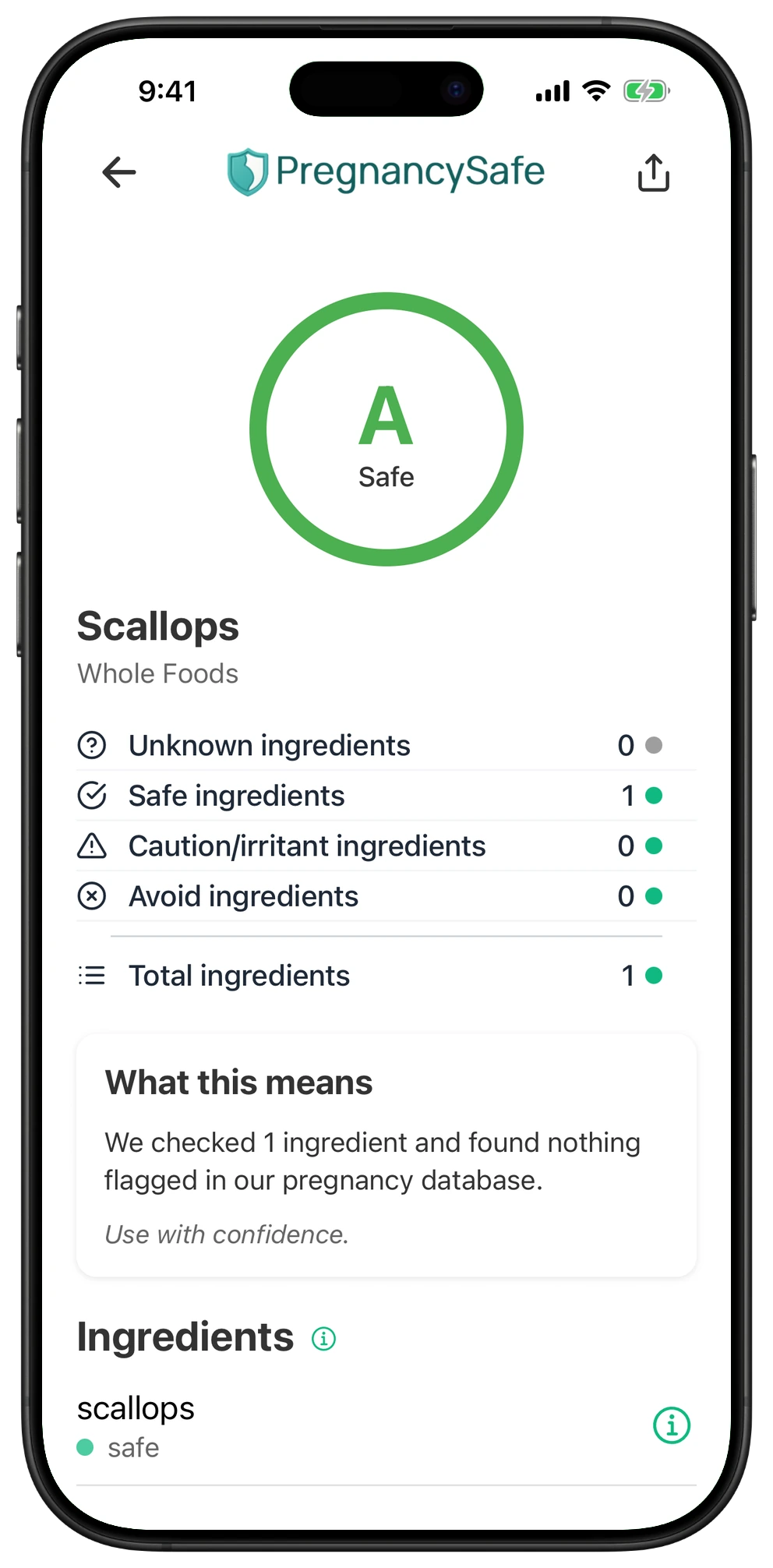
| A | Scallops | Whole Foods |
| A | Large Sea Scallops | — |
| A | Bay Scallops | Neptune |
| A | Sea Scallops | Heinen'S |
| A | Bay Scallops | Heinen'S |
Your Questions Answered
Is it safe to eat scallops while pregnant?
Yes, provided they are thoroughly cooked and properly handled. Scallops are a lower mercury Best Choice and can be included in your weekly seafood intake. Avoid raw or undercooked scallops even if they are fresh, expensive or highly graded.
Can I eat seared scallops during pregnancy?
Yes, if searing cooks them all the way through. A browned crust does not tell you whether the center is cooked. Aim for 145°F with opaque, firm flesh, and ask restaurants not to serve them rare.
How much scallop meat can I eat while pregnant?
Count scallops toward the recommended 8–12 ounces of lower mercury seafood each week. That is usually two to three four ounce servings across your seafood choices, not an additional allowance for scallops. Vary the species you eat rather than relying on scallops for every seafood meal.
Are scallops high in mercury?
No scallops are classified as a lower mercury Best Choice. That makes them an option within pregnancy seafood guidance, but it does not remove the need for thorough cooking. If your meal contains other seafood, consider those species separately rather than assuming the whole dish has the same mercury profile.
Are breaded or seasoned scallops safe during pregnancy?
They can be an option when thoroughly cooked, but check the complete label because coatings and sauces add ingredients not present in plain scallop meat. Prefer cooking fats without partially hydrogenated oils, and consider the amount and frequency of kombu containing accompaniments because iodine levels can be high. Flags for BHT or sodium aluminum phosphate do not establish pregnancy harm from a normal serving: the cited concerns involve limited human evidence or higher exposures. A plain scallop listing does not establish the suitability of a breaded or seasoned version.
Does an A grade mean scallops are guaranteed safe during pregnancy?
No ingredient grades do not assess pathogens, storage conditions or whether the scallops are cooked through. Our catalog contains 112 products, including 72 with an A grade, but these are not counts of independently verified safe products. Check your current package and preparation instructions regardless of grade. A lower grade or incomplete record also does not, by itself, prove that a product is harmful.
How to Interpret These Ratings
Our ingredient and category rules generate letter grades from the information recorded in the catalog. Missing ingredients and broad category assignments can affect the result. These grades do not measure your dose, confirm a complete current label, or test a product for contamination.
A high grade is not a guarantee of pregnancy safety. A low grade is not, by itself, proof of harm from every use. Follow the product-specific guidance above, check the actual package, and ask your prenatal clinician about supplements, treatment decisions or uncertain exposures.
People Also Checked
References
- https://www.fda.gov/food/people-risk-foodborne-illness/eating-out-bringing-food-safety-moms-be
- https://www.fda.gov/food/consumers/advice-about-eating-fish
- https://www.fda.gov/food/people-risk-foodborne-illness/cooking-food-safety-moms-be
- https://www.cdc.gov/listeria/prevention/index.html
- https://health.ec.europa.eu/system/files/2022-08/sccs_o_257.pdf
- https://pubmed.ncbi.nlm.nih.gov/37751543/
- https://pubmed.ncbi.nlm.nih.gov/12396675/
- https://pmc.ncbi.nlm.nih.gov/articles/PMC13151845/
- https://www.ecfr.gov/current/title-21/chapter-I/subchapter-B/part-172/subpart-B/section-172.115
- https://www.ecfr.gov/current/title-21/chapter-I/subchapter-B/part-182/subpart-D/section-182.3173
- https://www.fda.gov/news-events/press-announcements/fda-finalizes-food-chemical-safety-post-market-assessment-program-launches-reassessment-bht-ada
- https://journals.sagepub.com/doi/10.1177/10507256261445624
- https://ods.od.nih.gov/factsheets/Iodine-HealthProfessional/
- https://www.foodstandards.gov.au/consumer/nutrition/pregnancy/iodine-and-pregnancy
- https://www.foodstandards.gov.au/consumer/prevention-of-foodborne-illness/arseniciodine
- https://inspection.canada.ca/en/food-safety-consumers/fact-sheets/specific-products-and-risks/chemical-hazards/inorganic-arsenic
- https://pubmed.ncbi.nlm.nih.gov/35947162/
- https://pubmed.ncbi.nlm.nih.gov/20919974/
- https://pubmed.ncbi.nlm.nih.gov/30632947/
- https://pmc.ncbi.nlm.nih.gov/articles/PMC8077470/
- https://wwwn.cdc.gov/TSP/ToxProfiles/ToxProfiles.aspx?id=191&tid=34
- https://pmc.ncbi.nlm.nih.gov/articles/PMC9681673/
- https://pmc.ncbi.nlm.nih.gov/articles/PMC10809980/
- https://www.cdc.gov/vaccine-safety/about/adjuvants.html
- https://www.fda.gov/vaccines-blood-biologics/safety-availability-biologics/common-ingredients-fda-approved-vaccines
- https://www.acog.org/womens-health/infographics/vaccines-during-pregnancy
- https://www.fda.gov/food/food-additives-petitions/trans-fat
- https://www.fda.gov/food/hfp-constituent-updates/fda-completes-final-administrative-actions-partially-hydrogenated-oils-foods
- https://www.federalregister.gov/documents/2013/11/08/2013-26854/tentative-determination-regarding-partially-hydrogenated-oils-request-for-comments-and-for
- https://www.who.int/news-room/fact-sheets/detail/trans-fat
- https://cdn.realfood.gov/DGA.pdf
- https://www.fda.gov/food/people-risk-foodborne-illness/dietary-advice-and-during-pregnancy
- https://www.rcpi.ie/Portals/0/Document%20Repository/Institute%20of%20Obstetricians%20and%20Gynaecologists/National%20Clinical%20Guidelines/IOG_National%20Clinical%20Guidelines_Nutrition%20in%20pregnancy%20Guideline_2019.pdf
- https://pmc.ncbi.nlm.nih.gov/articles/PMC8027310/
- https://pmc.ncbi.nlm.nih.gov/articles/PMC3192475/
- https://www.cdc.gov/alcohol-pregnancy/about/index.html
- https://www.cdc.gov/fasd/about/index.html
- https://www.acog.org/womens-health/infographics/alcohol-and-pregnancy
- https://www.niaaa.nih.gov/publications/brochures-and-fact-sheets/alcohol-and-your-pregnancy
- https://mothertobaby.org/fact-sheets/alcohol-pregnancy/
- https://pubmed.ncbi.nlm.nih.gov/26482673/
- https://pmc.ncbi.nlm.nih.gov/articles/PMC9543418/