Is Shrimp Safe During Pregnancy? (Updated 2026 Guide)
Updated September 9, 2026
The Answer
Yes shrimp can be eaten during pregnancy when thoroughly cooked and safely handled, provided you do not have a shrimp allergy. Include it within 8–12 ounces of varied lower mercury seafood per week, rather than adding that amount on top of other seafood.
For shrimp, thorough cooking and safe cold storage are key: low mercury does not protect you from pathogens in raw, undercooked or poorly handled seafood. Ingredient cautions also depend on the amount and form consumed ordinary horseradish condiment portions are different from medicinal preparations or large regular doses. Catalog ingredient grades cannot establish doneness, contamination status or pregnancy suitability.
Pregnancy Safe is 100% independent and research driven. No companies pay to promote or sponsor products.
Stress Less This Pregnancy
Check your exact shrimp in the app

✓ What's Safe
- • Check whether the package says raw or fully cooked, and follow its preparation directions.
- • Choose thoroughly cooked shrimp; when eating out, ask whether the shrimp is fully cooked.
- • Keep shrimp chilled or frozen as the label directs, including products sold fully cooked.
- • Count shrimp toward 8–12 ounces of varied lower mercury seafood weekly, usually two to three four ounce servings.
- • Read the actual package’s full ingredient and allergen information, including any coating or accompanying sauce.
✗ What to Avoid
- • Avoid eating raw or undercooked shrimp, even if it has a favorable ingredient grade.
- • Skip buffet shrimp or shrimp cocktail when you cannot establish that it has been kept properly chilled.
- • Do not treat frozen, fully cooked or ready to eat shrimp as sterile or exempt from storage precautions.
- • Avoid shrimp if you have a shrimp allergy, and check sauces and coatings for other allergens you need to avoid.
- • Avoid medicinal horseradish preparations or large regular doses during pregnancy; this is not a reason to exclude ordinary condiment portions.
Most Common Ingredients in Shrimp Products
We analyzed 1,658 shrimp products. Here are the most common ingredients, ranked by how often they appear:
Ingredients to Watch Out For in Shrimp
These are the most common flagged ingredients across 1,658 shrimp products we analyzed.
horseradish
Caution
Horseradish is a pungent root vegetable known for its sharp, spicy flavor often used to add heat to sauces and condiments.
Is generally compatible at normal condiment amounts but should be avoided in medicinal products or large regular doses due to limited pregnancy data and possible uterine and irritant effects.
Flagged in 23 of 1,658 products (1%)
prepared horseradish horseradish
Caution
Prepared horseradish is a spicy, tangy condiment made from grated horseradish root mixed with vinegar and salt.
Is generally compatible at normal condiment amounts but should be avoided in medicinal products or large regular doses due to limited pregnancy data and possible uterine and irritant effects.
Flagged in 17 of 1,658 products (1%)
Caution
Red 40 is a synthetic food dye commonly used to add vibrant red color to candies, beverages, and processed foods.
Has limited human pregnancy data and is allowed at regulated food additive levels, but child neurobehavior concerns and high dose animal findings make frequent high dye intake worth limiting.
Flagged in 10 of 1,658 products (1%)
horseradish flavor
Caution
A pungent, spicy flavor with a sharp, tangy heat reminiscent of fresh horseradish root.
Is generally compatible at normal condiment amounts but should be avoided in medicinal products or large regular doses due to limited pregnancy data and possible uterine and irritant effects.
Flagged in 8 of 1,658 products (0%)
horseradish horseradish
Caution
Horseradish is a pungent root vegetable known for its spicy, tangy flavor often used to add heat to sauces and condiments.
Is generally compatible at normal condiment amounts but should be avoided in medicinal products or large regular doses due to limited pregnancy data and possible uterine and irritant effects.
Flagged in 6 of 1,658 products (0%)
prepared horseradish
Caution
Prepared horseradish is a spicy, tangy condiment made from grated horseradish root mixed with vinegar and salt.
Is generally compatible at normal condiment amounts but should be avoided in medicinal products or large regular doses due to limited pregnancy data and possible uterine and irritant effects.
Flagged in 6 of 1,658 products (0%)
sodium aluminum phosphate
Caution
Sodium aluminum phosphate is a leavening agent commonly used in baked goods to produce carbon dioxide and help the dough or batter rise.
Has developmental concern at higher chronic exposures, but regulated vaccine adjuvants and occasional clinician directed antacid use should be considered separately.
Flagged in 6 of 1,658 products (0%)
artificial horseradish flavor
Caution
Artificial horseradish flavor is a synthetic seasoning that mimics the spicy, pungent taste of natural horseradish.
Is generally compatible at normal condiment amounts but should be avoided in medicinal products or large regular doses due to limited pregnancy data and possible uterine and irritant effects.
Flagged in 4 of 1,658 products (0%)
Shrimp Products We've Analyzed
Our catalog contains ratings for 1,658 shrimp products. These are database grades, not independent safety certifications.
Catalog ingredient grades do not measure current-label completeness, pathogens, preparation, caffeine or clinical pregnancy suitability. These counts include unreviewed records and are not a percentage of independently verified safe products.
Pregnancy Safe Shrimp Products
Popular options from our catalog, prioritizing A and B ingredient grades, with C grade options used to fill remaining places. Within each group, products are ordered by searches in Pregnancy Safe, not retail sales. Read the cautions and guidance above; grades do not verify a complete current label or guarantee pregnancy safety.
| Grade | Product | Brand |
|---|---|---|
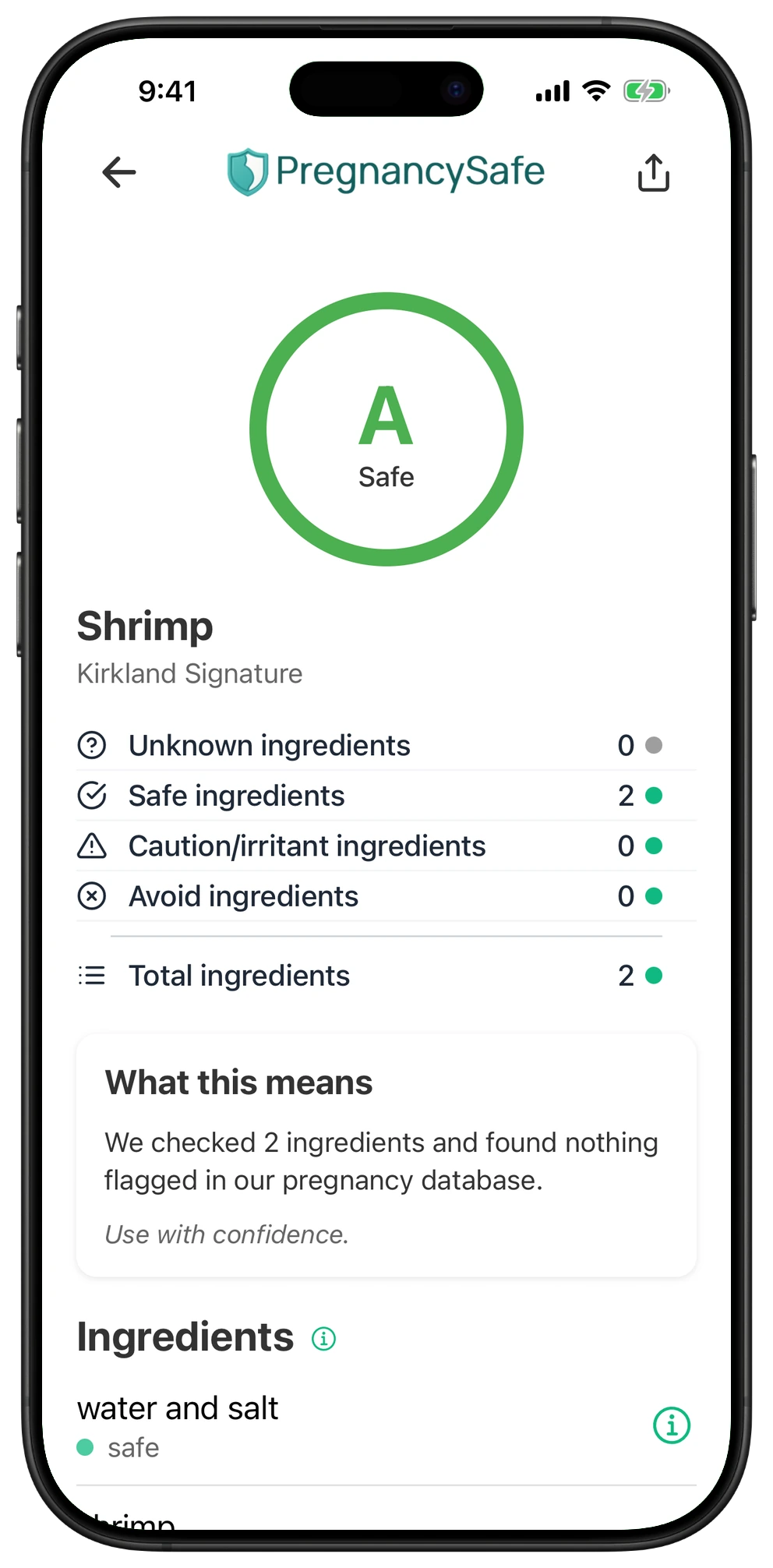
| A | Shrimp | Kirkland Signature |
| A | Trader Joe'S Raw Argentinian Red Shrimp | Trader Joe'S |
| B+ | Cooked Shrimp Extra Large | The Kroger Co. |
| A | Frozen Raw Shrimp 31/40 Sand Bar Bag | Sand Bar |
| A | Private Selection Wild Caught Extra Large Raw Argentine Red Shrimp Peeled & Deveined | Private Selection |
Your Questions Answered
Is cooked shrimp high in mercury?
Shrimp is a lower mercury seafood choice that can fit into pregnancy seafood guidance. Include it within 8–12 ounces of varied lower mercury seafood each week. Its low mercury level does not remove the need for thorough cooking and safe storage.
Does shrimp’s low mercury level mean I can eat it raw?
No mercury and foodborne pathogens are separate concerns. Raw or undercooked shrimp can pose a pathogen risk even when mercury is low. Choose thoroughly cooked shrimp, and do not use an A ingredient grade as evidence that raw shrimp is safe to eat.
How much shrimp can I eat during pregnancy?
Count shrimp toward the recommended 8–12 ounces of lower mercury seafood per week, usually two to three four ounce servings. That amount covers your combined seafood intake, not shrimp in addition to other seafood. Vary your seafood choices rather than relying on shrimp alone.
Can I eat cold shrimp cocktail while pregnant?
Shrimp cocktail can fit these precautions if the shrimp is thoroughly cooked and kept properly chilled. Serving it cold is not the same as serving it raw. Skip it when buffet or serving conditions make its handling uncertain, and follow the package’s storage directions.
Is frozen shrimp safe during pregnancy?
Frozen shrimp can be an option, but check whether it is raw or fully cooked. Raw frozen shrimp still needs thorough cooking before you eat it. Keep it frozen or chilled as directed, and remember that freezing or a fully cooked label does not make it sterile.
Should I avoid cocktail sauce containing horseradish?
Ordinary condiment amounts of horseradish are generally compatible with pregnancy guidance. The concern applies to medicinal oral preparations or large regular doses, where pregnancy evidence is limited and possible uterine and irritant effects are cited. A horseradish ingredient flag does not establish that a normal serving of cocktail sauce is harmful.
Does an A grade mean a shrimp product is safe during pregnancy?
No an ingredient grade does not assess pathogens, doneness, storage or the completeness of the current label. Our catalog contains 1,658 shrimp products, including 608 graded A, but these are not counts of independently verified pregnancy safe products. A lower grade is not, by itself, proof that a product is harmful either. Check the actual package and prioritize cooking, handling and allergen precautions.
How to Interpret These Ratings
Our ingredient and category rules generate letter grades from the information recorded in the catalog. Missing ingredients and broad category assignments can affect the result. These grades do not measure your dose, confirm a complete current label, or test a product for contamination.
A high grade is not a guarantee of pregnancy safety. A low grade is not, by itself, proof of harm from every use. Follow the product-specific guidance above, check the actual package, and ask your prenatal clinician about supplements, treatment decisions or uncertain exposures.
People Also Checked
References
- https://www.fda.gov/food/consumers/advice-about-eating-fish
- https://www.fda.gov/food/people-risk-foodborne-illness/cooking-food-safety-moms-be
- https://www.cdc.gov/listeria/prevention/index.html
- https://webprod.hc-sc.gc.ca/nhpid-bdipsn/atReq?atid=horseradish.raifort&lang=eng
- https://inchem.org/documents/jecfa/jeceval/jec_71.htm
- https://hfpappexternal.fda.gov/scripts/fdcc/index.cfm?id=ALLYLISOTHIOCYANATE&set=FoodSubstances
- https://pmc.ncbi.nlm.nih.gov/articles/PMC13085108/
- https://pubmed.ncbi.nlm.nih.gov/22129740/
- https://www.drugs.com/npp/horseradish.html
- https://www.hfpappexternal.fda.gov/scripts/fdcc/index.cfm?id=FDCRed40&set=ColorAdditives
- https://www.ecfr.gov/current/title-21/chapter-I/subchapter-A/part-74/subpart-A/section-74.340
- https://www.fda.gov/food/color-additives-information-consumers/tracking-food-industry-pledges-remove-petroleum-based-food-dyes
- https://www.efsa.europa.eu/en/efsajournal/pub/1327
- https://www.efsa.europa.eu/en/efsajournal/pub/4007
- https://apps.who.int/food-additives-contaminants-jecfa-database/Home/Chemical/2361
- https://oehha.ca.gov/risk-assessment/report/health-effects-assessment-potential-neurobehavioral-effects-synthetic-food-dyes-children
- https://pubmed.ncbi.nlm.nih.gov/6636206/
- https://pubmed.ncbi.nlm.nih.gov/2613118/
- https://pubmed.ncbi.nlm.nih.gov/7940558/
- https://wwwn.cdc.gov/TSP/ToxProfiles/ToxProfiles.aspx?id=191&tid=34
- https://pmc.ncbi.nlm.nih.gov/articles/PMC9681673/
- https://pmc.ncbi.nlm.nih.gov/articles/PMC10809980/
- https://www.cdc.gov/vaccine-safety/about/adjuvants.html
- https://www.fda.gov/vaccines-blood-biologics/safety-availability-biologics/common-ingredients-fda-approved-vaccines
- https://www.acog.org/womens-health/infographics/vaccines-during-pregnancy