Is Canada Dry Zero Sugar Ginger Ale Safe During Pregnancy? (Updated 2026 Guide)
Updated September 8, 2026
Canada Dry Zero Sugar Ginger Ale
Canada Dry
Canada Dry Zero Sugar Ginger Ale is generally a reasonable occasional drink during pregnancy, with a B+ ingredient based grade. Aspartame and sodium benzoate are rated likely safe at ordinary food use levels, rather than identified as pregnancy hazards; if you have phenylketonuria (PKU), its aspartame requires avoidance or restriction under your care plan.
Go ahead and use it. Nothing to worry about here.
Pregnancy Safe is 100% independent and research driven. No companies pay to promote or sponsor products.
Stress Less This Pregnancy
Check your soda in the app

What Ingredients Are in Canada Dry Zero Sugar Ginger Ale?
Canada Dry Zero Sugar Ginger Ale has 11 ingredients. All 11 ingredients are considered safe or likely safe for pregnancy.
aspartame
LIKELY SAFE
Aspartame is a low calorie artificial sweetener commonly used to sweeten foods and beverages. Aspartame is considered acceptable during pregnancy within established intake limits for most people, but you must avoid or restrict it if you have PKU.
sodium benzoate
LIKELY SAFE
Sodium benzoate is a preservative commonly used to inhibit microbial growth in food and beverage products. Sodium benzoate is generally low concern during pregnancy at regulated food levels despite limited direct human data, and high dose animal findings do not establish harm from ordinary soda intake.
acesulfame potassium
SAFE
Acesulfame potassium is a calorie free artificial sweetener commonly used to enhance the sweetness of food and beverages. The pregnancy evidence attached to this ingredient concerns dietary potassium, not acesulfame potassium itself, so it does not establish sweetener specific safety.
calcium disodium edta
SAFE
Calcium disodium EDTA is a chelating agent used to bind and remove metal ions, often as a preservative or stabilizer in food and pharmaceutical products. The pregnancy evidence attached to this ingredient concerns nutritional calcium, not calcium disodium EDTA, so it does not establish this additive's safety or nutritional benefit.
carbonated water
SAFE
Carbonated water is water infused with carbon dioxide gas, creating a fizzy, bubbly sensation. Water from a safe drinking source supports pregnancy hydration, although the evidence here addresses drinking water rather than carbonation specifically.
citric acid
SAFE
Citric acid is a natural organic acid commonly used as a preservative and flavor enhancer in food and beverages. Citric acid is generally compatible with pregnancy at ordinary food amounts, though acidic drinks may worsen reflux or dental irritation.
ginger extract
SAFE
Ginger extract is a concentrated form of ginger root known for its anti inflammatory, antioxidant, and digestive health benefits. Food level ginger is generally compatible with pregnancy, but this drink's unspecified extract amount should not be equated with studied nausea doses or high dose supplements.
sodium citrate
SAFE
Sodium citrate is a salt commonly used as a food additive and buffering agent to regulate acidity and stabilize emulsions. Food additive evidence for citric acid and citrate salts supports low pregnancy concern for sodium citrate at ordinary dietary amounts.
caramel color
SAFE
Caramel color is a widely used food additive that imparts a rich, brown hue to beverages and processed foods. Caramel color is unflagged in this assessment, but no pregnancy specific evidence is available here to confirm its safety at beverage amounts.
malic acid
SAFE
Malic acid is a naturally occurring organic compound known for its tart flavor and commonly used as a food additive and pH regulator. Malic acid is unflagged in this assessment, but no pregnancy specific evidence is available here to confirm its safety at beverage amounts.
natural flavors
SAFE
Natural flavors are derived from plant or animal sources and used to enhance the taste of food and beverages. Natural flavors are unflagged, but their unspecified composition prevents an ingredient specific pregnancy assessment.
Answering Your Questions
How much Canada Dry Zero Sugar Ginger Ale is safe during pregnancy?
Start with a small glass rather than a large bottle, especially if acidic drinks bother your stomach. There is no established pregnancy specific serving limit for this product here, and its sweetener quantities are not available to calculate one.
Can you use Canada Dry Zero Sugar Ginger Ale daily while pregnant?
Treat it as an occasional drink rather than your main source of hydration, and choose water most often. Cut back if it worsens reflux or dental sensitivity.
Why does Canada Dry Zero Sugar Ginger Ale receive a B+ grade?
Its B+ comes from ingredient based scoring, with aspartame and sodium benzoate contributing likely safe ratings. Aspartame is acceptable within established intake limits for most people, while sodium benzoate is generally low concern at regulated food levels but has limited direct human pregnancy data. The grade does not mean every ingredient has been individually confirmed safe in pregnancy.
Can I drink it while breastfeeding?
The B+ grade assesses pregnancy, not breastfeeding, so it is not a separate breastfeeding safety clearance. If you plan to drink it regularly while nursing, ask your clinician about your intake and any relevant medical conditions; the aspartame restriction for PKU still matters.
What alternatives can I choose during pregnancy?
Plain water is a straightforward everyday choice. If you want fizz without sweeteners, consider plain sparkling water; if acidic drinks trigger reflux, choose still water instead. For another ginger ale, compare the actual ingredients rather than assuming all brands or variants have the same assessment.
How much caffeine is in Canada Dry Zero Sugar Ginger Ale?
Caffeine is not listed among the ingredients assessed for this product. Check your package for a caffeine free statement to confirm your particular formulation rather than relying on the ginger ale name alone.
Will this ginger ale help with pregnancy nausea?
Ginger has evidence of benefit for pregnancy nausea, but the amount of ginger extract in this soda is not specified. You should not assume a glass delivers a studied nausea treatment dose, even if you find it soothing.
Can I drink it in the first trimester?
The B+ assessment does not identify a separate first trimester restriction for ordinary beverage exposure. Occasional intake is generally reasonable, but the grade is not proof of trimester specific safety, and you should follow your care plan if you have PKU.
What Are Pregnancy Safe Alternatives to Canada Dry Zero Sugar Ginger Ale?
Here are some solid alternatives. Everything below has an A or B grade, meaning no flagged ingredients in our database.
| Grade | Product | Brand | Type |
|---|---|---|---|
| A | Poppi Cranberry Fizz Prebiotic Soda | Poppi | soda |
| A | Poppi Cherry Lime Prebiotic Soda - 4Pk/12 Fl Oz Cans | Poppi | soda |
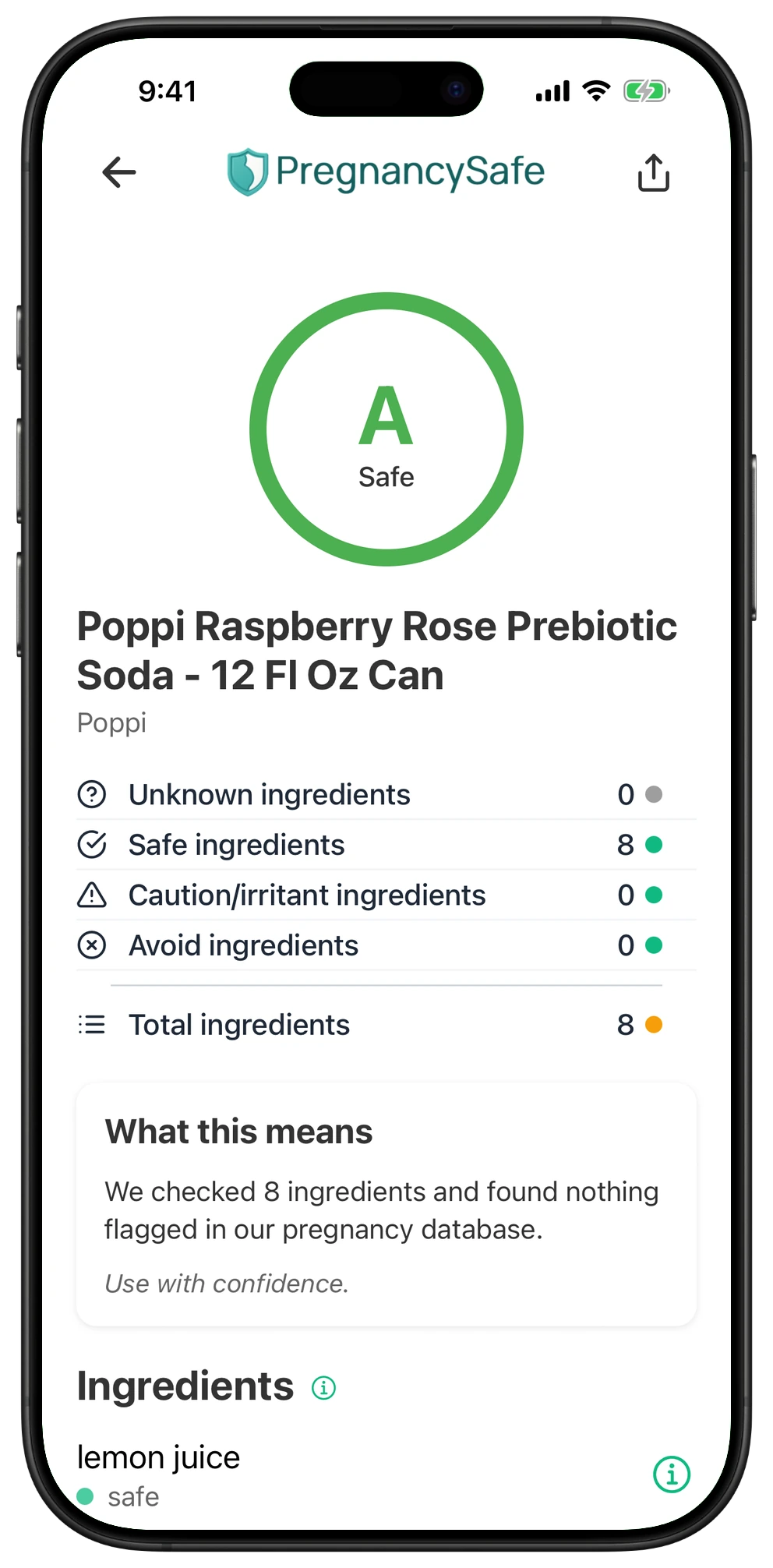
| A | Poppi Raspberry Rose Prebiotic Soda | Poppi | soda |
| B+ | Sprite Zero Lemon-Lime Soda 6Pk | Sprite Zero | soda |
Are Other Canada Dry Products Safe During Pregnancy?
We looked at 11 other Canada Dry products. 2 are pregnancy safe (A or B grade), while 9 need a closer look.
| Grade | Product | Type |
|---|---|---|
| C+ | Canada Dry Ginger Ale | soft drink |
| A | Pomegranate Cherry Sparkling Seltzer Water, Pomegranate; Cherry | sparkling water |
| A | Canada Dry Black Cherry Sparkling Seltzer Water 8 Pack | sparkling water |
| C- | Alex | — |
How Does Canada Dry Zero Sugar Ginger Ale Compare to Other Sodas?
We graded 3,107 Sodas for pregnancy safety. Here's how they stack up:
Canada Dry Zero Sugar Ginger Ale earns a B+ grade, placing it among the top of Sodas. Only 13% of products in this category get an A grade, so it pays to choose carefully.
How Do We Score Products for Pregnancy Safety?
We analyze each product's ingredients and category to flag known risks and provide cautionary notices for general category safety concerns.
A - Safe
Excellent choice! All ingredients are considered safe during pregnancy.
What to do: Use with confidence.
B - Likely Safe
Pretty much safe with very minimal risk. Some ingredients may have limited pregnancy studies, but no significant safety concerns have been identified.
What to do: Use with confidence.
C - Limit
Contains ingredients with some pregnancy considerations. Research shows these ingredients may have limited safety data, potential for minor hormonal effects, or require caution based on animal studies.
What to do: Use sparingly and consider safer alternatives when available.
D - Caution
Similar to C grade but contains multiple cautionary ingredients. The combination increases overall concern.
What to do: Try to avoid if that makes you feel better. If you've already used it, no need to panic.
F - Avoid
Contains an ingredient Pregnancy Safe recommends avoiding during pregnancy. This may reflect an established risk or a precaution based on limited evidence; check the ingredient guidance and exposure context.
What to do: Do not use during pregnancy. If you've already used it, don't worry - contact your OBGYN if concerned.
People Also Checked
References
- https://www.fda.gov/food/food-additives-petitions/aspartame-and-other-sweeteners-food
- https://www.who.int/news/item/14-07-2023-aspartame-hazard-and-risk-assessment-results-released
- https://www.canada.ca/en/health-canada/services/food-nutrition/food-safety/food-additives/sugar-substitutes/aspartame-artificial-sweeteners.html
- https://www.nhs.uk/live-well/eat-well/food-types/are-sweeteners-safe/
- https://www.ecfr.gov/current/title-21/chapter-I/subchapter-B/part-184/subpart-B/section-184.1733
- https://apps.who.int/food-additives-contaminants-jecfa-database/Home/Chemical/1098
- https://www.inchem.org/documents/jecfa/jecmono/v83je01.pdf
- https://efsa.onlinelibrary.wiley.com/doi/10.2903/j.efsa.2016.4433
- https://www.fda.gov/food/environmental-contaminants-food/questions-and-answers-occurrence-benzene-soft-drinks-and-other-beverages
- https://pubmed.ncbi.nlm.nih.gov/29243541/
- https://ec.europa.eu/health/ph_risk/committees/04_sccp/docs/sccp_o_015.pdf
- https://ods.od.nih.gov/factsheets/Potassium-HealthProfessional/
- https://www.ncbi.nlm.nih.gov/books/NBK545428/
- https://wicworks.fns.usda.gov/resources/eye-nutrition-potassium
- https://www.fda.gov/food/nutrition-facts-label/daily-value-nutrition-and-supplement-facts-labels
- https://dailymed.nlm.nih.gov/dailymed/lookup.cfm?setid=41ff55cf-4af3-487e-bd78-09703d310780
- https://www.kidney.org/kidney-topics/hyperkalemia-high-potassium
- https://www.acog.org/womens-health/faqs/healthy-eating-during-pregnancy
- https://ods.od.nih.gov/factsheets/Pregnancy-HealthProfessional/
- https://ods.od.nih.gov/factsheets/Calcium-HealthProfessional/
- https://ods.od.nih.gov/factsheets/Iron-HealthProfessional/
- https://www.who.int/tools/elena/interventions/calcium-pregnancy
- https://www.ncbi.nlm.nih.gov/books/NBK56056/
- https://www.cochrane.org/evidence/CD001059_taking-calcium-supplements-during-pregnancy-effective-way-prevent-blood-pressure-disorders-and
- https://www.acog.org/womens-health/experts-and-stories/ask-acog/how-much-water-should-i-drink-during-pregnancy
- https://www.cdc.gov/healthy-weight-growth/water-healthy-drinks/index.html
- https://www.cdc.gov/heat-health/hcp/clinical-overview/heat-and-pregnant-women.html
- https://www.cdc.gov/drinking-water/about/index.html
- https://www.cdc.gov/yellow-book/hcp/family-travel/pregnant-travelers.html
- https://www.epa.gov/privatewells/protect-your-homes-water
- https://www.fda.gov/consumers/consumer-updates/bottled-water-everywhere-keeping-it-safe
- https://www.nationalacademies.org/read/10925/chapter/6
- https://hfpappexternal.fda.gov/scripts/fdcc/index.cfm?id=CITRICACID&set=FoodSubstances
- https://www.ecfr.gov/current/title-21/chapter-I/subchapter-B/part-184/subpart-B/section-184.1033
- https://apps.who.int/food-additives-contaminants-jecfa-database/chemical.aspx?chemID=3594
- https://www.inchem.org/documents/jecfa/jeceval/jec_436.htm
- https://pmc.ncbi.nlm.nih.gov/articles/PMC7448088/
- https://www.fao.org/fileadmin/user_upload/jecfa_additives/docs/monograph16/additive-135-m16.pdf
- https://journals.lww.com/greenjournal/fulltext/2018/01000/acog_practice_bulletin_no__189__nausea_and.39.aspx
- https://www.ncbi.nlm.nih.gov/books/NBK582731/
- https://pmc.ncbi.nlm.nih.gov/articles/PMC3995184/
- https://pubmed.ncbi.nlm.nih.gov/22706624/
- https://pmc.ncbi.nlm.nih.gov/articles/PMC5920415/