Is Ginger Ale Safe During Pregnancy? (Updated 2026 Guide)
Updated September 9, 2026
The Answer
Nonalcoholic ginger ale can generally fit into pregnancy in occasional food amounts; check caffeine and added sugar on the exact label. Our catalog contains 11 A graded entries among 20 products, but ingredient grades do not establish clinical pregnancy safety or verify current labels.
The main practical considerations are added sugar, any caffeine, and confirming that your drink is nonalcoholic not treating ordinary soda ingredients as evidence of fetal harm. Frequent sugar sweetened drinks warrant limiting, and caffeine should stay below 200 mg daily across all sources; concerns about blue 1 and red 40 reflect limited pregnancy evidence rather than proven fetal harm at ordinary food exposures. Ginger flavor does not establish a therapeutic ginger dose, and persistent vomiting or dehydration needs clinical advice.
Pregnancy Safe is 100% independent and research driven. No companies pay to promote or sponsor products.
Stress Less This Pregnancy
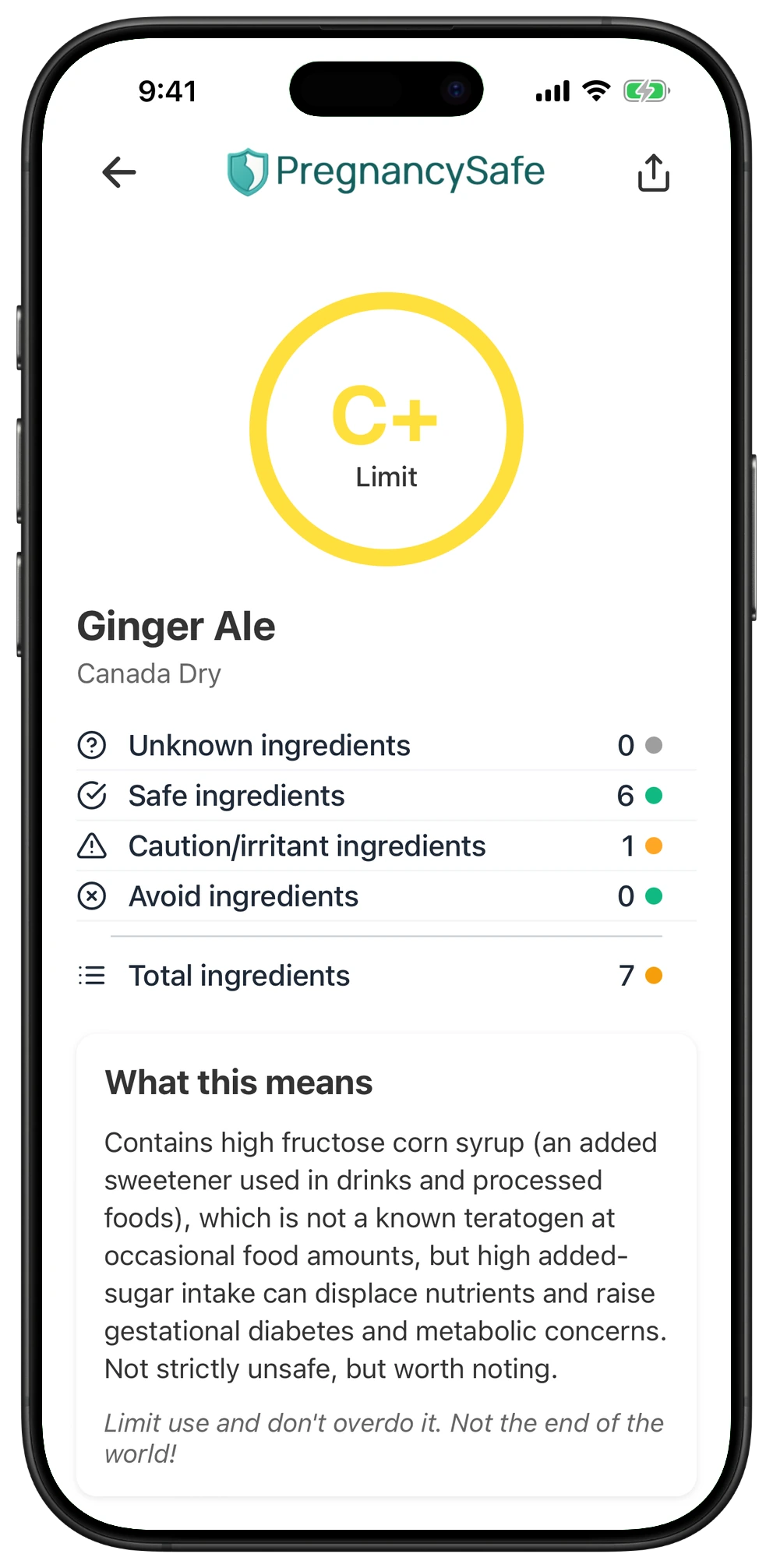
Check your exact ginger ale in the app
✓ What's Safe
- • Check the exact beverage label to confirm it is nonalcoholic, especially when choosing fermented ginger drinks or mixers.
- • Choose a clearly labeled caffeine free version, or check caffeine per serving and count it toward your daily total.
- • Compare added sugar for the amount you actually plan to drink, not just the listed serving size.
- • Choose smaller portions for occasional drinking rather than making sweetened ginger ale your main drink.
- • Follow the package's storage instructions, including any directions after opening.
- • If you have gestational diabetes, fit the drink's carbohydrate content into the plan agreed with your care team.
✗ What to Avoid
- • Avoid alcoholic ginger drinks or ginger ale mixed with alcohol.
- • Avoid assuming all ginger ales are caffeine free; do not let total caffeine reach 200 mg or more per day.
- • Limit frequent large servings sweetened with high fructose corn syrup, sugar or cane sugar; switching sweetener names does not remove added sugar.
- • If you want to reduce unnecessary dye exposure, skip versions containing blue 1 or red 40 without treating an occasional serving as proven fetal harm.
- • Avoid relying on ginger ale or natural ginger flavor to provide a treatment dose for nausea.
- • Avoid managing persistent vomiting or dehydration with soda alone instead of contacting your pregnancy care team.
Most Common Ingredients in Ginger Ale Products
We analyzed 20 ginger ale products. Here are the most common ingredients, ranked by how often they appear:
Ingredients to Watch Out For in Ginger Ale
These are the most common flagged ingredients across 20 ginger ale products we analyzed.
high fructose corn syrup
Caution
High fructose corn syrup is a sweet, liquid sweetener made from corn starch, commonly used in processed foods and beverages.
Is not a known teratogen at occasional food amounts, but high added sugar intake can displace nutrients and raise gestational diabetes and metabolic concerns.
Flagged in 7 of 20 products (35%)
blue 1
Caution
Blue 1 is a synthetic blue dye commonly used to add vibrant color to foods, beverages, and cosmetics.
Has limited human pregnancy data; regulated food use is not shown to cause fetal harm, but high dose animal neurobehavior findings and child sensitivity concerns support minimizing frequent exposure.
Flagged in 2 of 20 products (10%)
Caution
Red 40 is a synthetic food dye commonly used to add vibrant red color to candies, beverages, and processed foods.
Has limited human pregnancy data and is allowed at regulated food additive levels, but child neurobehavior concerns and high dose animal findings make frequent high dye intake worth limiting.
Flagged in 2 of 20 products (10%)
caffeine
Caution
Caffeine is a natural stimulant found in coffee, tea, and various plants that temporarily boosts alertness and reduces fatigue.
Should be counted across all sources and generally limited to below 200 mg/day in pregnancy because higher intake has observational links to miscarriage and fetal growth outcomes.
Flagged in 1 of 20 products (5%)
Ginger Ale Products We've Analyzed
Our catalog contains ratings for 20 ginger ale products. These are database grades, not independent safety certifications.
Catalog ingredient grades do not measure current-label completeness, pathogens, preparation, caffeine or clinical pregnancy suitability. These counts include unreviewed records and are not a percentage of independently verified safe products.
Pregnancy Safe Ginger Ale Products
Popular options from our catalog, prioritizing A and B ingredient grades, with C grade options used to fill remaining places. Within each group, products are ordered by searches in Pregnancy Safe, not retail sales. Read the cautions and guidance above; grades do not verify a complete current label or guarantee pregnancy safety.
| Grade | Product | Brand |
|---|---|---|
| A | Original Real Ginger Ale, Original | Reed'S |
| A | Original Ginger Ale, Original | Reed'S |
| A | Reed'S Zero Sugar Ginger Ale - 4Pk/ Cans | Reed'S Inc |
| B+ | Premium Ginger Ale | — |
| A | Delicate London Ginger Ale, Ginger | — |
Your Questions Answered
Is ginger ale safe during pregnancy?
An occasional serving of nonalcoholic ginger ale can generally fit into pregnancy. Check the exact label for caffeine, added sugar and ingredients you are allergic to, and follow storage directions. Ordinary beverage amounts are different from concentrated ginger supplements. An ingredient grade alone cannot confirm a drink's current formulation or suitability for your individual needs.
What soda should I avoid when pregnant?
Avoid alcoholic soda mixtures and limit caffeinated drinks so your total caffeine remains below 200 mg a day. Frequent large servings of sugar sweetened soda are also worth limiting, particularly if you need individualized blood glucose management. The presence of additives alone does not establish that a soda harms a pregnancy. Choose using the actual label and amount you drink rather than a blanket rule against ingredients described as chemicals.
Is caffeine free soda a better choice during pregnancy?
A caffeine free ginger ale makes it easier to keep your total caffeine below 200 mg daily. It does not necessarily contain less added sugar, so check the nutrition label separately. Count caffeine from coffee, tea, chocolate, other drinks and medicines when choosing a caffeinated version. Do not assume a ginger ale is caffeine free based on its name.
Does ginger ale help with morning sickness?
Do not assume ginger ale provides a therapeutic ginger dose or reliably treats morning sickness. Natural ginger flavor does not tell you how much ginger it supplies, and even a ginger containing ingredient list does not establish a treatment dose. Evidence about concentrated ginger preparations cannot automatically be applied to a flavored soda. Contact your care team for persistent vomiting, dehydration or difficulty keeping fluids down.
How much ginger ale can I drink while pregnant?
There is no single ginger ale serving limit that accounts for every formulation and your individual needs. Choose occasional smaller portions and check added sugar and caffeine for the entire amount you drink. High fructose corn syrup is an added sugar, not a known teratogen at occasional food amounts; frequent high added sugar intake is the concern. If you have gestational diabetes, ask your care team how the drink fits your carbohydrate plan.
Should I worry about blue 1 or red 40 in ginger ale?
Human pregnancy specific evidence for these food dyes is limited, but ordinary regulated food use has not been shown to cause fetal harm. Concerns involving children's behavior and high dose animal studies do not establish harm from an occasional ginger ale during pregnancy. Choosing versions without blue 1 or red 40 is an option if you want to minimize frequent dye exposure. A dye flag is not, by itself, a clinical verdict that the entire drink is unsafe.
How to Interpret These Ratings
Our ingredient and category rules generate letter grades from the information recorded in the catalog. Missing ingredients and broad category assignments can affect the result. These grades do not measure your dose, confirm a complete current label, or test a product for contamination.
A high grade is not a guarantee of pregnancy safety. A low grade is not, by itself, proof of harm from every use. Follow the product-specific guidance above, check the actual package, and ask your prenatal clinician about supplements, treatment decisions or uncertain exposures.
People Also Checked
References
- https://www.nhs.uk/pregnancy/keeping-well/foods-to-avoid/
- https://www.fda.gov/food/people-risk-foodborne-illness/cooking-food-safety-moms-be
- https://cdn.realfood.gov/DGA.pdf
- https://www.dietaryguidelines.gov/sites/default/files/2021-12/DGA_Pregnancy_FactSheet-508c.pdf
- https://www.acog.org/womens-health/faqs/healthy-eating-during-pregnancy
- https://www.cdc.gov/nutrition/php/data-research/added-sugars.html
- https://www.cdc.gov/diabetes/about/gestational-diabetes.html
- https://www.who.int/publications/i/item/9789241549028
- https://nesr.usda.gov/2025-dietary-guidelines-advisory-committee-systematic-reviews/dietary-patterns_gestational-diabetes
- https://www.hfpappexternal.fda.gov/scripts/fdcc/index.cfm?id=FDCBlue1&set=ColorAdditives
- https://www.ecfr.gov/current/title-21/chapter-I/subchapter-A/part-74
- https://www.fda.gov/food/color-additives-information-consumers/tracking-food-industry-pledges-remove-petroleum-based-food-dyes
- https://efsa.onlinelibrary.wiley.com/doi/10.2903/j.efsa.2010.1853
- https://apps.who.int/food-additives-contaminants-jecfa-database/Home/Chemical/3309
- https://pubmed.ncbi.nlm.nih.gov/23208798/
- https://pubmed.ncbi.nlm.nih.gov/24257113/
- https://oehha.ca.gov/risk-assessment/report/health-effects-assessment-potential-neurobehavioral-effects-synthetic-food-dyes-children
- https://www.hfpappexternal.fda.gov/scripts/fdcc/index.cfm?id=FDCRed40&set=ColorAdditives
- https://www.ecfr.gov/current/title-21/chapter-I/subchapter-A/part-74/subpart-A/section-74.340
- https://www.efsa.europa.eu/en/efsajournal/pub/1327
- https://www.efsa.europa.eu/en/efsajournal/pub/4007
- https://apps.who.int/food-additives-contaminants-jecfa-database/Home/Chemical/2361
- https://pubmed.ncbi.nlm.nih.gov/6636206/
- https://pubmed.ncbi.nlm.nih.gov/2613118/
- https://pubmed.ncbi.nlm.nih.gov/7940558/
- https://www.acog.org/clinical/clinical-guidance/committee-opinion/articles/2010/08/moderate-caffeine-consumption-during-pregnancy
- https://www.acog.org/womens-health/experts-and-stories/ask-acog/how-much-coffee-can-i-drink-while-pregnant
- https://www.ncbi.nlm.nih.gov/books/NBK582613/
- https://www.who.int/tools/elena/interventions/caffeine-pregnancy
- https://www.fda.gov/consumers/consumer-updates/spilling-beans-how-much-caffeine-too-much
- https://pubmed.ncbi.nlm.nih.gov/25179792/
- https://pubmed.ncbi.nlm.nih.gov/25238871/