Is Seltzer Safe During Pregnancy? (Updated 2026 Guide)
Updated September 9, 2026
The Answer
Yes plain, caffeine free, nonalcoholic seltzer can support hydration during pregnancy; check flavored versions for added stimulants, alcohol and herbal ingredients. Our catalog contains 589 A graded records among 632 products, but those ingredient grades are not independent pregnancy safety verification.
The main consideration is what accompanies the carbonated water: caffeine contributes to your daily total, while THC and some supplemental herbal extracts warrant avoidance or additional caution. Keep total caffeine below 200 mg per day from all sources, and do not treat fermented or energy style drinks as ordinary seltzer. Carbonation may worsen reflux or bloating, but that discomfort does not establish fetal harm.
Pregnancy Safe is 100% independent and research driven. No companies pay to promote or sponsor products.
Stress Less This Pregnancy
Check your exact seltzer in the app

✓ What's Safe
- • Choose plain, caffeine free, nonalcoholic seltzer for straightforward hydration.
- • Read the exact flavor and version’s full label, including sweeteners and any added herbal extracts or stimulants.
- • For caffeinated versions, check milligrams per serving and servings per container before adding them to your daily caffeine total.
- • If making seltzer at home, start with potable water; carbonation is not a substitute for a safe water source.
- • Try smaller portions or switch to still water if bubbles aggravate heartburn or bloating.
✗ What to Avoid
- • Avoid hard seltzer and other alcohol containing drinks during pregnancy.
- • Avoid THC infused drinks, including those listing nano emulsified hemp derived thc; drinking THC is not an established safe alternative to other cannabis exposure routes.
- • Avoid choosing drinks with organic panax ginseng extract as routine hydration. Human pregnancy evidence is limited, and oral supplemental use is not recommended.
- • Avoid letting caffeine or organic caffeine push your combined daily intake to 200 mg or more; tea based ingredients can contribute too.
- • Avoid raw, unpasteurized or home brewed kombucha as a substitute for ordinary seltzer because alcohol content and microbial safety can be uncertain.
- • Avoid relying on an A grade, an organic label or detox claims instead of checking the actual drink’s ingredients and formulation.
Most Common Ingredients in Seltzer Products
We analyzed 632 seltzer products. Here are the most common ingredients, ranked by how often they appear:
Ingredients to Watch Out For in Seltzer
These are the most common flagged ingredients across 632 seltzer products we analyzed.
organic caffeine
Caution
Organic caffeine is a natural stimulant derived from organically grown coffee beans, tea leaves, or other plant sources, providing an energizing boost without synthetic additives.
Should be counted across all sources and generally limited to below 200 mg/day in pregnancy because higher intake has observational links to miscarriage and fetal growth outcomes.
Flagged in 10 of 632 products (2%)
organic panax ginseng extract
Avoid
Organic Panax ginseng extract is a natural herbal supplement known for its revitalizing and energy boosting properties.
Is not recommended as an oral supplement in pregnancy because human data are limited and animal or embryo culture ginsenoside studies raise developmental concerns.
Flagged in 10 of 632 products (2%)
organic fermented black tea extract
Caution
Organic fermented black tea extract is a natural antioxidant rich ingredient derived from fermented black tea leaves, known for its revitalizing and skin boosting properties.
Is generally compatible in normal servings but contributes to the pregnancy caffeine limit and may interfere with iron absorption if taken with meals or iron supplements.
Flagged in 6 of 632 products (1%)
kombucha
Caution
Kombucha is a fermented, effervescent beverage made from sweetened tea infused with beneficial probiotics and organic acids.
Has limited pregnancy specific safety data and can contain alcohol, caffeine, high acidity, and live or contaminating microbes, especially in raw, unpasteurized, hard, or home brewed products.
Flagged in 4 of 632 products (1%)
nano emulsified hemp derived thc
Avoid
Crosses the placenta and should be avoided during pregnancy; observed birth outcome evidence is largely for cannabis exposure rather than isolated THC or every THC isomer.
Flagged in 4 of 632 products (1%)
hibiscus powder
Caution
Hibiscus powder is a vibrant red, tangy, and antioxidant rich ingredient made from dried, ground hibiscus flowers.
Has limited human pregnancy safety data; medicinal teas or supplements may lower blood pressure and uterine or menstrual effects are uncertain.
Flagged in 2 of 632 products (0%)
organic black tea
Caution
Organic black tea is a naturally cultivated, antioxidant rich beverage made from fermented Camellia sinensis leaves, offering a bold and invigorating flavor.
Is generally compatible in normal servings but contributes to the pregnancy caffeine limit and may interfere with iron absorption if taken with meals or iron supplements.
Flagged in 2 of 632 products (0%)
artificial color yellow 5
Caution
Artificial Color Yellow 5 is a synthetic dye used to impart a bright yellow hue to foods, beverages, and other products.
Has limited human pregnancy data, rare hypersensitivity labeling concerns, and animal/children's neurobehavior signals despite regulated dietary use under ADI based limits.
Flagged in 1 of 632 products (0%)
Seltzer Products We've Analyzed
Our catalog contains ratings for 632 seltzer products. These are database grades, not independent safety certifications.
Catalog ingredient grades do not measure current-label completeness, pathogens, preparation, caffeine or clinical pregnancy suitability. These counts include unreviewed records and are not a percentage of independently verified safe products.
Pregnancy Safe Seltzer Products
Popular options from our catalog, prioritizing A and B ingredient grades, with C grade options used to fill remaining places. Within each group, products are ordered by searches in Pregnancy Safe, not retail sales. Read the cautions and guidance above; grades do not verify a complete current label or guarantee pregnancy safety.
| Grade | Product | Brand |
|---|---|---|
| A | Hiyo Blackberry Lemon Seltzer | Hiyo |
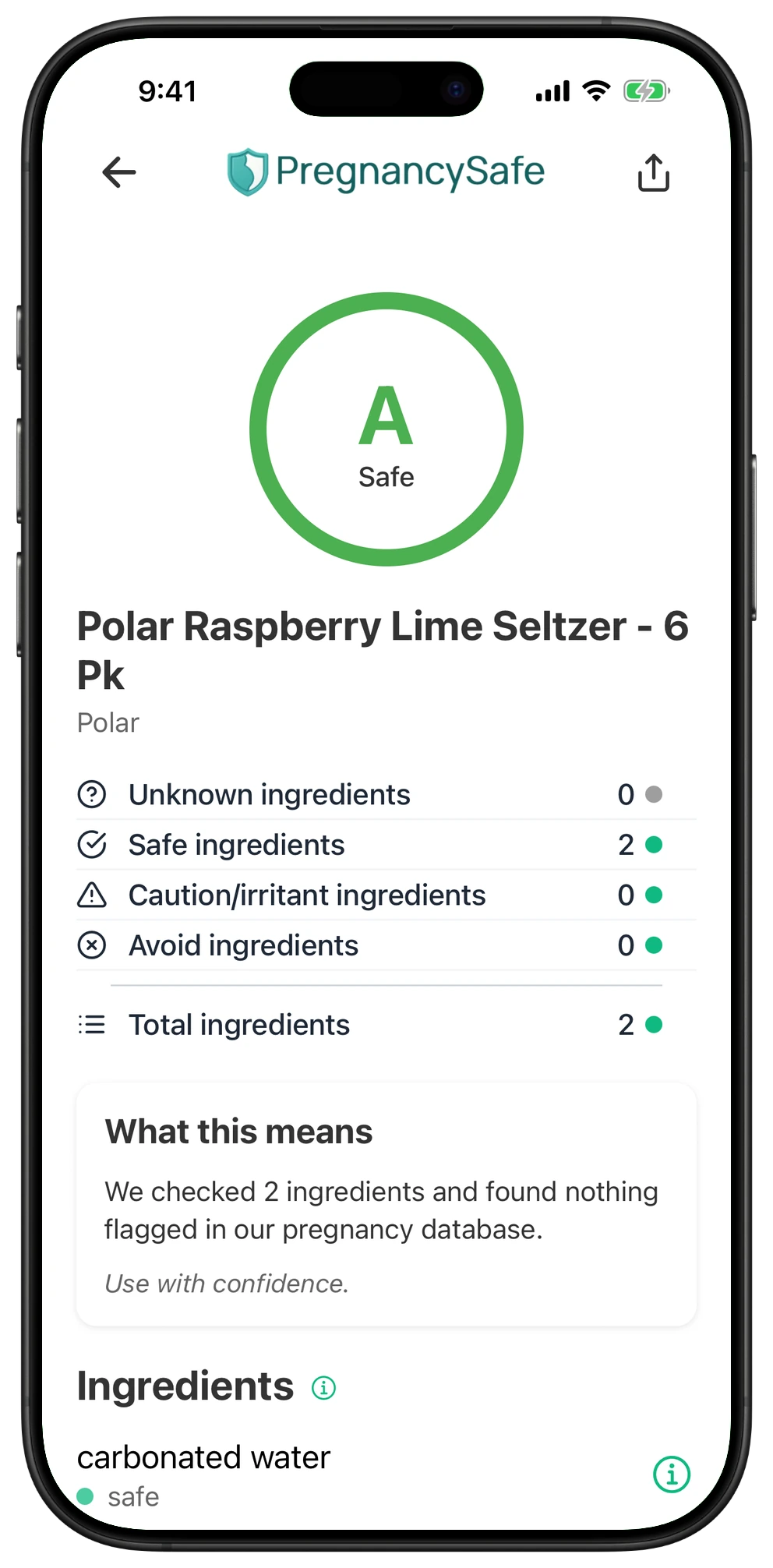
| A | Polar Raspberry Lime Seltzer - 6 Pk | Polar |
| A | Lemon Flavored Seltzer Water, Lemon | Refreshe, Safeway Inc. |
| A | Polar Lemon Seltzer | Polar |
| A | 6Pk Cans Lime Seltzer | Polar |
Your Questions Answered
Can a pregnant woman drink seltzer?
Yes plain, caffeine free, nonalcoholic seltzer is a suitable hydration option during pregnancy. Flavored versions need a label check because similarly named drinks can contain caffeine, herbal extracts or alcohol. This guidance concerns ordinary seltzer, not hard seltzer, tonic water or caffeinated energy drinks.
Can a pregnant woman drink flavored seltzer?
A suitable nonalcoholic flavored water can support hydration, just as plain water can. Check the exact formulation for caffeine, sweeteners, added stimulants and herbal ingredients rather than judging it by its flavor name. A drink marketed for energy, relaxation or mood deserves a closer ingredient check than ordinary flavored carbonated water.
How much seltzer can I drink during pregnancy?
There is no specific seltzer only daily limit established here for plain, caffeine free, nonalcoholic water. Let your tolerance guide whether to alternate it with still water, especially if carbonation causes reflux or bloating. For caffeinated versions, the relevant limit is below 200 mg of caffeine daily across drinks, foods, supplements and medicines not a fixed number of cans.
Can the bubbles in seltzer harm my baby or worsen heartburn?
Carbonation can affect reflux or bloating, but those symptoms do not establish fetal harm. If seltzer makes you uncomfortable, try smaller portions or choose still water instead. There is no need to keep drinking carbonated water for hydration if still water feels better.
Are tea based or herbal seltzers the same as ordinary sparkling water?
No the added ingredients and their amounts matter. Organic black tea and organic fermented black tea extract can contribute caffeine, while organic panax ginseng extract has limited human pregnancy evidence and is not recommended for oral supplemental use. Hibiscus powder also has limited pregnancy data; concerns from continuous animal extract exposure do not prove harm from a small beverage amount. For routine hydration, choose an ordinary seltzer rather than a concentrated herbal blend with unclear doses.
Is kombucha seltzer a suitable alcohol free alternative?
Do not assume a fermented drink is equivalent to ordinary nonalcoholic seltzer. Kombucha can contain residual alcohol and caffeine, and raw or home brewed versions add microbial uncertainty. Pasteurized, alcohol controlled commercial versions are lower concern, but pregnancy specific safety evidence remains limited. Plain nonfermented seltzer avoids those fermentation related questions.
Does an A grade mean a seltzer is verified safe during pregnancy?
No an ingredient grade does not verify the current package, caffeine dose, contamination status or overall pregnancy suitability. Our catalog contains 632 products, including 589 A graded records, and those counts include unreviewed records. The product list does not confirm the ingredients or condition of today’s retail package. An incomplete record or a lower grade is also not, by itself, proof that a drink is harmful.
How to Interpret These Ratings
Our ingredient and category rules generate letter grades from the information recorded in the catalog. Missing ingredients and broad category assignments can affect the result. These grades do not measure your dose, confirm a complete current label, or test a product for contamination.
A high grade is not a guarantee of pregnancy safety. A low grade is not, by itself, proof of harm from every use. Follow the product-specific guidance above, check the actual package, and ask your prenatal clinician about supplements, treatment decisions or uncertain exposures.
People Also Checked
References
- https://www.nhs.uk/pregnancy/keeping-well/foods-to-avoid/
- https://ods.od.nih.gov/factsheets/Pregnancy-HealthProfessional/
- https://www.acog.org/clinical/clinical-guidance/committee-opinion/articles/2010/08/moderate-caffeine-consumption-during-pregnancy
- https://www.acog.org/womens-health/experts-and-stories/ask-acog/how-much-coffee-can-i-drink-while-pregnant
- https://www.ncbi.nlm.nih.gov/books/NBK582613/
- https://www.who.int/tools/elena/interventions/caffeine-pregnancy
- https://www.fda.gov/consumers/consumer-updates/spilling-beans-how-much-caffeine-too-much
- https://pubmed.ncbi.nlm.nih.gov/25179792/
- https://pubmed.ncbi.nlm.nih.gov/25238871/
- https://www.nccih.nih.gov/health/asian-ginseng
- https://www.ema.europa.eu/en/documents/herbal-report/draft-assessment-report-panax-ginseng-camey-radix-revision-1_en.pdf
- https://pubmed.ncbi.nlm.nih.gov/18204104/
- https://pubmed.ncbi.nlm.nih.gov/14507839/
- https://pubmed.ncbi.nlm.nih.gov/15834894/
- https://pubmed.ncbi.nlm.nih.gov/15336721/
- https://pubmed.ncbi.nlm.nih.gov/20091796/
- https://www.nhsinform.scot/ready-steady-baby/pregnancy/looking-after-yourself-and-your-baby/eating-well-in-pregnancy/
- https://www.mayoclinic.org/healthy-lifestyle/pregnancy-week-by-week/in-depth/pregnancy-nutrition/art-20043844
- https://pubmed.ncbi.nlm.nih.gov/10999016/
- https://pmc.ncbi.nlm.nih.gov/articles/PMC5998341/
- https://mothertobaby.org/baby-blog/kombucha-pregnancy-answers/
- https://www.cdc.gov/food-safety/foods/pregnant-women.html
- https://www.fda.gov/food/people-risk-foodborne-illness/fruits-veggies-and-juices-food-safety-moms-be
- https://www.cdc.gov/alcohol-pregnancy/about/index.html
- https://www.ttb.gov/kombucha/kombucha-general/print
- https://pubmed.ncbi.nlm.nih.gov/20664420/
- https://www.mdpi.com/2311-5637/10/8/385
- https://www.cdc.gov/mmwr/preview/mmwrhtml/00039742.htm
- https://journals.sagepub.com/doi/10.1177/0885066609332963
- https://www.foodprotection.org/members/fpt-archive-articles/2025-03-determining-critical-food-safety-factors-for-safely-homebrewing-kombucha-a-study-on-microbia/
- https://www.acog.org/clinical/clinical-guidance/clinical-consensus/articles/2025/10/cannabis-use-during-pregnancy-and-lactation
- https://www.fda.gov/consumers/consumer-updates/what-you-should-know-about-using-cannabis-including-cbd-when-pregnant-or-breastfeeding
- https://www.cdc.gov/cannabis/health-effects/pregnancy.html
- https://mothertobaby.org/fact-sheets/marijuana-pregnancy/
- https://pubmed.ncbi.nlm.nih.gov/40323610/
- https://pubmed.ncbi.nlm.nih.gov/37968824/
- https://www.hhs.gov/surgeongeneral/reports-and-publications/addiction-and-substance-misuse/advisory-on-marijuana-use-and-developing-brain/index.html
- https://mothertobaby.org/fact-sheets/herbal-products-pregnancy/
- https://www.ncbi.nlm.nih.gov/books/NBK501882/
- https://pubmed.ncbi.nlm.nih.gov/19434218/
- https://pubmed.ncbi.nlm.nih.gov/18066103/
- https://pmc.ncbi.nlm.nih.gov/articles/PMC9086798/
- https://www.nccih.nih.gov/health/hypertension-high-blood-pressure
- https://www.ffhdj.com/index.php/ffhd/article/view/1768
- https://hfpappexternal.fda.gov/scripts/fdcc/index.cfm?id=FDCYellow5&set=ColorAdditives
- https://www.ecfr.gov/current/title-21/chapter-I/subchapter-A/part-74#74.705
- https://www.fda.gov/food/color-additives-information-consumers/tracking-food-industry-pledges-remove-petroleum-based-food-dyes
- https://www.fda.gov/food/nutrition-food-labeling-and-critical-foods/food-allergies
- https://apps.who.int/food-additives-contaminants-jecfa-database/Home/Chemical/3885
- https://efsa.onlinelibrary.wiley.com/doi/10.2903/j.efsa.2009.1331
- https://oehha.ca.gov/risk-assessment/report/health-effects-assessment-potential-neurobehavioral-effects-synthetic-food-dyes-children
- https://pubmed.ncbi.nlm.nih.gov/1628860/
- https://pmc.ncbi.nlm.nih.gov/articles/PMC7023231/
- https://pmc.ncbi.nlm.nih.gov/articles/PMC6354951/
- https://www.hfpappexternal.fda.gov/scripts/fdcc/index.cfm?id=FDCBlue1&set=ColorAdditives
- https://www.ecfr.gov/current/title-21/chapter-I/subchapter-A/part-74
- https://efsa.onlinelibrary.wiley.com/doi/10.2903/j.efsa.2010.1853
- https://apps.who.int/food-additives-contaminants-jecfa-database/Home/Chemical/3309
- https://pubmed.ncbi.nlm.nih.gov/23208798/
- https://pubmed.ncbi.nlm.nih.gov/24257113/