Is Mineral Water Safe During Pregnancy? (Updated 2026 Guide)
Updated September 9, 2026
The Answer
Yes plain mineral water that is safe to drink can support hydration during pregnancy, whether still or sparkling. Our catalog contains 65 A grade records among 71 products, but ingredient grades do not verify water quality, current labels or individual pregnancy suitability.
The main considerations are water quality and the exact drink formulation, not the mineral water name: check for alcohol, caffeine, added stimulants and sweeteners. Frequent high intake of added sugars warrants limiting, while nitrate concerns depend on the concentration in drinking water not simply its appearance on a mineral analysis. Carbonation may worsen reflux or bloating, and mineral content does not make the water a replacement for an indicated prenatal supplement.
Pregnancy Safe is 100% independent and research driven. No companies pay to promote or sponsor products.
Stress Less This Pregnancy
Check your exact mineral water in the app

✓ What's Safe
- • Choose plain, unsweetened mineral water for routine hydration.
- • Check the exact label for alcohol, caffeine and added stimulants, especially on flavored versions.
- • Look for water quality information from the supplier; use testing rather than assumptions if you rely on a private well.
- • Read the mineral analysis if your care team has given you specific mineral intake restrictions.
- • Choose still water if sparkling water makes reflux or bloating uncomfortable.
✗ What to Avoid
- • Avoid making drinks sweetened with high fructose corn syrup or other added sugars your main source of hydration.
- • Avoid drinking water known to exceed nitrate safety limits; a nitrate listing alone does not establish an unsafe concentration.
- • Avoid alcoholic versions, and do not assume flavored or energy style waters are caffeine free.
- • Avoid continuing with carbonation when it aggravates reflux or bloating; switch to still water.
- • Avoid replacing prescribed prenatal supplements with mineral water or relying on alkaline or detox claims for pregnancy benefits.
Most Common Ingredients in Mineral Water Products
We analyzed 71 mineral water products. Here are the most common ingredients, ranked by how often they appear:
Ingredients to Watch Out For in Mineral Water
These are the most common flagged ingredients across 71 mineral water products we analyzed.
high fructose corn syrup
Caution
High fructose corn syrup is a sweet, liquid sweetener made from corn starch, commonly used in processed foods and beverages.
Is not a known teratogen at occasional food amounts, but high added sugar intake can displace nutrients and raise gestational diabetes and metabolic concerns.
Flagged in 3 of 71 products (4%)
nitrate
Caution
Nitrate is a naturally occurring compound composed of nitrogen and oxygen, commonly used as a preservative and color fixative in processed meats.
Is context dependent because vegetable sources are generally compatible with pregnancy while contaminated well water above nitrate/nitrite limits can cause methemoglobinemia and has observational links to adverse birth outcomes.
Flagged in 1 of 71 products (1%)
nitrates
Caution
Is context dependent because vegetable sources are generally compatible with pregnancy while contaminated well water above nitrate/nitrite limits can cause methemoglobinemia and has observational links to adverse birth outcomes.
Flagged in 1 of 71 products (1%)
Caution
Red 40 is a synthetic food dye commonly used to add vibrant red color to candies, beverages, and processed foods.
Has limited human pregnancy data and is allowed at regulated food additive levels, but child neurobehavior concerns and high dose animal findings make frequent high dye intake worth limiting.
Flagged in 1 of 71 products (1%)
yellow 5
Caution
Yellow 5 is a synthetic food dye used to impart a bright yellow color to various processed foods and beverages.
Has limited human pregnancy data, rare hypersensitivity labeling concerns, and animal/children's neurobehavior signals despite regulated dietary use under ADI based limits.
Flagged in 1 of 71 products (1%)
Mineral Water Products We've Analyzed
Our catalog contains ratings for 71 mineral water products. These are database grades, not independent safety certifications.
Catalog ingredient grades do not measure current-label completeness, pathogens, preparation, caffeine or clinical pregnancy suitability. These counts include unreviewed records and are not a percentage of independently verified safe products.
Pregnancy Safe Mineral Water Products
Popular options from our catalog, prioritizing A and B ingredient grades, with C grade options used to fill remaining places. Within each group, products are ordered by searches in Pregnancy Safe, not retail sales. Read the cautions and guidance above; grades do not verify a complete current label or guarantee pregnancy safety.
| Grade | Product | Brand |
|---|---|---|
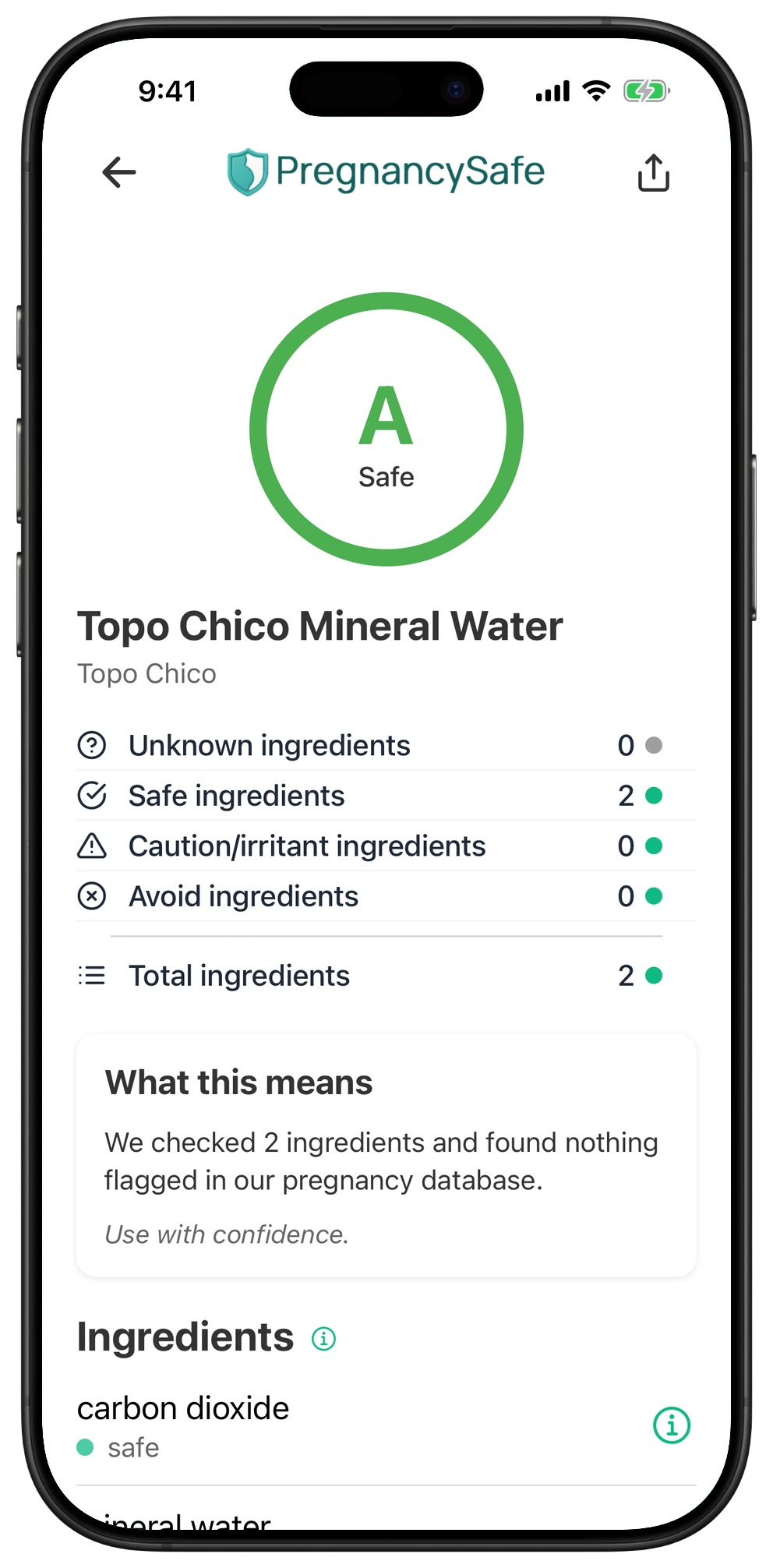
| A | Topo Chico Mineral Water | Topo Chico |
| A | Agua Mineral | Cia. Topo Chico S.A. |
| A | Gerolsteiner Natural Mineral Water, Sparkling | Gerolsteiner |
| A | Buxton Still Mineral Water 75Cl | Buxton |
| A | Topochico Mineral Water | Topo Chico |
Your Questions Answered
Can I drink bottled mineral water while pregnant?
Yes, plain bottled mineral water that is suitable for drinking can support hydration during pregnancy. Check the exact version rather than relying on the brand name, because flavored drinks can contain sweeteners, caffeine or other additions. Neither a mineral water label nor an ingredient grade is a contamination test.
Who should not drink mineral water?
Pregnancy alone is not a reason to avoid ordinary potable mineral water. If your care team has prescribed fluid or mineral restrictions, ask whether the particular water fits those limits because mineral content varies. If carbonation worsens reflux or bloating, choose still water rather than avoiding water altogether.
Can I drink sparkling mineral water during pregnancy?
Plain sparkling mineral water can be a hydration option during pregnancy. Carbonation may cause bloating or worsen reflux, but that discomfort does not establish fetal harm. Try still water if bubbles bother you, and check flavored versions separately for added sugar, caffeine and alcohol.
How much mineral water should I drink during pregnancy?
Use mineral water as a hydration option, not as a treatment or something you need to drink in a special dose. There is no single mineral water amount that accounts for every formulation and individual need. Follow any fluid guidance from your maternity team, and choose unsweetened water rather than sweetened drinks for routine hydration.
Should I avoid mineral water if nitrate appears on the label?
Not automatically: nitrate and nitrates refer to the same ingredient concern, and the amount in the water matters. The concern is elevated drinking water exposure, particularly from contaminated private wells, rather than the mere presence of the word on a label. Check the supplier's water analysis or arrange well water testing; an ingredient grade cannot establish whether the concentration exceeds a drinking water limit.
Are sweetened or colored mineral waters unsafe during pregnancy?
They need a separate label check rather than the same assessment as plain mineral water. High fructose corn syrup is an added sugar; occasional food exposure is not treated as a pregnancy teratogen, but frequent high intake is worth limiting. Red 40 and yellow 5 have limited direct human pregnancy evidence, and animal or children's studies do not prove fetal harm from occasional regulated food exposure. Unsweetened, uncolored water is a straightforward everyday choice; if you have gestational diabetes, follow your care team's carbohydrate guidance.
Can mineral water replace prenatal supplements?
No do not replace an indicated prenatal supplement with mineral water. Mineral content varies, and the mineral water name does not establish that a drink meets your nutritional needs or treats a deficiency. Mineral, alkaline and detox marketing also does not demonstrate better pregnancy outcomes.
How to Interpret These Ratings
Our ingredient and category rules generate letter grades from the information recorded in the catalog. Missing ingredients and broad category assignments can affect the result. These grades do not measure your dose, confirm a complete current label, or test a product for contamination.
A high grade is not a guarantee of pregnancy safety. A low grade is not, by itself, proof of harm from every use. Follow the product-specific guidance above, check the actual package, and ask your prenatal clinician about supplements, treatment decisions or uncertain exposures.
People Also Checked
References
- https://www.nhs.uk/pregnancy/keeping-well/foods-to-avoid/
- https://ods.od.nih.gov/factsheets/Pregnancy-HealthProfessional/
- https://cdn.realfood.gov/DGA.pdf
- https://www.dietaryguidelines.gov/sites/default/files/2021-12/DGA_Pregnancy_FactSheet-508c.pdf
- https://www.acog.org/womens-health/faqs/healthy-eating-during-pregnancy
- https://www.cdc.gov/nutrition/php/data-research/added-sugars.html
- https://www.cdc.gov/diabetes/about/gestational-diabetes.html
- https://www.who.int/publications/i/item/9789241549028
- https://nesr.usda.gov/2025-dietary-guidelines-advisory-committee-systematic-reviews/dietary-patterns_gestational-diabetes
- https://www.epa.gov/ground-water-and-drinking-water/national-primary-drinking-water-regulations
- https://www.epa.gov/children/private-wells-and-drinking-water-safety-and-infants
- https://archive.cdc.gov/www_atsdr_cdc_gov/csem/nitrate-nitrite/who_risk.html
- https://doh.wa.gov/community-and-environment/drinking-water/contaminants/nitrate
- https://pubmed.ncbi.nlm.nih.gov/41248583/
- https://pmc.ncbi.nlm.nih.gov/articles/PMC9834225/
- https://www.efsa.europa.eu/en/efsajournal/pub/689
- https://www.food.gov.uk/safety-hygiene/nitrates-and-nitrites-the-science-explained
- https://www.ecfr.gov/current/title-21/chapter-I/subchapter-B/part-172/subpart-B/section-172.175
- https://www.hfpappexternal.fda.gov/scripts/fdcc/index.cfm?id=FDCRed40&set=ColorAdditives
- https://www.ecfr.gov/current/title-21/chapter-I/subchapter-A/part-74/subpart-A/section-74.340
- https://www.fda.gov/food/color-additives-information-consumers/tracking-food-industry-pledges-remove-petroleum-based-food-dyes
- https://www.efsa.europa.eu/en/efsajournal/pub/1327
- https://www.efsa.europa.eu/en/efsajournal/pub/4007
- https://apps.who.int/food-additives-contaminants-jecfa-database/Home/Chemical/2361
- https://oehha.ca.gov/risk-assessment/report/health-effects-assessment-potential-neurobehavioral-effects-synthetic-food-dyes-children
- https://pubmed.ncbi.nlm.nih.gov/6636206/
- https://pubmed.ncbi.nlm.nih.gov/2613118/
- https://pubmed.ncbi.nlm.nih.gov/7940558/
- https://hfpappexternal.fda.gov/scripts/fdcc/index.cfm?id=FDCYellow5&set=ColorAdditives
- https://www.ecfr.gov/current/title-21/chapter-I/subchapter-A/part-74#74.705
- https://www.fda.gov/food/nutrition-food-labeling-and-critical-foods/food-allergies
- https://apps.who.int/food-additives-contaminants-jecfa-database/Home/Chemical/3885
- https://efsa.onlinelibrary.wiley.com/doi/10.2903/j.efsa.2009.1331
- https://pubmed.ncbi.nlm.nih.gov/1628860/
- https://pmc.ncbi.nlm.nih.gov/articles/PMC7023231/
- https://pmc.ncbi.nlm.nih.gov/articles/PMC6354951/