Is Laneige Lip Sleeping Mask Berry Safe During Pregnancy? (Updated 2026 Guide)
Updated September 9, 2026
Laneige Lip Sleeping Mask Berry
Laneige
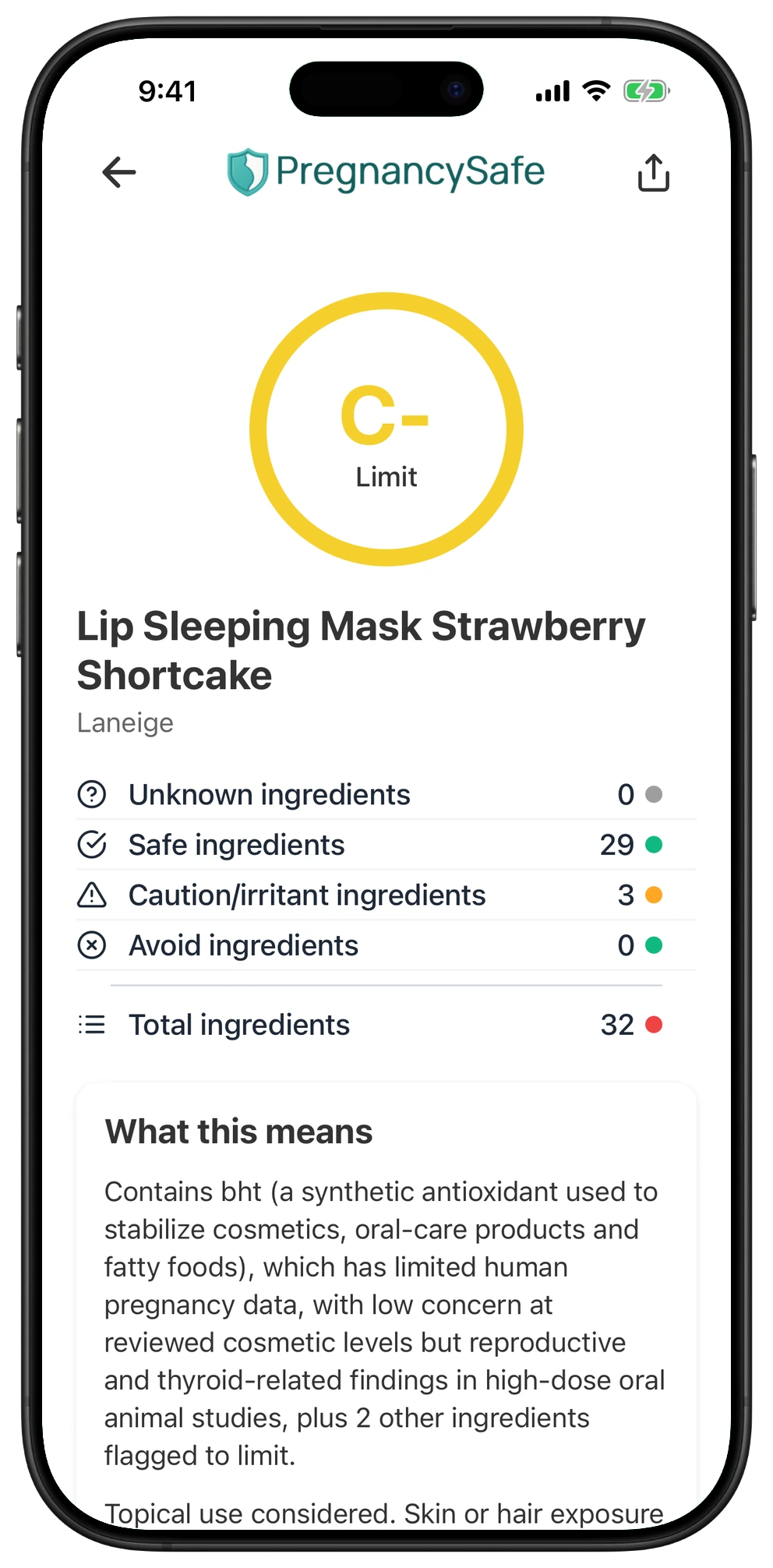
Laneige Lip Sleeping Mask Berry receives a C- pregnancy grade, making it a cautious choice rather than a first choice lip moisturizer. Its ingredient based score includes caution flags for BHT, fragrance, and a raspberry related match, but some supporting evidence concerns high dose oral exposure or raspberry leaf not ordinary use of this lip mask.
You can use this, but maybe don't make it your everyday go to. Not the end of the world if you've used it. Consult your OBGYN or midwife if you have concerns.
Pregnancy Safe is 100% independent and research driven. No companies pay to promote or sponsor products.
Stress Less This Pregnancy
Check your lip mask in the app

What Ingredients Are in Laneige Lip Sleeping Mask Berry?
Laneige Lip Sleeping Mask Berry has 34 ingredients. We flagged 3 ingredients to use with caution.
bht
CAUTION
BHT (butylated hydroxytoluene) is a synthetic antioxidant commonly used as a preservative to prevent the oxidation of fats and oils in food products. BHT carries a caution flag because human pregnancy data are limited, but high dose oral animal findings do not establish harm from ordinary topical lip use.
fragrance
CAUTION
A fragrant substance used to add a pleasant aroma to products or environments. Fragrance adds mixture uncertainty and irritation potential during pregnancy, without establishing that this particular mask contains phthalates or causes fetal harm.
rubus idaeus juice
CAUTION
This juice carries a raspberry related caution flag, but oral raspberry leaf evidence does not establish uterine effects from topical lip use.
propanediol
LIKELY SAFE
Propanediol is a versatile, plant derived humectant and solvent commonly used in skincare and cosmetic formulations to retain moisture and improve product texture. Propanediol is rated likely safe here through a propylene glycol match, whose high dose medication concerns do not establish risk from ordinary topical lip use.
punica granatum fruit juice
LIKELY SAFE
Punica granatum fruit juice is a vibrant, tangy liquid extracted from pomegranate seeds, rich in antioxidants and natural sweetness. Pomegranate fruit juice is rated likely safe, but the pregnancy evidence mainly concerns drinking juice rather than applying it in a lip mask.
titanium dioxide
LIKELY SAFE
Titanium dioxide is a white, naturally occurring mineral commonly used as a pigment and whitening agent in cosmetics, paints, and food products. Titanium dioxide is rated likely safe for ordinary topical use, while oral food additive uncertainty does not quantify pregnancy risk from incidental swallowing of this lip mask.
ascorbic acid
SAFE
Ascorbic acid is a natural antioxidant commonly known as vitamin C, used to enhance immune function and preserve food freshness. Vitamin C is compatible with ordinary topical use during pregnancy, although direct pregnancy studies are limited and acidic formulas may irritate your lips.
glycerin
SAFE
Glycerin is a colorless, odorless, and sweet tasting humectant commonly used in skincare products to attract and retain moisture in the skin. Glycerin is compatible with ordinary topical use during pregnancy, with low expected systemic exposure.
sucrose tetrastearate triacetate
SAFE
This ingredient is rated safe through a topical sucrose match, but the supporting evidence is indirect for this specific derivative and does not establish swallowed dose safety.
water
SAFE
Water is a clear, tasteless, and essential liquid that sustains all known forms of life. Water itself is not a concern in normal topical pregnancy use, although the formula's other ingredients and microbial quality still matter.
astrocaryum murumuru seed butter
SAFE
Astrocaryum murumuru seed butter is a rich, nourishing natural fat derived from the seeds of the murumuru palm, known for its moisturizing and skin softening properties. This moisturizing butter is unflagged in the assessment, but that does not establish pregnancy specific safety for topical lip use.
butylene ethylene styrene copolymer
SAFE
This ingredient is unflagged, with no pregnancy specific evidence available in this assessment for topical lip use.
butyrospermum parkii butter
SAFE
Butyrospermum parkii butter, commonly known as shea butter, is a rich, moisturizing natural fat derived from the nuts of the shea tree, widely used in skincare for its nourishing and healing properties. Shea butter is unflagged in this formula, but its moisturizing role does not itself establish pregnancy specific safety.
candelilla wax esters
SAFE
These wax esters are unflagged, rather than specifically reviewed as safe for pregnancy lip exposure.
cocos nucifera oil
SAFE
Cocos nucifera oil, commonly known as coconut oil, is a versatile natural oil derived from the kernel of mature coconuts, widely used for moisturizing skin and hair. Coconut oil is unflagged in this lip formula, with no pregnancy specific topical evidence included in this assessment.
copernicia cerifera wax
SAFE
Copernicia cerifera wax is a natural, plant derived wax obtained from the leaves of the carnauba palm, commonly used as a thickening and glazing agent in cosmetics and food products. Carnauba wax is unflagged here, but its plant origin does not establish pregnancy specific safety for lip use.
diisostearyl malate
SAFE
Diisostearyl malate is a lightweight, emollient ester used in cosmetics to provide a silky feel and improve the texture of skincare and makeup products. This emollient is unflagged in the assessment, without a pregnancy specific evaluation of topical lip exposure.
ethylene propylene styrene copolymer
SAFE
This ingredient is unflagged, with no pregnancy specific evidence included for its use on your lips.
euphorbia cerifera wax
SAFE
Euphorbia cerifera wax is a natural, plant derived wax obtained from the candelilla plant, commonly used as a vegan alternative to beeswax in cosmetics and skincare products. Candelilla wax is unflagged in this formula, but that is not a pregnancy specific safety finding.
glyceryl caprylate
SAFE
Glyceryl caprylate is a natural emulsifier and skin conditioning agent derived from glycerin and caprylic acid, commonly used in cosmetics and skincare products. This skin conditioning ingredient is unflagged, without pregnancy specific lip use evidence in this assessment.
hydrogenated poly c6 14 olefin
SAFE
This ingredient is unflagged, rather than established as pregnancy safe through a specific topical exposure review.
hydrogenated polyisobutene
SAFE
Hydrogenated polyisobutene is a synthetic, lightweight, and emollient polymer used in cosmetics and skincare products to provide a smooth, non greasy feel and enhance product texture. This emollient is unflagged here, but pregnancy specific evidence for topical lip use is not included.
methicone
SAFE
Methicone is a silicone based compound commonly used in cosmetics and skincare products to provide a smooth, silky feel and improve product spreadability. This silicone ingredient is unflagged in the assessment, without a pregnancy specific safety finding for lip application.
mica
SAFE
Mica is a naturally occurring mineral known for its shimmering, flaky appearance and is commonly used in cosmetics and decorative applications. Mica is unflagged in this lip mask, but no pregnancy specific evidence for this exposure is included.
microcrystalline wax
SAFE
Microcrystalline wax is a refined, semi solid wax derived from petroleum, known for its flexibility, high melting point, and use in cosmetics, candles, and industrial applications. This wax is unflagged here, which does not establish pregnancy specific safety for lip use.
pentaerythrityl tetra di t butyl hydroxyhydrocinnamate
SAFE
This ingredient is unflagged, with no pregnancy specific topical evidence included in the assessment.
phytosteryl isostearyl cetyl stearyl behenyl dimer dilinoleate
SAFE
This ingredient is unflagged, rather than specifically reviewed as safe for lip use during pregnancy.
polybutene
SAFE
Polybutene is a synthetic polymer commonly used as a thickening agent and binder in cosmetics and personal care products. This cosmetic binder is unflagged, but pregnancy specific safety evidence for lip application is not included.
polyglyceryl 2 diisostearate
SAFE
This ingredient is unflagged in the assessment, without pregnancy specific evidence for topical lip exposure.
polyglyceryl 2 triisostearate
SAFE
This ingredient is unflagged, which should not be read as a pregnancy specific safety confirmation.
red 6
SAFE
Red 6 is a synthetic red dye commonly used as a coloring agent in food, cosmetics, and pharmaceuticals. This colorant is unflagged here, with no pregnancy specific evaluation of lip application or incidental swallowing included.
synthetic wax
SAFE
Synthetic wax is a man made substance used for coating, polishing, and creating a smooth, protective finish on various surfaces. Synthetic wax is unflagged in this formula, without pregnancy specific evidence for topical lip use in this assessment.
vitis vinifera juice
SAFE
This juice ingredient is unflagged, but no pregnancy specific evidence for its use in a lip mask is included.
yellow 6 lake
SAFE
Yellow 6 Lake is a synthetic orange dye used as a coloring agent in food, beverages, and cosmetics. This colorant is unflagged, rather than specifically established as safe for pregnancy lip exposure or incidental swallowing.
Answering Your Questions
How much Laneige Lip Sleeping Mask Berry is safe during pregnancy?
If you choose to use it, apply only enough to lightly coat your lips rather than a thick excess layer. Small amounts may be swallowed from lip products; a pregnancy specific safe quantity has not been established for this formula.
Can you use Laneige Lip Sleeping Mask Berry daily while pregnant?
Follow the package directions without adding frequent repeat applications. There is no established pregnancy specific frequency limit, so consider a simpler fragrance free lip moisturizer for your regular routine.
Why does Laneige Lip Sleeping Mask Berry receive a C- grade?
The C- comes from ingredient based scoring, including caution flags for BHT, fragrance, and rubus idaeus juice. BHT concerns largely involve high dose oral animal studies, fragrance adds mixture uncertainty and irritation potential, and the raspberry evidence concerns oral leaf preparations rather than topical juice. The grade is a caution signal, not proof that normal lip application harms pregnancy.
Can I use Laneige Lip Sleeping Mask Berry while breastfeeding?
A breastfeeding specific safety assessment of this finished formula is not available here, and its pregnancy grade does not establish nursing safety. If you use it on your lips, avoid transferring fresh product to your baby's mouth or skin and do not use it as a nipple balm.
What lip balm should I choose instead during pregnancy?
Look for a simple, fragrance free lip moisturizer with a clearly disclosed ingredient list. Choosing one without BHT or added botanical mixtures avoids several uncertainties behind this product's grade, but the complete alternative formula still needs its own assessment.
What ingredients are in Laneige Lip Sleeping Mask Berry?
This Berry formula includes shea butter, murumuru butter, coconut oil, waxes, glycerin, vitamin C, fruit juices, fragrance, BHT, and colorants. The main caution flags are BHT, fragrance, and rubus idaeus juice; vitamin C and glycerin are compatible with ordinary topical pregnancy use. Check your package against this formula rather than relying on ingredient lists for Laneige face sleeping masks.
Does the raspberry ingredient mean this mask can trigger contractions?
The raspberry related caution does not establish that this lip mask triggers contractions. The evidence concerns raspberry leaf taken orally as tea or supplements, while this formula lists rubus idaeus juice for topical lip use a different plant preparation and exposure.
Does titanium dioxide make this lip mask unsafe?
Titanium dioxide is rated likely safe in this assessment, with low concern for ordinary topical cosmetic use. Oral food additive uncertainty and inhalation concerns are different exposures; small amounts of lip product may be swallowed, but those data do not establish harm from normal use of this mask. Its presence also does not establish SPF protection.
Are Other Laneige Products Safe During Pregnancy?
We looked at 10 other Laneige products. 3 are pregnancy safe (A or B grade), while 7 need a closer look.
| Grade | Product | Type |
|---|---|---|
| B+ | Cream Skin Toner & Moisturizer | skin toner |
| B+ | Cream Skin Toner & Moisturizer Jumbo | toner |
| B+ | Laneige Bouncy & Firm Eye Sleeping Mask | eye mask |
| C- | Laneige Bouncy & Firm Mini Skin Treats Set (Worth £29.03) | skin care set |
How Does Laneige Lip Sleeping Mask Berry Compare to Other Lip Masks?
We graded 44 Lip Masks for pregnancy safety. Here's how they stack up:
Laneige Lip Sleeping Mask Berry earns a C- grade, placing it among the majority of Lip Masks. Only 0% of products in this category get an A grade, so it pays to choose carefully.
How Do We Score Products for Pregnancy Safety?
We analyze each product's ingredients and category to flag known risks and provide cautionary notices for general category safety concerns.
A - Safe
Excellent choice! All ingredients are considered safe during pregnancy.
What to do: Use with confidence.
B - Likely Safe
Pretty much safe with very minimal risk. Some ingredients may have limited pregnancy studies, but no significant safety concerns have been identified.
What to do: Use with confidence.
C - Limit
Contains ingredients with some pregnancy considerations. Research shows these ingredients may have limited safety data, potential for minor hormonal effects, or require caution based on animal studies.
What to do: Use sparingly and consider safer alternatives when available.
D - Caution
Similar to C grade but contains multiple cautionary ingredients. The combination increases overall concern.
What to do: Try to avoid if that makes you feel better. If you've already used it, no need to panic.
F - Avoid
Contains an ingredient Pregnancy Safe recommends avoiding during pregnancy. This may reflect an established risk or a precaution based on limited evidence; check the ingredient guidance and exposure context.
What to do: Do not use during pregnancy. If you've already used it, don't worry - contact your OBGYN if concerned.
People Also Checked
References
- https://health.ec.europa.eu/system/files/2022-08/sccs_o_257.pdf
- https://pubmed.ncbi.nlm.nih.gov/37751543/
- https://pubmed.ncbi.nlm.nih.gov/12396675/
- https://pmc.ncbi.nlm.nih.gov/articles/PMC13151845/
- https://www.ecfr.gov/current/title-21/chapter-I/subchapter-B/part-172/subpart-B/section-172.115
- https://www.ecfr.gov/current/title-21/chapter-I/subchapter-B/part-182/subpart-D/section-182.3173
- https://www.fda.gov/news-events/press-announcements/fda-finalizes-food-chemical-safety-post-market-assessment-program-launches-reassessment-bht-ada
- https://www.fda.gov/cosmetics/cosmetic-ingredients/fragrances-cosmetics
- https://www.fda.gov/cosmetics/cosmetic-ingredients/phthalates-cosmetics
- https://www.fda.gov/cosmetics/cosmetic-ingredients/allergens-cosmetics
- https://pmc.ncbi.nlm.nih.gov/articles/PMC3110684/
- https://pmc.ncbi.nlm.nih.gov/articles/PMC4016195/
- https://pmc.ncbi.nlm.nih.gov/articles/PMC4097177/
- https://pmc.ncbi.nlm.nih.gov/articles/PMC8453372/
- https://pmc.ncbi.nlm.nih.gov/articles/PMC10999525/
- https://www.epa.gov/indoor-air-quality-iaq/volatile-organic-compounds-impact-indoor-air-quality
- https://www.ecfr.gov/current/title-21/part-184/section-184.1666
- https://pmc.ncbi.nlm.nih.gov/articles/PMC7009459/
- https://pubmed.ncbi.nlm.nih.gov/15995735/
- https://pubmed.ncbi.nlm.nih.gov/23064775/
- https://www.ema.europa.eu/en/documents/scientific-guideline/questions-and-answers-propylene-glycol-used-excipient-medicinal-products-human-use_en.pdf
- https://pmc.ncbi.nlm.nih.gov/articles/PMC11867916/
- https://pubmed.ncbi.nlm.nih.gov/29281181/
- https://pubmed.ncbi.nlm.nih.gov/40234020/
- https://www.nccih.nih.gov/health/pomegranate
- https://pmc.ncbi.nlm.nih.gov/articles/PMC7878922/
- https://pubmed.ncbi.nlm.nih.gov/33574371/
- https://pmc.ncbi.nlm.nih.gov/articles/PMC3361977/
- https://pubmed.ncbi.nlm.nih.gov/22374759/
- https://pubmed.ncbi.nlm.nih.gov/38525817/
- https://cot.food.gov.uk/print/pdf/node/12376
- https://pubmed.ncbi.nlm.nih.gov/33563275/
- https://pubmed.ncbi.nlm.nih.gov/38649906/
- https://pubmed.ncbi.nlm.nih.gov/11370690/
- https://www.ema.europa.eu/en/documents/herbal-report/final-assessment-report-rubus-idaeus-l-folium_en.pdf
- https://health-products.canada.ca/lnhpd-bdpsnh/info?licence=80012819
- https://mothertobaby.org/fact-sheets/herbal-products-pregnancy/
- https://www.fda.gov/industry/color-additives/titanium-dioxide-color-additive-foods
- https://www.ecfr.gov/current/title-21/chapter-I/subchapter-A/part-73/subpart-A/section-73.575
- https://www.efsa.europa.eu/en/news/titanium-dioxide-e171-no-longer-considered-safe-when-used-food-additive
- https://ec.europa.eu/newsroom/sante/items/732079/en
- https://www.who.int/publications/m/item/jecfa-risk-assessment-of-titanium-dioxide-risk-released-background-information
- https://www.ecfr.gov/current/title-21/chapter-I/subchapter-D/part-352
- https://www.tga.gov.au/resources/publication/corporate-reports/literature-review-safety-titanium-dioxide-and-zinc-oxide-nanoparticles-sunscreens
- https://pubmed.ncbi.nlm.nih.gov/33023621/
- https://www.aad.org/public/everyday-care/skin-care-secrets/routine/pregnancy-skin-care
- https://onlinelibrary.wiley.com/doi/10.1111/ijd.70620
- https://www.cir-safety.org/sites/default/files/RRSum_AscorbicAcid_062025.pdf
- https://pubmed.ncbi.nlm.nih.gov/16154915/
- https://pubmed.ncbi.nlm.nih.gov/11207686/
- https://pmc.ncbi.nlm.nih.gov/articles/PMC5605218/
- https://www.hfpappexternal.fda.gov/scripts/fdcc/index.cfm?id=GLYCERIN&set=FoodSubstances
- https://pubmed.ncbi.nlm.nih.gov/31840548/
- https://pmc.ncbi.nlm.nih.gov/articles/PMC7009851/
- https://www.medicinesinpregnancy.org/leaflets-a-z/glycerin-suppositories/
- https://mothertobaby.org/pregnancy-breastfeeding-exposures/cosmetics/
- https://doi.org/10.1177/1091581818814189
- https://pubmed.ncbi.nlm.nih.gov/27751951/
- https://pubmed.ncbi.nlm.nih.gov/2127677/
- https://www.fda.gov/cosmetics/resources-consumers-cosmetics/cosmetics-pregnancy
- https://www.ecfr.gov/current/title-21/chapter-I/subchapter-B/part-184/subpart-B/section-184.1854
- https://www.personalcarecouncil.org/wp-content/uploads/2022/03/INCINomenclatureConventionsReferenceInformation2022_v1.pdf
- https://www.seslhd.health.nsw.gov.au/sites/default/files/groups/Royal_Hospital_for_Women/Mothersafe/documents/skinhaircareandcosmetictreatmentsapril2021.pdf
- https://www.nhs.uk/pregnancy/complications/itching-and-intrahepatic-cholestasis/
- https://www.fda.gov/cosmetics/cosmetics-guidance-documents/good-manufacturing-practice-gmp-guidelinesinspection-checklist-cosmetics
- https://www.fda.gov/cosmetics/potential-contaminants-cosmetics/microbiological-safety-and-cosmetics
- https://pubmed.ncbi.nlm.nih.gov/25153208/