Best Pregnancy Safe Lip Mask (Updated 2026 Guide)
Updated September 9, 2026
The Answer
For lip care during pregnancy, choose a non medicated, retinoid free mask, check the exact formula, and stop if it irritates your lips. Our catalog contains 44 lip masks with grades from B+ to F and no A grades, but these ingredient scores are not clinical pregnancy safety verdicts.
Lip masks involve topical use with small incidental oral exposure, not intentional ingestion or supplement dosing. Concerns about bht, sweeteners, and some botanical ingredients often rely on oral or high dose evidence that does not establish harm from ordinary lip mask use. Fragrance can cause irritation or allergy, while ordinary cosmetic preservatives and mineral pigments are not automatically proven fetal toxins.
Pregnancy Safe is 100% independent and research driven. No companies pay to promote or sponsor products.
Stress Less This Pregnancy
Check your exact lip mask in the app

✓ What's Safe
- • Check the full ingredient list for your exact flavor, size, region, and version; similarly named lip masks can have different formulas.
- • Choose a retinoid free moisturizing formula rather than an anti aging or medicated treatment.
- • Consider fragrance free formulations, especially if scented lip products have irritated your lips before.
- • Look for moisturizing ingredients such as glycerin, sodium hyaluronate, or shea butter, while checking the rest of the formula.
- • Choose products with clear lip use directions and follow the stated amount and wear time.
✗ What to Avoid
- • Avoid retinoid containing lip treatments during pregnancy; discuss prescription or medicated products with your pregnancy clinician.
- • Avoid fragrance, parfum, or fragrance parfum if they trigger irritation or allergy; these are related scent label terms, not three separate reproductive hazards.
- • Avoid deliberately licking or eating sweetened masks containing saccharin; incidental small exposure is different from frequent dietary intake.
- • Avoid carica papaya fruit extract if you have a known papaya allergy; ask about suitability if you have latex allergy.
- • Avoid continuing any mask that causes burning, redness, or swelling, even if it is labeled natural or clean.
Most Common Ingredients in Lip Mask Products
We analyzed 44 lip mask products. Here are the most common ingredients, ranked by how often they appear:
Ingredients to Watch Out For in Lip Mask
These are the most common flagged ingredients across 44 lip mask products we analyzed.
bht
Caution
BHT (butylated hydroxytoluene) is a synthetic antioxidant commonly used as a preservative to prevent the oxidation of fats and oils in food products.
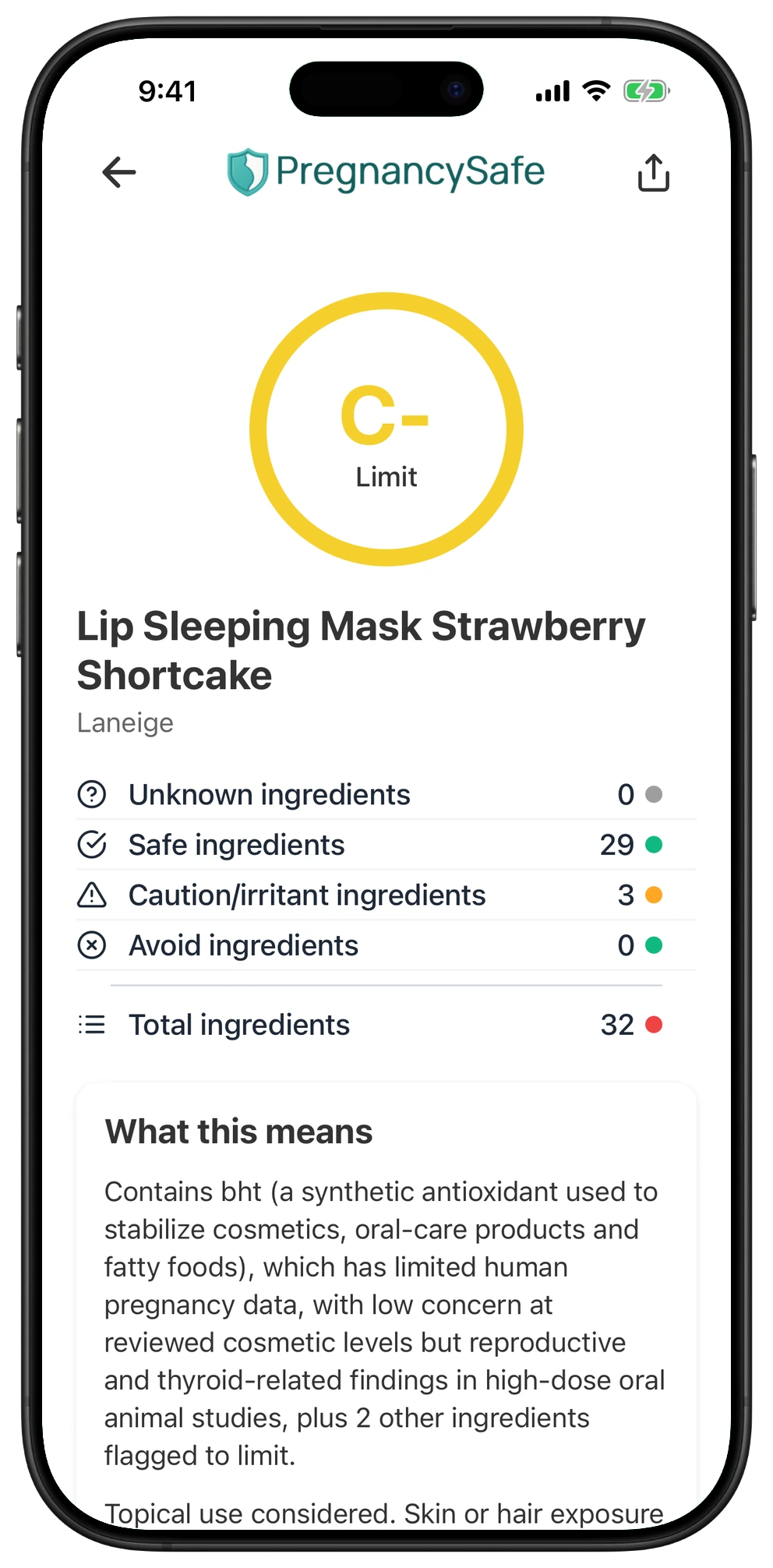
Has limited human pregnancy data, with low concern at reviewed cosmetic levels but reproductive and thyroid related findings in high dose oral animal studies.
Bht, or butylated hydroxytoluene, helps keep oils in a lip mask from oxidizing. Direct pregnancy data are limited, but cosmetic reviews support specified concentrations; high dose oral animal findings do not establish harm from normal topical lip use with small incidental oral exposure.
Flagged in 8 of 44 products (18%)
fragrance
Caution
A fragrant substance used to add a pleasant aroma to products or environments.
Can hide product specific mixtures and has been associated with higher DEP metabolite exposure in some pregnancy studies; fragrance allergens and VOCs may also irritate sensitive skin or airways.
Fragrance identifies a scent mixture whose individual components may not be disclosed. In lip masks, irritation or allergy is a practical concern; broader fragranced product studies do not prove that every mixture contains phthalates or that ordinary lip use harms pregnancy.
Flagged in 7 of 44 products (16%)
parfum
Caution
Parfum is a fragrant mixture of essential oils, aroma compounds, and solvents used to impart a pleasant scent.
Can hide product specific mixtures and has been associated with higher DEP metabolite exposure in some pregnancy studies; fragrance allergens and VOCs may also irritate sensitive skin or airways.
Parfum is another label term for fragrance, not a separate ingredient hazard. Choose a parfum free lip mask if scent irritates your lips; the term alone does not reveal the mixture or establish reproductive harm.
Flagged in 7 of 44 products (16%)
Caution
Phenoxyethanol is a preservative commonly used in cosmetics and skincare products to prevent microbial growth and extend shelf life.
Has limited direct pregnancy data and possible infant oral exposure concerns from nipple area products, while regulated cosmetic concentrations are generally considered low systemic risk.
Phenoxyethanol preserves cosmetic formulas against microbial growth. Reviews support regulated cosmetic concentrations, although direct pregnancy data are limited. Warnings about infant ingestion from nipple creams do not establish the same risk from ordinary maternal lip mask use.
Flagged in 7 of 44 products (16%)
fragrance parfum
Caution
A fragrant, concentrated scent used to enhance personal aroma and add a touch of elegance.
Can hide product specific mixtures and has been associated with higher DEP metabolite exposure in some pregnancy studies; fragrance allergens and VOCs may also irritate sensitive skin or airways.
Fragrance parfum is a combined label expression for a scent mixture, not evidence of two different hazardous ingredients. In a lip mask, consider your sensitivity to scented products; this wording does not establish the mixture's composition or fetal toxicity.
Flagged in 6 of 44 products (14%)
saccharin
Caution
Saccharin is a synthetic, calorie free sweetener commonly used as a sugar substitute in various food and beverage products.
Crosses the placenta and has limited pregnancy outcome data so frequent or high intake is best treated cautiously.
Saccharin is a sweetener that may make a lip mask taste sweet. Pregnancy concerns involve maternal ingestion and uncertain effects with frequent or high intake, not established harm from small incidental lip product exposure. Do not intentionally eat or repeatedly lick off the mask.
Flagged in 4 of 44 products (9%)
aluminum hydroxide
Caution
Aluminum hydroxide is a compound commonly used as an antacid to neutralize stomach acid and as an adjuvant in vaccines.
Is generally low concern for short term labeled antacid use but needs caution with chronic high dose use, kidney disease, constipation, or medication and iron interactions.
Aluminum hydroxide in a cosmetic lip mask is not an oral antacid dose. Cautions about prolonged high dose antacid use, kidney disease, and iron interactions should not be transferred to ordinary lip application; those sources do not establish a pregnancy hazard for this cosmetic exposure.
Flagged in 2 of 44 products (5%)
carica papaya fruit extract
Caution
Carica papaya fruit extract is a natural ingredient rich in enzymes and antioxidants, commonly used to promote skin exfoliation, brighten complexion, and support overall skin health.
Has oral uterine findings that do not establish a risk from normal topical cosmetic use, while direct pregnancy data are lacking and leaf or papain rich forms have added uncertainty or allergy concerns.
Carica papaya fruit extract is a papaya fruit derived cosmetic ingredient, distinct from papaya leaf or medicinal papain preparations. Cosmetic reviews support fruit derived ingredients as used, but direct pregnancy studies are lacking; oral and animal uterine findings do not establish harm from normal lip use. Papaya allergy and possible latex cross reactivity remain relevant.
Flagged in 2 of 44 products (5%)
How Do Lip Mask Products Stack Up?
Our catalog contains ratings for 44 lip mask products. These are database grades, not independent safety certifications.
Grades are catalog ingredient scores, not measurements of current labels, preparation, pathogens, dose or clinical pregnancy suitability. Unreviewed products remain in the aggregate counts.
Best Pregnancy Safe Lip Mask
Popular options from our catalog, prioritizing A and B ingredient grades, with C grade options used to fill remaining places. Within each group, products are ordered by searches in Pregnancy Safe, not retail sales. Read the cautions and guidance above; grades do not verify a complete current label or guarantee pregnancy safety.
| Grade | Product | Brand |
|---|---|---|
| B+ | Phyto-Glow Lip Mask | Naturium |
| B+ | Peptide Lip Boost Sugarmint Plumping Lip Mask | Rhode |
| B+ | Dr.Jart+ Vital Hydra Solution Hydrating Lip Mask | Dr.Jart+ |
| B+ | Strawberry Pound Cake Nourishing Lip Mask | Bath & Body Works |
| B+ | Pacifica Lavender Moon Lip Mask | Pacifica |
Your Questions Answered
What lip products should be avoided during pregnancy?
Avoid lip treatments containing retinoids during pregnancy. Discuss prescription or medicated lip products with your pregnancy clinician rather than judging them by a cosmetic grade. Stop products that irritate your lips, but do not assume fragrance, preservatives, or pigments automatically indicate fetal harm.
What face masks should I avoid while pregnant?
Avoid retinoid containing masks and discuss prescription or medicated treatments with your pregnancy clinician. A face mask and a lip mask are not interchangeable: check that the product is intended for the area where you apply it. Choose based on the exact ingredients and directions, not the word mask or a clean beauty claim.
Can I leave a lip mask on overnight during pregnancy?
Use a lip mask overnight only if its directions allow that wear time. Check for retinoids and ingredients that have irritated you before, and follow the labeled amount. Overnight lip care is optional cosmetic care, not a necessary prenatal treatment.
Are fragrance and preservatives in lip masks harmful to my baby?
Their presence alone does not establish fetal harm from normal lip use. Fragrance mixtures can cause irritation or allergy, and their composition may not be fully disclosed. Bht and phenoxyethanol have limited direct pregnancy data, but cosmetic safety reviews support their use at specified concentrations. High dose oral animal findings should not be treated as evidence of harm from ordinary topical exposure.
Do low grades mean I should stop using my lip mask?
No: catalog grades are ingredient scores, not measurements of dose or clinical pregnancy suitability. Our catalog contains 9 B+, 20 C+, 3 C, 11 C-, and 1 F lip masks, including records without an individual label review. A low grade does not by itself prove a product is unsafe, and incomplete information is not proof of harm. Check your exact label and read any qualifications attached to a listed product.
Do fruit extracts in lip masks carry the same risks as herbal supplements?
No: ingredient identity, plant part, route, and dose all matter. Raspberry juice is not raspberry leaf tea, and watermelon fruit extract is not a concentrated citrulline supplement. Oral papaya findings likewise do not establish harm from normal topical use of papaya fruit extract. Direct pregnancy evidence for these lip care exposures is limited, so neither a botanical name nor a natural label guarantees safety.
How to Interpret These Ratings
Our ingredient and category rules generate letter grades from the information recorded in the catalog. Missing ingredients and broad category assignments can affect the result. These grades do not measure your dose, confirm a complete current label, or test a product for contamination.
A high grade is not a guarantee of pregnancy safety. A low grade is not, by itself, proof of harm from every use. Follow the product-specific guidance above, check the actual package, and ask your prenatal clinician about supplements, treatment decisions or uncertain exposures.
People Also Checked
References
- https://www.aad.org/public/everyday-care/skin-care-secrets/routine/pregnancy-skin-care
- https://health.ec.europa.eu/system/files/2022-08/sccs_o_257.pdf
- https://pubmed.ncbi.nlm.nih.gov/37751543/
- https://pubmed.ncbi.nlm.nih.gov/12396675/
- https://pmc.ncbi.nlm.nih.gov/articles/PMC13151845/
- https://www.ecfr.gov/current/title-21/chapter-I/subchapter-B/part-172/subpart-B/section-172.115
- https://www.ecfr.gov/current/title-21/chapter-I/subchapter-B/part-182/subpart-D/section-182.3173
- https://www.fda.gov/news-events/press-announcements/fda-finalizes-food-chemical-safety-post-market-assessment-program-launches-reassessment-bht-ada
- https://www.fda.gov/cosmetics/cosmetic-ingredients/fragrances-cosmetics
- https://www.fda.gov/cosmetics/cosmetic-ingredients/phthalates-cosmetics
- https://www.fda.gov/cosmetics/cosmetic-ingredients/allergens-cosmetics
- https://pmc.ncbi.nlm.nih.gov/articles/PMC3110684/
- https://pmc.ncbi.nlm.nih.gov/articles/PMC4016195/
- https://pmc.ncbi.nlm.nih.gov/articles/PMC4097177/
- https://pmc.ncbi.nlm.nih.gov/articles/PMC8453372/
- https://pmc.ncbi.nlm.nih.gov/articles/PMC10999525/
- https://www.epa.gov/indoor-air-quality-iaq/volatile-organic-compounds-impact-indoor-air-quality
- https://health.ec.europa.eu/system/files/2021-08/sccs_o_195_0.pdf
- https://ec.europa.eu/growth/tools-databases/cosing/details/28157
- https://journals.sagepub.com/doi/10.3109/10915819009078737
- https://link.springer.com/article/10.1007/s00204-024-03938-5
- https://www.sfda.gov.sa/en/warnings/1156
- https://www.industrialchemicals.gov.au/sites/default/files/Ethanol%2C%202-phenoxy-_Human%20health%20tier%20II%20assessment.pdf
- https://hero.epa.gov/reference/2857875
- https://books.publisso.de/sites/default/files/documents/series/mak/dam/Vol2019/Iss1/Alt006/mb12299kske6319_w.pdf
- https://www.fda.gov/food/food-additives-petitions/aspartame-and-other-sweeteners-food
- https://apps.who.int/food-additives-contaminants-jecfa-database/Home/Chemical/3164
- https://www.efsa.europa.eu/en/news/saccharin-safety-threshold-increased
- https://pubmed.ncbi.nlm.nih.gov/34500483/
- https://pubmed.ncbi.nlm.nih.gov/3756841/
- https://pubmed.ncbi.nlm.nih.gov/32275895/
- https://www.acog.org/womens-health/experts-and-stories/ask-acog/are-diet-drinks-a-good-choice
- https://pubmed.ncbi.nlm.nih.gov/22777177/
- https://www.ncbi.nlm.nih.gov/books/NBK573943/
- https://pmc.ncbi.nlm.nih.gov/articles/PMC9439837/
- https://pmc.ncbi.nlm.nih.gov/articles/PMC2821234/
- https://dailymed.nlm.nih.gov/dailymed/drugInfo.cfm?setid=27848ae0-3b2f-4bfe-8856-4b8de419091e
- https://pubmed.ncbi.nlm.nih.gov/39249590/
- https://pubmed.ncbi.nlm.nih.gov/7565498/
- https://www.ncbi.nlm.nih.gov/books/NBK526049/
- https://www.cir-safety.org/sites/default/files/papaya032021FR.pdf
- https://pubmed.ncbi.nlm.nih.gov/29243540/
- https://www.fda.gov/drugs/unapproved-drugs/questions-and-answers-about-fdas-enforcement-action-regarding-unapproved-topical-drug-products
- https://pubmed.ncbi.nlm.nih.gov/25705851/
- https://pubmed.ncbi.nlm.nih.gov/18468758/
- https://pubmed.ncbi.nlm.nih.gov/12144723/