Best Pregnancy Safe Lash Serum (Updated 2026 Guide)
Updated September 9, 2026
The Answer
Avoid self starting prostaglandin analogue lash growth serums during pregnancy; a prostaglandin free formula still needs an ingredient and label check. Our catalog contains 10 products, including one graded A and six graded F, but these grades do not establish pregnancy suitability.
Lash growth products need different consideration from ordinary hydrating face serums: isopropyl cloprostenate has pharmacologic activity and unresolved reproductive safety concerns, although harm from typical cosmetic eye area exposure is not established. Many botanical flags rely on oral or animal evidence that cannot establish harm from small lash line applications, while phenoxyethanol at regulated cosmetic levels is not an automatic reason to avoid a serum. Eye irritation and pigment changes are separate concerns from pregnancy outcomes.
Pregnancy Safe is 100% independent and research driven. No companies pay to promote or sponsor products.
Stress Less This Pregnancy
Check your exact lash serum in the app

✓ What's Safe
- • Check the complete ingredient list for the exact formula and version you plan to buy, rather than relying on a product name or grade.
- • Look for confirmation that the formula contains no prostaglandin analogues, while recognizing that this does not establish pregnancy safety.
- • Distinguish lash conditioning ingredients such as glycerin and panthenol from ingredients marketed to stimulate growth; conditioning does not prove growth efficacy.
- • Choose products with clear eye area application instructions, amounts and warnings, and follow those limits if your clinician agrees to use.
- • Bring the full label to your pregnancy clinician before starting a lash growth serum, especially when active ingredients or botanical preparations are unclear.
✗ What to Avoid
- • Avoid cosmetic lash growth serums containing isopropyl cloprostenate during pregnancy; do not apply this advice to prescribed glaucoma treatment without your treating clinician.
- • Avoid choosing panax ginseng root extract or apigenin formulas solely because they are botanical; their oral exposure concerns do not prove lash line harm, but pregnancy evidence for this use is limited.
- • Avoid chamomilla recutita flower extract or calendula officinalis flower extract if you have a known allergy to these ingredients or related daisy family plants.
- • Avoid assuming cannabis sativa seed extract means either a CBD product or a verified cannabinoid free formula; seek clarification about the exact preparation.
- • Avoid treating phenoxyethanol or alcohol on a lash serum label as proof of fetal harm; regulated preservative use and topical solvent exposure differ from ingestion.
- • Avoid using more than the labeled amount or accepting peptide based, castor oil or pregnancy safe marketing as a substitute for formula specific evidence.
Most Common Ingredients in Lash Serum Products
We analyzed 10 lash serum products. Here are the most common ingredients, ranked by how often they appear:
Ingredients to Watch Out For in Lash Serum
These are the most common flagged ingredients across 10 lash serum products we analyzed.
Caution
Phenoxyethanol is a preservative commonly used in cosmetics and skincare products to prevent microbial growth and extend shelf life.
Has limited direct pregnancy data and possible infant oral exposure concerns from nipple area products, while regulated cosmetic concentrations are generally considered low systemic risk.
This preservative helps protect lash serum from microbial growth. Direct pregnancy data are limited, but regulated cosmetic concentrations are generally considered low systemic risk; infant ingestion warnings for nipple products do not establish harm from lash line use.
Flagged in 8 of 10 products (80%)
panax ginseng root extract
Avoid
Panax ginseng root extract is a traditional herbal ingredient known for its energizing, adaptogenic, and immune boosting properties.
Is not recommended as an oral supplement in pregnancy because human data are limited and animal or embryo culture ginsenoside studies raise developmental concerns.
This ginseng derived botanical has limited pregnancy evidence for lash line application. Oral supplement cautions and isolated ginsenoside embryo studies do not establish harm from a small cosmetic application, but they cannot confirm its pregnancy safety either.
Flagged in 4 of 10 products (40%)
alcohol
Caution
Alcohol is a volatile, colorless liquid commonly used as a solvent, disinfectant, or intoxicating beverage.
No amount of Alcohol is considered safe. Avoid alcohol beverages entirely. Be extremely careful when using in cooking or even with small percentages.
Alcohol can serve as a solvent in lash serum. Pregnancy warnings about drinking alcohol should not be transferred to small topical applications; the label alone does not establish the concentration or absorbed dose.
Flagged in 3 of 10 products (30%)
apigenin
Caution
Apigenin is a natural flavonoid found in various plants, known for its antioxidant, anti inflammatory, and potential anticancer properties.
Is low concern in normal food amounts but lacks direct pregnancy safety data as an isolated high dose supplement.
Apigenin is a plant flavonoid included in some lash formulas. Concerns about isolated high dose supplements do not establish risk from lash line exposure, for which direct pregnancy safety evidence is lacking.
Flagged in 2 of 10 products (20%)
chamomilla recutita flower extract
Caution
Chamomilla recutita flower extract is a soothing botanical ingredient known for its calming and anti inflammatory properties.
Has limited and mixed pregnancy data with lower concern for occasional tea or food flavoring than for regular high dose oral supplements, tinctures, or essential oils.
This German chamomile flower extract is a botanical used in cosmetic formulas. Pregnancy findings from teas and medicinal preparations cannot establish risk for lash serum application; allergy is a clearer concern if you react to chamomile or related daisy family plants.
Flagged in 2 of 10 products (20%)
hibiscus sabdariffa flower extract
Caution
Hibiscus sabdariffa flower extract is a natural antioxidant rich ingredient derived from the vibrant calyces of the hibiscus plant, known for its tart flavor and vibrant color.
Has limited human pregnancy safety data; medicinal teas or supplements may lower blood pressure and uterine or menstrual effects are uncertain.
This hibiscus derived botanical lacks direct pregnancy safety evidence for lash serum use. Blood pressure effects from oral preparations and developmental findings from animal extract studies should not be presented as established effects of a small lash line application.
Flagged in 2 of 10 products (20%)
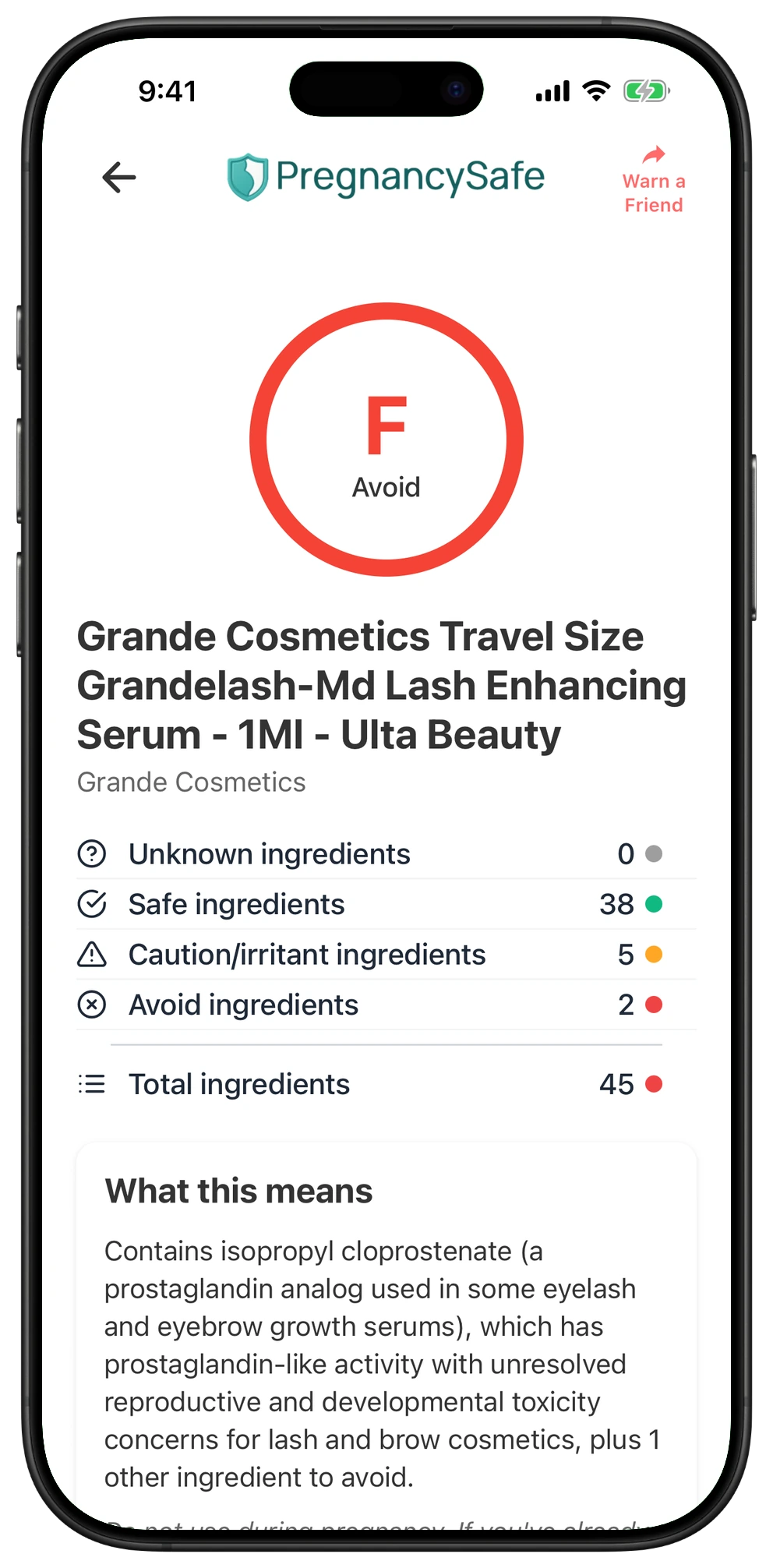
isopropyl cloprostenate
Avoid
Has prostaglandin like activity with unresolved reproductive and developmental toxicity concerns for lash and brow cosmetics.
This prostaglandin analogue is used to promote lash or brow growth. Avoid cosmetic use during pregnancy because of potent pharmacologic activity and unresolved reproductive safety concerns; this precaution does not mean typical past application has been shown to cause fetal harm.
Flagged in 2 of 10 products (20%)
aloe barbadensis leaf juice
Caution
Aloe barbadensis leaf juice is a soothing, hydrating extract derived from the aloe vera plant's leaves, commonly used in skincare for its moisturizing and healing properties.
Is low concern on skin but oral latex, whole leaf, laxative, supplement, or juice forms may stimulate uterine contractions and cause laxative related fluid or electrolyte imbalance.
This aloe derived cosmetic ingredient is generally low concern when used topically on skin rather than ingested. Oral aloe latex and whole leaf laxative warnings do not establish the same risk for a lash serum, and skin use evidence does not guarantee eye area tolerability.
Flagged in 1 of 10 products (10%)
How Do Lash Serum Products Stack Up?
Our catalog contains ratings for 10 lash serum products. These are database grades, not independent safety certifications.
Ingredient grades cannot establish dose, preparation, label completeness, efficacy or pregnancy suitability. An A score is not an endorsement, and counts include unreviewed catalog records.
Your Questions Answered
Can I use lash serum during pregnancy?
Do not self start a prostaglandin analogue lash growth serum during pregnancy. These cosmetic growth products have unresolved reproductive safety questions and are not equivalent to ordinary face moisturizers. For other formulas, discuss the exact ingredients and application instructions with your pregnancy clinician rather than relying on a pregnancy safe label.
Are prostaglandin free or peptide lash serums pregnancy safe?
Prostaglandin free formulas avoid one important ingredient class, but the claim does not establish pregnancy safety for the finished product. Peptide based marketing also does not demonstrate lash growth efficacy or pregnancy suitability. Cosmetic peptides should not automatically be described as hormones. Check the whole formula, intended eye area use and manufacturer warnings.
What is isopropyl cloprostenate, and why should I avoid it?
Isopropyl cloprostenate is a prostaglandin analogue used in some lash and brow growth serums. The February 2026 final SCCS opinion concluded that this and two other assessed analogues could not be considered safe for cosmetic lash/brow growth, citing potent drug like activity and unresolved reproductive/developmental safety. Avoid this optional cosmetic exposure during pregnancy; the opinion does not establish harm from an individual past application.
What if I used lash serum before knowing I was pregnant?
Past use alone does not establish that your baby was harmed. Check the exact label and discuss the ingredient list, amount, frequency and dates of use with your pregnancy clinician. If it contains a prostaglandin analogue, pause the cosmetic serum while seeking advice. Do not stop prescribed glaucoma eye drops on your own; those require a separate treatment decision.
Are botanical or castor oil lash formulas safer?
A plant based formula is not automatically proven safe or effective for lash growth during pregnancy. Concerns about ingredients such as panax ginseng root extract and hibiscus sabdariffa flower extract largely involve oral preparations or animal exposures, not typical lash line application. Those findings cannot establish fetal harm from a cosmetic serum, but they also do not demonstrate its safety. Botanical allergy remains a separate consideration near the eyes.
Does an A grade mean a lash serum is safe during pregnancy?
No. Our catalog contains one A graded product, but an ingredient grade cannot establish dose, label completeness, eye area tolerability, efficacy or pregnancy suitability. Counts include catalog records that have not been independently label reviewed, and an F grade does not by itself prove a product is unsafe. No lash serum is endorsed here as a pregnancy safe growth treatment.
How to Interpret These Ratings
Our ingredient and category rules generate letter grades from the information recorded in the catalog. Missing ingredients and broad category assignments can affect the result. These grades do not measure your dose, confirm a complete current label, or test a product for contamination.
A high grade is not a guarantee of pregnancy safety. A low grade is not, by itself, proof of harm from every use. Follow the product-specific guidance above, check the actual package, and ask your prenatal clinician about supplements, treatment decisions or uncertain exposures.
People Also Checked
See our full guide to serum during pregnancy.
References
- https://health.ec.europa.eu/publications/sccs-prostaglandin-analogues-methylamido-dihydro-noralfaprostal-mdn-isopropyl-cloprostenate-ipcp_en
- https://health.ec.europa.eu/system/files/2021-08/sccs_o_195_0.pdf
- https://ec.europa.eu/growth/tools-databases/cosing/details/28157
- https://journals.sagepub.com/doi/10.3109/10915819009078737
- https://link.springer.com/article/10.1007/s00204-024-03938-5
- https://www.sfda.gov.sa/en/warnings/1156
- https://www.industrialchemicals.gov.au/sites/default/files/Ethanol%2C%202-phenoxy-_Human%20health%20tier%20II%20assessment.pdf
- https://hero.epa.gov/reference/2857875
- https://books.publisso.de/sites/default/files/documents/series/mak/dam/Vol2019/Iss1/Alt006/mb12299kske6319_w.pdf
- https://www.nccih.nih.gov/health/asian-ginseng
- https://www.ema.europa.eu/en/documents/herbal-report/draft-assessment-report-panax-ginseng-camey-radix-revision-1_en.pdf
- https://pubmed.ncbi.nlm.nih.gov/18204104/
- https://pubmed.ncbi.nlm.nih.gov/14507839/
- https://pubmed.ncbi.nlm.nih.gov/15834894/
- https://pubmed.ncbi.nlm.nih.gov/15336721/
- https://pubmed.ncbi.nlm.nih.gov/20091796/
- https://mothertobaby.org/fact-sheets/herbal-products-pregnancy/
- https://pubmed.ncbi.nlm.nih.gov/26240050/
- https://pmc.ncbi.nlm.nih.gov/articles/PMC12045525/
- https://pubmed.ncbi.nlm.nih.gov/33098770/
- https://pmc.ncbi.nlm.nih.gov/articles/PMC7675036/
- https://pmc.ncbi.nlm.nih.gov/articles/PMC11504338/
- https://www.ncbi.nlm.nih.gov/books/NBK501808/
- https://www.nccih.nih.gov/health/chamomile
- https://www.ema.europa.eu/en/documents/herbal-monograph/final-european-union-herbal-monograph-matricaria-recutita-l-flos-first-version_en.pdf
- https://www.ema.europa.eu/en/documents/herbal-monograph/final-community-herbal-monograph-chamaemelum-nobile-l-all-flos_en.pdf
- https://pubmed.ncbi.nlm.nih.gov/22516883/
- https://pubmed.ncbi.nlm.nih.gov/20872924/
- https://www.ecfr.gov/current/title-21/chapter-I/subchapter-B/part-182/subpart-A/section-182.10
- https://www.ncbi.nlm.nih.gov/books/NBK501882/
- https://pubmed.ncbi.nlm.nih.gov/19434218/
- https://pubmed.ncbi.nlm.nih.gov/18066103/
- https://pmc.ncbi.nlm.nih.gov/articles/PMC9086798/
- https://www.nccih.nih.gov/health/hypertension-high-blood-pressure
- https://www.ffhdj.com/index.php/ffhd/article/view/1768
- https://www.canada.ca/en/health-canada/services/consumer-product-safety/cosmetics/cosmetic-ingredient-hotlist-prohibited-restricted-ingredients/hotlist.html
- https://www.fda.gov/cosmetics/warning-letters-related-cosmetics/warning-letters-address-drug-claims-made-products-marketed-cosmetics
- https://dailymed.nlm.nih.gov/dailymed/drugInfo.cfm?setid=2c997c76-fd01-479a-a005-dbdb375560a4
- https://pmc.ncbi.nlm.nih.gov/articles/PMC8243098/
- https://pmc.ncbi.nlm.nih.gov/articles/PMC9052104/
- https://uktis.org/monographs/use-of-latanoprost-in-pregnancy/
- https://assets.publishing.service.gov.uk/media/67472647886c31e352d8d0b4/prostaglandin-analogues-in-cosmetics.pdf
- https://dailymed.nlm.nih.gov/dailymed/lookup.cfm?setid=34f83d9d-2c64-463e-8a90-9a460fedfead
- https://dailymed.nlm.nih.gov/dailymed/lookup.cfm?setid=19cdfef0-b770-4758-8f59-1769e4b6119c
- https://pubmed.ncbi.nlm.nih.gov/34797554/
- https://pubmed.ncbi.nlm.nih.gov/35482340/
- https://www.nccih.nih.gov/health/aloe-vera
- https://webprod.hc-sc.gc.ca/nhpid-bdipsn/dbImages/mono_aloe--oral_english.pdf
- https://www.ema.europa.eu/en/documents/herbal-monograph/final-european-union-herbal-monograph-aloe-barbadensis-mill-and-aloe-various-species-mainly-aloe-ferox-mill-and-its-hybrids-folii-succus-siccatus_en.pdf
- https://www.utep.edu/herbal-safety/populations/herbs-to-avoid-during-pregnancy.html
- https://www.federalregister.gov/documents/2002/05/09/02-11510/status-of-certain-additional-over-the-counter-drug-category-ii-and-iii-active-ingredients
- https://pubmed.ncbi.nlm.nih.gov/33164294/
- https://pubmed.ncbi.nlm.nih.gov/28139161/
- https://journals.sagepub.com/doi/10.1080/10915810701351186
- https://www.ema.europa.eu/en/documents/herbal-monograph/final-european-union-herbal-monograph-calendula-officinalis-l-flos-revision-1_en.pdf
- https://www.ema.europa.eu/en/documents/herbal-report/final-assessment-report-calendula-officinalis-l-flos-revision-1_en.pdf
- https://www.ema.europa.eu/en/documents/herbal-report/addendum-assessment-report-calendula-officinalis-l-flos-revision-1_en.pdf
- https://pubmed.ncbi.nlm.nih.gov/19288530/
- https://pubmed.ncbi.nlm.nih.gov/11558637/
- https://www.ncbi.nlm.nih.gov/books/NBK501857/
- https://www.mskcc.org/cancer-care/integrative-medicine/herbs/calendula
- https://www.acog.org/clinical/clinical-guidance/clinical-consensus/articles/2025/10/cannabis-use-during-pregnancy-and-lactation
- https://www.acog.org/womens-health/faqs/marijuana-and-pregnancy
- https://www.cdc.gov/cannabis/health-effects/pregnancy.html
- https://www.fda.gov/consumers/consumer-updates/what-you-should-know-about-using-cannabis-including-cbd-when-pregnant-or-breastfeeding
- https://mothertobaby.org/fact-sheets/marijuana-pregnancy/
- https://pubmed.ncbi.nlm.nih.gov/40323610/
- https://pubmed.ncbi.nlm.nih.gov/37968824/
- https://pubmed.ncbi.nlm.nih.gov/39037795/
- https://www.cdc.gov/breastfeeding-special-circumstances/hcp/vaccine-medication-drugs/marijuana.html
- https://www.hhs.gov/surgeongeneral/reports-and-publications/addiction-and-substance-misuse/advisory-on-marijuana-use-and-developing-brain/index.html
- https://www.ncbi.nlm.nih.gov/books/NBK501587/
- https://doi.org/10.1001/jamapediatrics.2025.0689