Best Pregnancy Safe Mascara (Updated 2026 Guide)
Updated September 9, 2026
The Answer
Ordinary mascara use on your lashes is not established as a pregnancy hazard; choose a clearly labeled formula and prioritize eye hygiene rather than clean claims. Our catalog contains 443 products with grades ranging from A to F, but those ingredient scores are not clinical pregnancy safety verdicts.
The practical priorities are avoiding contaminated mascara, preventing eye irritation, and distinguishing cosmetic mascara from lash growth medicines. Phenoxyethanol, parabens, and bht carry evidence qualifications, but their presence at regulated cosmetic levels does not establish fetal harm from normal lash application. Findings from high dose ingestion, occupational exposure, or breastfeeding related infant ingestion should not be treated as evidence about ordinary mascara use.
Pregnancy Safe is 100% independent and research driven. No companies pay to promote or sponsor products.
Stress Less This Pregnancy
Check your exact mascara in the app

✓ What's Safe
- • Check the complete ingredient list on the current package, matching the exact shade and waterproof or washable version.
- • Choose a product labeled for cosmetic lash use; assess lash growth medicines separately rather than treating them as mascara.
- • Look for clear shelf life and use instructions, and keep track of when you opened the tube.
- • Choose a formula without ingredients that have previously irritated your eyes; natural ingredients are not automatically nonirritating.
- • Use listed products as a starting point, checking their qualifications rather than treating an A grade as a safety guarantee.
✗ What to Avoid
- • Avoid shared, expired, or contaminated mascara, regardless of its ingredient score.
- • Do not add water or saliva to thin mascara or revive a dried out tube.
- • Avoid applying mascara during an eye infection or to damaged surrounding skin, and stop using it if irritation develops.
- • If you prefer to reduce paraben exposure, choose a formula without propylparaben, methylparaben, or ethylparaben; this is optional precaution, not evidence that regulated mascara containing them harms pregnancy.
- • Avoid treating phenoxyethanol or triethanolamine on a label as an automatic danger signal, or choosing an inadequately labeled product simply because it claims to exclude them.
Most Common Ingredients in Mascara Products
We analyzed 443 mascara products. Here are the most common ingredients, ranked by how often they appear:
Ingredients to Watch Out For in Mascara
These are the most common flagged ingredients across 443 mascara products we analyzed.
Caution
Phenoxyethanol is a preservative commonly used in cosmetics and skincare products to prevent microbial growth and extend shelf life.
Has limited direct pregnancy data and possible infant oral exposure concerns from nipple area products, while regulated cosmetic concentrations are generally considered low systemic risk.
Phenoxyethanol preserves mascara against microbial growth. Direct pregnancy data are limited, but reviewed cosmetic concentrations are considered low systemic concern. Warnings involving infant ingestion from nipple creams do not establish a risk from normal lash application.
Flagged in 325 of 443 products (73%)
triethanolamine
Caution
Triethanolamine is an organic compound commonly used as a pH balancer and emulsifier in cosmetics and personal care products.
Has limited direct pregnancy data and should only be considered low concern in well formulated cosmetics that avoid nitrosating systems and excess nitrosamine impurities.
Triethanolamine adjusts pH and helps emulsify mascara. Its main qualification concerns nonirritating formulation and controls against nitrosamine formation, which an ingredient list alone cannot verify. Direct pregnancy data for cosmetic use are lacking, and it should not be confused with diethanolamine or monoethanolamine.
Flagged in 95 of 443 products (21%)
methylparaben
Caution
Methylparaben is a synthetic preservative commonly used in cosmetics and personal care products to inhibit microbial growth and extend shelf life.
Has mixed human pregnancy biomonitoring signals and weak endocrine activity, while regulated cosmetic levels are generally considered low concern.
Methylparaben is a short chain preservative that helps protect mascara from microbial growth. Pregnancy biomonitoring findings are mixed and do not establish harm from normal mascara use. Reviewed cosmetic levels are considered low concern; choosing a formula without it is an optional exposure reduction preference.
Flagged in 47 of 443 products (11%)
bht
Caution
BHT (butylated hydroxytoluene) is a synthetic antioxidant commonly used as a preservative to prevent the oxidation of fats and oils in food products.
Has limited human pregnancy data, with low concern at reviewed cosmetic levels but reproductive and thyroid related findings in high dose oral animal studies.
Bht, or butylated hydroxytoluene, helps protect a mascara's oily ingredients from oxidation. Reproductive concerns largely come from high dose oral animal studies, not ordinary lash application. Human pregnancy data are limited, but reviewed topical cosmetic concentrations are considered low concern.
Flagged in 41 of 443 products (9%)
propylparaben
Caution
Propylparaben is a synthetic preservative commonly used in cosmetics and personal care products to inhibit microbial growth and extend shelf life.
Has mixed pregnancy biomonitoring signals and weak endocrine activity, but regulated cosmetic concentrations are considered low concern by FDA, SCCS and CIR.
Propylparaben preserves mascara and has greater endocrine related concern than shorter chain methylparaben or ethylparaben. Pregnancy observational findings remain mixed, without consistent causal evidence of harm at cosmetic use levels. A propylparaben free formula is an optional precaution, not a medically established requirement for mascara.
Flagged in 36 of 443 products (8%)
magnesium aluminum silicate
Caution
Magnesium aluminum silicate is a naturally occurring mineral used as a thickening, stabilizing, and anti caking agent in various cosmetic and pharmaceutical products.
Has developmental concern at higher chronic exposures, but regulated vaccine adjuvants and occasional clinician directed antacid use should be considered separately.
Magnesium aluminum silicate is a mineral thickener and stabilizer used in mascara. Evidence about high chronic aluminum ingestion or occupational exposure is not direct evidence about this compound applied to lashes. Its aluminum related caution does not establish a pregnancy hazard from ordinary mascara use.
Flagged in 28 of 443 products (6%)
talc
Caution
Talc is a soft mineral composed primarily of magnesium, silicon, and oxygen, commonly used in cosmetics and personal care products for its absorbent and smoothing properties.
Has limited pregnancy specific data plus contamination and inhalation concerns with loose body powders, while modern asbestos tested pressed cosmetics appear lower concern.
Talc can contribute texture and absorbency to cosmetics, including mascara. Loose powder inhalation concerns should not be transferred directly to talc incorporated into a wet mascara formula, though raw material contamination remains a separate quality issue. An ingredient label or grade does not verify asbestos testing, and pregnancy specific topical evidence is limited.
Flagged in 23 of 443 products (5%)
hydrogenated palm oil
Caution
Hydrogenated palm oil is a processed form of palm oil that has been chemically altered to become solid at room temperature, often used in baked goods and processed foods.
Mainly raise concern when partially hydrogenated and high in artificial trans fat; fully hydrogenated oils are mostly a saturated fat limit rather than the same trans fat issue.
Hydrogenated palm oil is palm derived oil hardened to change its consistency and can contribute to mascara texture. Dietary concerns about eating partially hydrogenated oils do not establish harm from applying this ingredient to lashes. The name alone also does not establish that it is partially hydrogenated or high in trans fat.
Flagged in 22 of 443 products (5%)
How Do Mascara Products Stack Up?
Our catalog contains ratings for 443 mascara products. These are database grades, not independent safety certifications.
Catalog ingredient scores are not clinical pregnancy verdicts or independent current-label/contaminant checks. Unreviewed, mixed-route or incompletely sourced records can affect counts. Follow exact product form, active ingredients, exposure and directions rather than choosing solely by grade.
Best Pregnancy Safe Mascara
Popular options from our catalog, prioritizing A and B ingredient grades, with C grade options used to fill remaining places. Within each group, products are ordered by searches in Pregnancy Safe, not retail sales. Read the cautions and guidance above; grades do not verify a complete current label or guarantee pregnancy safety.
| Grade | Product | Brand |
|---|---|---|
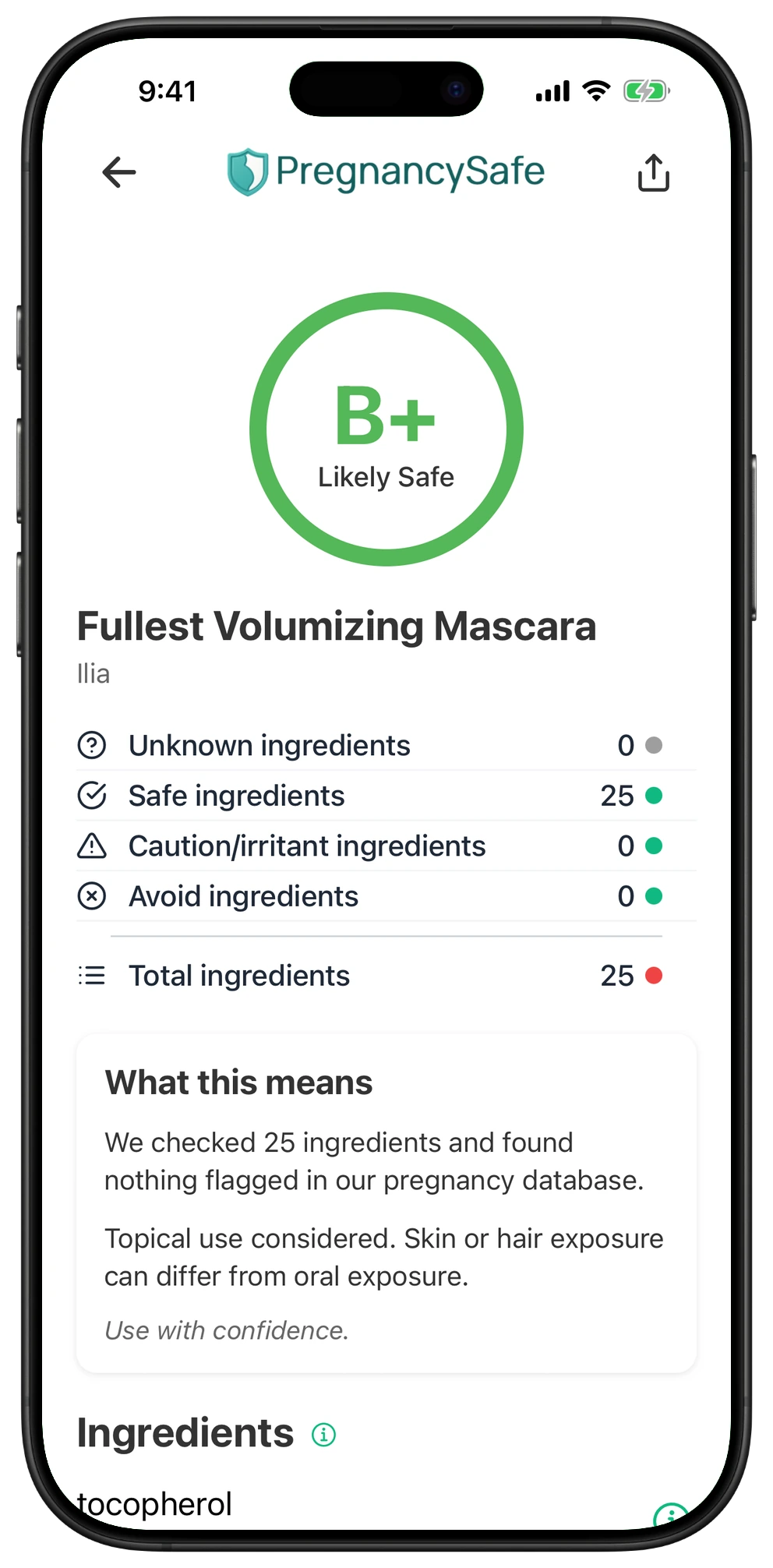
| B+ | Fullest Volumizing Mascara | Ilia |
| B+ | L'Oreal Paris Makeup Lash Paradise Mascara, Instant Volume And Length, Latte Brown | L'Oreal Paris |
| B+ | Burt'S Bees Multi Benefit Mascara | Burt'S Bees |
| A | Mascara 101 - Lengthening And Lifting | Blinktrends |
| B+ | Limitless Lash Mascara | Ilia |
Your Questions Answered
Which mascara is safe during pregnancy?
Choose an ordinary cosmetic mascara with a complete current label, clear use instructions, and a formula your eyes tolerate. No ingredient grade or natural claim can guarantee pregnancy safety. A listed product here is a comparison option, not a clinical endorsement or a contaminant tested guarantee. Match the exact version and check the package before buying.
What makeup brands are safe during pregnancy?
Assess the specific formula rather than assuming every product from one brand has the same safety profile. Shades, waterproof versions, and reformulations can have different labels. A clean or natural brand claim is not pregnancy certification. For mascara, the product's intended use, current ingredients, shelf life, and your eye tolerance matter more than the brand name.
Does makeup cross the placenta?
Some cosmetic ingredients can be absorbed through skin, but absorption alone does not establish placental transfer at a harmful dose. Exposure depends on the ingredient, concentration, application area, and condition of the skin. Normal lash application is not equivalent to swallowing an ingredient or receiving a high experimental dose. The evidence described here does not establish fetal harm from ordinary mascara use.
Should I avoid preservatives in mascara?
Preservatives help prevent microbial growth, so preservative free is not automatically a safer choice for eye makeup. Phenoxyethanol is considered acceptable at reviewed cosmetic concentrations, although direct pregnancy outcome data are limited. Methylparaben, ethylparaben, and propylparaben have mixed observational pregnancy findings rather than consistent proof of harm at cosmetic use levels. You can choose a paraben free formula as a preference without assuming every preserved mascara is unsafe.
Is peptide mascara the same as a lash growth serum?
No: peptides in a cosmetic mascara are not automatically hormones or prostaglandin lash growth drugs. Mascara coats lashes, whereas a lash growth medicine requires a separate assessment of its active ingredient and directions. Do not extend reassurance about ordinary mascara to a medicinal lash treatment. If you use a lash growth medicine, ask your prescriber about pregnancy use.
Does a low mascara grade mean I should stop using it?
A low grade alone does not establish that a mascara is unsafe during pregnancy. Ingredient scores can reflect indirect evidence, different exposure routes, or incomplete product information, and they do not verify current labels or contaminants. Check the exact formula and the reason for each concern before deciding to switch. Stop using mascara if it irritates your eyes, and do not use expired or contaminated eye makeup whatever its grade.
How to Interpret These Ratings
Our ingredient and category rules generate letter grades from the information recorded in the catalog. Missing ingredients and broad category assignments can affect the result. These grades do not measure your dose, confirm a complete current label, or test a product for contamination.
A high grade is not a guarantee of pregnancy safety. A low grade is not, by itself, proof of harm from every use. Follow the product-specific guidance above, check the actual package, and ask your prenatal clinician about supplements, treatment decisions or uncertain exposures.
People Also Checked
References
- https://www.fda.gov/cosmetics/resources-consumers-cosmetics/cosmetics-pregnancy
- https://health.ec.europa.eu/system/files/2021-08/sccs_o_195_0.pdf
- https://ec.europa.eu/growth/tools-databases/cosing/details/28157
- https://journals.sagepub.com/doi/10.3109/10915819009078737
- https://link.springer.com/article/10.1007/s00204-024-03938-5
- https://www.sfda.gov.sa/en/warnings/1156
- https://www.industrialchemicals.gov.au/sites/default/files/Ethanol%2C%202-phenoxy-_Human%20health%20tier%20II%20assessment.pdf
- https://hero.epa.gov/reference/2857875
- https://books.publisso.de/sites/default/files/documents/series/mak/dam/Vol2019/Iss1/Alt006/mb12299kske6319_w.pdf
- https://pubmed.ncbi.nlm.nih.gov/23696578/
- https://health.ec.europa.eu/document/download/ac80d106-eb65-4248-a2f8-dde5d9d9996f_en
- https://www.industrialchemicals.gov.au/sites/default/files/Ethanol%2C%202%2C2%27%2C2%27%27-nitrilotris-_Human%20health%20tier%20II%20assessment.pdf
- https://www.ncbi.nlm.nih.gov/books/NBK390891/
- https://www.govinfo.gov/content/pkg/FR-2009-08-05/html/E9-18698.htm
- https://pubmed.ncbi.nlm.nih.gov/15213765/
- https://pubmed.ncbi.nlm.nih.gov/21673209/
- https://www.fda.gov/cosmetics/cosmetic-ingredients/parabens-cosmetics
- https://health.ec.europa.eu/system/files/2023-12/sccs_o_276_final.pdf
- https://pubmed.ncbi.nlm.nih.gov/19101832/
- https://pubmed.ncbi.nlm.nih.gov/32283359/
- https://pubmed.ncbi.nlm.nih.gov/33477047/
- https://pubmed.ncbi.nlm.nih.gov/36709902/
- https://pubmed.ncbi.nlm.nih.gov/40117576/
- https://pubmed.ncbi.nlm.nih.gov/27156397/
- https://health.ec.europa.eu/system/files/2022-08/sccs_o_257.pdf
- https://pubmed.ncbi.nlm.nih.gov/37751543/
- https://pubmed.ncbi.nlm.nih.gov/12396675/
- https://pmc.ncbi.nlm.nih.gov/articles/PMC13151845/
- https://www.ecfr.gov/current/title-21/chapter-I/subchapter-B/part-172/subpart-B/section-172.115
- https://www.ecfr.gov/current/title-21/chapter-I/subchapter-B/part-182/subpart-D/section-182.3173
- https://www.fda.gov/news-events/press-announcements/fda-finalizes-food-chemical-safety-post-market-assessment-program-launches-reassessment-bht-ada
- https://health.ec.europa.eu/publications/propylparaben_en
- https://journals.sagepub.com/doi/10.1177/1091581820925001
- https://pubmed.ncbi.nlm.nih.gov/32279061/
- https://pubmed.ncbi.nlm.nih.gov/30412856/
- https://pubmed.ncbi.nlm.nih.gov/32521303/
- https://pubmed.ncbi.nlm.nih.gov/35487354/
- https://pubmed.ncbi.nlm.nih.gov/16097138/
- https://wwwn.cdc.gov/TSP/ToxProfiles/ToxProfiles.aspx?id=191&tid=34
- https://pmc.ncbi.nlm.nih.gov/articles/PMC9681673/
- https://pmc.ncbi.nlm.nih.gov/articles/PMC10809980/
- https://www.cdc.gov/vaccine-safety/about/adjuvants.html
- https://www.fda.gov/vaccines-blood-biologics/safety-availability-biologics/common-ingredients-fda-approved-vaccines
- https://www.acog.org/womens-health/infographics/vaccines-during-pregnancy
- https://www.fda.gov/cosmetics/cosmetic-ingredients/talc
- https://www.fda.gov/cosmetics/cosmetics-news-events/fda-releases-data-agencys-2023-testing-talc-containing-cosmetic-products-asbestos
- https://www.federalregister.gov/documents/2025/11/28/2025-21407/testing-methods-for-detecting-and-identifying-asbestos-in-talc-containing-cosmetic-products
- https://publications.iarc.who.int/Book-And-Report-Series/Iarc-Monographs-On-The-Identification-Of-Carcinogenic-Hazards-To-Humans/Talc-And-Acrylonitrile-2025
- https://www.cancer.org/cancer/risk-prevention/chemicals/talcum-powder-and-cancer.html
- https://www.cdc.gov/niosh/npg/npgd0584.html
- https://pmc.ncbi.nlm.nih.gov/articles/PMC6310682/
- https://recalls-rappels.canada.ca/en/alert-recall/talc-health-risks-associated-inhalation-and-exposure-female-genital-area
- https://www.fda.gov/food/food-additives-petitions/trans-fat
- https://www.fda.gov/food/hfp-constituent-updates/fda-completes-final-administrative-actions-partially-hydrogenated-oils-foods
- https://www.federalregister.gov/documents/2013/11/08/2013-26854/tentative-determination-regarding-partially-hydrogenated-oils-request-for-comments-and-for
- https://www.who.int/news-room/fact-sheets/detail/trans-fat
- https://cdn.realfood.gov/DGA.pdf
- https://www.fda.gov/food/people-risk-foodborne-illness/dietary-advice-and-during-pregnancy
- https://www.rcpi.ie/Portals/0/Document%20Repository/Institute%20of%20Obstetricians%20and%20Gynaecologists/National%20Clinical%20Guidelines/IOG_National%20Clinical%20Guidelines_Nutrition%20in%20pregnancy%20Guideline_2019.pdf
- https://pmc.ncbi.nlm.nih.gov/articles/PMC8027310/
- https://pmc.ncbi.nlm.nih.gov/articles/PMC3192475/
- https://ec.europa.eu/health/scientific_committees/consumer_safety/docs/sccs_o_132.pdf
- https://pubmed.ncbi.nlm.nih.gov/34474324/
- https://pubmed.ncbi.nlm.nih.gov/29596967/