Is Nuts Safe During Pregnancy? (Updated 2026 Guide)
Updated September 9, 2026
The Answer
Yes, ordinary nuts can be eaten during pregnancy unless you are allergic or your healthcare professional advises otherwise. Our catalog contains 7,481 A grade records among 8,106 products, but ingredient grades are not independent pregnancy safety verification.
Your main considerations are allergies, appropriate portions, storage, and whether you are eating ordinary nuts or a sweetened or heavily flavored snack. Added sugars and partially hydrogenated soybean oil warrant attention, while food dye cautions reflect limited pregnancy evidence rather than established fetal harm from occasional food exposure. Normal horseradish seasoning amounts are also different from medicinal preparations or large regular doses.
Pregnancy Safe is 100% independent and research driven. No companies pay to promote or sponsor products.
Stress Less This Pregnancy
Check your exact nuts in the app

✓ What's Safe
- • Choose plain nuts as an everyday option, and compare added sugars when buying coated varieties.
- • Read the actual package’s ingredient list and allergen information, including on mixed nuts and flavored coatings.
- • Use the labeled serving size as a starting point rather than eating directly from a large bag.
- • Follow the package’s storage instructions before and after opening.
- • Distinguish ordinary edible nuts from concentrated oils or supplements; the same pregnancy guidance does not automatically apply.
✗ What to Avoid
- • Avoid nuts you are allergic to, and follow any individualized restrictions from your healthcare professional.
- • Avoid eating nuts that have not been stored according to their package instructions.
- • Limit frequent large portions of sugary coatings, including those made with high fructose corn syrup; occasional intake is not a known cause of birth defects.
- • Choose an alternative if the current ingredient list includes partially hydrogenated soybean oil; fully hydrogenated oil is not the same trans fat concern.
- • Limit frequent dyed coatings containing red 40, yellow 5, blue 1, or red 3 without treating an occasional serving as evidence of fetal harm.
- • Avoid treating concentrated nut oils, supplements, or large medicinal doses of flavoring herbs as equivalent to an ordinary nut snack.
Most Common Ingredients in Nuts Products
We analyzed 8,106 nuts products. Here are the most common ingredients, ranked by how often they appear:
Ingredients to Watch Out For in Nuts
These are the most common flagged ingredients across 8,106 nuts products we analyzed.
Caution
Red 40 is a synthetic food dye commonly used to add vibrant red color to candies, beverages, and processed foods.
Has limited human pregnancy data and is allowed at regulated food additive levels, but child neurobehavior concerns and high dose animal findings make frequent high dye intake worth limiting.
Flagged in 33 of 8,106 products (0%)
yellow 5
Caution
Yellow 5 is a synthetic food dye used to impart a bright yellow color to various processed foods and beverages.
Has limited human pregnancy data, rare hypersensitivity labeling concerns, and animal/children's neurobehavior signals despite regulated dietary use under ADI based limits.
Flagged in 22 of 8,106 products (0%)
horseradish
Caution
Horseradish is a pungent root vegetable known for its sharp, spicy flavor often used to add heat to sauces and condiments.
Is generally compatible at normal condiment amounts but should be avoided in medicinal products or large regular doses due to limited pregnancy data and possible uterine and irritant effects.
Flagged in 15 of 8,106 products (0%)
blue 1
Caution
Blue 1 is a synthetic blue dye commonly used to add vibrant color to foods, beverages, and cosmetics.
Has limited human pregnancy data; regulated food use is not shown to cause fetal harm, but high dose animal neurobehavior findings and child sensitivity concerns support minimizing frequent exposure.
Flagged in 13 of 8,106 products (0%)
high fructose corn syrup
Caution
High fructose corn syrup is a sweet, liquid sweetener made from corn starch, commonly used in processed foods and beverages.
Is not a known teratogen at occasional food amounts, but high added sugar intake can displace nutrients and raise gestational diabetes and metabolic concerns.
Flagged in 13 of 8,106 products (0%)
partially hydrogenated soybean oil
Caution
Partially hydrogenated soybean oil is a processed fat commonly used in foods to improve texture and shelf life, but it contains trans fats linked to health risks.
Mainly raise concern when partially hydrogenated and high in artificial trans fat; fully hydrogenated oils are mostly a saturated fat limit rather than the same trans fat issue.
Flagged in 12 of 8,106 products (0%)
alcohol
Caution
Alcohol is a volatile, colorless liquid commonly used as a solvent, disinfectant, or intoxicating beverage.
No amount of Alcohol is considered safe. Avoid alcohol beverages entirely. Be extremely careful when using in cooking or even with small percentages.
Flagged in 11 of 8,106 products (0%)
yellow 5 lake
Caution
Yellow 5 Lake is a synthetic, orange colored dye used to add vibrant color to foods, beverages, and cosmetics.
Has limited human pregnancy data, rare hypersensitivity labeling concerns, and animal/children's neurobehavior signals despite regulated dietary use under ADI based limits.
Flagged in 10 of 8,106 products (0%)
Nuts Products We've Analyzed
Our catalog contains ratings for 8,106 nuts products. These are database grades, not independent safety certifications.
Catalog ingredient grades do not measure current-label completeness, pathogens, preparation, caffeine or clinical pregnancy suitability. These counts include unreviewed records and are not a percentage of independently verified safe products.
Pregnancy Safe Nuts Products
Popular options from our catalog, prioritizing A and B ingredient grades, with C grade options used to fill remaining places. Within each group, products are ordered by searches in Pregnancy Safe, not retail sales. Read the cautions and guidance above; grades do not verify a complete current label or guarantee pregnancy safety.
| Grade | Product | Brand |
|---|---|---|
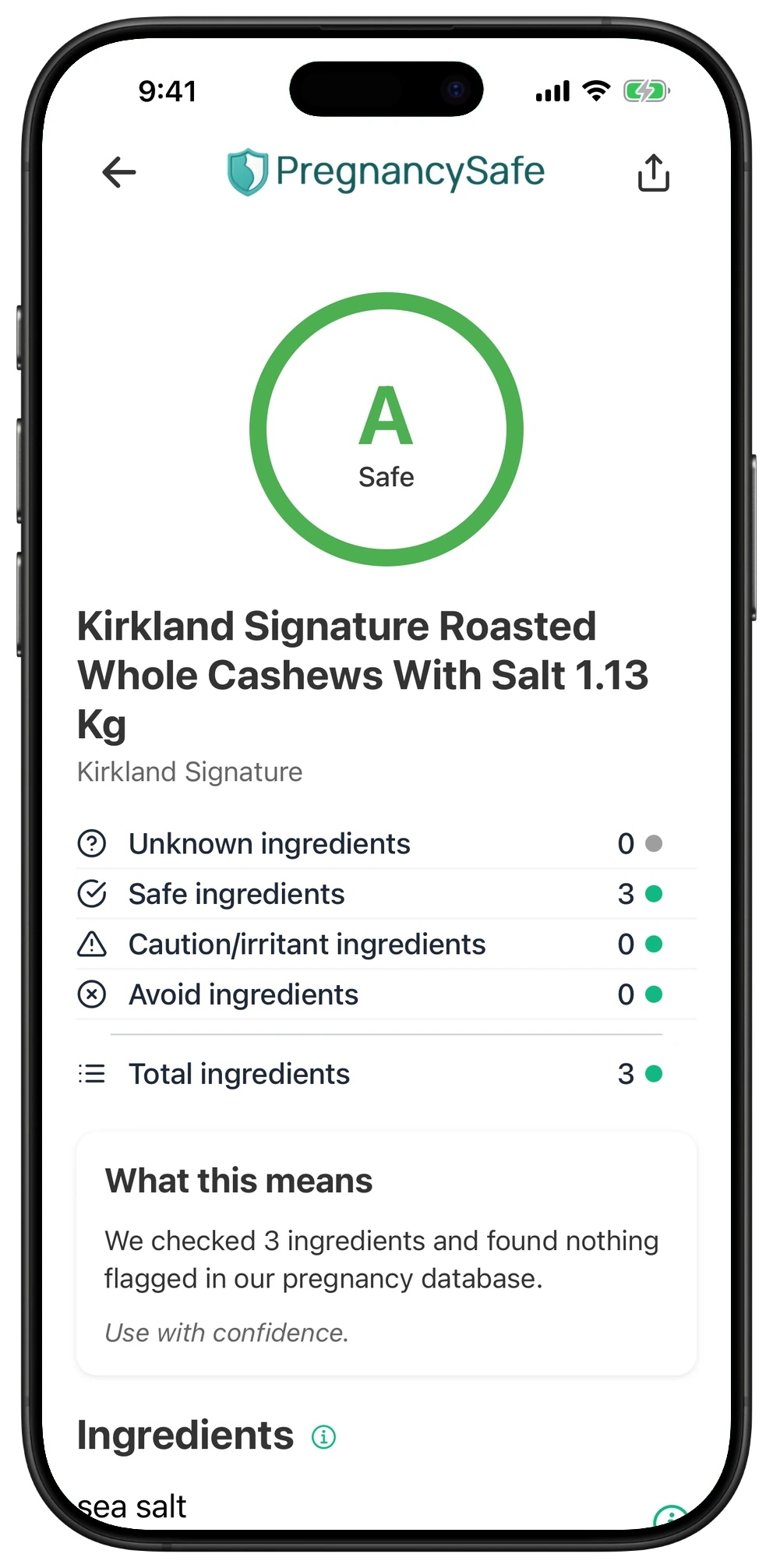
| A | Kirkland Signature Roasted Whole Cashews With Salt | Kirkland Signature |
| B+ | Dill Pickle Cashews | Planters |
| A | Blue Diamond Almonds, Honey Roasted, Value Pack | Blue Diamond |
| A | Organic Whole Brazil Nuts | Kirkland Signature |
| A | Walnuts | Kirkland Signature |
Your Questions Answered
Which nuts should be avoided in pregnancy?
There is no routine need to avoid ordinary nuts solely because you are pregnant. Avoid those you are allergic to, and follow any specific advice from your healthcare professional. Preparation, storage, and added coatings deserve attention, but a lower ingredient grade alone does not establish that a nut product is unsafe.
What kind of nuts to eat during pregnancy?
Ordinary almonds, walnuts, cashews, pistachios, and other nuts can fit into your diet if you tolerate them. Plain varieties make it easier to avoid added sugar from coatings. Choose an appropriate serving and follow storage instructions rather than looking for one nut that promises better fetal development.
Can I eat Brazil nuts while pregnant?
Brazil nuts are not automatically excluded during pregnancy if you are not allergic or individually advised to avoid them. Keep portions modest rather than assuming that more is better. The general guidance for ordinary nuts does not establish a specific daily Brazil nut allowance or justify using them as a substitute for prescribed supplements.
Should I avoid nuts to prevent my baby from developing an allergy?
There is no routine need to avoid nuts during pregnancy to prevent allergy in your baby. That does not override your own food allergies or individualized medical advice. Continue checking ingredient and allergen labels, particularly when switching between plain nuts, mixed nuts, and coated varieties.
Are honey roasted or flavored nuts safe during pregnancy?
Coatings and seasonings do not automatically make nuts unsuitable, but they change what you are eating. Honey roasted varieties contain added sugar and may contain added oil, so compare labels and portions. Normal culinary horseradish seasoning is different from medicinal horseradish or large regular doses. Food dye cautions likewise do not establish fetal harm from an occasional serving.
Does an A grade mean a nut product is verified safe during pregnancy?
No. Our catalog contains 7,481 A grade records, but these are ingredient grades, not a count of independently verified safe products. Grades do not establish current label completeness, pathogen safety, preparation, caffeine content, or individual pregnancy suitability. A catalog listing also does not verify the package you buy, so check its exact version and full label.
How to Interpret These Ratings
Our ingredient and category rules generate letter grades from the information recorded in the catalog. Missing ingredients and broad category assignments can affect the result. These grades do not measure your dose, confirm a complete current label, or test a product for contamination.
A high grade is not a guarantee of pregnancy safety. A low grade is not, by itself, proof of harm from every use. Follow the product-specific guidance above, check the actual package, and ask your prenatal clinician about supplements, treatment decisions or uncertain exposures.
People Also Checked
References
- https://www.nhs.uk/pregnancy/keeping-well/foods-to-avoid/
- https://ods.od.nih.gov/factsheets/Pregnancy-HealthProfessional/
- https://www.hfpappexternal.fda.gov/scripts/fdcc/index.cfm?id=FDCRed40&set=ColorAdditives
- https://www.ecfr.gov/current/title-21/chapter-I/subchapter-A/part-74/subpart-A/section-74.340
- https://www.fda.gov/food/color-additives-information-consumers/tracking-food-industry-pledges-remove-petroleum-based-food-dyes
- https://www.efsa.europa.eu/en/efsajournal/pub/1327
- https://www.efsa.europa.eu/en/efsajournal/pub/4007
- https://apps.who.int/food-additives-contaminants-jecfa-database/Home/Chemical/2361
- https://oehha.ca.gov/risk-assessment/report/health-effects-assessment-potential-neurobehavioral-effects-synthetic-food-dyes-children
- https://pubmed.ncbi.nlm.nih.gov/6636206/
- https://pubmed.ncbi.nlm.nih.gov/2613118/
- https://pubmed.ncbi.nlm.nih.gov/7940558/
- https://hfpappexternal.fda.gov/scripts/fdcc/index.cfm?id=FDCYellow5&set=ColorAdditives
- https://www.ecfr.gov/current/title-21/chapter-I/subchapter-A/part-74#74.705
- https://www.fda.gov/food/nutrition-food-labeling-and-critical-foods/food-allergies
- https://apps.who.int/food-additives-contaminants-jecfa-database/Home/Chemical/3885
- https://efsa.onlinelibrary.wiley.com/doi/10.2903/j.efsa.2009.1331
- https://pubmed.ncbi.nlm.nih.gov/1628860/
- https://pmc.ncbi.nlm.nih.gov/articles/PMC7023231/
- https://pmc.ncbi.nlm.nih.gov/articles/PMC6354951/
- https://webprod.hc-sc.gc.ca/nhpid-bdipsn/atReq?atid=horseradish.raifort&lang=eng
- https://inchem.org/documents/jecfa/jeceval/jec_71.htm
- https://hfpappexternal.fda.gov/scripts/fdcc/index.cfm?id=ALLYLISOTHIOCYANATE&set=FoodSubstances
- https://pmc.ncbi.nlm.nih.gov/articles/PMC13085108/
- https://pubmed.ncbi.nlm.nih.gov/22129740/
- https://www.drugs.com/npp/horseradish.html
- https://www.hfpappexternal.fda.gov/scripts/fdcc/index.cfm?id=FDCBlue1&set=ColorAdditives
- https://www.ecfr.gov/current/title-21/chapter-I/subchapter-A/part-74
- https://efsa.onlinelibrary.wiley.com/doi/10.2903/j.efsa.2010.1853
- https://apps.who.int/food-additives-contaminants-jecfa-database/Home/Chemical/3309
- https://pubmed.ncbi.nlm.nih.gov/23208798/
- https://pubmed.ncbi.nlm.nih.gov/24257113/
- https://cdn.realfood.gov/DGA.pdf
- https://www.dietaryguidelines.gov/sites/default/files/2021-12/DGA_Pregnancy_FactSheet-508c.pdf
- https://www.acog.org/womens-health/faqs/healthy-eating-during-pregnancy
- https://www.cdc.gov/nutrition/php/data-research/added-sugars.html
- https://www.cdc.gov/diabetes/about/gestational-diabetes.html
- https://www.who.int/publications/i/item/9789241549028
- https://nesr.usda.gov/2025-dietary-guidelines-advisory-committee-systematic-reviews/dietary-patterns_gestational-diabetes
- https://www.fda.gov/food/food-additives-petitions/trans-fat
- https://www.fda.gov/food/hfp-constituent-updates/fda-completes-final-administrative-actions-partially-hydrogenated-oils-foods
- https://www.federalregister.gov/documents/2013/11/08/2013-26854/tentative-determination-regarding-partially-hydrogenated-oils-request-for-comments-and-for
- https://www.who.int/news-room/fact-sheets/detail/trans-fat
- https://www.fda.gov/food/people-risk-foodborne-illness/dietary-advice-and-during-pregnancy
- https://www.rcpi.ie/Portals/0/Document%20Repository/Institute%20of%20Obstetricians%20and%20Gynaecologists/National%20Clinical%20Guidelines/IOG_National%20Clinical%20Guidelines_Nutrition%20in%20pregnancy%20Guideline_2019.pdf
- https://pmc.ncbi.nlm.nih.gov/articles/PMC8027310/
- https://pmc.ncbi.nlm.nih.gov/articles/PMC3192475/
- https://www.fda.gov/industry/color-additives/fdc-red-no-3
- https://www.federalregister.gov/documents/2025/01/16/2025-00830/color-additive-petition-from-center-for-science-in-the-public-interest-et-al-request-to-revoke-color
- https://efsa.onlinelibrary.wiley.com/doi/10.2903/j.efsa.2011.1854
- https://pubmed.ncbi.nlm.nih.gov/2824305/
- https://pubmed.ncbi.nlm.nih.gov/2177442/
- https://pubmed.ncbi.nlm.nih.gov/8296313/
- https://pubmed.ncbi.nlm.nih.gov/8386132/
- https://pmc.ncbi.nlm.nih.gov/articles/PMC9368057/
- https://health.ec.europa.eu/system/files/2022-08/sccs_o_257.pdf
- https://pubmed.ncbi.nlm.nih.gov/37751543/
- https://pubmed.ncbi.nlm.nih.gov/12396675/
- https://pmc.ncbi.nlm.nih.gov/articles/PMC13151845/
- https://www.ecfr.gov/current/title-21/chapter-I/subchapter-B/part-172/subpart-B/section-172.115
- https://www.ecfr.gov/current/title-21/chapter-I/subchapter-B/part-182/subpart-D/section-182.3173
- https://www.fda.gov/news-events/press-announcements/fda-finalizes-food-chemical-safety-post-market-assessment-program-launches-reassessment-bht-ada