Is Peanuts Safe During Pregnancy? (Updated 2026 Guide)
Updated September 9, 2026
The Answer
Yes, you can eat ordinary peanuts during pregnancy unless you're allergic or have been individually advised to avoid them. Our catalog contains mostly A grade records, but ingredient grades are not pregnancy safety guarantees; your allergy history, portion and actual package matter more.
Your own peanut allergy is the main reason to avoid peanuts; there is no routine need to exclude them to prevent allergy in your baby. Choose appropriate portions, follow storage instructions and distinguish ordinary peanuts from sweetened coatings or concentrated supplements. Some coatings contain dyes with limited pregnancy evidence or partially hydrogenated oils that warrant limiting, but occasional dietary dye exposure is not established fetal harm.
Pregnancy Safe is 100% independent and research driven. No companies pay to promote or sponsor products.
Stress Less This Pregnancy
Check your exact peanuts in the app

✓ What's Safe
- • Choose plain or simply roasted peanuts for an everyday option without a sweetened coating.
- • Compare sodium per serving and choose unsalted or less salted versions when reducing salt intake.
- • Use the package serving size to portion your snack rather than eating directly from a large container.
- • Read the full current ingredient and allergen label, especially on flavored or coated peanuts.
- • Follow the package storage instructions and keep peanuts properly sealed after opening.
✗ What to Avoid
- • Avoid peanuts if you have a peanut allergy or have been individually advised not to eat them.
- • Do not eat visibly spoiled peanuts or keep eating from a package that has been stored contrary to its instructions.
- • Avoid making heavily salted or sugar coated peanuts your default snack; compare salt and added sugar per serving.
- • Choose an alternative if the current label lists partially hydrogenated soybean oil, a source of industrial trans fat.
- • Limit frequent brightly colored coatings containing yellow 5, red 40 or blue 1 if you want to reduce unnecessary dye exposure; occasional food exposure is not proven to harm a pregnancy.
- • Do not assume peanut protein supplements or concentrated oils have the same considerations as an ordinary serving of peanuts.
Most Common Ingredients in Peanuts Products
We analyzed 526 peanuts products. Here are the most common ingredients, ranked by how often they appear:
Ingredients to Watch Out For in Peanuts
These are the most common flagged ingredients across 526 peanuts products we analyzed.
yellow 5
Caution
Yellow 5 is a synthetic food dye used to impart a bright yellow color to various processed foods and beverages.
Has limited human pregnancy data, rare hypersensitivity labeling concerns, and animal/children's neurobehavior signals despite regulated dietary use under ADI based limits.
Flagged in 11 of 526 products (2%)
Caution
Red 40 is a synthetic food dye commonly used to add vibrant red color to candies, beverages, and processed foods.
Has limited human pregnancy data and is allowed at regulated food additive levels, but child neurobehavior concerns and high dose animal findings make frequent high dye intake worth limiting.
Flagged in 10 of 526 products (2%)
red 40 lake
Caution
Red 40 Lake is a synthetic colorant used to impart a vibrant red hue to food, beverages, and cosmetics.
Has limited human pregnancy data and is allowed at regulated food additive levels, but child neurobehavior concerns and high dose animal findings make frequent high dye intake worth limiting.
Flagged in 8 of 526 products (2%)
blue 1
Caution
Blue 1 is a synthetic blue dye commonly used to add vibrant color to foods, beverages, and cosmetics.
Has limited human pregnancy data; regulated food use is not shown to cause fetal harm, but high dose animal neurobehavior findings and child sensitivity concerns support minimizing frequent exposure.
Flagged in 5 of 526 products (1%)
yellow 5 lake
Caution
Yellow 5 Lake is a synthetic, orange colored dye used to add vibrant color to foods, beverages, and cosmetics.
Has limited human pregnancy data, rare hypersensitivity labeling concerns, and animal/children's neurobehavior signals despite regulated dietary use under ADI based limits.
Flagged in 5 of 526 products (1%)
artificial color red 40 lake
Caution
Artificial Color Red 40 Lake is a synthetic dye used to impart a vibrant red hue in food, beverages, and cosmetics.
Has limited human pregnancy data and is allowed at regulated food additive levels, but child neurobehavior concerns and high dose animal findings make frequent high dye intake worth limiting.
Flagged in 3 of 526 products (1%)
artificial colors red 3
Caution
Artificial colors Red 3 are synthetic dye additives used to impart a vibrant red hue to foods and beverages.
Has limited human pregnancy outcome data and is being phased out of U.S. foods and ingested drugs after high dose male rat thyroid tumor findings.
Flagged in 3 of 526 products (1%)
partially hydrogenated soybean oil
Caution
Partially hydrogenated soybean oil is a processed fat commonly used in foods to improve texture and shelf life, but it contains trans fats linked to health risks.
Mainly raise concern when partially hydrogenated and high in artificial trans fat; fully hydrogenated oils are mostly a saturated fat limit rather than the same trans fat issue.
Flagged in 3 of 526 products (1%)
Peanuts Products We've Analyzed
Our catalog contains ratings for 526 peanuts products. These are database grades, not independent safety certifications.
Catalog ingredient grades do not measure current-label completeness, pathogens, preparation, caffeine or clinical pregnancy suitability. These counts include unreviewed records and are not a percentage of independently verified safe products.
Pregnancy Safe Peanuts Products
Popular options from our catalog, prioritizing A and B ingredient grades, with C grade options used to fill remaining places. Within each group, products are ordered by searches in Pregnancy Safe, not retail sales. Read the cautions and guidance above; grades do not verify a complete current label or guarantee pregnancy safety.
| Grade | Product | Brand |
|---|---|---|
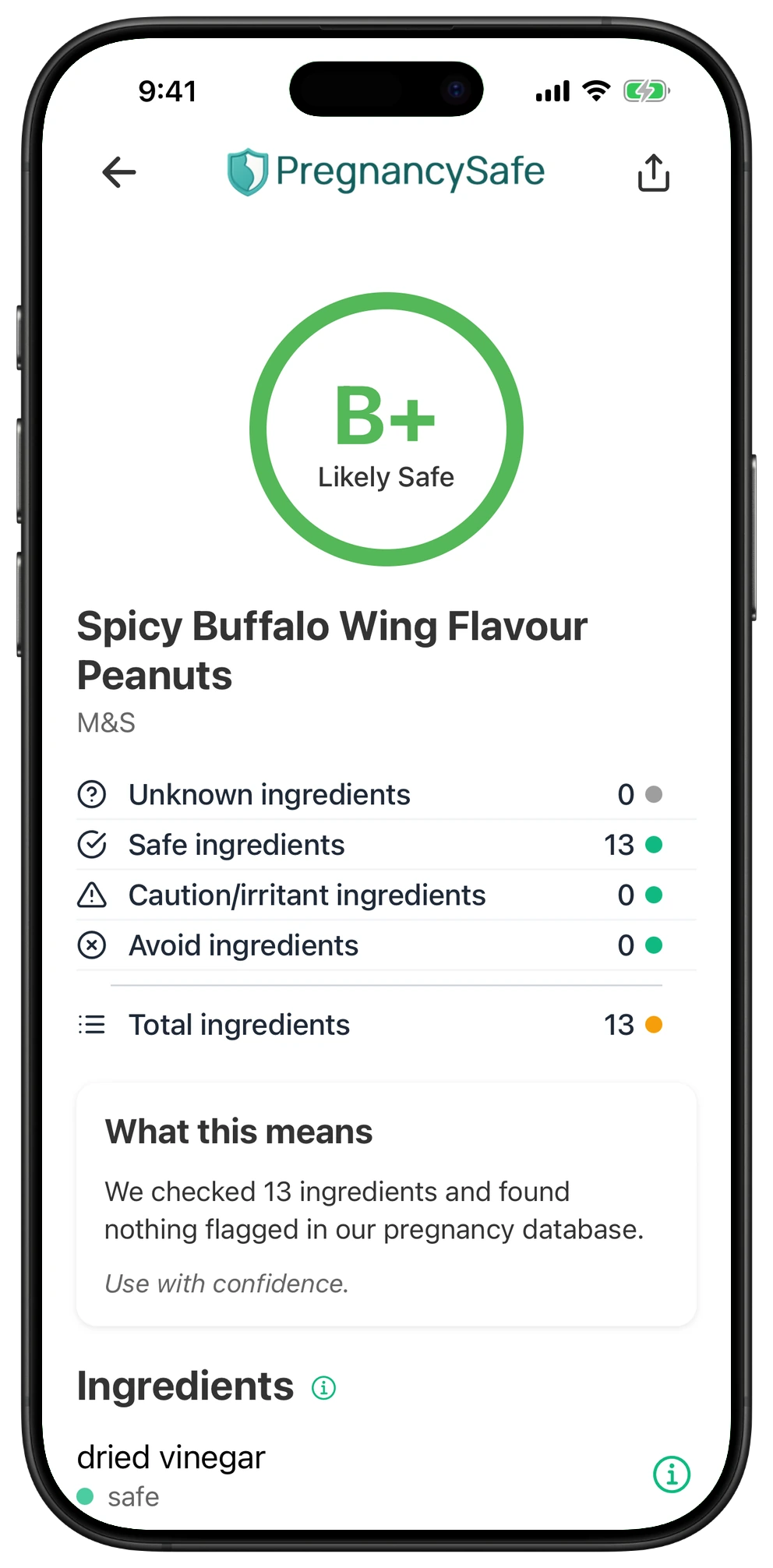
| B+ | Spicy Buffalo Wing Flavour Peanuts | M&S |
| A | Sabritas Salt & Lime Flavored Peanuts | Sabritas |
| A | Planters Cocktail Peanuts | Planters |
| A | Salted & Roasted Peanuts | Hampton Farms |
| A | Cocktail Peanuts | — |
Your Questions Answered
How much peanut can I eat a day during pregnancy?
Choose a modest portion that fits your overall meals and snacks rather than treating peanuts as something you must eat daily. The package serving size is a practical starting point, not a pregnancy specific maximum. Your needs may differ if your maternity team has given you an individual eating plan.
Which nuts should be avoided in pregnancy?
Ordinary nuts and seeds do not need to be routinely avoided during pregnancy. Avoid those you are allergic to and follow any individual advice from your clinician. Storage, portions and added coatings still matter, and guidance for ordinary foods does not automatically cover concentrated supplements.
Should I avoid peanuts to prevent my baby from developing an allergy?
No, there is no routine need to avoid peanuts during pregnancy to prevent allergy in your baby. If you tolerate them, you can include them as an ordinary food. Eating them is not a guarantee against childhood allergy either, and you should not eat them if you are allergic yourself.
Are roasted, salted or honey coated peanuts okay during pregnancy?
Ordinary roasted peanuts can fit your pregnancy diet if you are not allergic. Salted and sweetened versions need a closer look at sodium, added sugar and portion size rather than an automatic pregnancy ban. Plain or less salted versions make it easier to limit those extras. Read the exact package because coatings and seasonings vary.
Should I worry if I ate peanuts with artificial food coloring?
An occasional serving containing yellow 5, red 40 or blue 1 is not established to cause fetal harm. Pregnancy specific human evidence is limited, and findings from children or high dose animal studies do not prove harm from ordinary dietary exposure during pregnancy. Choosing uncolored peanuts is a practical way to reduce repeated exposure without assuming a past serving harmed your baby.
Does an A grade mean a peanut product is verified safe during pregnancy?
No. Our catalog contains 526 peanut products, including 437 with an A ingredient grade, but those counts include unreviewed records. Grades do not establish current label completeness, pathogen safety, preparation or suitability for your pregnancy. Check your actual package and allergy needs; an incomplete record or lower grade is not by itself proof that a product is harmful.
How to Interpret These Ratings
Our ingredient and category rules generate letter grades from the information recorded in the catalog. Missing ingredients and broad category assignments can affect the result. These grades do not measure your dose, confirm a complete current label, or test a product for contamination.
A high grade is not a guarantee of pregnancy safety. A low grade is not, by itself, proof of harm from every use. Follow the product-specific guidance above, check the actual package, and ask your prenatal clinician about supplements, treatment decisions or uncertain exposures.
People Also Checked
References
- https://www.nhs.uk/pregnancy/keeping-well/foods-to-avoid/
- https://ods.od.nih.gov/factsheets/Pregnancy-HealthProfessional/
- https://hfpappexternal.fda.gov/scripts/fdcc/index.cfm?id=FDCYellow5&set=ColorAdditives
- https://www.ecfr.gov/current/title-21/chapter-I/subchapter-A/part-74#74.705
- https://www.fda.gov/food/color-additives-information-consumers/tracking-food-industry-pledges-remove-petroleum-based-food-dyes
- https://www.fda.gov/food/nutrition-food-labeling-and-critical-foods/food-allergies
- https://apps.who.int/food-additives-contaminants-jecfa-database/Home/Chemical/3885
- https://efsa.onlinelibrary.wiley.com/doi/10.2903/j.efsa.2009.1331
- https://oehha.ca.gov/risk-assessment/report/health-effects-assessment-potential-neurobehavioral-effects-synthetic-food-dyes-children
- https://pubmed.ncbi.nlm.nih.gov/1628860/
- https://pmc.ncbi.nlm.nih.gov/articles/PMC7023231/
- https://pmc.ncbi.nlm.nih.gov/articles/PMC6354951/
- https://www.hfpappexternal.fda.gov/scripts/fdcc/index.cfm?id=FDCRed40&set=ColorAdditives
- https://www.ecfr.gov/current/title-21/chapter-I/subchapter-A/part-74/subpart-A/section-74.340
- https://www.efsa.europa.eu/en/efsajournal/pub/1327
- https://www.efsa.europa.eu/en/efsajournal/pub/4007
- https://apps.who.int/food-additives-contaminants-jecfa-database/Home/Chemical/2361
- https://pubmed.ncbi.nlm.nih.gov/6636206/
- https://pubmed.ncbi.nlm.nih.gov/2613118/
- https://pubmed.ncbi.nlm.nih.gov/7940558/
- https://www.hfpappexternal.fda.gov/scripts/fdcc/index.cfm?id=FDCBlue1&set=ColorAdditives
- https://www.ecfr.gov/current/title-21/chapter-I/subchapter-A/part-74
- https://efsa.onlinelibrary.wiley.com/doi/10.2903/j.efsa.2010.1853
- https://apps.who.int/food-additives-contaminants-jecfa-database/Home/Chemical/3309
- https://pubmed.ncbi.nlm.nih.gov/23208798/
- https://pubmed.ncbi.nlm.nih.gov/24257113/
- https://www.fda.gov/industry/color-additives/fdc-red-no-3
- https://www.federalregister.gov/documents/2025/01/16/2025-00830/color-additive-petition-from-center-for-science-in-the-public-interest-et-al-request-to-revoke-color
- https://efsa.onlinelibrary.wiley.com/doi/10.2903/j.efsa.2011.1854
- https://pubmed.ncbi.nlm.nih.gov/2824305/
- https://pubmed.ncbi.nlm.nih.gov/2177442/
- https://pubmed.ncbi.nlm.nih.gov/8296313/
- https://pubmed.ncbi.nlm.nih.gov/8386132/
- https://pmc.ncbi.nlm.nih.gov/articles/PMC9368057/
- https://www.fda.gov/food/food-additives-petitions/trans-fat
- https://www.fda.gov/food/hfp-constituent-updates/fda-completes-final-administrative-actions-partially-hydrogenated-oils-foods
- https://www.federalregister.gov/documents/2013/11/08/2013-26854/tentative-determination-regarding-partially-hydrogenated-oils-request-for-comments-and-for
- https://www.who.int/news-room/fact-sheets/detail/trans-fat
- https://cdn.realfood.gov/DGA.pdf
- https://www.fda.gov/food/people-risk-foodborne-illness/dietary-advice-and-during-pregnancy
- https://www.rcpi.ie/Portals/0/Document%20Repository/Institute%20of%20Obstetricians%20and%20Gynaecologists/National%20Clinical%20Guidelines/IOG_National%20Clinical%20Guidelines_Nutrition%20in%20pregnancy%20Guideline_2019.pdf
- https://pmc.ncbi.nlm.nih.gov/articles/PMC8027310/
- https://pmc.ncbi.nlm.nih.gov/articles/PMC3192475/