Is Popcorn Safe During Pregnancy? (Updated 2026 Guide)
Updated September 9, 2026
The Answer
Yes, popcorn in ordinary food amounts can fit into your pregnancy diet; follow the package’s preparation and storage instructions and choose toppings and portions that suit your needs. Most entries in our catalog have A or B+ ingredient grades, but those grades are not pregnancy safety guarantees.
For popcorn, focus on preparation, allergens, portion size, and the salt, sugar and fats added through coatings or toppings. Partially hydrogenated soybean oil raises an industrial trans fat concern, while cautions for certain dyes and BHA reflect limited pregnancy data and largely indirect evidence not established fetal harm from occasional ordinary food exposure. Routine flavorings, salt and sugar should not be treated as fetal toxins.
Pregnancy Safe is 100% independent and research driven. No companies pay to promote or sponsor products.
Stress Less This Pregnancy
Check your exact popcorn in the app

✓ What's Safe
- • Choose plain popcorn when you want control over how much salt, sugar or butter you add.
- • Compare sodium, added sugar and saturated fat using the same serving size, then consider how much you actually eat.
- • Read the exact package’s preparation and storage instructions; already popped and microwave popcorn are different forms.
- • Check the full ingredient list and allergen statement, especially for milk in cheese flavored popcorn.
- • Prefer options without partially hydrogenated oils, and check the current package rather than relying on an archived label.
✗ What to Avoid
- • Avoid popcorn containing an ingredient you are allergic to; cheese coatings can contain milk.
- • Skip formulations listing partially hydrogenated soybean oil when choosing an everyday snack.
- • Limit frequent large portions with heavy caramel, salty seasoning or butter coatings; this is nutrition guidance, not a claim of fetal harm.
- • If you want to reduce nonessential dye exposure, limit frequently eating popcorn with yellow 5, blue 1 or red 40; occasional dietary exposure is not proven to harm a fetus.
- • Avoid assuming that one flavor’s ingredient list or preparation instructions apply to every popcorn product from the same brand.
Most Common Ingredients in Popcorn Products
We analyzed 4,048 popcorn products. Here are the most common ingredients, ranked by how often they appear:
Ingredients to Watch Out For in Popcorn
These are the most common flagged ingredients across 4,048 popcorn products we analyzed.
yellow 5
Caution
Yellow 5 is a synthetic food dye used to impart a bright yellow color to various processed foods and beverages.
Has limited human pregnancy data, rare hypersensitivity labeling concerns, and animal/children's neurobehavior signals despite regulated dietary use under ADI based limits.
Flagged in 209 of 4,048 products (5%)
blue 1
Caution
Blue 1 is a synthetic blue dye commonly used to add vibrant color to foods, beverages, and cosmetics.
Has limited human pregnancy data; regulated food use is not shown to cause fetal harm, but high dose animal neurobehavior findings and child sensitivity concerns support minimizing frequent exposure.
Flagged in 137 of 4,048 products (3%)
Caution
Red 40 is a synthetic food dye commonly used to add vibrant red color to candies, beverages, and processed foods.
Has limited human pregnancy data and is allowed at regulated food additive levels, but child neurobehavior concerns and high dose animal findings make frequent high dye intake worth limiting.
Flagged in 130 of 4,048 products (3%)
yellow 5 lake
Caution
Yellow 5 Lake is a synthetic, orange colored dye used to add vibrant color to foods, beverages, and cosmetics.
Has limited human pregnancy data, rare hypersensitivity labeling concerns, and animal/children's neurobehavior signals despite regulated dietary use under ADI based limits.
Flagged in 119 of 4,048 products (3%)
red 40 lake
Caution
Red 40 Lake is a synthetic colorant used to impart a vibrant red hue to food, beverages, and cosmetics.
Has limited human pregnancy data and is allowed at regulated food additive levels, but child neurobehavior concerns and high dose animal findings make frequent high dye intake worth limiting.
Flagged in 116 of 4,048 products (3%)
partially hydrogenated soybean oil
Caution
Partially hydrogenated soybean oil is a processed fat commonly used in foods to improve texture and shelf life, but it contains trans fats linked to health risks.
Mainly raise concern when partially hydrogenated and high in artificial trans fat; fully hydrogenated oils are mostly a saturated fat limit rather than the same trans fat issue.
Flagged in 88 of 4,048 products (2%)
bha bht in corn oil to retard oxidation
Caution
Has limited pregnancy specific human data and normal regulated food use appears lower concern than high dose animal exposures that drove carcinogenicity classifications.
Flagged in 84 of 4,048 products (2%)
blue 1 lake
Caution
Blue 1 Lake is a vibrant, water soluble synthetic dye used to add bright blue color to foods, beverages, and cosmetics.
Has limited human pregnancy data; regulated food use is not shown to cause fetal harm, but high dose animal neurobehavior findings and child sensitivity concerns support minimizing frequent exposure.
Flagged in 66 of 4,048 products (2%)
Popcorn Products We've Analyzed
Our catalog contains ratings for 4,048 popcorn products. These are database grades, not independent safety certifications.
Catalog ingredient grades do not measure current-label completeness, pathogens, preparation, caffeine or clinical pregnancy suitability. These counts include unreviewed records and are not a percentage of independently verified safe products.
Pregnancy Safe Popcorn Products
Popular options from our catalog, prioritizing A and B ingredient grades, with C grade options used to fill remaining places. Within each group, products are ordered by searches in Pregnancy Safe, not retail sales. Read the cautions and guidance above; grades do not verify a complete current label or guarantee pregnancy safety.
| Grade | Product | Brand |
|---|---|---|
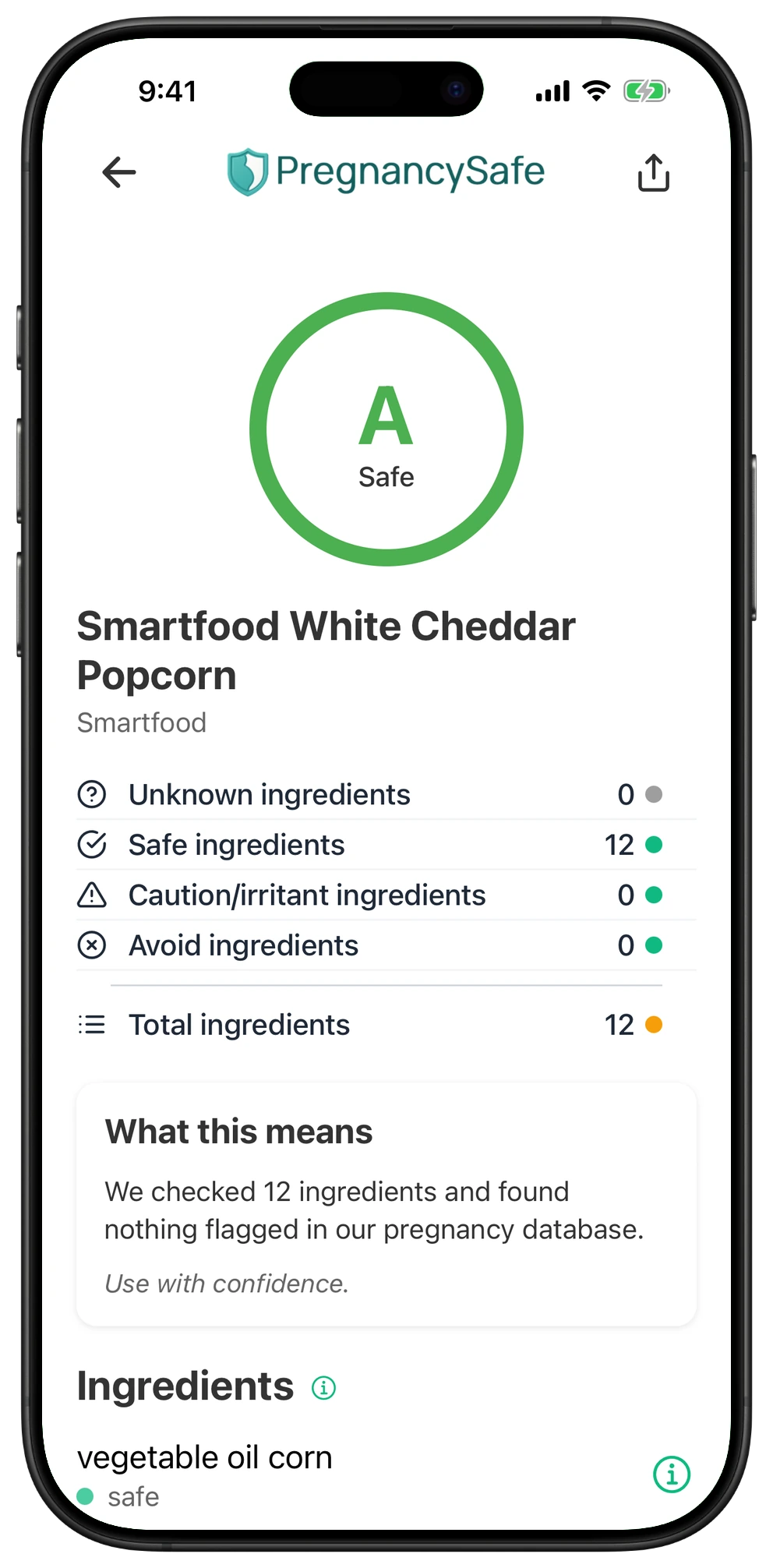
| A | Smartfood White Cheddar Popcorn | Smartfood |
| A | Original Popcorn | Skinnypop |
| B+ | Khloud Protein Popcorn White Cheddar | Khloud |
| A | Smartfood White Cheddar Cheese Popcorn | Smartfood |
| A | Skinny Pop Popcorn | Amplify Snack Brands |
Your Questions Answered
Is it safe to eat popcorn during pregnancy?
Yes, ordinary portions of popcorn can fit into your pregnancy diet. Follow the exact package’s preparation and storage instructions, and check for allergens that affect you. Toppings and portion size are mainly nutrition considerations rather than evidence that popcorn harms your baby.
What junk food should be avoided during pregnancy?
For popcorn and similar snacks, focus on the actual ingredients and amounts rather than the label “junk food.” Avoid your known allergens and choose options without partially hydrogenated oils. Limit frequent large portions high in salt, added sugar or saturated fat. An occasional sweet or salty snack is not, by itself, evidence of fetal harm.
Should sweet or salty popcorn be avoided as junk food during pregnancy?
You do not need to treat all sweet or salty popcorn as off limits. Compare nutrition labels and portion out the amount you plan to eat instead of assuming a whole bag is one serving. If you have individualized diabetes or sodium advice, use that advice to guide your choice. Sugar and salt are nutrition considerations, not proof that an ordinary serving is toxic to your baby.
Is microwave popcorn different from already popped popcorn?
Yes, microwave popcorn requires preparation, while already popped popcorn is ready to eat as directed. Read the instructions and ingredients for the exact version you buy. A label checked for an already popped cheese flavor does not establish the ingredients or suitability of every microwave formulation. Neither the cooking format nor an ingredient grade alone provides a complete safety assessment.
How much popcorn can I eat during pregnancy?
There is no single pregnancy specific popcorn portion established here. Use the labeled serving size as a starting point for comparing sodium, added sugar and saturated fat, not as a medical maximum. Consider your overall diet and how much coating or topping you add. Follow any personalized portion guidance from your maternity care team.
Should I worry about food dyes in popcorn?
Human pregnancy data for dyes such as yellow 5, blue 1 and red 40 are limited. Findings from children or high dose animal studies do not establish fetal harm from occasional regulated food exposure. You can choose popcorn without added dyes to reduce nonessential exposure, especially if you eat it frequently. Avoid a dye if you have a known sensitivity to it.
Does an A grade mean a popcorn product is verified safe during pregnancy?
No. Our catalog contains 4,048 products, including 2,434 with an A ingredient grade, but these are not counts of independently verified safe products. Ingredient grades do not measure pathogens, contaminants, preparation or current label completeness. Read your actual package, and do not assume a lower grade or an incomplete record proves a product is harmful.
How to Interpret These Ratings
Our ingredient and category rules generate letter grades from the information recorded in the catalog. Missing ingredients and broad category assignments can affect the result. These grades do not measure your dose, confirm a complete current label, or test a product for contamination.
A high grade is not a guarantee of pregnancy safety. A low grade is not, by itself, proof of harm from every use. Follow the product-specific guidance above, check the actual package, and ask your prenatal clinician about supplements, treatment decisions or uncertain exposures.
People Also Checked
References
- https://www.nhs.uk/pregnancy/keeping-well/foods-to-avoid/
- https://www.fda.gov/food/people-risk-foodborne-illness/cooking-food-safety-moms-be
- https://hfpappexternal.fda.gov/scripts/fdcc/index.cfm?id=FDCYellow5&set=ColorAdditives
- https://www.ecfr.gov/current/title-21/chapter-I/subchapter-A/part-74#74.705
- https://www.fda.gov/food/color-additives-information-consumers/tracking-food-industry-pledges-remove-petroleum-based-food-dyes
- https://www.fda.gov/food/nutrition-food-labeling-and-critical-foods/food-allergies
- https://apps.who.int/food-additives-contaminants-jecfa-database/Home/Chemical/3885
- https://efsa.onlinelibrary.wiley.com/doi/10.2903/j.efsa.2009.1331
- https://oehha.ca.gov/risk-assessment/report/health-effects-assessment-potential-neurobehavioral-effects-synthetic-food-dyes-children
- https://pubmed.ncbi.nlm.nih.gov/1628860/
- https://pmc.ncbi.nlm.nih.gov/articles/PMC7023231/
- https://pmc.ncbi.nlm.nih.gov/articles/PMC6354951/
- https://www.hfpappexternal.fda.gov/scripts/fdcc/index.cfm?id=FDCBlue1&set=ColorAdditives
- https://www.ecfr.gov/current/title-21/chapter-I/subchapter-A/part-74
- https://efsa.onlinelibrary.wiley.com/doi/10.2903/j.efsa.2010.1853
- https://apps.who.int/food-additives-contaminants-jecfa-database/Home/Chemical/3309
- https://pubmed.ncbi.nlm.nih.gov/23208798/
- https://pubmed.ncbi.nlm.nih.gov/24257113/
- https://www.hfpappexternal.fda.gov/scripts/fdcc/index.cfm?id=FDCRed40&set=ColorAdditives
- https://www.ecfr.gov/current/title-21/chapter-I/subchapter-A/part-74/subpart-A/section-74.340
- https://www.efsa.europa.eu/en/efsajournal/pub/1327
- https://www.efsa.europa.eu/en/efsajournal/pub/4007
- https://apps.who.int/food-additives-contaminants-jecfa-database/Home/Chemical/2361
- https://pubmed.ncbi.nlm.nih.gov/6636206/
- https://pubmed.ncbi.nlm.nih.gov/2613118/
- https://pubmed.ncbi.nlm.nih.gov/7940558/
- https://www.fda.gov/food/food-additives-petitions/trans-fat
- https://www.fda.gov/food/hfp-constituent-updates/fda-completes-final-administrative-actions-partially-hydrogenated-oils-foods
- https://www.federalregister.gov/documents/2013/11/08/2013-26854/tentative-determination-regarding-partially-hydrogenated-oils-request-for-comments-and-for
- https://www.who.int/news-room/fact-sheets/detail/trans-fat
- https://cdn.realfood.gov/DGA.pdf
- https://www.fda.gov/food/people-risk-foodborne-illness/dietary-advice-and-during-pregnancy
- https://www.rcpi.ie/Portals/0/Document%20Repository/Institute%20of%20Obstetricians%20and%20Gynaecologists/National%20Clinical%20Guidelines/IOG_National%20Clinical%20Guidelines_Nutrition%20in%20pregnancy%20Guideline_2019.pdf
- https://pmc.ncbi.nlm.nih.gov/articles/PMC8027310/
- https://pmc.ncbi.nlm.nih.gov/articles/PMC3192475/
- https://www.fda.gov/food/food-chemical-safety/list-select-chemicals-food-supply-under-fda-review
- https://www.federalregister.gov/documents/2026/02/11/2026-02761/butylated-hydroxyanisole-bha-request-for-information
- https://www.ecfr.gov/current/title-21/chapter-I/subchapter-B/part-182/subpart-D/section-182.3169
- https://www.ecfr.gov/current/title-21/chapter-I/subchapter-B/part-172/subpart-B/section-172.110
- https://www.efsa.europa.eu/en/efsajournal/pub/2392
- https://pmc.ncbi.nlm.nih.gov/articles/PMC13092903/
- https://www.ncbi.nlm.nih.gov/books/NBK590883/
- https://www.inchem.org/documents/iarc/vol40/butylatedhydroxyanisole.html
- https://pubmed.ncbi.nlm.nih.gov/7290287/
- https://pubmed.ncbi.nlm.nih.gov/3804125/
- https://www.fda.gov/food/color-additives-information-consumers/color-additives-questions-and-answers-consumers
- https://www.fda.gov/food/food-ingredients-packaging/color-additives-information-consumers
- https://www.fda.gov/cosmetics/cosmetic-ingredient-names/color-additives-permitted-use-cosmetics
- https://www.fda.gov/industry/color-additives/fdc-red-no-3
- https://pubmed.ncbi.nlm.nih.gov/35233072/
- https://pubmed.ncbi.nlm.nih.gov/35484553/
- https://pubmed.ncbi.nlm.nih.gov/35106984/
- https://www.federalregister.gov/documents/2025/01/16/2025-00830/color-additive-petition-from-center-for-science-in-the-public-interest-et-al-request-to-revoke-color
- https://efsa.onlinelibrary.wiley.com/doi/10.2903/j.efsa.2011.1854
- https://pubmed.ncbi.nlm.nih.gov/2824305/
- https://pubmed.ncbi.nlm.nih.gov/2177442/
- https://pubmed.ncbi.nlm.nih.gov/8296313/
- https://pubmed.ncbi.nlm.nih.gov/8386132/
- https://pmc.ncbi.nlm.nih.gov/articles/PMC9368057/