Best Pregnancy Safe Crackers (Updated 2026 Guide)
Updated September 9, 2026
The Answer
Ordinary crackers can fit into your pregnancy diet: choose a formulation that suits your allergies and nutrition needs, and follow the package instructions. Our catalog contains mostly A and B+ ingredient grades, but those grades are not independent verification of pregnancy safety.
For crackers, focus on your usual portions, added sugar, sodium and allergens rather than treating routine additives as evidence of fetal harm. Partially hydrogenated oils warrant attention because of industrial trans fat, while concerns about certain colors and BHT rely on limited pregnancy evidence and indirect findings that do not establish harm from occasional food exposure. Seaweed type and amount, and any residual alcohol in wine containing crackers, need product specific context.
Pregnancy Safe is 100% independent and research driven. No companies pay to promote or sponsor products.
Stress Less This Pregnancy
Check your exact crackers in the app

✓ What's Safe
- • Read the full ingredient and allergen label on your actual package; flavors, sizes and recipes can differ from archived records.
- • Compare added sugar and sodium using similar serving sizes, especially if your care team has given you carbohydrate or sodium advice.
- • Choose formulations without partially hydrogenated oils when checking the current ingredient list.
- • Check cheese, sandwich and flavored crackers for allergens relevant to you, including wheat, milk and soy.
- • For seaweed crackers, look for the seaweed species and any iodine information rather than assuming all seaweed provides the same amount.
- • Follow the exact storage and preparation instructions, including separate instructions for any toppings or fillings you add.
✗ What to Avoid
- • Avoid choosing crackers listing partially hydrogenated cottonseed oil for regular eating; the concern is industrial trans fat, not ordinary cottonseed oil.
- • Limit frequent large portions of crackers sweetened with high fructose corn syrup; compare total added sugar rather than treating this sweetener alone as a fetal hazard.
- • If you want to reduce unnecessary color exposure, choose crackers without yellow 5, red 40, red 40 lake, blue 1 or blue 1 lake; occasional food exposure is not established to harm a pregnancy.
- • Avoid making crackers labeled bht for freshness a frequent high intake staple if you prefer to reduce uncertain additive exposure; high dose animal findings do not prove harm from an occasional serving.
- • Avoid hijiki containing crackers and frequent large amounts of kelp rich seaweed crackers with unknown iodine content; modest nori containing portions are a different exposure.
- • Avoid assuming white wine on a cracker label means either beverage level alcohol exposure or complete alcohol removal; ask the manufacturer about residual alcohol or choose a wine free recipe.
Most Common Ingredients in Crackers Products
We analyzed 4,490 crackers products. Here are the most common ingredients, ranked by how often they appear:
Ingredients to Watch Out For in Crackers
These are the most common flagged ingredients across 4,490 crackers products we analyzed.
high fructose corn syrup
Caution
High fructose corn syrup is a sweet, liquid sweetener made from corn starch, commonly used in processed foods and beverages.
Is not a known teratogen at occasional food amounts, but high added sugar intake can displace nutrients and raise gestational diabetes and metabolic concerns.
This corn derived sweetener adds sugar to crackers. The concern is frequent high added sugar intake across your diet, not established fetal harm from an occasional serving. Compare added sugar and portions, and follow individualized carbohydrate advice if you have gestational diabetes.
Flagged in 247 of 4,490 products (6%)
yellow 5
Caution
Yellow 5 is a synthetic food dye used to impart a bright yellow color to various processed foods and beverages.
Has limited human pregnancy data, rare hypersensitivity labeling concerns, and animal/children's neurobehavior signals despite regulated dietary use under ADI based limits.
Yellow 5, also called tartrazine, adds yellow color to crackers and can trigger hypersensitivity in susceptible people. Pregnancy specific human evidence is limited; animal and child behavior findings do not prove fetal harm from occasional regulated food amounts. A version without this dye is an option for reducing exposure.
Flagged in 53 of 4,490 products (1%)
partially hydrogenated cottonseed oil
Caution
Partially hydrogenated cottonseed oil is a processed vegetable oil used to improve texture and shelf life in baked goods and snacks, but it contains trans fats that may impact health.
Mainly raise concern when partially hydrogenated and high in artificial trans fat; fully hydrogenated oils are mostly a saturated fat limit rather than the same trans fat issue.
This partially hardened cottonseed oil is a source of industrial trans fat used for texture and shelf life. Choose crackers without it for regular eating, while recognizing that occasional past exposure is not proof of pregnancy harm. Fully hydrogenated oil and ordinary cottonseed oil are not the same trans fat concern.
Flagged in 47 of 4,490 products (1%)
bht for freshness
Caution
BHT (butylated hydroxytoluene) is an antioxidant added to foods to help preserve freshness by preventing oxidation and spoilage.
Has limited human pregnancy data, with low concern at reviewed cosmetic levels but reproductive and thyroid related findings in high dose oral animal studies.
This label phrase identifies BHT, or butylated hydroxytoluene, an antioxidant used to slow rancidity. Pregnancy concerns largely come from high dose oral animal research, not demonstrated harm from occasional cracker servings. Choosing a BHT free formulation can reduce exposure, but evidence from cosmetic use cannot establish food exposure safety.
Flagged in 28 of 4,490 products (1%)
seaweed
Caution
Seaweed is a nutrient rich marine plant commonly used in culinary dishes for its umami flavor and health benefits.
Can contain highly variable iodine, with high dose brown seaweed or kelp products and hijiki arsenic exposure requiring caution in pregnancy.
Seaweed in crackers can contribute highly variable iodine depending on its species and amount. Modest nori containing portions differ from frequent kelp rich foods or concentrated supplements; the ingredient name alone does not reveal your iodine dose. Avoid hijiki because of inorganic arsenic concerns, and seek species and iodine details for crackers you eat often.
Flagged in 16 of 4,490 products (0%)
white wine
Avoid
White wine is a crisp, pale yellow alcoholic beverage made from fermented white grapes, often used to enhance the flavor of dishes or enjoyed on its own.
Has no established safe amount in pregnancy and is linked to fetal alcohol spectrum disorders and other adverse pregnancy outcomes.
White wine may be used in cracker dough, but its presence on the ingredient list does not establish how much alcohol remains in the finished food. Guidance to avoid drinking alcohol during pregnancy should not be treated as proof that a baked cracker delivers the same exposure. Ask about residual alcohol or choose a wine free recipe if you want to avoid the uncertainty.
Flagged in 15 of 4,490 products (0%)
red 40 lake
Caution
Red 40 Lake is a synthetic colorant used to impart a vibrant red hue to food, beverages, and cosmetics.
Has limited human pregnancy data and is allowed at regulated food additive levels, but child neurobehavior concerns and high dose animal findings make frequent high dye intake worth limiting.
Red 40 lake is a lake form of the Red 40 colorant used to add color to crackers, not evidence of a separate pregnancy hazard. Human pregnancy data are limited, and high dose animal or child behavior findings do not establish fetal harm from occasional food exposure. An uncolored formulation can reduce unnecessary dye intake.
Flagged in 14 of 4,490 products (0%)
blue 1
Caution
Blue 1 is a synthetic blue dye commonly used to add vibrant color to foods, beverages, and cosmetics.
Has limited human pregnancy data; regulated food use is not shown to cause fetal harm, but high dose animal neurobehavior findings and child sensitivity concerns support minimizing frequent exposure.
Blue 1, also called Brilliant Blue FCF, is a synthetic blue food color that may appear in colored crackers. Pregnancy specific evidence is very limited, and ordinary regulated food use has not been shown to cause fetal harm. High dose animal findings and child sensitivity concerns are indirect evidence, so choosing crackers without it is an exposure reduction option rather than proof that containing products are unsafe.
Flagged in 12 of 4,490 products (0%)
How Do Crackers Products Stack Up?
Our catalog contains ratings for 4,490 crackers products. These are database grades, not independent safety certifications.
Catalog ingredient grades do not measure current-label completeness, pathogens, preparation, caffeine or clinical pregnancy suitability. These counts include unreviewed records and are not a percentage of independently verified safe products.
Best Pregnancy Safe Crackers
Popular options from our catalog, prioritizing A and B ingredient grades, with C grade options used to fill remaining places. Within each group, products are ordered by searches in Pregnancy Safe, not retail sales. Read the cautions and guidance above; grades do not verify a complete current label or guarantee pregnancy safety.
| Grade | Product | Brand |
|---|---|---|
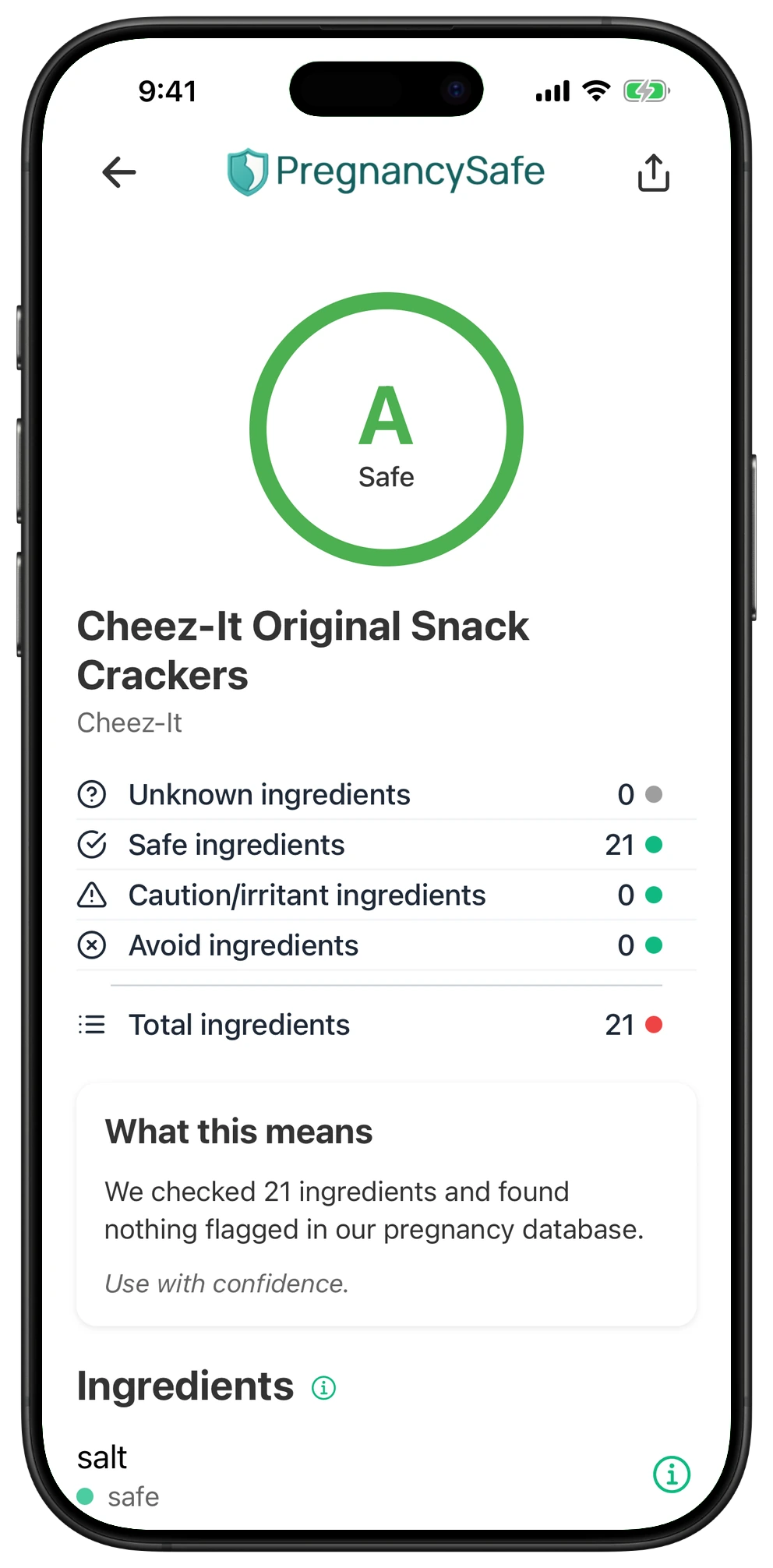
| A | Cheez-It Original Snack Crackers | Cheez-It |
| B+ | Pepperidge Farm Goldfish Cheddar Baked Snack Crackers | Pepperidge Farm Goldfish |
| B+ | Goldfish Baked Snack Crackers Cheddar | Pepperidge Farm |
| B+ | Cheez-It White Cheddar Snack Crackers | Cheez-It |
| A | Wheat Thins Original Crackers | Wheat Thins |
Your Questions Answered
Are crackers safe to eat during pregnancy?
Ordinary crackers can fit into your pregnancy diet when the ingredients suit your needs and you follow the package instructions. Check allergens and consider your usual portions, added sugar and sodium. A routine additive on the label does not by itself demonstrate fetal harm. Ingredient grades also cannot establish current label accuracy, contamination status or clinical suitability.
What are the best crackers to choose during pregnancy?
Start with the current label rather than a brand name or grade. Compare added sugar and sodium at similar serving sizes, check your allergens, and choose formulations without partially hydrogenated oils. Your best fit may differ if you have individualized diabetes or sodium advice. A listed product is not a clinical endorsement or a pregnancy safety guarantee.
Can I rely on crackers when I feel nauseated?
If crackers are something you can tolerate, they can be one food option while you feel nauseated. They are not a treatment for severe nausea and should not be treated as a complete pregnancy diet. Contact your pregnancy care team if nausea or vomiting is making it difficult to eat or drink rather than relying on crackers alone.
Do cheese crackers need the same precautions as fresh cheese?
A baked cheese cracker is not the same food as fresh cheese added as a topping. Follow the cracker package's storage instructions and check for milk and other allergens. If you add cheese or another perishable topping, its pregnancy food safety and storage requirements apply separately. The presence of cheese flavor alone is not enough to judge a product.
Should I worry about food dyes or BHT in crackers?
Human pregnancy evidence for these additives is limited, but occasional regulated food exposure is not established to cause fetal harm. Some concerns come from high dose oral animal studies or research involving children, neither of which directly demonstrates harm from eating a serving of crackers during pregnancy. Choosing versions without added colors or BHT is an option for reducing exposure, not a requirement supported by proof that every containing product is harmful. Avoid yellow 5 if you have a known sensitivity to it.
Does an A grade mean a cracker has been verified safe for pregnancy?
No. Our catalog contains 4,490 crackers, including 1,476 with an A ingredient grade, but those counts include unreviewed records. Grades do not measure pathogens, preparation, current label completeness or clinical pregnancy suitability. Catalog listings do not verify your current package, so match the exact version and read its label. A lower grade or incomplete record is not, by itself, proof that a cracker is harmful.
How to Interpret These Ratings
Our ingredient and category rules generate letter grades from the information recorded in the catalog. Missing ingredients and broad category assignments can affect the result. These grades do not measure your dose, confirm a complete current label, or test a product for contamination.
A high grade is not a guarantee of pregnancy safety. A low grade is not, by itself, proof of harm from every use. Follow the product-specific guidance above, check the actual package, and ask your prenatal clinician about supplements, treatment decisions or uncertain exposures.
People Also Checked
References
- https://www.nhs.uk/pregnancy/keeping-well/foods-to-avoid/
- https://www.fda.gov/food/people-risk-foodborne-illness/cooking-food-safety-moms-be
- https://cdn.realfood.gov/DGA.pdf
- https://www.dietaryguidelines.gov/sites/default/files/2021-12/DGA_Pregnancy_FactSheet-508c.pdf
- https://www.acog.org/womens-health/faqs/healthy-eating-during-pregnancy
- https://www.cdc.gov/nutrition/php/data-research/added-sugars.html
- https://www.cdc.gov/diabetes/about/gestational-diabetes.html
- https://www.who.int/publications/i/item/9789241549028
- https://nesr.usda.gov/2025-dietary-guidelines-advisory-committee-systematic-reviews/dietary-patterns_gestational-diabetes
- https://hfpappexternal.fda.gov/scripts/fdcc/index.cfm?id=FDCYellow5&set=ColorAdditives
- https://www.ecfr.gov/current/title-21/chapter-I/subchapter-A/part-74#74.705
- https://www.fda.gov/food/color-additives-information-consumers/tracking-food-industry-pledges-remove-petroleum-based-food-dyes
- https://www.fda.gov/food/nutrition-food-labeling-and-critical-foods/food-allergies
- https://apps.who.int/food-additives-contaminants-jecfa-database/Home/Chemical/3885
- https://efsa.onlinelibrary.wiley.com/doi/10.2903/j.efsa.2009.1331
- https://oehha.ca.gov/risk-assessment/report/health-effects-assessment-potential-neurobehavioral-effects-synthetic-food-dyes-children
- https://pubmed.ncbi.nlm.nih.gov/1628860/
- https://pmc.ncbi.nlm.nih.gov/articles/PMC7023231/
- https://pmc.ncbi.nlm.nih.gov/articles/PMC6354951/
- https://www.fda.gov/food/food-additives-petitions/trans-fat
- https://www.fda.gov/food/hfp-constituent-updates/fda-completes-final-administrative-actions-partially-hydrogenated-oils-foods
- https://www.federalregister.gov/documents/2013/11/08/2013-26854/tentative-determination-regarding-partially-hydrogenated-oils-request-for-comments-and-for
- https://www.who.int/news-room/fact-sheets/detail/trans-fat
- https://www.fda.gov/food/people-risk-foodborne-illness/dietary-advice-and-during-pregnancy
- https://www.rcpi.ie/Portals/0/Document%20Repository/Institute%20of%20Obstetricians%20and%20Gynaecologists/National%20Clinical%20Guidelines/IOG_National%20Clinical%20Guidelines_Nutrition%20in%20pregnancy%20Guideline_2019.pdf
- https://pmc.ncbi.nlm.nih.gov/articles/PMC8027310/
- https://pmc.ncbi.nlm.nih.gov/articles/PMC3192475/
- https://health.ec.europa.eu/system/files/2022-08/sccs_o_257.pdf
- https://pubmed.ncbi.nlm.nih.gov/37751543/
- https://pubmed.ncbi.nlm.nih.gov/12396675/
- https://pmc.ncbi.nlm.nih.gov/articles/PMC13151845/
- https://www.ecfr.gov/current/title-21/chapter-I/subchapter-B/part-172/subpart-B/section-172.115
- https://www.ecfr.gov/current/title-21/chapter-I/subchapter-B/part-182/subpart-D/section-182.3173
- https://www.fda.gov/news-events/press-announcements/fda-finalizes-food-chemical-safety-post-market-assessment-program-launches-reassessment-bht-ada
- https://journals.sagepub.com/doi/10.1177/10507256261445624
- https://ods.od.nih.gov/factsheets/Iodine-HealthProfessional/
- https://www.foodstandards.gov.au/consumer/nutrition/pregnancy/iodine-and-pregnancy
- https://www.foodstandards.gov.au/consumer/prevention-of-foodborne-illness/arseniciodine
- https://inspection.canada.ca/en/food-safety-consumers/fact-sheets/specific-products-and-risks/chemical-hazards/inorganic-arsenic
- https://pubmed.ncbi.nlm.nih.gov/35947162/
- https://pubmed.ncbi.nlm.nih.gov/20919974/
- https://pubmed.ncbi.nlm.nih.gov/30632947/
- https://pmc.ncbi.nlm.nih.gov/articles/PMC8077470/
- https://www.cdc.gov/alcohol-pregnancy/about/index.html
- https://www.cdc.gov/fasd/about/index.html
- https://www.acog.org/womens-health/infographics/alcohol-and-pregnancy
- https://www.niaaa.nih.gov/publications/brochures-and-fact-sheets/alcohol-and-your-pregnancy
- https://mothertobaby.org/fact-sheets/alcohol-pregnancy/
- https://pubmed.ncbi.nlm.nih.gov/26482673/
- https://pmc.ncbi.nlm.nih.gov/articles/PMC9543418/
- https://www.hfpappexternal.fda.gov/scripts/fdcc/index.cfm?id=FDCRed40&set=ColorAdditives
- https://www.ecfr.gov/current/title-21/chapter-I/subchapter-A/part-74/subpart-A/section-74.340
- https://www.efsa.europa.eu/en/efsajournal/pub/1327
- https://www.efsa.europa.eu/en/efsajournal/pub/4007
- https://apps.who.int/food-additives-contaminants-jecfa-database/Home/Chemical/2361
- https://pubmed.ncbi.nlm.nih.gov/6636206/
- https://pubmed.ncbi.nlm.nih.gov/2613118/
- https://pubmed.ncbi.nlm.nih.gov/7940558/
- https://www.hfpappexternal.fda.gov/scripts/fdcc/index.cfm?id=FDCBlue1&set=ColorAdditives
- https://www.ecfr.gov/current/title-21/chapter-I/subchapter-A/part-74
- https://efsa.onlinelibrary.wiley.com/doi/10.2903/j.efsa.2010.1853
- https://apps.who.int/food-additives-contaminants-jecfa-database/Home/Chemical/3309
- https://pubmed.ncbi.nlm.nih.gov/23208798/
- https://pubmed.ncbi.nlm.nih.gov/24257113/