Is Peanut Butter Safe During Pregnancy? (Updated 2026 Guide)
Updated September 9, 2026
The Answer
Yes you can eat peanut butter during pregnancy unless you have a peanut allergy or have been advised otherwise by your clinician. Choose according to your allergy and nutrition needs; catalog grades are not pregnancy safety guarantees.
You do not need to avoid ordinary peanut butter during pregnancy to prevent your baby developing allergies, but eating it does not guarantee allergy prevention. For everyday eating, compare added sugars and saturated fat: partially hydrogenated oils are an artificial trans fat concern, while fully hydrogenated oils are mostly a saturated fat consideration. Use ordinary amounts within a varied diet rather than treating any serving size or catalog grade as a pregnancy safety threshold.
Pregnancy Safe is 100% independent and research driven. No companies pay to promote or sponsor products.
Stress Less This Pregnancy
Check your exact peanut butter in the app

✓ What's Safe
- • Check the full ingredient list and allergen information against your own allergies and any clinician advice.
- • Choose plain peanut butter made from peanuts, with or without salt, if you want an easy way to limit added sweeteners and oils.
- • Compare added sugars, sodium, and saturated fat using the same serving size across jars.
- • Read whether added oils are partially or fully hydrogenated; if the label only says hydrogenated, ask the manufacturer for clarification.
- • Use the labeled serving size to understand nutrition amounts, then fit your portion into your overall diet and individual needs.
✗ What to Avoid
- • Avoid peanut butter if you have a peanut allergy, even when it is organic or has a high catalog grade.
- • Avoid choosing a spread with explicitly listed partially hydrogenated oils, which are a source of artificial trans fat.
- • Limit frequent large portions of heavily sweetened spreads, including those with high fructose corn syrup; occasional food amounts are not a known birth defect concern.
- • Avoid assuming honey, molasses, or cane sugar makes a sweetened peanut butter free of added sugars.
- • Avoid using organic claims, short ingredient lists, or catalog grades as substitutes for checking your actual jar's label.
Most Common Ingredients in Peanut Butter Products
We analyzed 1,485 peanut butter products. Here are the most common ingredients, ranked by how often they appear:
Ingredients to Watch Out For in Peanut Butter
These are the most common flagged ingredients across 1,485 peanut butter products we analyzed.
hydrogenated vegetable oil rapeseed
Caution
Hydrogenated rapeseed oil is a processed vegetable oil made from rapeseed that has been chemically altered to become solid or semi solid at room temperature.
Mainly raise concern when partially hydrogenated and high in artificial trans fat; fully hydrogenated oils are mostly a saturated fat limit rather than the same trans fat issue.
Flagged in 140 of 1,485 products (9%)
hydrogenated vegetable oil
Caution
Hydrogenated vegetable oil is a processed fat created by adding hydrogen to liquid vegetable oils to make them solid or semi solid at room temperature.
Mainly raise concern when partially hydrogenated and high in artificial trans fat; fully hydrogenated oils are mostly a saturated fat limit rather than the same trans fat issue.
Flagged in 98 of 1,485 products (7%)
hydrogenated vegetable oil cottonseed
Caution
Hydrogenated cottonseed oil is a processed vegetable fat derived from cottonseed oil that has been chemically altered to become solid at room temperature.
Mainly raise concern when partially hydrogenated and high in artificial trans fat; fully hydrogenated oils are mostly a saturated fat limit rather than the same trans fat issue.
Flagged in 37 of 1,485 products (2%)
fully hydrogenated vegetable oil rapeseed
Caution
Fully hydrogenated rapeseed oil is a stable, solid fat derived from rapeseed oil through hydrogenation, often used as a butter or margarine substitute in food products.
Mainly raise concern when partially hydrogenated and high in artificial trans fat; fully hydrogenated oils are mostly a saturated fat limit rather than the same trans fat issue.
Flagged in 33 of 1,485 products (2%)
hydrogenated vegetable oil rapeseed oil
Caution
Hydrogenated vegetable oil derived from rapeseed oil is a processed fat used in food products to improve texture and shelf life.
Mainly raise concern when partially hydrogenated and high in artificial trans fat; fully hydrogenated oils are mostly a saturated fat limit rather than the same trans fat issue.
Flagged in 9 of 1,485 products (1%)
high fructose corn syrup
Caution
High fructose corn syrup is a sweet, liquid sweetener made from corn starch, commonly used in processed foods and beverages.
Is not a known teratogen at occasional food amounts, but high added sugar intake can displace nutrients and raise gestational diabetes and metabolic concerns.
Flagged in 6 of 1,485 products (0%)
hydrogenated palm oil
Caution
Hydrogenated palm oil is a processed form of palm oil that has been chemically altered to become solid at room temperature, often used in baked goods and processed foods.
Mainly raise concern when partially hydrogenated and high in artificial trans fat; fully hydrogenated oils are mostly a saturated fat limit rather than the same trans fat issue.
Flagged in 5 of 1,485 products (0%)
fully hydrogenated soybean oil
Caution
Fully hydrogenated soybean oil is a type of vegetable fat that has been chemically processed to become solid at room temperature, often used as a stable, shelf friendly ingredient in processed foods.
Mainly raise concern when partially hydrogenated and high in artificial trans fat; fully hydrogenated oils are mostly a saturated fat limit rather than the same trans fat issue.
Flagged in 4 of 1,485 products (0%)
Peanut Butter Products We've Analyzed
Our catalog contains ratings for 1,485 peanut butter products. These are database grades, not independent safety certifications.
These are ingredient-based catalog scores, not nutrition or allergy certifications. Fully hydrogenated oil is not the same as partially hydrogenated oil or proof of artificial trans fat; check the full label and your allergy needs. 1 source-confirmed protein bar was excluded from this spread category.
Pregnancy Safe Peanut Butter Products
Popular options from our catalog, prioritizing A and B ingredient grades, with C grade options used to fill remaining places. Within each group, products are ordered by searches in Pregnancy Safe, not retail sales. Read the cautions and guidance above; grades do not verify a complete current label or guarantee pregnancy safety.
| Grade | Product | Brand |
|---|---|---|
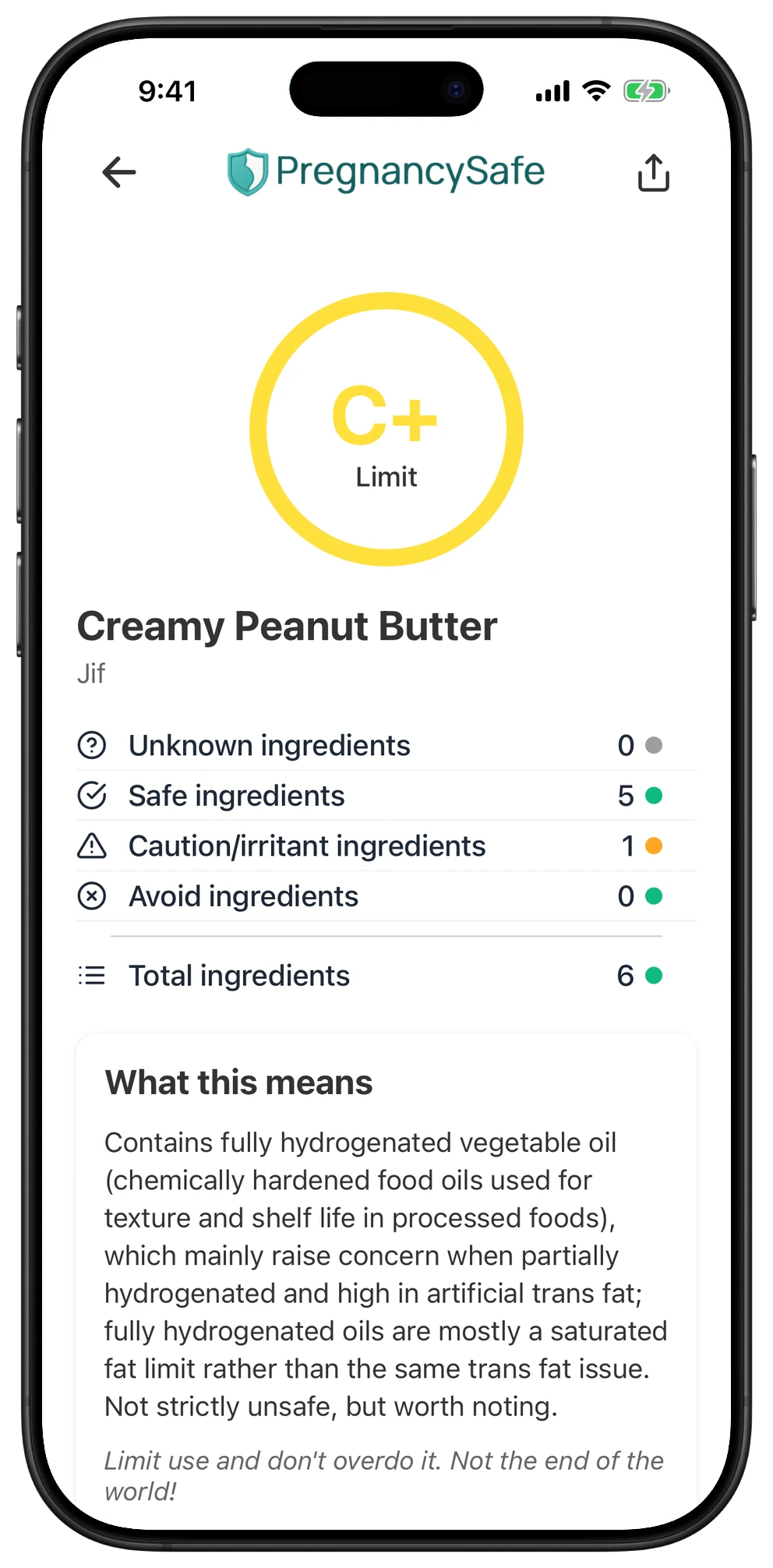
| A | Creamy Peanut Butter | Jif |
| A | Jif Natural Crunchy Peanut Butter Spread – Contains 90% Peanuts | Jif |
| A | Creamy Peanut Butter | Kroger |
| A | Peanut Butter | Peter Pan |
| A | Jif Natural Creamy Peanut Butter | Jif |
Your Questions Answered
Can I have peanut butter while pregnant?
Yes, ordinary peanut butter can be part of your pregnancy diet unless you have a peanut allergy or your clinician has advised otherwise. You do not need to stop eating it simply because you are pregnant. Compare labels for your nutrition needs and enjoy it within a varied diet.
What foods help the fetus grow?
Protein supports fetal growth, and nuts, seeds, beans, peas, and soy foods are among the options that contribute it. Peanut butter can be one part of that variety if you tolerate peanuts. It is not a complete pregnancy diet on its own, and eating extra peanut butter is not a guarantee of better fetal growth.
Should I avoid peanut butter to prevent my baby having an allergy?
No you do not need to avoid ordinary peanut butter during pregnancy solely to prevent your baby developing allergies. That does not mean eating it will prevent an allergy either. If you have a peanut allergy yourself, avoid it and follow your clinician's advice.
Are hydrogenated oils in peanut butter unsafe during pregnancy?
The type matters: partially hydrogenated oils are a source of artificial trans fat and are best avoided. Fully hydrogenated oils contain little or trace trans fat and are mainly a consideration when comparing saturated fat intake. A label that only says hydrogenated vegetable oil does not establish that the oil is partially hydrogenated. Check the full wording rather than treating every hydrogenated oil as the same risk.
How much peanut butter can I eat during pregnancy?
There is no universal pregnancy specific serving prescription for peanut butter. Use the label's serving size to understand the nutrients in your portion, not as a medical safety limit. Fit the amount into a varied diet, and ask your care team for individualized carbohydrate guidance if you have gestational diabetes.
Does an A grade mean a peanut butter is verified safe for pregnancy?
No our catalog contains 1,485 peanut butter products, including 1,030 with an A grade, but these are ingredient based catalog scores rather than pregnancy safety, nutrition, or allergy certifications. The product list prioritizes A/B ingredient grades, with C grades filling remaining slots, and uses searches in Pregnancy Safe within each group, not nutritional quality or suitability for every allergy. A lower grade or incomplete record does not by itself establish that a spread is harmful. This category covers peanut butter spreads, not every bar or snack that contains peanut butter.
How to Interpret These Ratings
Our ingredient and category rules generate letter grades from the information recorded in the catalog. Missing ingredients and broad category assignments can affect the result. These grades do not measure your dose, confirm a complete current label, or test a product for contamination.
A high grade is not a guarantee of pregnancy safety. A low grade is not, by itself, proof of harm from every use. Follow the product-specific guidance above, check the actual package, and ask your prenatal clinician about supplements, treatment decisions or uncertain exposures.
People Also Checked
References
- https://www.nhs.uk/pregnancy/keeping-well/foods-to-avoid/
- https://www.fda.gov/food/food-additives-petitions/trans-fat
- https://www.who.int/news-room/fact-sheets/detail/trans-fat
- https://www.fda.gov/food/hfp-constituent-updates/fda-completes-final-administrative-actions-partially-hydrogenated-oils-foods
- https://www.federalregister.gov/documents/2013/11/08/2013-26854/tentative-determination-regarding-partially-hydrogenated-oils-request-for-comments-and-for
- https://cdn.realfood.gov/DGA.pdf
- https://www.fda.gov/food/people-risk-foodborne-illness/dietary-advice-and-during-pregnancy
- https://www.rcpi.ie/Portals/0/Document%20Repository/Institute%20of%20Obstetricians%20and%20Gynaecologists/National%20Clinical%20Guidelines/IOG_National%20Clinical%20Guidelines_Nutrition%20in%20pregnancy%20Guideline_2019.pdf
- https://pmc.ncbi.nlm.nih.gov/articles/PMC8027310/
- https://pmc.ncbi.nlm.nih.gov/articles/PMC3192475/
- https://www.dietaryguidelines.gov/sites/default/files/2021-12/DGA_Pregnancy_FactSheet-508c.pdf
- https://www.acog.org/womens-health/faqs/healthy-eating-during-pregnancy
- https://www.cdc.gov/nutrition/php/data-research/added-sugars.html
- https://www.cdc.gov/diabetes/about/gestational-diabetes.html
- https://www.who.int/publications/i/item/9789241549028
- https://nesr.usda.gov/2025-dietary-guidelines-advisory-committee-systematic-reviews/dietary-patterns_gestational-diabetes