Is The Ordinary Azelaic Acid Suspension 10% Safe During Pregnancy? (Updated 2026 Guide)
Updated September 9, 2026
The Ordinary Azelaic Acid Suspension 10%
The Ordinary
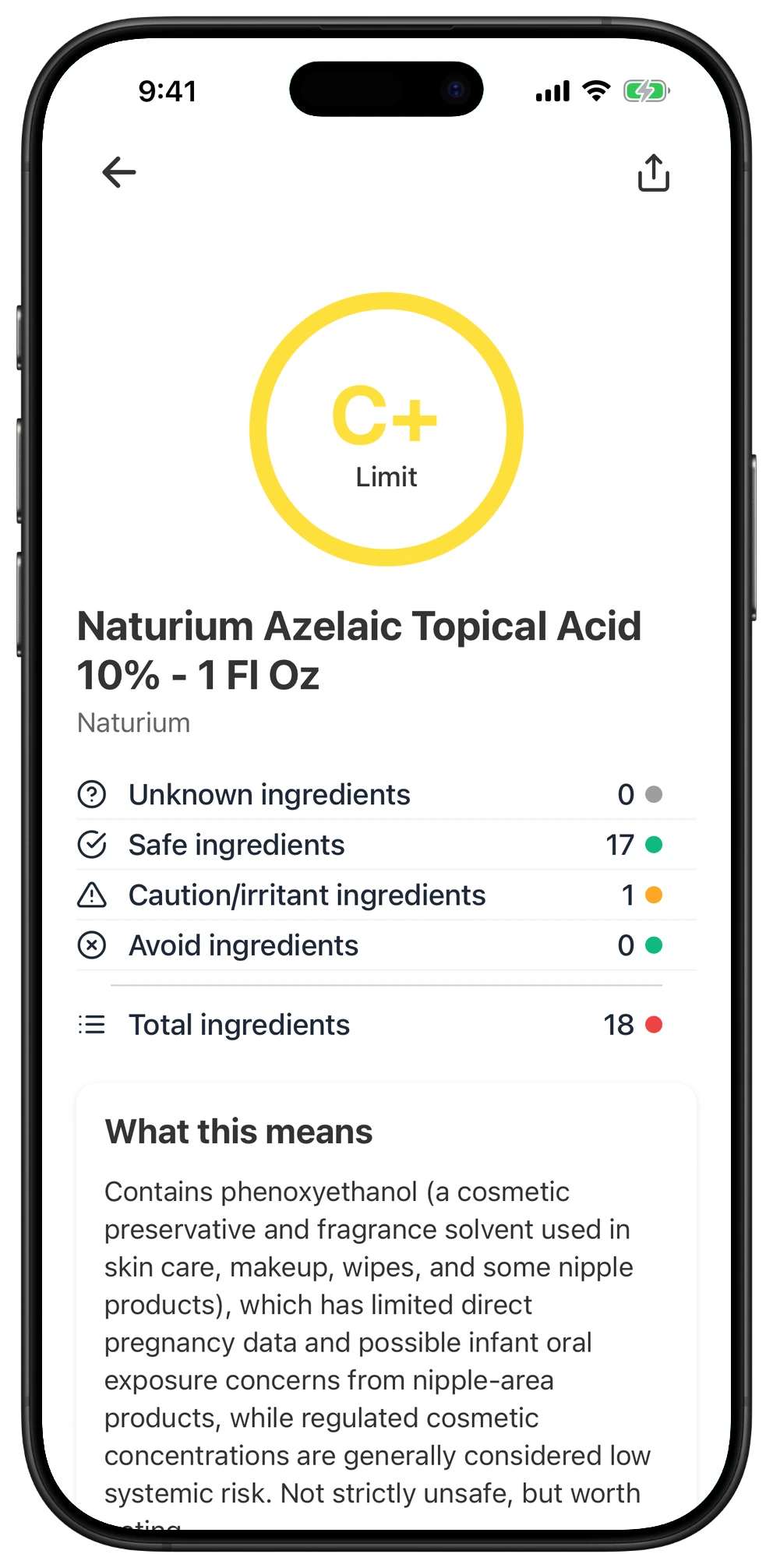
The Ordinary Azelaic Acid Suspension 10% receives a C grade, making it a use with caution choice during pregnancy rather than an unconditional safety recommendation. The ingredient based grade reflects caution flags for phenoxyethanol and triethanolamine, chiefly involving limited direct pregnancy evidence and formulation considerations not proof that ordinary facial use causes fetal harm.
You can use this, but maybe don't make it your everyday go to. Not the end of the world if you've used it. Consult your OBGYN or midwife if you have concerns.
Pregnancy Safe is 100% independent and research driven. No companies pay to promote or sponsor products.
Stress Less This Pregnancy
Check your skin care in the app

What Ingredients Are in The Ordinary Azelaic Acid Suspension 10%?
The Ordinary Azelaic Acid Suspension 10% has 17 ingredients. We flagged 2 ingredients to use with caution.
CAUTION
Phenoxyethanol is a preservative commonly used in cosmetics and skincare products to prevent microbial growth and extend shelf life. Phenoxyethanol warrants caution because direct pregnancy data are limited, although regulated cosmetic concentrations are generally considered low systemic risk and nursing concerns involve infant ingestion.
triethanolamine
CAUTION
Triethanolamine is an organic compound commonly used as a pH balancer and emulsifier in cosmetics and personal care products. Triethanolamine warrants caution because direct pregnancy data are lacking and low concern topical use depends on formulation controls that prevent nitrosamine formation and excess impurities.
tocopherol
LIKELY SAFE
Tocopherol is a form of vitamin E commonly used as an antioxidant in skincare and cosmetic products. Topical tocopherol is likely safe with normal skin use because systemic exposure is expected to be minimal; high dose oral vitamin E concerns do not directly apply.
dimethicone
SAFE
Dimethicone is a silicone based polymer commonly used in skincare and cosmetic products to provide a smooth, silky feel and create a protective barrier on the skin. Normal topical dimethicone use is expected to produce very little systemic exposure, supporting low pregnancy concern despite limited direct pregnancy studies.
dimethicone bis isobutyl ppg 20 crosspolymer
SAFE
Its safe rating relies on dimethicone related evidence of low topical absorption, rather than direct pregnancy studies of this specific crosspolymer.
aqua
SAFE
Aqua is the scientific term for water, commonly used as a solvent and base ingredient in various cosmetic and skincare products. Water serves as the formula's base and is unflagged, rather than individually confirmed safe for pregnancy by this assessment.
azelaic acid
SAFE
Azelaic acid is a naturally occurring dicarboxylic acid known for its anti inflammatory, antimicrobial, and skin brightening properties, commonly used in treating acne and rosacea. Azelaic acid is unflagged in this topical formula, but its entry does not establish pregnancy safety for the complete 10% suspension.
chlorphenesin
SAFE
Chlorphenesin is a synthetic preservative and muscle relaxant commonly used in cosmetics and topical products to inhibit microbial growth. Chlorphenesin is unflagged here; a warning involving it with phenoxyethanol in nipple cream concerned infant ingestion during nursing, not ordinary facial use during pregnancy.
dimethyl isosorbide
SAFE
Dimethyl isosorbide is a colorless, water miscible solvent commonly used in cosmetics and pharmaceuticals to enhance the delivery and absorption of active ingredients. This delivery enhancing solvent is unflagged, but its entry does not establish pregnancy specific absorption or safety for this formulation.
ethoxydiglycol
SAFE
Ethoxydiglycol is a clear, colorless, and odorless solvent commonly used in cosmetics and skincare products to enhance ingredient delivery and improve texture. This topical solvent is unflagged, but its entry contains no pregnancy specific evidence confirming safety at this product's concentration.
hydroxyethyl acrylate sodium acryloyldimethyl taurate copolymer
SAFE
This ingredient is unflagged, with no ingredient specific pregnancy evidence available in its assessment.
isoceteth 20
SAFE
Isoceteth 20 is unflagged, which should not be interpreted as a completed pregnancy safety review.
isodecyl neopentanoate
SAFE
Isodecyl neopentanoate is a lightweight, skin conditioning ester commonly used in cosmetics and skincare products for its emollient and smoothing properties. This skin conditioning ester is unflagged, but its entry does not establish pregnancy safety for topical exposure.
isohexadecane
SAFE
Isohexadecane is a lightweight, non greasy, and highly emollient hydrocarbon used in cosmetics and skincare products to provide a silky feel and improve product spreadability. This emollient is unflagged, without pregnancy specific evidence in its entry confirming safety for this use.
polysilicone 11
SAFE
Polysilicone 11 is unflagged, but no ingredient specific pregnancy evidence is available in its assessment.
polysorbate 60
SAFE
Polysorbate 60 is an emulsifier and surfactant commonly used in cosmetics and food products to help blend oil and water based ingredients. This emulsifier is unflagged, rather than individually verified safe for topical use during pregnancy.
trisodium ethylenediamine disuccinate
SAFE
Trisodium ethylenediamine disuccinate is a chelating agent used in skincare and cosmetic products to bind and neutralize metal ions, enhancing stability and efficacy. This formula stabilizing ingredient is unflagged, but its entry contains no pregnancy specific evidence confirming topical safety.
Answering Your Questions
How much The Ordinary Azelaic Acid Suspension 10% is safe during pregnancy?
If you choose to use it, apply a small amount to unbroken facial skin, avoiding your eye contour, eyes, and mouth. Patch test first; the manufacturer does not specify a pregnancy specific amount. Product directions
Can you use The Ordinary Azelaic Acid Suspension 10% daily while pregnant?
The manufacturer directs morning and evening application, but this is a general skincare schedule, not a pregnancy specific safety limit. Given the C grade, discuss regular use with your prenatal clinician or dermatologist. Stop and rinse off if irritation occurs. Product directions
Why did this product receive a C grade?
Its C grade comes from ingredient based scoring, with phenoxyethanol and triethanolamine flagged for caution. Phenoxyethanol has limited direct pregnancy data, while triethanolamine also requires appropriate formulation controls to prevent nitrosamine formation; neither flag establishes harm from this finished product. Tocopherol is rated likely safe for normal topical use.
Can I use azelaic acid on my face while pregnant?
Azelaic acid itself is not flagged in this assessment, but that is not a separate confirmation of pregnancy safety. This 10% suspension receives a C because the whole formula matters, so discuss the specific product not just its active ingredient with your clinician.
Can I use this product while breastfeeding?
Facial application is different from applying a product where your baby could swallow it. Avoid the nipple and breast area and prevent your baby from contacting treated skin with their mouth: a warning involving phenoxyethanol and chlorphenesin in a nipple cream concerned infant ingestion, not ordinary facial use. That warning alone does not establish whether this finished formula is suitable for you while nursing.
What alternatives should I consider during pregnancy?
If you want azelaic acid, ask your dermatologist about another formulation whose complete ingredient list has been reviewed for pregnancy. To avoid this product's specific caution flags, look for options without phenoxyethanol and triethanolamine, but do not assume their absence guarantees safety.
Can this suspension help with uneven skin tone and texture?
The manufacturer describes it as targeting uneven tone and texture in blemish prone skin. Those skincare benefits do not change its C pregnancy grade or establish treatment results specifically during pregnancy. Product information
Does the vitamin E in this product pose the same concerns as high dose supplements?
No tocopherol applied to skin is a different exposure from high dose oral vitamin E. Normal topical use is considered low concern because systemic exposure is expected to be minimal, although direct pregnancy studies are limited and evidence is less direct for extensively damaged skin or unusually large application areas.
What Are Pregnancy Safe Alternatives to The Ordinary Azelaic Acid Suspension 10%?
Here are some solid alternatives. Everything below has an A or B grade, meaning no flagged ingredients in our database.
| Grade | Product | Brand | Type |
|---|---|---|---|
| A | Shark Cryoglow Under Eye Cooling + Led Anti-Aging & Skin | Shark | skin care |
| A | Hypochlorous Acid Skin Spray 2 Fl Oz | Magic Molecule | skin care |
| A | Prequel Skin Universal Skin Solution Dermal Spray 2 Fl Oz | Prequel | skin care |
| A | Now Solutions, Vegetable Glycerin, 100% Pure, Versatile Skin Care | Now | skin care |
Are Other The Ordinary Products Safe During Pregnancy?
We looked at 12 other The Ordinary products. 5 are pregnancy safe (A or B grade), while 7 need a closer look.
| Grade | Product | Type |
|---|---|---|
| C | The Ordinary Natural Moisturizing Factors + Hyaluronic Acid Daily Moisturizer | moisturizer |
| C+ | The Ordinary Hyaluronic Acid 2% + B5 with Ceramides 60ml | serum |
| C+ | The Ordinary Niacinamide 10% + Zinc 1% | serum |
| A | 100% Plant-Derived Squalane | face oil |
How Does The Ordinary Azelaic Acid Suspension 10% Compare to Other Skin Cares?
We graded 499 Skin Cares for pregnancy safety. Here's how they stack up:
The Ordinary Azelaic Acid Suspension 10% earns a C grade, placing it among the top of Skin Cares. Only 8% of products in this category get an A grade, so it pays to choose carefully.
How Do We Score Products for Pregnancy Safety?
We analyze each product's ingredients and category to flag known risks and provide cautionary notices for general category safety concerns.
A - Safe
Excellent choice! All ingredients are considered safe during pregnancy.
What to do: Use with confidence.
B - Likely Safe
Pretty much safe with very minimal risk. Some ingredients may have limited pregnancy studies, but no significant safety concerns have been identified.
What to do: Use with confidence.
C - Limit
Contains ingredients with some pregnancy considerations. Research shows these ingredients may have limited safety data, potential for minor hormonal effects, or require caution based on animal studies.
What to do: Use sparingly and consider safer alternatives when available.
D - Caution
Similar to C grade but contains multiple cautionary ingredients. The combination increases overall concern.
What to do: Try to avoid if that makes you feel better. If you've already used it, no need to panic.
F - Avoid
Contains an ingredient Pregnancy Safe recommends avoiding during pregnancy. This may reflect an established risk or a precaution based on limited evidence; check the ingredient guidance and exposure context.
What to do: Do not use during pregnancy. If you've already used it, don't worry - contact your OBGYN if concerned.
People Also Checked
References
- https://health.ec.europa.eu/system/files/2021-08/sccs_o_195_0.pdf
- https://ec.europa.eu/growth/tools-databases/cosing/details/28157
- https://journals.sagepub.com/doi/10.3109/10915819009078737
- https://link.springer.com/article/10.1007/s00204-024-03938-5
- https://www.sfda.gov.sa/en/warnings/1156
- https://www.industrialchemicals.gov.au/sites/default/files/Ethanol%2C%202-phenoxy-_Human%20health%20tier%20II%20assessment.pdf
- https://hero.epa.gov/reference/2857875
- https://books.publisso.de/sites/default/files/documents/series/mak/dam/Vol2019/Iss1/Alt006/mb12299kske6319_w.pdf
- https://cdnservices.industrialchemicals.gov.au/statements/EVA00103%20-%20Evaluation%20Statement%20-%2026%20June%202023.pdf
- https://journals.sagepub.com/doi/10.1177/1091581818794455
- https://pmc.ncbi.nlm.nih.gov/articles/PMC4154592/
- https://pubmed.ncbi.nlm.nih.gov/15868062/
- https://mothertobaby.org/fact-sheets/vitamin-e/
- https://pubmed.ncbi.nlm.nih.gov/23696578/
- https://health.ec.europa.eu/document/download/ac80d106-eb65-4248-a2f8-dde5d9d9996f_en
- https://www.industrialchemicals.gov.au/sites/default/files/Ethanol%2C%202%2C2%27%2C2%27%27-nitrilotris-_Human%20health%20tier%20II%20assessment.pdf
- https://www.ncbi.nlm.nih.gov/books/NBK390891/
- https://www.govinfo.gov/content/pkg/FR-2009-08-05/html/E9-18698.htm
- https://pubmed.ncbi.nlm.nih.gov/15213765/
- https://pubmed.ncbi.nlm.nih.gov/21673209/
- https://www.medicinesinpregnancy.org/leaflets-a-z/dimethicone/
- https://uktis.org/monographs/use-of-head-lice-treatments-in-pregnancy/
- https://www.cir-safety.org/sites/default/files/FAR_Methicones_032022.pdf
- https://www.medicines.org.uk/emc/product/4860/smpc
- https://www.sps.nhs.uk/articles/treating-lice-during-breastfeeding/
- https://mothertobaby.org/fact-sheets/lice-scabies-pregnancy/
- https://www.ecfr.gov/current/title-21/chapter-I/subchapter-D/part-347/subpart-B/section-347.10