Is Cheetos Crunchy Xxtra Flamin' Hot Safe During Pregnancy? (Updated 2026 Guide)
Updated September 9, 2026
Cheetos Crunchy Xxtra Flamin' Hot
Cheetos
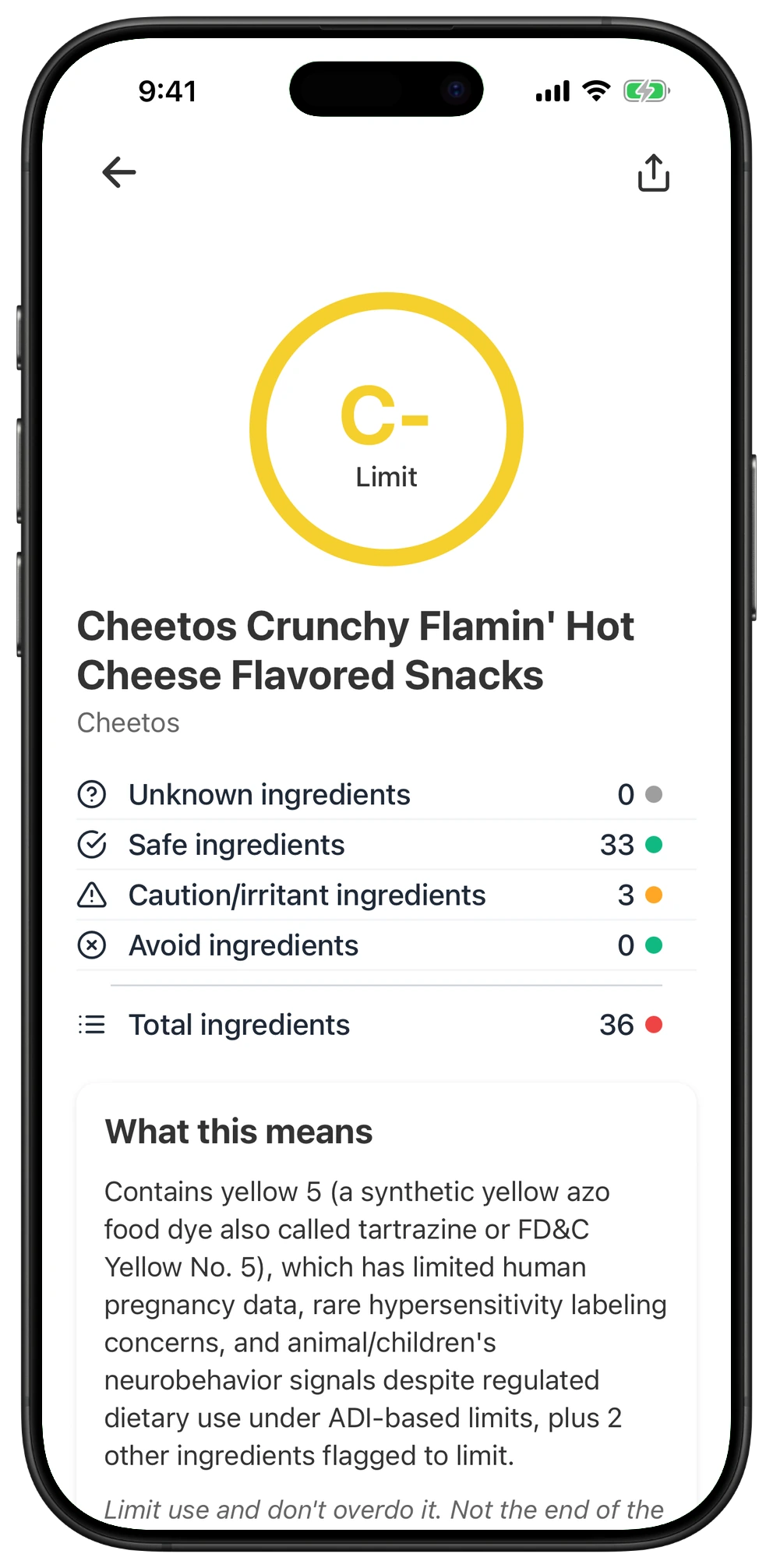
Cheetos Crunchy Xxtra Flamin' Hot earns a C- grade, making it a snack to limit rather than an everyday pregnancy choice. Artificial color, Red 40 Lake, and Yellow 5 carry caution ratings because pregnancy specific evidence is limited; occasional food exposure is not established to cause fetal harm.
You can use this, but maybe don't make it your everyday go to. Not the end of the world if you've used it. Consult your OBGYN or midwife if you have concerns.
Pregnancy Safe is 100% independent and research driven. No companies pay to promote or sponsor products.
Stress Less This Pregnancy
Check your chips in the app

What Ingredients Are in Cheetos Crunchy Xxtra Flamin' Hot?
Cheetos Crunchy Xxtra Flamin' Hot has 36 ingredients. We flagged 3 ingredients to use with caution.
artificial color
CAUTION
Artificial color is a synthetic dye added to foods and products to enhance or alter their visual appearance. Artificial color carries pregnancy caution because human outcome data are limited, although occasional regulated food exposure is generally low concern.
red 40 lake
CAUTION
Red 40 Lake is a synthetic colorant used to impart a vibrant red hue to food, beverages, and cosmetics. Red 40 Lake carries pregnancy caution for limited human data and indirect animal or child findings, not proven fetal harm from occasional food exposure.
yellow 5
CAUTION
Yellow 5 is a synthetic food dye used to impart a bright yellow color to various processed foods and beverages. Yellow 5 carries pregnancy caution for limited human data and indirect developmental findings, with hypersensitivity a separate concern in susceptible people.
LIKELY SAFE
Monosodium glutamate (MSG) is a flavor enhancer commonly used to impart a savory, umami taste to various dishes. Monosodium glutamate is likely safe at typical food additive amounts during pregnancy, with limited human pregnancy specific evidence.
cheddar cheese
SAFE
Cheddar cheese is a firm, tangy, and creamy yellow or white cheese originating from England, commonly used in cooking and snacking. Cheddar cheese is compatible with pregnancy when made from pasteurized milk and properly handled.
cheese cultures
SAFE
Cheese cultures are beneficial microorganisms used to ferment milk and develop the flavor, texture, and characteristic qualities of various cheeses. The pregnancy guidance for cheese cultures concerns pasteurized, properly handled dairy rather than a separate assessment of the cultures.
citric acid
SAFE
Citric acid is a natural organic acid commonly used as a preservative and flavor enhancer in food and beverages. Citric acid is low concern at normal food amounts during pregnancy, though acidic foods may worsen reflux.
corn
SAFE
Corn is a versatile cereal grain known for its sweet flavor and starchy texture, widely used in cooking and food production worldwide. Pregnancy dietary guidance does not identify ordinary corn as a food to avoid, but topical corn studies do not establish dietary safety.
corn meal
SAFE
Cornmeal is a finely ground or coarsely ground flour made from dried corn, commonly used in baking, breading, and as a base for dishes like polenta. Corn meal fits ordinary grain intake during pregnancy, while the matched cosmetic evidence is not direct evidence about eating it.
corn syrup solids
SAFE
Corn syrup solids are dehydrated forms of corn syrup that provide sweetness and viscosity to food products. The matched corn evidence largely concerns topical exposure and does not directly assess corn syrup solids eaten during pregnancy.
enriched corn meal
SAFE
Enriched cornmeal is finely ground cornmeal fortified with added vitamins and minerals to enhance its nutritional value. Enriched corn meal fits ordinary grain intake during pregnancy, but corn derived cosmetic studies do not directly assess this food ingredient.
ferrous sulfate
SAFE
Ferrous sulfate is a common iron supplement used to treat and prevent iron deficiency anemia. Ferrous sulfate at food fortification amounts is compatible with pregnancy and should not be equated with high dose iron supplements.
folic acid
SAFE
Folic acid is a synthetic form of vitamin B9 essential for DNA synthesis and cell growth. Folic acid at food fortification amounts is compatible with pregnancy, but these chips do not replace your recommended prenatal supplementation.
hydrolyzed corn protein
SAFE
Hydrolyzed corn protein is a processed plant based ingredient that provides moisturizing and conditioning benefits to hair and skin by delivering amino acids and peptides. The matched evidence for hydrolyzed corn protein largely concerns cosmetics and does not directly establish safety when eaten during pregnancy.
milk
SAFE
Milk is a nutritious, white liquid produced by mammals, commonly used as a beverage and in cooking and baking. Milk ingredients are compatible with pregnancy when pasteurized, while milk allergy remains a separate reason to avoid them.
niacin
SAFE
Niacin, also known as vitamin B3, is a water soluble vitamin essential for energy metabolism and maintaining healthy skin and nerves. Niacin at food fortification amounts is compatible with pregnancy, unlike high dose therapeutic supplementation that needs medical supervision.
potassium chloride
SAFE
Potassium chloride is a mineral salt commonly used as a potassium supplement and a salt substitute in food. Potassium chloride at normal food amounts is compatible with pregnancy, with individualized advice needed for kidney disease or potassium altering medicines.
riboflavin
SAFE
Riboflavin is a water soluble B vitamin (vitamin B2) essential for energy production and the metabolism of fats, proteins, and carbohydrates. Riboflavin at ordinary food fortification amounts is compatible with pregnancy and supports normal energy metabolism.
salt
SAFE
Salt is a mineral essential for flavor enhancement and preserving food. Salt is compatible with pregnancy in normal dietary amounts, while excessive intake and medical sodium restrictions require attention to your overall diet.
sugar
SAFE
Sugar is a sweet, crystalline substance derived from plants like sugarcane or sugar beets, commonly used to sweeten and enhance the flavor of foods and beverages. Sugar at normal food amounts is compatible with pregnancy, but overall added sugar intake and any gestational diabetes plan still matter.
thiamin mononitrate
SAFE
Thiamin mononitrate is a synthetic form of vitamin B1 used as a dietary supplement and food additive to support energy metabolism. Thiamin mononitrate at food fortification amounts is compatible with pregnancy and helps meet essential vitamin B1 needs.
whey
SAFE
Whey is a high quality protein derived from milk during cheese production, commonly used to support muscle growth and recovery. Whey in pasteurized food amounts is compatible with pregnancy, while concentrated protein supplement findings should not be applied to chip seasoning.
whey protein concentrate
SAFE
Whey protein concentrate is a high quality protein derived from milk, rich in essential amino acids and commonly used to support muscle growth and recovery. Whey protein concentrate in pasteurized foods is compatible with pregnancy unless you have a milk allergy, and differs from high protein supplementation.
buttermilk
SAFE
Buttermilk is a tangy, fermented dairy liquid commonly used in baking, cooking, and as a refreshing beverage. Buttermilk is unflagged here, but that is not a pregnancy safety review or confirmation of pasteurization.
canola
SAFE
Canola is a versatile vegetable oil known for its light flavor, high smoke point, and healthful omega-3 fatty acids. Canola is unflagged in this food, without an ingredient specific pregnancy safety assessment.
enzymes
SAFE
Enzymes are biological catalysts that speed up chemical reactions in living organisms. Enzymes are unflagged here, but their unspecified identity limits pregnancy specific assessment.
garlic powder
SAFE
Garlic powder is a finely ground seasoning made from dried garlic cloves, offering a concentrated, savory flavor. Garlic powder is unflagged as a seasoning here, without an ingredient specific pregnancy safety review.
maltodextrin
SAFE
Maltodextrin is a white, powdery carbohydrate derived from starch, commonly used as a thickener, filler, or energy source in processed foods. Maltodextrin is unflagged in this food, but that does not establish a pregnancy specific safety assessment.
natural flavors
SAFE
Natural flavors are derived from plant or animal sources and used to enhance the taste of food and beverages. Natural flavors are unflagged here, but their unspecified composition prevents a specific pregnancy safety conclusion.
onion powder
SAFE
Onion powder is a finely ground spice made from dried onions, offering a concentrated, savory flavor to dishes. Onion powder is unflagged as a seasoning here, without an ingredient specific pregnancy safety assessment.
sodium diacetate
SAFE
Sodium diacetate is a food additive used as a preservative and flavoring agent, providing a tangy taste and helping to inhibit microbial growth. Sodium diacetate is unflagged in this food, without a pregnancy specific safety review.
sunflower oil
SAFE
Sunflower oil is a light, mild tasting vegetable oil extracted from sunflower seeds, commonly used for cooking and frying. Sunflower oil is unflagged in this food, without an ingredient specific pregnancy safety assessment.
vegetable oil
SAFE
Vegetable oil is a versatile, plant derived oil commonly used for cooking, frying, and baking. Vegetable oil is unflagged here, but this broad ingredient name does not provide a pregnancy specific safety assessment.
yeast extract
SAFE
Yeast extract is a savory, umami rich ingredient made from the concentrated extract of yeast cells, commonly used to enhance flavor in various dishes. Yeast extract is unflagged in this food, without an ingredient specific pregnancy safety review.
yellow 6
SAFE
Yellow 6 is a synthetic yellow dye commonly used to add vibrant color to foods, beverages, and cosmetics. Yellow 6 is unflagged here, which should not be interpreted as a reviewed pregnancy safety finding for dietary exposure.
yellow 6 lake
SAFE
Yellow 6 Lake is a synthetic orange dye used as a coloring agent in food, beverages, and cosmetics. Yellow 6 Lake is unflagged here, rather than specifically reviewed as safe to eat during pregnancy.
Answering Your Questions
How much Cheetos Crunchy Xxtra Flamin' Hot is safe during pregnancy?
If you choose to eat these chips, pour a small portion into a bowl instead of eating straight from the bag. Use the label's serving size as a portion guide, not a proven pregnancy safe limit; dye quantities are not available to calculate one.
Can you use Cheetos Crunchy Xxtra Flamin' Hot daily while pregnant?
Keep these as an occasional snack rather than a daily staple, choosing options without the flagged dyes more often. There is no established pregnancy specific weekly limit for this product.
Why did Cheetos Crunchy Xxtra Flamin' Hot receive a C- grade?
The C- comes from ingredient based scoring: artificial color, Red 40 Lake, and Yellow 5 are rated caution, while monosodium glutamate is rated likely safe and also contributes to scoring. The dye concerns reflect limited pregnancy evidence and indirect findings from animal or child studies, not proof that an occasional portion harms your baby.
Can I eat these chips while breastfeeding?
An occasional portion can generally fit into a varied breastfeeding diet; CDC says breastfeeding parents usually do not need to avoid specific foods. That general guidance is not a product specific safety assessment, and the C- pregnancy grade does not establish breastfeeding risk. CDC
What alternatives can satisfy a crunchy, spicy craving?
Look for chips or popcorn without artificial colors, especially Red 40 and Yellow 5, and compare sodium per serving. You can also season plain popcorn yourself, adjusting the heat to your tolerance; these selection criteria are not an endorsement of a particular unreviewed product.
Can Xxtra Flamin' Hot Cheetos make pregnancy heartburn worse?
Yes, spicy and fatty foods can aggravate pregnancy heartburn, although triggers vary. Choose a milder snack if these cause burning or reflux, and avoid eating them close to bedtime. NHS
Should I worry if I already ate a portion?
An occasional portion is not established to cause pregnancy harm, and the C- grade does not mean that eating some has harmed your baby. The practical takeaway is to limit frequent exposure to the flagged dyes rather than panic about a single snack.
Is the MSG in these chips a pregnancy concern?
Monosodium glutamate is rated likely safe at typical food additive amounts, though human pregnancy specific evidence is limited. High dose animal or supplement findings should not be treated as evidence of harm from an ordinary portion of chips.
What Are Pregnancy Safe Alternatives to Cheetos Crunchy Xxtra Flamin' Hot?
Here are some solid alternatives. Everything below has an A or B grade, meaning no flagged ingredients in our database.
| Grade | Product | Brand | Type |
|---|---|---|---|
| A | Garden Salsa | Sun Chips | chips |
| A | Popcorners Sweet & Salty Kettle Corn Chips | Popcorners | chips |
| A | Pirate'S Booty Pikachu Shape Chips Multipack | Pirate'S Booty | chips |
| A | Mexican Street Corn Protein Chips | Quest | chips |
Are Other Cheetos Products Safe During Pregnancy?
We looked at 11 other Cheetos products. 4 are pregnancy safe (A or B grade), while 7 need a closer look.
| Grade | Product | Type |
|---|---|---|
| C- | Cheetos Crunchy Flamin' Hot Cheese Flavored Snacks | snack |
| A | Baked Crunchy Cheese Flavored | snack |
| B+ | American Turkey | snack |
| B+ | Cheddar & Crunchy Cheese Flavored Popcorn Snacks | popcorn |
How Does Cheetos Crunchy Xxtra Flamin' Hot Compare to Other Chips?
We graded 867 Chips for pregnancy safety. Here's how they stack up:
Cheetos Crunchy Xxtra Flamin' Hot earns a C- grade, placing it among the top of Chips. About 86% of products in this category get an A or B grade.
How Do We Score Products for Pregnancy Safety?
We analyze each product's ingredients and category to flag known risks and provide cautionary notices for general category safety concerns.
A - Safe
Excellent choice! All ingredients are considered safe during pregnancy.
What to do: Use with confidence.
B - Likely Safe
Pretty much safe with very minimal risk. Some ingredients may have limited pregnancy studies, but no significant safety concerns have been identified.
What to do: Use with confidence.
C - Limit
Contains ingredients with some pregnancy considerations. Research shows these ingredients may have limited safety data, potential for minor hormonal effects, or require caution based on animal studies.
What to do: Use sparingly and consider safer alternatives when available.
D - Caution
Similar to C grade but contains multiple cautionary ingredients. The combination increases overall concern.
What to do: Try to avoid if that makes you feel better. If you've already used it, no need to panic.
F - Avoid
Contains an ingredient Pregnancy Safe recommends avoiding during pregnancy. This may reflect an established risk or a precaution based on limited evidence; check the ingredient guidance and exposure context.
What to do: Do not use during pregnancy. If you've already used it, don't worry - contact your OBGYN if concerned.
People Also Checked
References
- https://www.fda.gov/food/color-additives-information-consumers/color-additives-questions-and-answers-consumers
- https://www.fda.gov/food/food-ingredients-packaging/color-additives-information-consumers
- https://www.fda.gov/cosmetics/cosmetic-ingredient-names/color-additives-permitted-use-cosmetics
- https://www.fda.gov/industry/color-additives/fdc-red-no-3
- https://pubmed.ncbi.nlm.nih.gov/35233072/
- https://pubmed.ncbi.nlm.nih.gov/35484553/
- https://pubmed.ncbi.nlm.nih.gov/35106984/
- https://www.fda.gov/food/food-additives-petitions/questions-and-answers-monosodium-glutamate-msg
- https://efsa.onlinelibrary.wiley.com/doi/10.2903/j.efsa.2017.4910
- https://pubmed.ncbi.nlm.nih.gov/32625571/
- https://pmc.ncbi.nlm.nih.gov/articles/PMC6952072/
- https://pmc.ncbi.nlm.nih.gov/articles/PMC10104942/
- https://www.hfpappexternal.fda.gov/scripts/fdcc/index.cfm?id=FDCRed40&set=ColorAdditives
- https://www.ecfr.gov/current/title-21/chapter-I/subchapter-A/part-74/subpart-A/section-74.340
- https://www.fda.gov/food/color-additives-information-consumers/tracking-food-industry-pledges-remove-petroleum-based-food-dyes
- https://www.efsa.europa.eu/en/efsajournal/pub/1327
- https://www.efsa.europa.eu/en/efsajournal/pub/4007
- https://apps.who.int/food-additives-contaminants-jecfa-database/Home/Chemical/2361
- https://oehha.ca.gov/risk-assessment/report/health-effects-assessment-potential-neurobehavioral-effects-synthetic-food-dyes-children
- https://pubmed.ncbi.nlm.nih.gov/6636206/
- https://pubmed.ncbi.nlm.nih.gov/2613118/
- https://pubmed.ncbi.nlm.nih.gov/7940558/
- https://hfpappexternal.fda.gov/scripts/fdcc/index.cfm?id=FDCYellow5&set=ColorAdditives
- https://www.ecfr.gov/current/title-21/chapter-I/subchapter-A/part-74#74.705
- https://www.fda.gov/food/nutrition-food-labeling-and-critical-foods/food-allergies
- https://apps.who.int/food-additives-contaminants-jecfa-database/Home/Chemical/3885
- https://efsa.onlinelibrary.wiley.com/doi/10.2903/j.efsa.2009.1331
- https://pubmed.ncbi.nlm.nih.gov/1628860/
- https://pmc.ncbi.nlm.nih.gov/articles/PMC7023231/
- https://pmc.ncbi.nlm.nih.gov/articles/PMC6354951/
- https://www.acog.org/womens-health/faqs/healthy-eating-during-pregnancy
- https://www.cdc.gov/food-safety/foods/pregnant-women.html
- https://www.fda.gov/food/people-risk-foodborne-illness/food-safety-moms-be
- https://www.fda.gov/food/health-educators/listeria-food-safety-moms-be
- https://www.foodsafety.gov/people-at-risk/pregnant-women
- https://hfpappexternal.fda.gov/scripts/fdcc/index.cfm?id=CITRICACID&set=FoodSubstances
- https://www.ecfr.gov/current/title-21/chapter-I/subchapter-B/part-184/subpart-B/section-184.1033
- https://apps.who.int/food-additives-contaminants-jecfa-database/chemical.aspx?chemID=3594
- https://www.inchem.org/documents/jecfa/jeceval/jec_436.htm
- https://pmc.ncbi.nlm.nih.gov/articles/PMC7448088/
- https://www.fao.org/fileadmin/user_upload/jecfa_additives/docs/monograph16/additive-135-m16.pdf
- https://journals.sagepub.com/doi/pdf/10.1177/1091581811403832
- https://pubmed.ncbi.nlm.nih.gov/21772025/
- https://www.cir-safety.org/ingredient/zea-mays-corn-starch
- https://www.ecfr.gov/current/title-21/chapter-I/subchapter-D/part-347
- https://www.hfpappexternal.fda.gov/scripts/fdcc/index.cfm?id=CORNSTARCH&set=FoodSubstances
- https://www.fda.gov/food/people-risk-foodborne-illness/dietary-advice-and-during-pregnancy
- https://pubmed.ncbi.nlm.nih.gov/40984809/
- https://www.cdc.gov/mmwr/preview/mmwrhtml/00051880.htm
- https://www.who.int/tools/elena/interventions/daily-iron-pregnancy
- https://ods.od.nih.gov/factsheets/Iron-HealthProfessional/
- https://www.uspreventiveservicestaskforce.org/uspstf/document/RecommendationStatementFinal/iron-deficiency-anemia-in-pregnant-women-screening-and-supplementation
- https://www.cdc.gov/folic-acid/about/intake-and-sources.html
- https://www.cdc.gov/folic-acid/hcp/clinical-overview/index.html
- https://www.uspreventiveservicestaskforce.org/uspstf/recommendation/folic-acid-for-the-prevention-of-neural-tube-defects-preventive-medication
- https://ods.od.nih.gov/factsheets/Folate-HealthProfessional/
- https://www.who.int/tools/elena/interventions/folate-periconceptional
- https://www.acog.org/womens-health/faqs/listeria-and-pregnancy
- https://www.fda.gov/food/buy-store-serve-safe-food/dangers-raw-milk-unpasteurized-milk-can-pose-serious-health-risk
- https://www.fda.gov/food/buy-store-serve-safe-food/raw-milk-misconceptions-and-danger-raw-milk-consumption
- https://ods.od.nih.gov/factsheets/Niacin-HealthProfessional/
- https://ods.od.nih.gov/factsheets/Niacin-Consumer/
- https://www.ncbi.nlm.nih.gov/books/NBK114304/
- https://www.ncbi.nlm.nih.gov/books/NBK548176/
- https://www.ncbi.nlm.nih.gov/books/NBK557728/
- https://ods.od.nih.gov/factsheets/Potassium-HealthProfessional/
- https://ods.od.nih.gov/factsheets/Potassium-Consumer/
- https://dailymed.nlm.nih.gov/dailymed/lookup.cfm?setid=0224e5b3-3c49-4e6e-aa78-1abcc6969246
- https://lpi.oregonstate.edu/mic/minerals/potassium
- https://pmc.ncbi.nlm.nih.gov/articles/PMC10863666/
- https://ods.od.nih.gov/factsheets/Riboflavin-HealthProfessional/
- https://ods.od.nih.gov/factsheets/Riboflavin-Consumer/
- https://ods.od.nih.gov/factsheets/Pregnancy-HealthProfessional/
- https://www.ncbi.nlm.nih.gov/books/NBK114322/
- https://www.ncbi.nlm.nih.gov/books/NBK114310/
- https://pmc.ncbi.nlm.nih.gov/articles/PMC11270530/
- https://pmc.ncbi.nlm.nih.gov/articles/PMC6946899/
- https://www.who.int/publications/i/item/9789241504836
- https://www.ncbi.nlm.nih.gov/books/NBK610895/
- https://www.ecfr.gov/current/title-21/chapter-I/subchapter-B/part-184/subpart-B/section-184.1854
- https://www.fda.gov/files/food/published/Guidance-for-Industry--Ingredients-Declared-as-Evaporated-Cane-Juice-%28PDF%29.pdf
- https://cdn.realfood.gov/DGA.pdf
- https://www.cdc.gov/maternal-infant-health/pregnancy-diabetes/index.html
- https://pubmed.ncbi.nlm.nih.gov/30501650/
- https://pubmed.ncbi.nlm.nih.gov/35483873/
- https://pubmed.ncbi.nlm.nih.gov/34666569/
- https://ods.od.nih.gov/factsheets/Thiamin-HealthProfessional/
- https://www.ncbi.nlm.nih.gov/books/NBK482360/
- https://pmc.ncbi.nlm.nih.gov/articles/PMC10158844/
- https://www.ecfr.gov/current/title-21/part-184/section-184.1979
- https://www.ecfr.gov/current/title-21/part-184/section-184.1979c
- https://odphp.health.gov/myhealthfinder/pregnancy/nutrition-and-physical-activity/eat-healthy-during-pregnancy-quick-tips
- https://pmc.ncbi.nlm.nih.gov/articles/PMC12779656/
- https://pubmed.ncbi.nlm.nih.gov/34060419/
- https://pubmed.ncbi.nlm.nih.gov/37010155/
- https://www.fda.gov/food/dietary-supplements/information-consumers-using-dietary-supplements
- https://www.ncbi.nlm.nih.gov/books/NBK562630/
- https://www.who.int/tools/elena/interventions/energy-protein-pregnancy
- https://www.who.int/tools/elena/interventions/high-protein-pregnancy
- https://pubmed.ncbi.nlm.nih.gov/41203981/
- https://www.foodallergy.org/living-food-allergy/food-allergy-essentials/common-allergens/milk