Is Cheese Safe During Pregnancy? (Updated 2026 Guide)
Updated September 9, 2026
The Answer
Yes many cheeses can be eaten during pregnancy when you choose pasteurized varieties and handle them safely. Avoid cold raw milk cheese, and heat queso fresco type cheeses to 165°F or steaming hot even when pasteurized.
The main pregnancy concern is Listeria and other foodborne germs, not cheese as a whole: raw milk can carry pathogens, and pasteurized cheese can become contaminated after processing. Pasteurized hard cheeses, cottage cheese, cream cheese, string cheese, feta and mozzarella are safer choices when handled properly, while queso fresco type cheeses need heating. Ingredient flags for pasteurized feta do not make it inherently unsafe, and catalog grades cannot verify pasteurization, refrigeration or recall status.
Pregnancy Safe is 100% independent and research driven. No companies pay to promote or sponsor products.
Stress Less This Pregnancy
Check your exact cheese in the app

✓ What's Safe
- • Check the exact package for a statement that the cheese is made with pasteurized milk.
- • Choose pasteurized hard cheese or pasteurized cottage cheese, cream cheese, string cheese, feta or mozzarella for options that do not generally require cooking.
- • Heat queso fresco type cheeses to 165°F or steaming hot throughout, even if the milk was pasteurized.
- • Keep refrigerated cheese cold and follow the package’s storage and after opening instructions.
- • Ask restaurants or cheese counters to confirm both the cheese type and pasteurization status rather than relying on the cheese’s name.
- • Check recall notices and match the exact package details before eating an affected cheese.
✗ What to Avoid
- • Avoid eating raw milk or unpasteurized cheese cold; choose pasteurized alternatives. CDC advises heating raw milk cheese to 165°F or steaming hot.
- • Do not eat queso fresco type cheeses cold simply because their labels say pasteurized.
- • Avoid recalled cheese rather than trying to make it acceptable by cooking it.
- • Skip cheese when you cannot confirm its pasteurization status or appropriate storage; missing information is uncertainty, not proof of contamination.
- • Do not assume lightly melted cheese has reached 165°F or is steaming hot throughout when heating is needed.
- • If following NHS guidance, avoid cold soft mold ripened and soft blue cheeses, even when pasteurized; cook them until steaming hot throughout.
Most Common Ingredients in Cheese Products
We analyzed 13,379 cheese products. Here are the most common ingredients, ranked by how often they appear:
Ingredients to Watch Out For in Cheese
These are the most common flagged ingredients across 13,379 cheese products we analyzed.
artificial color
Caution
Artificial color is a synthetic dye added to foods and products to enhance or alter their visual appearance.
Has limited pregnancy specific outcome data; regulated incidental exposure is generally low concern but some dyes have child behavior allergy or regulatory caveats.
Flagged in 202 of 13,379 products (2%)
sodium nitrite
Caution
Sodium nitrite is a chemical compound commonly used as a preservative and color fixative in processed meats.
Is regulated at low food additive levels, but frequent cured or processed meat intake has limited observational pregnancy concerns; cyanide antidote and contaminated water exposures are separate issues.
Flagged in 46 of 13,379 products (0%)
feta cheese pasteurized milk
Caution
Feta cheese made from pasteurized milk is a tangy, crumbly Greek cheese with a creamy texture and salty flavor.
May carry Listeria risk if made from raw or unpasteurized milk or contaminated after pasteurization, while pasteurized feta kept cold or cooked until steaming hot is generally the safer pregnancy choice.
Flagged in 42 of 13,379 products (0%)
raw milk
Avoid
Raw milk is unpasteurized, naturally occurring milk straight from the source, containing all its original enzymes and nutrients.
Can carry Listeria and other foodborne pathogens; pregnancy listeriosis can harm the fetus or newborn even when maternal illness seems mild.
Flagged in 29 of 13,379 products (0%)
blue cheese pasteurized milk
Caution
Blue cheese pasteurized milk is milk that has been heat treated to eliminate bacteria, used as a base for making blue cheese with its distinctive mold veins and tangy flavor.
Can carry Listeria risk in pregnancy when soft unpasteurized or eaten cold and is lower risk when pasteurized and heated until steaming hot.
Flagged in 28 of 13,379 products (0%)
high fructose corn syrup
Caution
High fructose corn syrup is a sweet, liquid sweetener made from corn starch, commonly used in processed foods and beverages.
Is not a known teratogen at occasional food amounts, but high added sugar intake can displace nutrients and raise gestational diabetes and metabolic concerns.
Flagged in 27 of 13,379 products (0%)
feta cheese cultured pasteurized milk
Caution
Feta cheese is a tangy, crumbly cheese made from cultured, pasteurized milk, commonly used in salads and Mediterranean dishes.
May carry Listeria risk if made from raw or unpasteurized milk or contaminated after pasteurization, while pasteurized feta kept cold or cooked until steaming hot is generally the safer pregnancy choice.
Flagged in 24 of 13,379 products (0%)
port wine
Avoid
Port wine is a rich, sweet fortified wine from Portugal, traditionally enjoyed as a dessert wine or after dinner drink.
Has no established safe amount in pregnancy and is linked to fetal alcohol spectrum disorders and other adverse pregnancy outcomes.
Flagged in 24 of 13,379 products (0%)
Types of Cheese
Cheese Products We've Analyzed
Our catalog contains ratings for 13,379 cheese products. These are database grades, not independent safety certifications.
These counts span different cheese types. A grade cannot verify pasteurization, handling or Listeria risk; a flagged pasteurized-feta phrase is not a blanket reason to avoid pasteurized feta. Follow the type-specific food guidance above.
Pregnancy Safe Cheese Products
Popular options from our catalog, prioritizing A and B ingredient grades, with C grade options used to fill remaining places. Within each group, products are ordered by searches in Pregnancy Safe, not retail sales. Read the cautions and guidance above; grades do not verify a complete current label or guarantee pregnancy safety.
| Grade | Product | Brand |
|---|---|---|
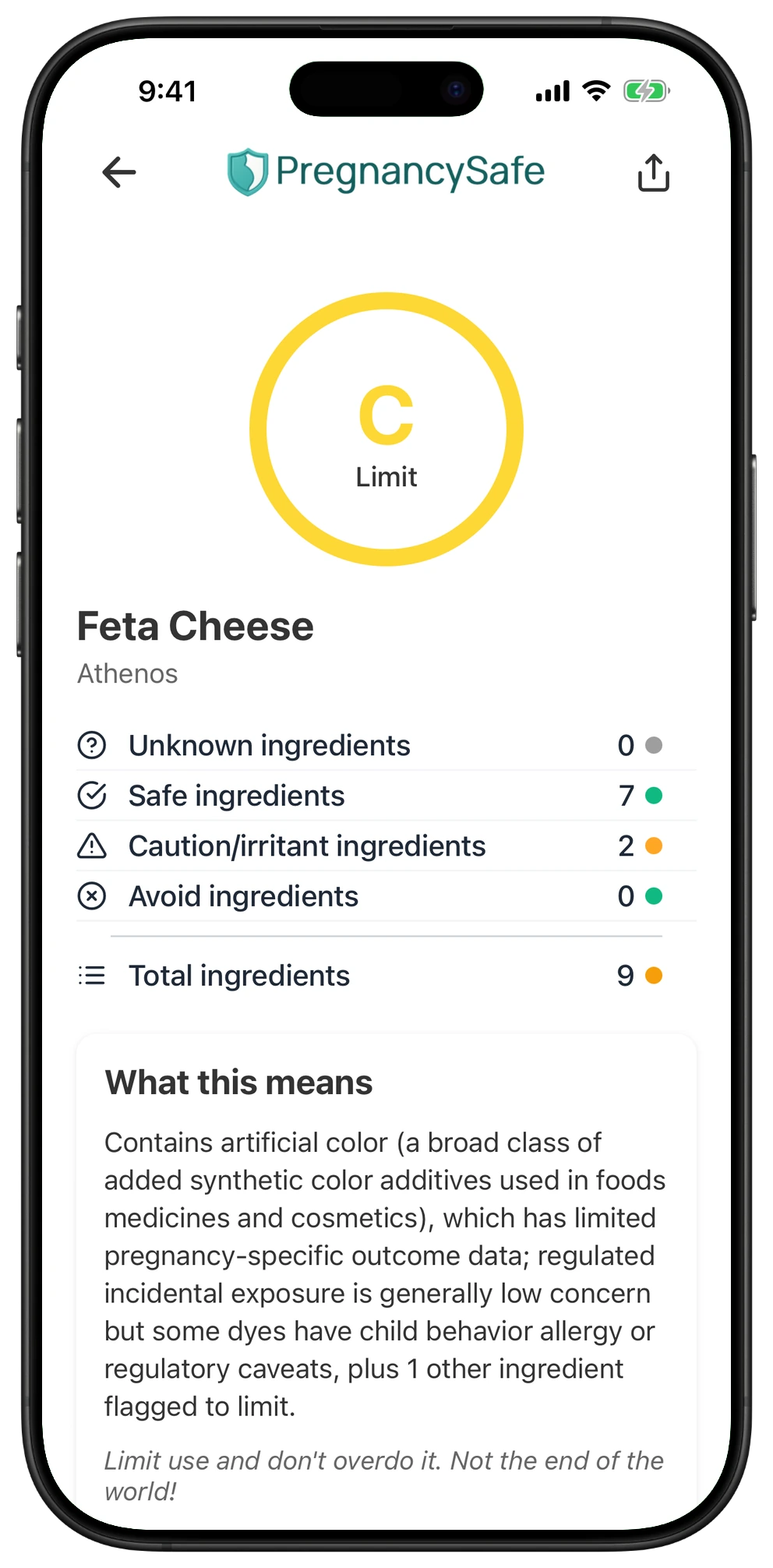
| A | Feta Cheese | Athenos |
| A | Cottage Cheese | Daisy |
| A | Burrata | Belgioioso |
| A | Parmesan Cheese | Kraft |
| A | Ricotta Cheese | Galbani |
Your Questions Answered
Which cheeses can I eat during pregnancy?
Pasteurized hard cheeses and pasteurized cottage cheese, cream cheese, string cheese, feta and mozzarella are safer choices under US CDC guidance. Check your package rather than assuming every version uses pasteurized milk. Keep refrigerated cheese cold and follow storage instructions. Queso fresco type cheeses are an important exception: heat them to 165°F or steaming hot even when pasteurized.
Is Asiago cheese safe during pregnancy?
For hard Asiago, choose a version labeled as made with pasteurized milk and follow its storage instructions. The name Asiago alone does not establish pasteurization or how the cheese has been handled. If you cannot confirm the type or milk treatment, ask the manufacturer or choose a clearly labeled pasteurized hard cheese instead.
Can I eat pasteurized feta while pregnant?
Yes, pasteurized feta is generally an acceptable choice when handled safely. Pasteurization reduces the initial pathogen risk but does not prevent contamination afterward, so refrigeration and recall checks still matter. A caution attached to a label phrase containing pasteurized feta is not a blanket reason to avoid it. Avoid raw milk feta served cold.
Are all pasteurized soft cheeses safe to eat cold?
No the cheese type matters as well as pasteurization. CDC lists pasteurized options such as cottage cheese, cream cheese, feta and mozzarella as safer choices, but advises heating queso fresco type cheeses even when pasteurized. Heat those cheeses to 165°F or steaming hot throughout. Do not extend the guidance for one soft cheese to every soft cheese.
Can I eat blue cheese or Brie during pregnancy?
Guidance differs by country and cheese type. NHS guidance advises cooking soft blue cheeses and soft mold ripened cheeses such as Brie until steaming hot throughout, even when pasteurized. US guidance emphasizes pasteurization and has specific heating advice for queso fresco type and raw milk cheeses. Cooking soft blue or mold ripened cheese until steaming hot is a cautious option, but it does not make recalled cheese acceptable to eat.
Does cooking make raw milk cheese a safer choice?
CDC advises heating raw milk cheese to 165°F or steaming hot before eating it. Choosing pasteurized cheese is the simpler way to avoid the raw milk concern. If heating is needed, the cheese must be hot throughout, not merely softened or melted on top. Do not use cooking to rescue recalled cheese.
Does an A grade mean a cheese is guaranteed safe during pregnancy?
No. Our catalog contains 13,379 cheese products, including 10,666 with an A grade, but those grades cannot confirm pasteurization, handling or Listeria risk. A lower grade also does not automatically mean a cheese is unsafe to eat. Use the cheese type guidance and your exact package’s label first; a listed product is not a safety guarantee or a clinical endorsement.
How to Interpret These Ratings
Our ingredient and category rules generate letter grades from the information recorded in the catalog. Missing ingredients and broad category assignments can affect the result. These grades do not measure your dose, confirm a complete current label, or test a product for contamination.
A high grade is not a guarantee of pregnancy safety. A low grade is not, by itself, proof of harm from every use. Follow the product-specific guidance above, check the actual package, and ask your prenatal clinician about supplements, treatment decisions or uncertain exposures.
References
- https://www.cdc.gov/foodsafety/rawmilk/index.html
- https://www.cdc.gov/listeria/prevention/index.html
- https://www.nhs.uk/pregnancy/keeping-well/foods-to-avoid/
- https://www.fda.gov/food/people-risk-foodborne-illness/ready-eat-foods-food-safety-moms-be
- https://www.fda.gov/food/color-additives-information-consumers/color-additives-questions-and-answers-consumers
- https://www.fda.gov/food/food-ingredients-packaging/color-additives-information-consumers
- https://www.fda.gov/cosmetics/cosmetic-ingredient-names/color-additives-permitted-use-cosmetics
- https://www.fda.gov/industry/color-additives/fdc-red-no-3
- https://pubmed.ncbi.nlm.nih.gov/35233072/
- https://pubmed.ncbi.nlm.nih.gov/35484553/
- https://pubmed.ncbi.nlm.nih.gov/35106984/
- https://hfpappexternal.fda.gov/scripts/fdcc/index.cfm?id=SODIUMNITRITE&set=FoodSubstances
- https://www.ecfr.gov/current/title-9/section-424.21
- https://www.ecfr.gov/current/title-21/section-172.175
- https://www.efsa.europa.eu/en/press/news/170615
- https://www.inchem.org/documents/jecfa/jecmono/v50je07.htm
- https://pubmed.ncbi.nlm.nih.gov/41248583/
- https://www.cdc.gov/food-safety/foods/pregnant-women.html
- https://publications.iarc.who.int/Book-And-Report-Series/Iarc-Monographs-On-The-Identification-Of-Carcinogenic-Hazards-To-Humans/Red-Meat-And-Processed-Meat-2018
- https://dailymed.nlm.nih.gov/dailymed/drugInfo.cfm?setid=52f01c6e-172a-47a9-98a6-9eab7651a032
- https://www.atsdr.cdc.gov/toxprofiles/tp204.pdf
- https://www.cdc.gov/listeria/causes/dairy.html
- https://www.fda.gov/food/health-educators/listeria-food-safety-moms-be
- https://www.foodsafety.gov/people-at-risk/pregnant-women
- https://www.acog.org/clinical/clinical-guidance/committee-opinion/articles/2014/12/management-of-pregnant-women-with-presumptive-exposure-to-listeria-monocytogenes
- https://www.ncbi.nlm.nih.gov/books/NBK582795/
- https://pubmed.ncbi.nlm.nih.gov/29774843/
- https://www.cdc.gov/food-safety/foods/raw-milk.html
- https://www.fda.gov/food/buy-store-serve-safe-food/dangers-raw-milk-unpasteurized-milk-can-pose-serious-health-risk
- https://www.fda.gov/food/people-risk-foodborne-illness/food-safety-booklet-pregnant-women-their-unborn-babies-and-children-under-five
- https://www.acog.org/womens-health/faqs/listeria-and-pregnancy
- https://www.acog.org/womens-health/faqs/healthy-eating-during-pregnancy
- https://www.ars.usda.gov/oc/utm/eating-right-before-and-after-pregnancy/
- https://www.usda.gov/about-usda/news/blog/listeria-monocytogenes-listeriosis-and-you
- https://www.cdc.gov/listeria/signs-symptoms/index.html
- https://wwwnc.cdc.gov/eid/article/24/6/17-1051_article
- https://cdn.realfood.gov/DGA.pdf
- https://www.dietaryguidelines.gov/sites/default/files/2021-12/DGA_Pregnancy_FactSheet-508c.pdf
- https://www.cdc.gov/nutrition/php/data-research/added-sugars.html
- https://www.cdc.gov/diabetes/about/gestational-diabetes.html
- https://www.who.int/publications/i/item/9789241549028
- https://nesr.usda.gov/2025-dietary-guidelines-advisory-committee-systematic-reviews/dietary-patterns_gestational-diabetes
- https://www.cdc.gov/alcohol-pregnancy/about/index.html
- https://www.cdc.gov/fasd/about/index.html
- https://www.acog.org/womens-health/infographics/alcohol-and-pregnancy
- https://www.niaaa.nih.gov/publications/brochures-and-fact-sheets/alcohol-and-your-pregnancy
- https://mothertobaby.org/fact-sheets/alcohol-pregnancy/
- https://pubmed.ncbi.nlm.nih.gov/26482673/
- https://pmc.ncbi.nlm.nih.gov/articles/PMC9543418/
- https://www.hfpappexternal.fda.gov/scripts/fdcc/index.cfm?id=FDCRed40&set=ColorAdditives
- https://www.ecfr.gov/current/title-21/chapter-I/subchapter-A/part-74/subpart-A/section-74.340
- https://www.fda.gov/food/color-additives-information-consumers/tracking-food-industry-pledges-remove-petroleum-based-food-dyes
- https://www.efsa.europa.eu/en/efsajournal/pub/1327
- https://www.efsa.europa.eu/en/efsajournal/pub/4007
- https://apps.who.int/food-additives-contaminants-jecfa-database/Home/Chemical/2361
- https://oehha.ca.gov/risk-assessment/report/health-effects-assessment-potential-neurobehavioral-effects-synthetic-food-dyes-children
- https://pubmed.ncbi.nlm.nih.gov/6636206/
- https://pubmed.ncbi.nlm.nih.gov/2613118/
- https://pubmed.ncbi.nlm.nih.gov/7940558/