Is String Cheese Safe During Pregnancy? (Updated 2026 Guide)
Updated September 9, 2026
The Answer
Yes you can eat pasteurized string cheese during pregnancy when it has been kept refrigerated and you follow its use by and after opening instructions. Avoid versions made with raw or unpasteurized milk; pasteurization does not eliminate the need for safe handling.
The main pregnancy consideration is foodborne illness, including Listeria, rather than ordinary cheese ingredients such as cultures and enzymes. Choose the exact pasteurized version and keep it refrigerated, because ingredient grades cannot detect contamination. Flags for additives or sage do not establish fetal harm from an ordinary serving: some concerns come from high dose animal studies or concentrated herbal exposures rather than typical food use.
Pregnancy Safe is 100% independent and research driven. No companies pay to promote or sponsor products.
Stress Less This Pregnancy
Check your exact string cheese in the app

✓ What's Safe
- • Check the exact package for pasteurized milk, including pasteurized part skim milk, rather than relying on the brand name.
- • Choose string cheese that is refrigerated at purchase and keep it cold during transport and storage.
- • Read the use by date and follow any separate instructions for storage after opening.
- • Check whether you are buying ordinary mozzarella string cheese or a different cheese type with different pregnancy precautions.
- • For mixed snack packs, read the ingredients and handling instructions for every component, not just the cheese.
✗ What to Avoid
- • Avoid string cheese made with raw or unpasteurized milk.
- • Do not assume a label that says only milk confirms pasteurization; check with the manufacturer or choose a clearly labeled version.
- • Skip cheese that has not been kept refrigerated as directed or is beyond its use by or after opening limit.
- • Do not use an A grade, organic claim, or simple ingredient list as proof that a package is free of Listeria.
- • Avoid eating cold deli meat or dry sausage from a cheese snack pack; those components need heating to 165°F or until steaming hot.
- • Do not apply ordinary string cheese guidance to queso fresco type cheeses, which require heating even when made with pasteurized milk.
Most Common Ingredients in String Cheese Products
We analyzed 340 string cheese products. Here are the most common ingredients, ranked by how often they appear:
Ingredients to Watch Out For in String Cheese
These are the most common flagged ingredients across 340 string cheese products we analyzed.
and sage
Caution
And sage is a fragrant herb known for its earthy, slightly peppery flavor and aromatic leaves, often used to enhance savory dishes.
Is generally low concern at normal culinary amounts but medicinal teas, extracts, supplements, and essential oil should be avoided or clinician reviewed in pregnancy due to limited data and thujone exposure concerns.
Flagged in 1 of 340 products (0%)
bha
Caution
BHA (beta hydroxy acid) is a chemical exfoliant commonly used in skincare to penetrate pores, remove dead skin cells, and improve skin texture.
Has limited pregnancy specific human data and normal regulated food use appears lower concern than high dose animal exposures that drove carcinogenicity classifications.
Flagged in 1 of 340 products (0%)
bht
Caution
BHT (butylated hydroxytoluene) is a synthetic antioxidant commonly used as a preservative to prevent the oxidation of fats and oils in food products.
Has limited human pregnancy data, with low concern at reviewed cosmetic levels but reproductive and thyroid related findings in high dose oral animal studies.
Flagged in 1 of 340 products (0%)
bht amp citric acid added to help protect flavor pork
Caution
Has limited human pregnancy data, with low concern at reviewed cosmetic levels but reproductive and thyroid related findings in high dose oral animal studies.
Flagged in 1 of 340 products (0%)
blue 1
Caution
Blue 1 is a synthetic blue dye commonly used to add vibrant color to foods, beverages, and cosmetics.
Has limited human pregnancy data; regulated food use is not shown to cause fetal harm, but high dose animal neurobehavior findings and child sensitivity concerns support minimizing frequent exposure.
Flagged in 1 of 340 products (0%)
red 3
Caution
Red 3 is a synthetic red dye commonly used to add vibrant color to food and beverages.
Has limited human pregnancy outcome data and is being phased out of U.S. foods and ingested drugs after high dose male rat thyroid tumor findings.
Flagged in 1 of 340 products (0%)
Caution
Red 40 is a synthetic food dye commonly used to add vibrant red color to candies, beverages, and processed foods.
Has limited human pregnancy data and is allowed at regulated food additive levels, but child neurobehavior concerns and high dose animal findings make frequent high dye intake worth limiting.
Flagged in 1 of 340 products (0%)
sodium nitrite
Caution
Sodium nitrite is a chemical compound commonly used as a preservative and color fixative in processed meats.
Is regulated at low food additive levels, but frequent cured or processed meat intake has limited observational pregnancy concerns; cyanide antidote and contaminated water exposures are separate issues.
Flagged in 1 of 340 products (0%)
String Cheese Products We've Analyzed
Our catalog contains ratings for 340 string cheese products. These are database grades, not independent safety certifications.
Catalog ingredient grades are not pregnancy safety certifications, a check of current labels, or measurements of caffeine, pathogens or handling. Not all candidates were independently reviewed.
Pregnancy Safe String Cheese Products
Popular options from our catalog, prioritizing A and B ingredient grades, with C grade options used to fill remaining places. Within each group, products are ordered by searches in Pregnancy Safe, not retail sales. Read the cautions and guidance above; grades do not verify a complete current label or guarantee pregnancy safety.
| Grade | Product | Brand |
|---|---|---|
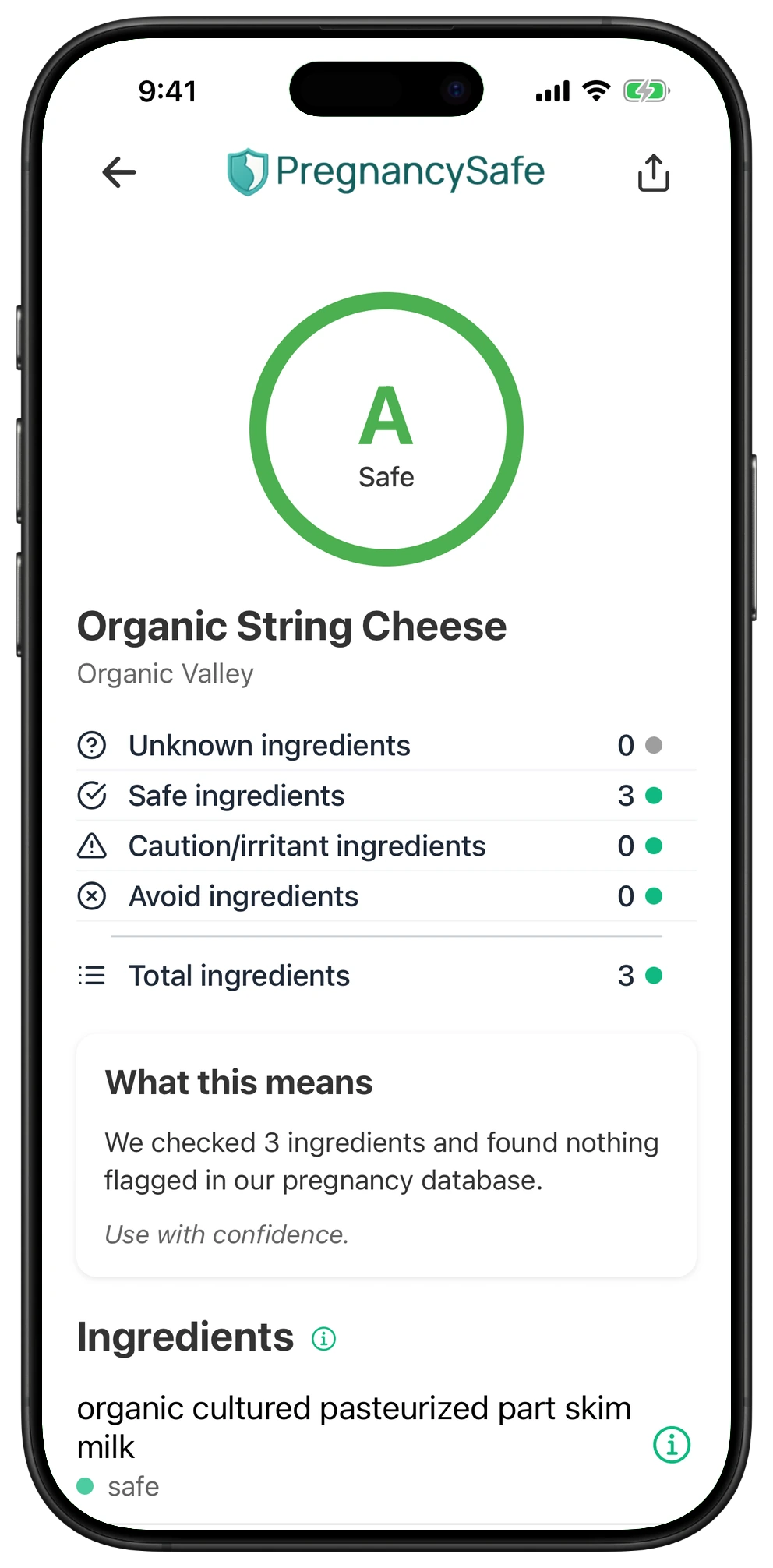
| A | Organic String Cheese | Organic Valley |
| A | Original String Cheese | Frigo Cheeseheads |
| B+ | String Cheese | Galbani |
| B+ | Reduced Fat Mozzarella String Cheese | Galbani |
| A | Land O Lakes Mozzarella String Cheese | Land O Lakes |
Your Questions Answered
Can I eat a cheese string when pregnant?
Yes, choose a version made with pasteurized milk and keep it refrigerated. Follow the package's use by and after opening instructions. The key checks are pasteurization and handling, not whether the cheese has a high ingredient grade.
What string cheese is pasteurized?
Look for pasteurized milk or pasteurized part skim milk on the exact package's ingredient list. Cultured pasteurized milk also confirms that the milk was pasteurized. Do not assume that every size or version from the same brand has an identical label. If the label says only milk, that leaves pasteurization unconfirmed rather than proving the cheese is harmful.
What cheese is off limits while pregnant?
Avoid raw milk and cheeses made from it. Ordinary pasteurized mozzarella string cheese is different from mold ripened or soft blue cheeses, which have additional cooking precautions. Queso fresco type cheeses also need separate treatment: CDC advises heating them even if they are pasteurized. Do not judge a cheese's pregnancy suitability by softness or shape alone.
Do I need to heat string cheese before eating it?
Ordinary pasteurized mozzarella string cheese can be eaten cold when it has been stored correctly and is within its package instructions. That does not extend to every cheese or every component of a snack pack. Queso fresco type cheeses require heating, and accompanying deli meats or dry sausages should reach 165°F or be steaming hot.
Should I worry about preservatives, colors, or sage in a cheese snack?
Check the whole snack's label, because an ingredient may belong to an accompanying component rather than the string cheese. BHA means butylated hydroxyanisole in food, not a skincare exfoliant; pregnancy data for BHA, BHT, and several synthetic colors are limited, and indirect or high dose findings do not establish fetal harm from ordinary food amounts. Normal culinary sage is lower concern than medicinal teas, extracts, supplements, or essential oil. Choosing plain string cheese can reduce optional additives without implying that an occasional additive containing snack caused harm.
Does an A grade mean string cheese is guaranteed safe during pregnancy?
No. Our catalog contains 340 products, including 270 with an A ingredient grade, but those grades are not pregnancy safety certifications. They do not confirm current labels, refrigeration, or absence of pathogens, and not every product was independently label reviewed. Use the grade as ingredient information while checking the exact package and its handling.
How to Interpret These Ratings
Our ingredient and category rules generate letter grades from the information recorded in the catalog. Missing ingredients and broad category assignments can affect the result. These grades do not measure your dose, confirm a complete current label, or test a product for contamination.
A high grade is not a guarantee of pregnancy safety. A low grade is not, by itself, proof of harm from every use. Follow the product-specific guidance above, check the actual package, and ask your prenatal clinician about supplements, treatment decisions or uncertain exposures.
People Also Checked
Feta Cheese
4 products
Goat Cheese
191 products
Mascarpone Cheese
14 products
Ricotta Cheese
194 products
Mozzarella Cheese
10 products
Cottage Cheese
1,036 products
Cheddar Cheese
184 products
Cheese
13,379 products
See our full guide to cheese during pregnancy.
References
- https://www.cdc.gov/foodsafety/rawmilk/index.html
- https://www.cdc.gov/listeria/prevention/index.html
- https://www.nhs.uk/pregnancy/keeping-well/foods-to-avoid/
- https://www.nccih.nih.gov/health/sage
- https://www.ema.europa.eu/en/documents/herbal-monograph/final-european-union-herbal-monograph-salvia-officinalis-l-folium-revision-1_en.pdf
- https://www.ema.europa.eu/en/documents/public-statement/public-statement-salvia-officinalis-l-aetheroleum_en.pdf
- https://www.ema.europa.eu/en/documents/scientific-guideline/public-statement-use-herbal-medicinal-products-containing-thujone-revision-1_en.pdf
- https://webprod.hc-sc.gc.ca/nhpid-bdipsn/dbImages/mono_Sage_Oral_EN.pdf
- https://pubmed.ncbi.nlm.nih.gov/23933314/
- https://pmc.ncbi.nlm.nih.gov/articles/PMC7956842/
- https://www.fda.gov/food/food-chemical-safety/list-select-chemicals-food-supply-under-fda-review
- https://www.federalregister.gov/documents/2026/02/11/2026-02761/butylated-hydroxyanisole-bha-request-for-information
- https://www.ecfr.gov/current/title-21/chapter-I/subchapter-B/part-182/subpart-D/section-182.3169
- https://www.ecfr.gov/current/title-21/chapter-I/subchapter-B/part-172/subpart-B/section-172.110
- https://www.efsa.europa.eu/en/efsajournal/pub/2392
- https://pmc.ncbi.nlm.nih.gov/articles/PMC13092903/
- https://www.ncbi.nlm.nih.gov/books/NBK590883/
- https://www.inchem.org/documents/iarc/vol40/butylatedhydroxyanisole.html
- https://pubmed.ncbi.nlm.nih.gov/7290287/
- https://pubmed.ncbi.nlm.nih.gov/3804125/
- https://health.ec.europa.eu/system/files/2022-08/sccs_o_257.pdf
- https://pubmed.ncbi.nlm.nih.gov/37751543/
- https://pubmed.ncbi.nlm.nih.gov/12396675/
- https://pmc.ncbi.nlm.nih.gov/articles/PMC13151845/
- https://www.ecfr.gov/current/title-21/chapter-I/subchapter-B/part-172/subpart-B/section-172.115
- https://www.ecfr.gov/current/title-21/chapter-I/subchapter-B/part-182/subpart-D/section-182.3173
- https://www.fda.gov/news-events/press-announcements/fda-finalizes-food-chemical-safety-post-market-assessment-program-launches-reassessment-bht-ada
- https://www.hfpappexternal.fda.gov/scripts/fdcc/index.cfm?id=FDCBlue1&set=ColorAdditives
- https://www.ecfr.gov/current/title-21/chapter-I/subchapter-A/part-74
- https://www.fda.gov/food/color-additives-information-consumers/tracking-food-industry-pledges-remove-petroleum-based-food-dyes
- https://efsa.onlinelibrary.wiley.com/doi/10.2903/j.efsa.2010.1853
- https://apps.who.int/food-additives-contaminants-jecfa-database/Home/Chemical/3309
- https://pubmed.ncbi.nlm.nih.gov/23208798/
- https://pubmed.ncbi.nlm.nih.gov/24257113/
- https://oehha.ca.gov/risk-assessment/report/health-effects-assessment-potential-neurobehavioral-effects-synthetic-food-dyes-children
- https://www.fda.gov/industry/color-additives/fdc-red-no-3
- https://www.federalregister.gov/documents/2025/01/16/2025-00830/color-additive-petition-from-center-for-science-in-the-public-interest-et-al-request-to-revoke-color
- https://efsa.onlinelibrary.wiley.com/doi/10.2903/j.efsa.2011.1854
- https://pubmed.ncbi.nlm.nih.gov/2824305/
- https://pubmed.ncbi.nlm.nih.gov/2177442/
- https://pubmed.ncbi.nlm.nih.gov/8296313/
- https://pubmed.ncbi.nlm.nih.gov/8386132/
- https://pmc.ncbi.nlm.nih.gov/articles/PMC9368057/
- https://www.hfpappexternal.fda.gov/scripts/fdcc/index.cfm?id=FDCRed40&set=ColorAdditives
- https://www.ecfr.gov/current/title-21/chapter-I/subchapter-A/part-74/subpart-A/section-74.340
- https://www.efsa.europa.eu/en/efsajournal/pub/1327
- https://www.efsa.europa.eu/en/efsajournal/pub/4007
- https://apps.who.int/food-additives-contaminants-jecfa-database/Home/Chemical/2361
- https://pubmed.ncbi.nlm.nih.gov/6636206/
- https://pubmed.ncbi.nlm.nih.gov/2613118/
- https://pubmed.ncbi.nlm.nih.gov/7940558/
- https://hfpappexternal.fda.gov/scripts/fdcc/index.cfm?id=SODIUMNITRITE&set=FoodSubstances
- https://www.ecfr.gov/current/title-9/section-424.21
- https://www.ecfr.gov/current/title-21/section-172.175
- https://www.efsa.europa.eu/en/press/news/170615
- https://www.inchem.org/documents/jecfa/jecmono/v50je07.htm
- https://pubmed.ncbi.nlm.nih.gov/41248583/
- https://www.cdc.gov/food-safety/foods/pregnant-women.html
- https://publications.iarc.who.int/Book-And-Report-Series/Iarc-Monographs-On-The-Identification-Of-Carcinogenic-Hazards-To-Humans/Red-Meat-And-Processed-Meat-2018
- https://dailymed.nlm.nih.gov/dailymed/drugInfo.cfm?setid=52f01c6e-172a-47a9-98a6-9eab7651a032
- https://www.atsdr.cdc.gov/toxprofiles/tp204.pdf
- https://hfpappexternal.fda.gov/scripts/fdcc/index.cfm?id=FDCYellow5&set=ColorAdditives
- https://www.ecfr.gov/current/title-21/chapter-I/subchapter-A/part-74#74.705
- https://www.fda.gov/food/nutrition-food-labeling-and-critical-foods/food-allergies
- https://apps.who.int/food-additives-contaminants-jecfa-database/Home/Chemical/3885
- https://efsa.onlinelibrary.wiley.com/doi/10.2903/j.efsa.2009.1331
- https://pubmed.ncbi.nlm.nih.gov/1628860/
- https://pmc.ncbi.nlm.nih.gov/articles/PMC7023231/
- https://pmc.ncbi.nlm.nih.gov/articles/PMC6354951/