Is Goat Cheese Safe During Pregnancy? (Updated 2026 Guide)
Updated September 9, 2026
The Answer
Yes pasteurized fresh goat cheese without a mold ripened rind and pasteurized hard goat cheese are lower risk choices during pregnancy when properly refrigerated. Avoid raw milk versions, and cook soft mold ripened or soft blue goat cheese until steaming hot throughout.
The main concern is Listeria contamination, not goat milk itself: pasteurization, cheese style and handling matter more than an ingredient grade. Ordinary pasteurized fresh goat cheese without a mold ripened rind is distinct from white rind chèvre and queso fresco type cheeses, which need thorough heating during pregnancy. Keep cheese refrigerated and follow its use by date and after opening instructions; an ingredient list cannot confirm that a package is uncontaminated.
Pregnancy Safe is 100% independent and research driven. No companies pay to promote or sponsor products.
Stress Less This Pregnancy
Check your exact goat cheese in the app

✓ What's Safe
- • Check the exact package for pasteurized goat milk; do not rely on the brand or the word chèvre alone.
- • For eating cold, choose ordinary pasteurized fresh goat cheese without a mold ripened rind, or pasteurized hard goat cheese.
- • Heat soft mold ripened, soft blue and queso fresco type cheeses to 165°F or until steaming hot throughout, even when pasteurized.
- • Choose properly refrigerated cheese and follow the package's use by and after opening instructions.
- • At restaurants, ask whether the cheese is pasteurized, which style it is and whether it will be thoroughly cooked.
✗ What to Avoid
- • Raw or unpasteurized goat cheese; choose a clearly labeled pasteurized version instead.
- • Cold white rind, soft mold ripened or soft blue goat cheese, even if made with pasteurized milk.
- • Unheated queso fresco type cheese made with goat milk, including pasteurized versions.
- • Treating lightly warmed or merely softened cheese as thoroughly cooked.
- • Cheese with uncertain refrigeration history or cheese kept beyond its use by or after opening instructions.
- • Using an A grade, an organic claim or a short ingredient list as proof that cheese is free of Listeria.
Most Common Ingredients in Goat Cheese Products
We analyzed 191 goat cheese products. Here are the most common ingredients, ranked by how often they appear:
Ingredients to Watch Out For in Goat Cheese
These are the most common flagged ingredients across 191 goat cheese products we analyzed.
goat cheese cultured pasteurized goat's milk
Caution
Is mainly a Listeria concern when fresh soft, soft ripened, deli sliced, or made with unpasteurized milk; pasteurized or hard aged options are lower risk, and heating to 165°F or steaming hot reduces risk.
Flagged in 5 of 191 products (3%)
goat cheese pasteurized cultured goats' milk
Caution
Is mainly a Listeria concern when fresh soft, soft ripened, deli sliced, or made with unpasteurized milk; pasteurized or hard aged options are lower risk, and heating to 165°F or steaming hot reduces risk.
Flagged in 4 of 191 products (2%)
bourbon
Avoid
Bourbon is a rich, amber colored American whiskey known for its sweet, smoky flavor with notes of caramel, vanilla, and oak.
Has no established safe amount in pregnancy and is linked to fetal alcohol spectrum disorders and other adverse pregnancy outcomes.
Flagged in 2 of 191 products (1%)
goat cheese pasteurized cultured goats milk
Caution
A creamy, tangy cheese made from pasteurized, cultured goat's milk.
Is mainly a Listeria concern when fresh soft, soft ripened, deli sliced, or made with unpasteurized milk; pasteurized or hard aged options are lower risk, and heating to 165°F or steaming hot reduces risk.
Flagged in 2 of 191 products (1%)
high fructose corn syrup
Caution
High fructose corn syrup is a sweet, liquid sweetener made from corn starch, commonly used in processed foods and beverages.
Is not a known teratogen at occasional food amounts, but high added sugar intake can displace nutrients and raise gestational diabetes and metabolic concerns.
Flagged in 2 of 191 products (1%)
port wine
Avoid
Port wine is a rich, sweet fortified wine from Portugal, traditionally enjoyed as a dessert wine or after dinner drink.
Has no established safe amount in pregnancy and is linked to fetal alcohol spectrum disorders and other adverse pregnancy outcomes.
Flagged in 2 of 191 products (1%)
Caution
Red 40 is a synthetic food dye commonly used to add vibrant red color to candies, beverages, and processed foods.
Has limited human pregnancy data and is allowed at regulated food additive levels, but child neurobehavior concerns and high dose animal findings make frequent high dye intake worth limiting.
Flagged in 2 of 191 products (1%)
artificial flavor horseradish
Caution
Artificial flavor horseradish is a synthetic flavoring designed to mimic the spicy, pungent taste of natural horseradish.
Is generally compatible at normal condiment amounts but should be avoided in medicinal products or large regular doses due to limited pregnancy data and possible uterine and irritant effects.
Flagged in 1 of 191 products (1%)
Goat Cheese Products We've Analyzed
Our catalog contains ratings for 191 goat cheese products. These are database grades, not independent safety certifications.
Catalog ingredient grades are not pregnancy safety certifications, a check of current labels, or measurements of caffeine, pathogens or handling. Not all candidates were independently reviewed.
Pregnancy Safe Goat Cheese Products
Popular options from our catalog, prioritizing A and B ingredient grades, with C grade options used to fill remaining places. Within each group, products are ordered by searches in Pregnancy Safe, not retail sales. Read the cautions and guidance above; grades do not verify a complete current label or guarantee pregnancy safety.
| Grade | Product | Brand |
|---|---|---|
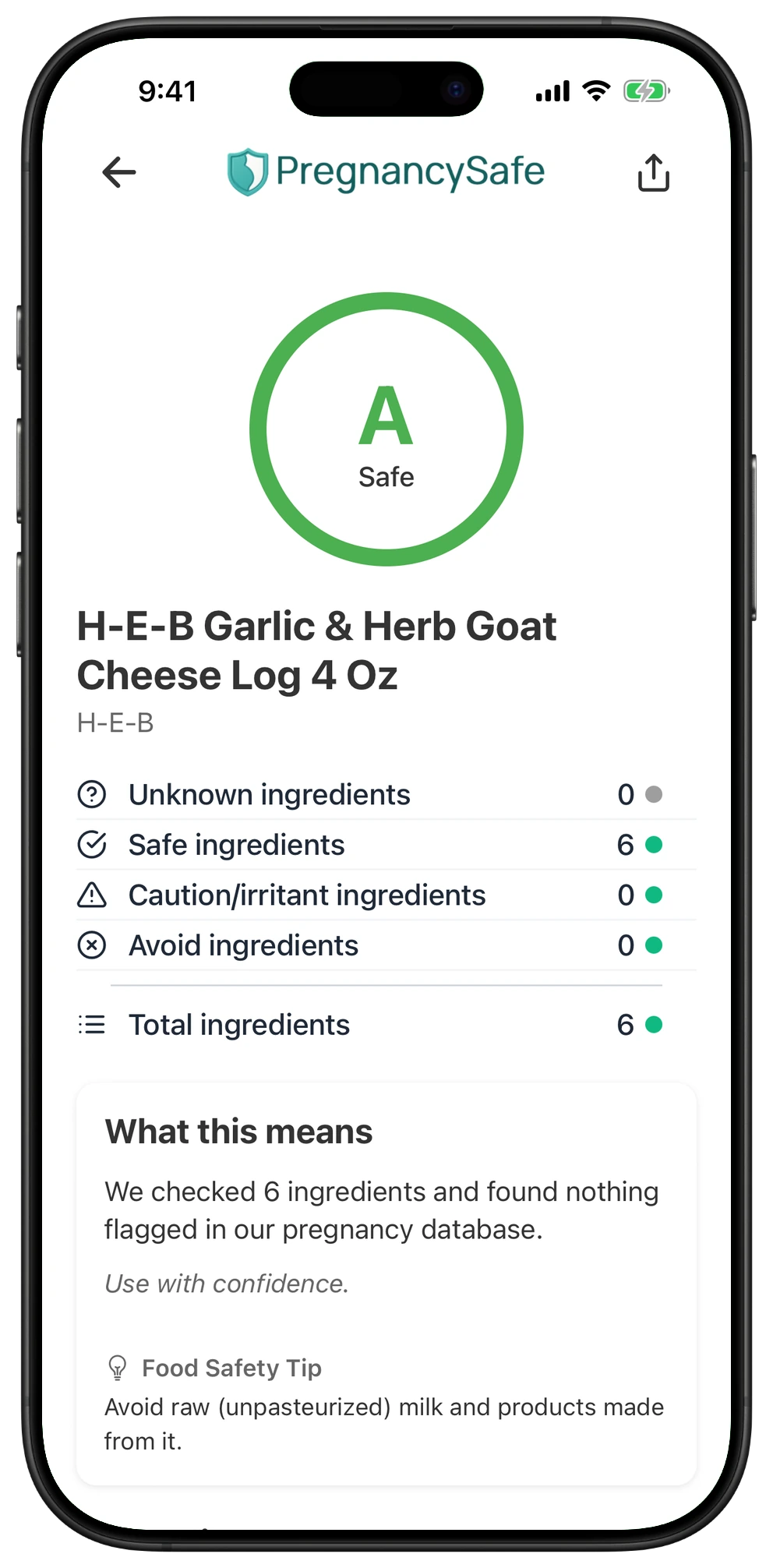
| A | H-E-B Garlic & Herb Goat Cheese Log | H-E-B |
| A | Creamy, Fresh Goat Cheese | Trader Joe'S |
| A | Fine Herbs Chèvre | Trader Joe'S |
| A | Boar'S Head Chevre Goat Cheese | Boar'S Head |
| A | Mild Classic Chevre Fresh Crumbled Goat Cheese, Mild | — |
Your Questions Answered
Can I eat cold goat cheese while pregnant?
Ordinary pasteurized fresh goat cheese without a mold ripened rind is a lower risk option for eating cold. Pasteurized hard goat cheese is another option. Keep it refrigerated and follow the package instructions. Soft white rind, soft blue and queso fresco type cheeses need thorough heating rather than being served cold.
Is cooked goat cheese safe during pregnancy?
Heating goat cheese to 165°F or until steaming hot throughout reduces Listeria risk. This matters especially for soft mold ripened, soft blue and queso fresco type cheeses. A warm salad topping or softened cheese is not necessarily heated sufficiently. Start with a pasteurized product and follow its storage instructions.
Is Costco goat cheese pasteurized?
Check the exact package rather than assuming every goat cheese sold by the retailer is pasteurized. Look for pasteurized goat milk in the ingredients or an explicit pasteurization statement. Also check the style: pasteurization alone does not make cold soft mold ripened cheese a suitable choice during pregnancy. If the label is unclear, ask for confirmation or choose a clearly labeled alternative.
Why avoid goats when pregnant?
This advice concerns contact with animals giving birth, not a blanket ban on goat cheese. Goats and other farm animals that have recently given birth can carry infections, so pregnant people should not assist with kidding, lambing or calving. For eating goat cheese, the relevant checks are pasteurization, cheese style, refrigeration and cooking.
Can I eat honey flavored goat cheese during pregnancy?
Honey in an adult food is not subject to the honey restriction for infants under one year. For honey flavored goat cheese, check that the milk is pasteurized and identify whether the cheese is fresh, hard or mold ripened. Refrigeration and appropriate heating still matter. Compare added sugars if you eat sweetened varieties frequently; occasional food amounts are not an established fetal harm concern.
Does an A grade mean goat cheese is pregnancy safe?
No. Our catalog contains 191 goat cheese products, including 164 with an A ingredient grade, but those grades are not pregnancy safety certifications. They do not verify current labels, detect Listeria or assess storage and handling, and not every product was independently label reviewed. A lower grade or an incomplete record likewise does not establish that a cheese is harmful.
How to Interpret These Ratings
Our ingredient and category rules generate letter grades from the information recorded in the catalog. Missing ingredients and broad category assignments can affect the result. These grades do not measure your dose, confirm a complete current label, or test a product for contamination.
A high grade is not a guarantee of pregnancy safety. A low grade is not, by itself, proof of harm from every use. Follow the product-specific guidance above, check the actual package, and ask your prenatal clinician about supplements, treatment decisions or uncertain exposures.
People Also Checked
Feta Cheese
4 products
Mascarpone Cheese
14 products
Ricotta Cheese
194 products
String Cheese
340 products
Mozzarella Cheese
10 products
Cottage Cheese
1,036 products
Cheddar Cheese
184 products
Cheese
13,379 products
See our full guide to cheese during pregnancy.
References
- https://www.cdc.gov/foodsafety/rawmilk/index.html
- https://www.cdc.gov/listeria/prevention/index.html
- https://www.nhs.uk/pregnancy/keeping-well/foods-to-avoid/
- https://www.nhs.uk/conditions/q-fever/
- https://www.cdc.gov/food-safety/foods/pregnant-women.html
- https://www.cdc.gov/listeria/causes/dairy.html
- https://www.fda.gov/food/people-risk-foodborne-illness/dairy-and-eggs-food-safety-moms-be
- https://www.fda.gov/food/people-risk-foodborne-illness/food-safety-moms-be-glance
- https://www.fda.gov/consumers/consumer-updates/avoid-queso-fresco-type-cheeses-if-youre-high-risk-groups
- https://www.acog.org/womens-health/faqs/listeria-and-pregnancy
- https://wwwnc.cdc.gov/eid/article/24/6/17-1051_article
- https://www.cdc.gov/alcohol-pregnancy/about/index.html
- https://www.cdc.gov/fasd/about/index.html
- https://www.acog.org/womens-health/infographics/alcohol-and-pregnancy
- https://www.niaaa.nih.gov/publications/brochures-and-fact-sheets/alcohol-and-your-pregnancy
- https://mothertobaby.org/fact-sheets/alcohol-pregnancy/
- https://pubmed.ncbi.nlm.nih.gov/26482673/
- https://pmc.ncbi.nlm.nih.gov/articles/PMC9543418/
- https://cdn.realfood.gov/DGA.pdf
- https://www.dietaryguidelines.gov/sites/default/files/2021-12/DGA_Pregnancy_FactSheet-508c.pdf
- https://www.acog.org/womens-health/faqs/healthy-eating-during-pregnancy
- https://www.cdc.gov/nutrition/php/data-research/added-sugars.html
- https://www.cdc.gov/diabetes/about/gestational-diabetes.html
- https://www.who.int/publications/i/item/9789241549028
- https://nesr.usda.gov/2025-dietary-guidelines-advisory-committee-systematic-reviews/dietary-patterns_gestational-diabetes
- https://www.hfpappexternal.fda.gov/scripts/fdcc/index.cfm?id=FDCRed40&set=ColorAdditives
- https://www.ecfr.gov/current/title-21/chapter-I/subchapter-A/part-74/subpart-A/section-74.340
- https://www.fda.gov/food/color-additives-information-consumers/tracking-food-industry-pledges-remove-petroleum-based-food-dyes
- https://www.efsa.europa.eu/en/efsajournal/pub/1327
- https://www.efsa.europa.eu/en/efsajournal/pub/4007
- https://apps.who.int/food-additives-contaminants-jecfa-database/Home/Chemical/2361
- https://oehha.ca.gov/risk-assessment/report/health-effects-assessment-potential-neurobehavioral-effects-synthetic-food-dyes-children
- https://pubmed.ncbi.nlm.nih.gov/6636206/
- https://pubmed.ncbi.nlm.nih.gov/2613118/
- https://pubmed.ncbi.nlm.nih.gov/7940558/
- https://webprod.hc-sc.gc.ca/nhpid-bdipsn/atReq?atid=horseradish.raifort&lang=eng
- https://inchem.org/documents/jecfa/jeceval/jec_71.htm
- https://hfpappexternal.fda.gov/scripts/fdcc/index.cfm?id=ALLYLISOTHIOCYANATE&set=FoodSubstances
- https://pmc.ncbi.nlm.nih.gov/articles/PMC13085108/
- https://pubmed.ncbi.nlm.nih.gov/22129740/
- https://www.drugs.com/npp/horseradish.html
- https://www.acog.org/clinical/clinical-guidance/clinical-consensus/articles/2025/10/cannabis-use-during-pregnancy-and-lactation
- https://www.acog.org/womens-health/faqs/marijuana-and-pregnancy
- https://www.cdc.gov/cannabis/health-effects/pregnancy.html
- https://www.fda.gov/consumers/consumer-updates/what-you-should-know-about-using-cannabis-including-cbd-when-pregnant-or-breastfeeding
- https://mothertobaby.org/fact-sheets/marijuana-pregnancy/
- https://pubmed.ncbi.nlm.nih.gov/40323610/
- https://pubmed.ncbi.nlm.nih.gov/37968824/
- https://pubmed.ncbi.nlm.nih.gov/39037795/
- https://www.cdc.gov/breastfeeding-special-circumstances/hcp/vaccine-medication-drugs/marijuana.html
- https://www.hhs.gov/surgeongeneral/reports-and-publications/addiction-and-substance-misuse/advisory-on-marijuana-use-and-developing-brain/index.html
- https://www.ncbi.nlm.nih.gov/books/NBK501587/
- https://doi.org/10.1001/jamapediatrics.2025.0689