Is CeraVe AM Facial Moisturizing Lotion SPF 30 Safe During Pregnancy? (Updated 2026 Guide)
Updated September 9, 2026
CeraVe AM Facial Moisturizing Lotion SPF 30
Cerave
CeraVe AM Facial Moisturizing Lotion SPF 30 receives a D- pregnancy rating, making it a less preferred choice under our ingredient based scoring. Several UV filters and other ingredients carry caution flags, although these reflect limited pregnancy evidence and exposure uncertainties not proof that ordinary facial use harms your baby. Consider a mineral only sunscreen alternative rather than going without sun protection.
Try to avoid if that makes you feel better. If you've already used it, no need to panic. Consult your OBGYN or midwife for guidance.
Pregnancy Safe is 100% independent and research driven. No companies pay to promote or sponsor products.
Stress Less This Pregnancy
Check your face moisturizer in the app

What Ingredients Are in CeraVe AM Facial Moisturizing Lotion SPF 30?
CeraVe AM Facial Moisturizing Lotion SPF 30 has 31 ingredients. We flagged 7 ingredients to use with caution.
aluminum starch octenylsuccinate
CAUTION
Aluminum starch octenylsuccinate is a modified starch derivative used as an anti caking and stabilizing agent in food products. Its caution flag draws on broader aluminum evidence involving higher chronic exposures, not demonstrated pregnancy harm from ordinary facial lotion use.
bht
CAUTION
BHT (butylated hydroxytoluene) is a synthetic antioxidant commonly used as a preservative to prevent the oxidation of fats and oils in food products. BHT carries a caution flag despite low concern at reviewed cosmetic levels, because pregnancy data are limited and high dose oral animal studies show reproductive signals.
homosalate
CAUTION
Homosalate is a chemical compound commonly used in sunscreens to help absorb and block ultraviolet (UV) rays from the sun. Homosalate warrants caution because topical absorption occurs and pregnancy outcome data are limited, without demonstrated human pregnancy harm from ordinary facial use.
octinoxate
CAUTION
Octinoxate carries a pregnancy caution for dermal absorption and endocrine uncertainty, while high dose animal findings do not establish harm from normal facial application.
octisalate
CAUTION
Octisalate is a sunscreen agent used to absorb UVB rays and protect the skin from sun damage. Octisalate warrants caution because pregnancy data are limited and large area sunscreen use produces systemic absorption, but normal topical use is not equivalent to oral salicylates.
octocrylene
CAUTION
Octocrylene is a chemical compound commonly used in sunscreens to absorb UVB rays and stabilize other UV filters. Octocrylene carries a pregnancy caution for limited outcome data, systemic absorption, and impurity or degradation concerns, not proven harm from ordinary topical use.
CAUTION
Phenoxyethanol is a preservative commonly used in cosmetics and skincare products to prevent microbial growth and extend shelf life. Phenoxyethanol carries a pregnancy caution despite low systemic concern at regulated cosmetic levels, while nursing related warnings concern infant ingestion from nipple products rather than facial use.
benzoic acid
LIKELY SAFE
Benzoic acid is a white, crystalline organic compound commonly used as a preservative in food and beverages to inhibit microbial growth. Benzoic acid is rated likely safe, but the supporting pregnancy assessment is mainly food additive and animal evidence rather than direct topical pregnancy studies.
propanediol
LIKELY SAFE
Propanediol is a versatile, plant derived humectant and solvent commonly used in skincare and cosmetic formulations to retain moisture and improve product texture. Propanediol is rated likely safe using related propylene glycol evidence indicating low concern for ordinary intact skin exposure, not high dose medication exposure.
zinc oxide
LIKELY SAFE
Zinc oxide is a white, powdery mineral commonly used in sunscreens, skincare products, and ointments for its protective and soothing properties. Zinc oxide is low concern during pregnancy in conventional lotions on intact skin, while inhaled powders and sprays require separate caution.
cholesterol
SAFE
Cholesterol is a waxy, fat like substance found in the blood and cells that is essential for hormone production and cell membrane integrity. Cholesterol is considered compatible with pregnancy in ordinary topical cosmetics, although direct studies in pregnant users are limited.
dimethicone
SAFE
Dimethicone is a silicone based polymer commonly used in skincare and cosmetic products to provide a smooth, silky feel and create a protective barrier on the skin. Normal topical dimethicone use is expected to produce very little systemic exposure, supporting low pregnancy concern despite limited direct outcome data.
glycerin
SAFE
Glycerin is a colorless, odorless, and sweet tasting humectant commonly used in skincare products to attract and retain moisture in the skin. Glycerin is compatible with ordinary topical use during pregnancy, with low expected exposure from moisturizers.
SAFE
Niacinamide is a versatile skincare ingredient known for its ability to improve skin elasticity, enhance the barrier function, and reduce the appearance of blemishes and uneven skin tone. Niacinamide is generally considered safe in normal topical pregnancy skincare, unlike high dose oral supplements, which require a separate assessment.
sodium hyaluronate
SAFE
Sodium hyaluronate is a powerful hydrating agent that helps retain moisture in the skin, promoting plumpness and elasticity. Sodium hyaluronate is generally compatible with pregnancy in topical moisturizers because systemic exposure is expected to be low, unlike injectable uses.
triethyl citrate
SAFE
Triethyl citrate is a colorless, odorless liquid commonly used as a plasticizer, solvent, or flavoring agent in food, cosmetics, and pharmaceutical products. Its pregnancy assessment draws on related citric acid evidence supporting ordinary topical use, rather than direct pregnancy studies of triethyl citrate.
water
SAFE
Water is a clear, tasteless, and essential liquid that sustains all known forms of life. Water in a topical lotion is not a pregnancy concern, although the finished product's other ingredients and microbial quality still matter.
behentrimonium methosulfate
SAFE
Behentrimonium methosulfate is a gentle conditioning agent derived from natural oils that helps detangle and soften hair. This conditioning ingredient is unflagged, but that does not establish pregnancy safety for ordinary topical use.
caprylyl glycol
SAFE
Caprylyl glycol is a versatile moisturizing agent and skin conditioner commonly used in skincare products for its humectant and antimicrobial properties. This moisturizing ingredient is unflagged, with no pregnancy specific evidence here establishing safety for topical use.
carbomer
SAFE
Carbomer is a synthetic, water soluble polymer used as a thickening, stabilizing, and emulsifying agent in cosmetic and pharmaceutical formulations. This cosmetic thickener is unflagged rather than specifically established as safe for topical use during pregnancy.
ceramide ap
SAFE
Ceramide AP is a lipid molecule that helps strengthen and restore the skin's natural barrier, promoting hydration and overall skin health. Ceramide AP supports the skin barrier, but its unflagged status is not a pregnancy specific safety assessment of topical use.
ceramide eop
SAFE
Ceramide EOP is a lipid molecule that helps restore and strengthen the skin's natural barrier, promoting hydration and protection. Ceramide EOP supports the skin barrier, but direct pregnancy evidence for its topical use is not established in this assessment.
ceramide np
SAFE
Ceramide NP is a lipid molecule that helps strengthen and restore the skin's natural barrier, providing hydration and protection against environmental stressors. This barrier supporting lipid is unflagged, which should not be interpreted as proof of pregnancy safety for topical use.
cetearyl alcohol
SAFE
Cetearyl alcohol is a fatty alcohol commonly used as an emollient, emulsifier, and thickening agent in skincare and cosmetic products. This fatty alcohol is unflagged in the lotion, but no pregnancy specific topical safety conclusion is established here.
hydroxyacetophenone
SAFE
Hydroxyacetophenone is a chemical compound commonly used in skincare formulations for its antioxidant and skin soothing properties. This cosmetic antioxidant is unflagged, but pregnancy specific safety evidence for topical use is not established here.
hydroxyethylcellulose
SAFE
Hydroxyethylcellulose is a water soluble, plant derived thickening and stabilizing agent commonly used in cosmetics and personal care products. This cosmetic thickener is unflagged rather than specifically reviewed as safe for topical use during pregnancy.
phytosphingosine
SAFE
Phytosphingosine is a naturally occurring sphingolipid that helps to strengthen the skin's barrier and provide antimicrobial benefits. This barrier supporting lipid is unflagged, but that status does not establish pregnancy safety for topical exposure.
sodium lauroyl lactylate
SAFE
Sodium lauroyl lactylate is a gentle, biodegradable surfactant and emulsifier derived from lactic acid and fatty acids, commonly used in cosmetics and personal care products. This emulsifier is unflagged, with no pregnancy specific topical safety evidence established in this assessment.
triethoxycaprylylsilane
SAFE
Triethoxycaprylylsilane is a silane based compound used as a surface modifier and coupling agent to enhance the adhesion and stability of cosmetic and skincare formulations. This formulation ingredient is unflagged rather than specifically established as safe for topical use during pregnancy.
trisodium ethylenediamine disuccinate
SAFE
Trisodium ethylenediamine disuccinate is a chelating agent used in skincare and cosmetic products to bind and neutralize metal ions, enhancing stability and efficacy. This stabilizing chelating agent is unflagged, but pregnancy specific safety for topical use is not established here.
xanthan gum
SAFE
Xanthan gum is a natural thickening and stabilizing agent derived from fermented sugars, commonly used in gluten free baking and food processing. This thickener is unflagged, but its general ingredient description does not establish pregnancy safety for topical use.
Answering Your Questions
How much CeraVe AM Facial Moisturizing Lotion SPF 30 is safe during pregnancy?
There is no established pregnancy specific amount for this formula. If you continue using it, follow the package’s sunscreen application directions rather than applying less to reduce exposure, which could compromise protection.
Can you use CeraVe AM Facial Moisturizing Lotion SPF 30 daily while pregnant?
For ongoing daily use during pregnancy, consider switching to a mineral only SPF product to reduce the flagged uncertainties. Until then, follow the sunscreen label’s application and reapplication directions; using it less frequently is not an established pregnancy safety strategy.
Why does this CeraVe moisturizer receive a D- grade?
The D- comes from ingredient based scoring, with caution flags for homosalate, octinoxate, octisalate, octocrylene, BHT, phenoxyethanol, and aluminum starch octenylsuccinate. The evidence varies: UV filter concerns include measurable absorption and limited pregnancy outcomes, while some other flags rely on high dose oral or broader aluminum evidence rather than ordinary facial use. This grade is not a measured risk of harm to your baby.
Can I use it while breastfeeding?
The pregnancy grade does not establish breastfeeding safety. Octocrylene has been detected in breast milk, but detection alone does not establish harm from facial use; phenoxyethanol concerns involving nipple products relate to direct infant ingestion, not the same exposure as a face lotion. Keep this product off the nipple and areas your baby may lick, and ask your clinician if you want to continue using this formula.
What alternative should I look for during pregnancy?
Look for a broad spectrum mineral only sunscreen lotion using zinc oxide and/or titanium dioxide, and review the full ingredient list rather than relying on the brand. You can pair it with a separate moisturizer suited to dry skin. A lotion avoids the inhalation concerns associated with sunscreen powders and sprays.
Is this a mineral only sunscreen because it contains zinc oxide?
No. This formula contains zinc oxide alongside homosalate, octinoxate, octisalate, and octocrylene, so it combines mineral and organic UV filters. Zinc oxide's low concern in ordinary topical use does not remove the other ingredients' caution flags.
Are all CeraVe facial moisturizers rated the same during pregnancy?
No this D- applies to this AM SPF 30 formula, not the entire CeraVe range. Different moisturizers, SPF strengths, and regional formulas need their own ingredient review, so check your package rather than transferring a rating from another product.
Does SPF 30 itself raise pregnancy concerns?
The SPF number is not the reason for this product's D- grade; the ingredient profile is. When choosing sun protection, consider broad spectrum coverage and the UV filters rather than assuming a higher or lower SPF establishes pregnancy safety.
What if I already used it during pregnancy?
Previous facial use does not establish that your baby was harmed. Absorption findings are not proof of harm, and high dose oral animal findings cannot be directly applied to normal facial application. You can choose a different sunscreen going forward and discuss your amount and frequency of use with your prenatal clinician if you remain concerned.
What Are Pregnancy Safe Alternatives to CeraVe AM Facial Moisturizing Lotion SPF 30?
Here are some solid alternatives. Everything below has an A or B grade, meaning no flagged ingredients in our database.
| Grade | Product | Brand | Type |
|---|---|---|---|
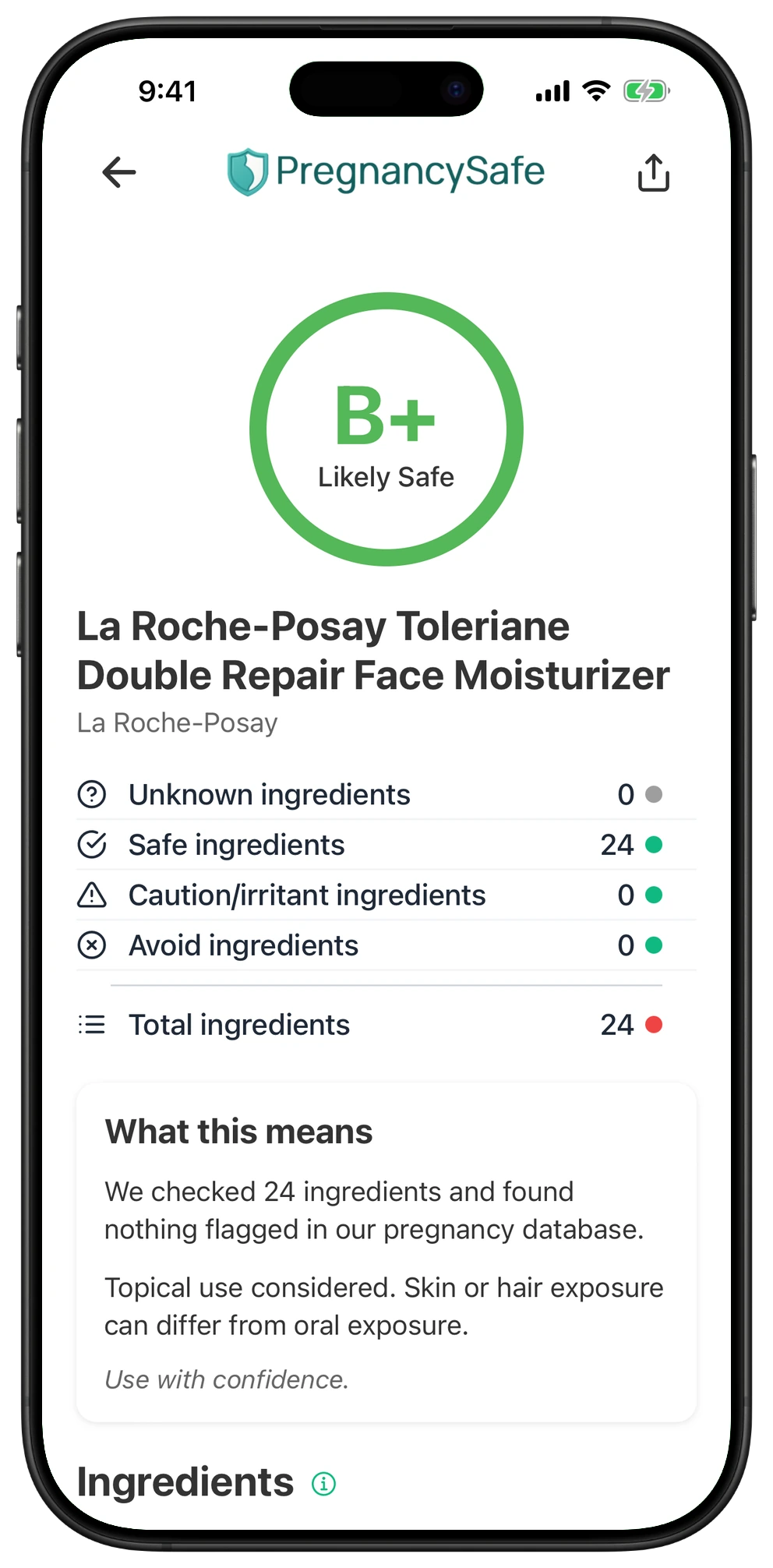
| B+ | La Roche-Posay Toleriane Double Repair Face Moisturizer | La Roche Posay | face moisturizer |
| B+ | Neutrogena Hydro Boost Fragrance Free Water Gel | Neutrogena | face moisturizer |
| A | La Roche-Posay Toleriane Dermallegro Soothing Face Moisturizer For Sensitive Skin | La Roche-Posay | face moisturizer |
| A | Vichy Liftactiv Supreme Spf30 50Ml | Vichy | face moisturizer |
Are Other Cerave Products Safe During Pregnancy?
We looked at 18 other Cerave products. 0 are pregnancy safe (A or B grade), while 18 need a closer look.
| Grade | Product | Type |
|---|---|---|
| C | Cerave Daily Moisturizing Lotion | moisturizer |
| C | Cerave Foaming Facial Cleanser | facial cleanser |
| C | Cerave Hydrating Cream-To-Foam Cleanser With Amino Acids For Normal To Dry Skin 236Ml | facial cleanser |
| C | Cerave Sa Face Wash Salicylic Acid Cleanser With Hyaluronic Acid And Niacinamide | face wash |
How Does CeraVe AM Facial Moisturizing Lotion SPF 30 Compare to Other Face Moisturizers?
We graded 279 Face Moisturizers for pregnancy safety. Here's how they stack up:
CeraVe AM Facial Moisturizing Lotion SPF 30 earns a D- grade, placing it among the top of Face Moisturizers. Only 1% of products in this category get an A grade, so it pays to choose carefully.
How Do We Score Products for Pregnancy Safety?
We analyze each product's ingredients and category to flag known risks and provide cautionary notices for general category safety concerns.
A - Safe
Excellent choice! All ingredients are considered safe during pregnancy.
What to do: Use with confidence.
B - Likely Safe
Pretty much safe with very minimal risk. Some ingredients may have limited pregnancy studies, but no significant safety concerns have been identified.
What to do: Use with confidence.
C - Limit
Contains ingredients with some pregnancy considerations. Research shows these ingredients may have limited safety data, potential for minor hormonal effects, or require caution based on animal studies.
What to do: Use sparingly and consider safer alternatives when available.
D - Caution
Similar to C grade but contains multiple cautionary ingredients. The combination increases overall concern.
What to do: Try to avoid if that makes you feel better. If you've already used it, no need to panic.
F - Avoid
Contains an ingredient Pregnancy Safe recommends avoiding during pregnancy. This may reflect an established risk or a precaution based on limited evidence; check the ingredient guidance and exposure context.
What to do: Do not use during pregnancy. If you've already used it, don't worry - contact your OBGYN if concerned.
People Also Checked
References
- https://wwwn.cdc.gov/TSP/ToxProfiles/ToxProfiles.aspx?id=191&tid=34
- https://pmc.ncbi.nlm.nih.gov/articles/PMC9681673/
- https://pmc.ncbi.nlm.nih.gov/articles/PMC10809980/
- https://www.cdc.gov/vaccine-safety/about/adjuvants.html
- https://www.fda.gov/vaccines-blood-biologics/safety-availability-biologics/common-ingredients-fda-approved-vaccines
- https://www.acog.org/womens-health/infographics/vaccines-during-pregnancy
- https://apps.who.int/food-additives-contaminants-jecfa-database/Home/Chemical/1227
- https://www.inchem.org/documents/jecfa/jecmono/v83je01.pdf
- https://www.ecfr.gov/current/title-21/part-184/section-184.1733
- https://www.ecfr.gov/current/title-21/part-184/section-184.1021
- https://www.fda.gov/food/environmental-contaminants-food/questions-and-answers-occurrence-benzene-soft-drinks-and-other-beverages
- https://efsa.onlinelibrary.wiley.com/doi/10.2903/j.efsa.2016.4433
- https://health.ec.europa.eu/system/files/2022-08/sccs_o_257.pdf
- https://pubmed.ncbi.nlm.nih.gov/37751543/
- https://pubmed.ncbi.nlm.nih.gov/12396675/
- https://pmc.ncbi.nlm.nih.gov/articles/PMC13151845/
- https://www.ecfr.gov/current/title-21/chapter-I/subchapter-B/part-172/subpart-B/section-172.115
- https://www.ecfr.gov/current/title-21/chapter-I/subchapter-B/part-182/subpart-D/section-182.3173
- https://www.fda.gov/news-events/press-announcements/fda-finalizes-food-chemical-safety-post-market-assessment-program-launches-reassessment-bht-ada
- https://health.ec.europa.eu/publications/homosalate_en
- https://health.ec.europa.eu/system/files/2022-08/sccs_o_260.pdf
- https://eur-lex.europa.eu/legal-content/EN/TXT/HTML/?uri=CELEX%3A32022R2195
- https://www.fda.gov/drugs/understanding-over-counter-medicines/questions-and-answers-fda-posts-deemed-final-order-and-proposed-order-over-counter-sunscreen
- https://jamanetwork.com/journals/jama/fullarticle/2759002
- https://www.tga.gov.au/resources/explore-topic/sunscreens/sunscreen-ingredients
- https://www.tga.gov.au/sites/default/files/2025-04/safety-review-seven-active-sunscreen-ingredients.pdf
- https://mothertobaby.org/baby-blog/screening-your-sunscreen-during-pregnancy/
- https://link.springer.com/article/10.1007/s00204-024-03935-8
- https://health.ec.europa.eu/document/download/3166a978-06de-4526-b25e-8d5a66943a2e_en?filename=sccs_o_294.pdf
- https://pubmed.ncbi.nlm.nih.gov/31961417/
- https://pubmed.ncbi.nlm.nih.gov/15191542/
- https://www.ncbi.nlm.nih.gov/books/NBK581587/
- https://pubmed.ncbi.nlm.nih.gov/32108942/
- https://pubmed.ncbi.nlm.nih.gov/40212279/
- https://health.ec.europa.eu/publications/sccs-opinion-ethylhexyl-methoxycinnamate-ehmc-cas-no-5466-77-383834-59-7-ec-no-226-775-7629-661-9_en
- https://www.federalregister.gov/documents/2019/02/26/2019-03019/sunscreen-drug-products-for-over-the-counter-human-use
- https://pubmed.ncbi.nlm.nih.gov/26151237/
- https://pubmed.ncbi.nlm.nih.gov/31195281/
- https://pubmed.ncbi.nlm.nih.gov/35767664/
- https://pubmed.ncbi.nlm.nih.gov/15833384/
- https://pubmed.ncbi.nlm.nih.gov/21059369/
- https://www.fda.gov/drugs/understanding-over-counter-medicines/sunscreen-how-help-protect-your-skin-sun
- https://ec.europa.eu/health/scientific_committees/consumer_safety/opinions/sccnfp_opinions_97_04/sccp_out26_en.htm
- https://www.cir-safety.org/sites/default/files/salicy042019FAR.pdf
- https://pmc.ncbi.nlm.nih.gov/articles/PMC6990686/
- https://pmc.ncbi.nlm.nih.gov/articles/PMC11402844/
- https://pmc.ncbi.nlm.nih.gov/articles/PMC5744631/
- https://mothertobaby.org/baby-blog/national-safety-month-can-beauty-products-in-my-bathroom-be-bad-for-baby/
- https://health.ec.europa.eu/document/download/2928185b-f8b7-474e-937a-052a90a90970_en
- https://pubmed.ncbi.nlm.nih.gov/31058986/
- https://www.tga.gov.au/resources/publication/corporate-reports/safety-review-benzophenone
- https://pubmed.ncbi.nlm.nih.gov/33682414/
- https://pubmed.ncbi.nlm.nih.gov/21030064/
- https://www.frontiersin.org/journals/medicine/articles/10.3389/fmed.2025.1563369/full
- https://health.ec.europa.eu/system/files/2021-08/sccs_o_195_0.pdf
- https://ec.europa.eu/growth/tools-databases/cosing/details/28157
- https://journals.sagepub.com/doi/10.3109/10915819009078737
- https://link.springer.com/article/10.1007/s00204-024-03938-5
- https://www.sfda.gov.sa/en/warnings/1156
- https://www.industrialchemicals.gov.au/sites/default/files/Ethanol%2C%202-phenoxy-_Human%20health%20tier%20II%20assessment.pdf
- https://hero.epa.gov/reference/2857875
- https://books.publisso.de/sites/default/files/documents/series/mak/dam/Vol2019/Iss1/Alt006/mb12299kske6319_w.pdf
- https://www.ecfr.gov/current/title-21/part-184/section-184.1666
- https://pmc.ncbi.nlm.nih.gov/articles/PMC7009459/
- https://pubmed.ncbi.nlm.nih.gov/15995735/
- https://pubmed.ncbi.nlm.nih.gov/23064775/
- https://www.ema.europa.eu/en/documents/scientific-guideline/questions-and-answers-propylene-glycol-used-excipient-medicinal-products-human-use_en.pdf
- https://pmc.ncbi.nlm.nih.gov/articles/PMC11867916/
- https://pubmed.ncbi.nlm.nih.gov/29281181/
- https://pubmed.ncbi.nlm.nih.gov/40234020/
- https://pmc.ncbi.nlm.nih.gov/articles/PMC11984416/
- https://pmc.ncbi.nlm.nih.gov/articles/PMC7607677/
- https://pmc.ncbi.nlm.nih.gov/articles/PMC4279755/
- https://pubmed.ncbi.nlm.nih.gov/40932360/
- https://doi.org/10.3109/10915818609141922
- https://doi.org/10.1080/10915810600964618
- https://pubmed.ncbi.nlm.nih.gov/22209282/
- https://pubmed.ncbi.nlm.nih.gov/34921679/
- https://www.medicinesinpregnancy.org/leaflets-a-z/dimethicone/
- https://uktis.org/monographs/use-of-head-lice-treatments-in-pregnancy/
- https://www.cir-safety.org/sites/default/files/FAR_Methicones_032022.pdf
- https://www.medicines.org.uk/emc/product/4860/smpc
- https://www.sps.nhs.uk/articles/treating-lice-during-breastfeeding/
- https://mothertobaby.org/fact-sheets/lice-scabies-pregnancy/
- https://www.ecfr.gov/current/title-21/chapter-I/subchapter-D/part-347/subpart-B/section-347.10
- https://www.hfpappexternal.fda.gov/scripts/fdcc/index.cfm?id=GLYCERIN&set=FoodSubstances
- https://pubmed.ncbi.nlm.nih.gov/31840548/
- https://pmc.ncbi.nlm.nih.gov/articles/PMC7009851/
- https://www.medicinesinpregnancy.org/leaflets-a-z/glycerin-suppositories/
- https://mothertobaby.org/pregnancy-breastfeeding-exposures/cosmetics/
- https://pubmed.ncbi.nlm.nih.gov/41944999/
- https://jintegrativederm.org/doi/10.64550/joid.97jp5737
- https://pubmed.ncbi.nlm.nih.gov/16596767/
- https://ods.od.nih.gov/factsheets/Niacin-HealthProfessional/
- https://www.fda.gov/cosmetics/resources-consumers-cosmetics/cosmetics-pregnancy
- https://www.aad.org/public/everyday-care/skin-care-secrets/routine/pregnancy-skin-care
- https://pubmed.ncbi.nlm.nih.gov/25399625/
- https://pubmed.ncbi.nlm.nih.gov/35309882/
- https://www.cir-safety.org/sites/default/files/TR_Hyaluronates_032023_1.pdf
- https://pubmed.ncbi.nlm.nih.gov/19636067/
- https://www.fda.gov/medical-devices/aesthetic-cosmetic-devices/dermal-fillers-soft-tissue-fillers
- https://pubmed.ncbi.nlm.nih.gov/28492048/
- https://www.cir-safety.org/sites/default/files/citric032012FR.pdf
- https://www.canada.ca/en/health-canada/services/consumer-product-safety/cosmetics/cosmetic-ingredient-hotlist-prohibited-restricted-ingredients/hotlist.html
- https://www.fda.gov/cosmetics/cosmetic-ingredients/alpha-hydroxy-acids
- https://pubmed.ncbi.nlm.nih.gov/16040403/
- https://pubmed.ncbi.nlm.nih.gov/9256916/
- https://www.personalcarecouncil.org/wp-content/uploads/2022/03/INCINomenclatureConventionsReferenceInformation2022_v1.pdf
- https://www.seslhd.health.nsw.gov.au/sites/default/files/groups/Royal_Hospital_for_Women/Mothersafe/documents/skinhaircareandcosmetictreatmentsapril2021.pdf
- https://www.nhs.uk/pregnancy/complications/itching-and-intrahepatic-cholestasis/
- https://www.fda.gov/cosmetics/cosmetics-guidance-documents/good-manufacturing-practice-gmp-guidelinesinspection-checklist-cosmetics
- https://www.fda.gov/cosmetics/potential-contaminants-cosmetics/microbiological-safety-and-cosmetics
- https://pubmed.ncbi.nlm.nih.gov/25153208/