Is CeraVe Hydrating Cream-to-Foam Cleanser Safe During Pregnancy? (Updated 2026 Guide)
Updated September 8, 2026
CeraVe Hydrating Cream-to-Foam Cleanser
Cerave
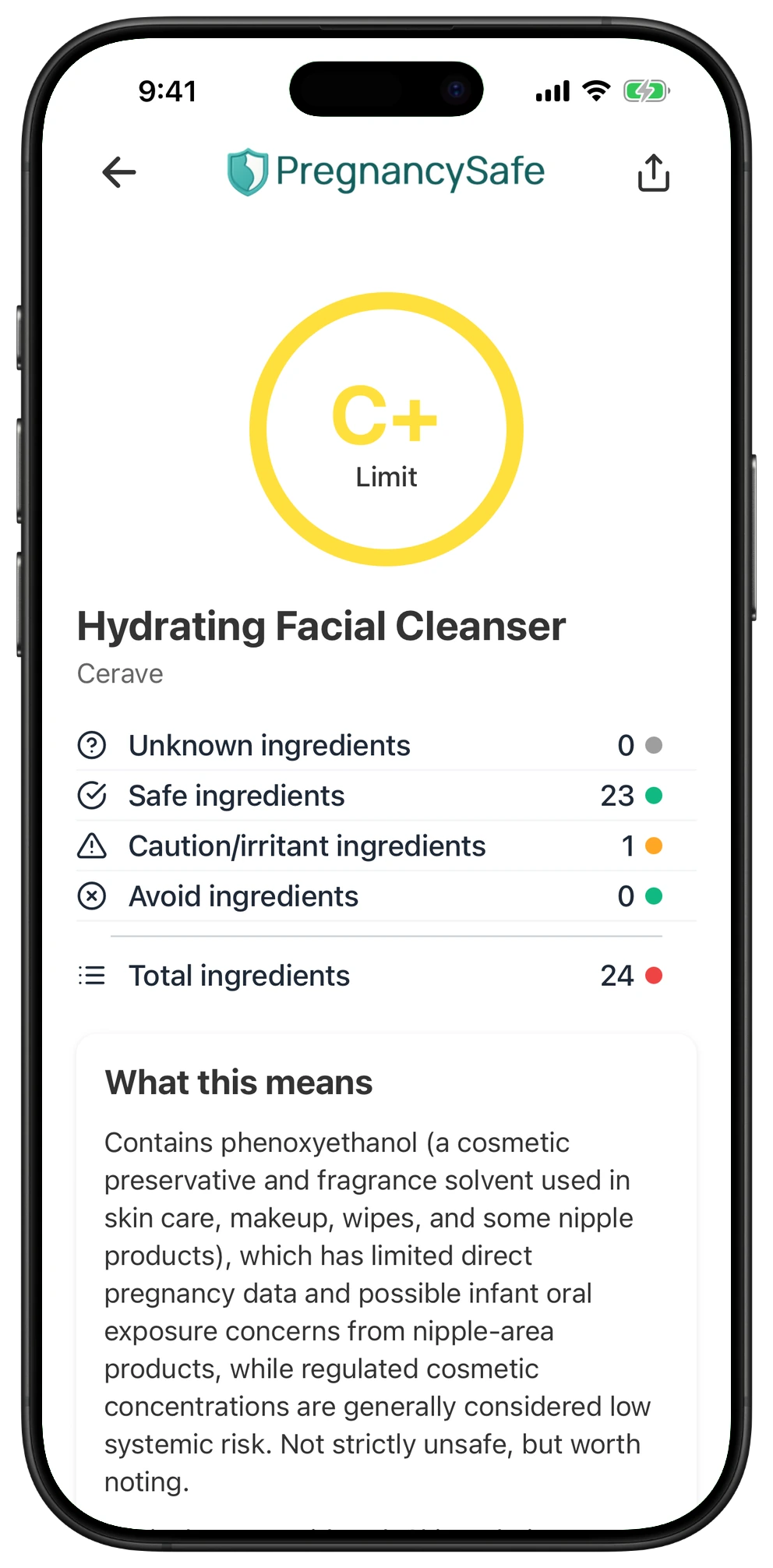
CeraVe Hydrating Cream to Foam Cleanser receives a C grade, making it a use with caution choice during pregnancy rather than an unconditional safe pick. Its ingredient based assessment flags salicylic acid and phenoxyethanol for caution, but ordinary rinse off facial use is different from high dose treatments or infant ingestion, and the grade does not establish harm from normal use.
You can use this, but maybe don't make it your everyday go to. Not the end of the world if you've used it. Consult your OBGYN or midwife if you have concerns.
Pregnancy Safe is 100% independent and research driven. No companies pay to promote or sponsor products.
Stress Less This Pregnancy
Check your facial cleanser in the app

What Ingredients Are in CeraVe Hydrating Cream-to-Foam Cleanser?
CeraVe Hydrating Cream-to-Foam Cleanser has 60 ingredients. We flagged 2 ingredients to use with caution.
CAUTION
Phenoxyethanol is a preservative commonly used in cosmetics and skincare products to prevent microbial growth and extend shelf life. Phenoxyethanol warrants caution because direct pregnancy data are limited, although regulated cosmetic levels are generally low systemic risk and nursing ingestion concerns involve nipple area exposure.
salicylic acid
CAUTION
Salicylic acid is a beta hydroxy acid commonly used in skincare to exfoliate the skin, unclog pores, and treat acne. Salicylic acid warrants caution with high concentrations or increased absorption, although directed low dose topical use is generally low concern during pregnancy and this cleanser's concentration is unspecified.
benzoic acid
LIKELY SAFE
Benzoic acid is a white, crystalline organic compound commonly used as a preservative in food and beverages to inhibit microbial growth. Benzoic acid is rated likely safe here, but its pregnancy evidence mainly concerns regulated food exposure and is indirect for this rinse off cleanser.
ci 77891 titanium dioxide
LIKELY SAFE
Titanium dioxide is likely low concern in ordinary topical cosmetic use during pregnancy; oral food additive uncertainty and inhaled powder concerns are separate exposures.
histidine
LIKELY SAFE
Histidine is an essential amino acid involved in protein synthesis and the production of histamine, playing a key role in immune response and metabolic processes. Histidine is likely low concern during pregnancy at ordinary cosmetic levels because skin permeation is low, although direct pregnancy studies are lacking.
sodium benzoate
LIKELY SAFE
Sodium benzoate is a preservative commonly used to inhibit microbial growth in food and beverage products. Sodium benzoate is generally low concern during pregnancy at regulated cosmetic preservative levels, although direct human pregnancy data are limited.
alanine
SAFE
Alanine is a non essential amino acid that plays a key role in energy production and muscle metabolism. Alanine is considered compatible with pregnancy at ordinary rinse off cosmetic concentrations, although direct studies in pregnant users are lacking.
aqua water eau
SAFE
Aqua, water, or eau is a clear, tasteless, and odorless liquid essential for life and commonly used as a solvent in various applications. Water used as the base of a rinse off cleanser is not a pregnancy concern, although the finished formula and microbial quality still matter.
arginine
SAFE
Arginine is a semi essential amino acid that plays a key role in nitric oxide production, supporting blood flow and immune function. Arginine is considered compatible with pregnancy in ordinary rinse off cosmetic use, despite limited pregnancy specific topical studies.
aspartic acid
SAFE
Aspartic acid is a non essential amino acid that plays a key role in protein synthesis and the functioning of the nervous system. Aspartic acid is considered compatible with pregnancy at normal rinse off cosmetic levels, without extending that assessment to high dose oral supplements.
cholesterol
SAFE
Cholesterol is a waxy, fat like substance found in the blood and cells that is essential for hormone production and cell membrane integrity. Cholesterol is considered compatible with pregnancy at ordinary rinse off cosmetic levels, although direct studies in pregnant users are limited.
citric acid
SAFE
Citric acid is a natural organic acid commonly used as a preservative and flavor enhancer in food and beverages. Citric acid is generally compatible with pregnancy in ordinary topical cosmetics, but stronger or lower pH formulations can irritate skin.
coco betaine
SAFE
The pregnancy assessment references topical betaine evidence, which is indirect for coco betaine and does not establish this cleanser ingredient's specific absorption.
glycerin
SAFE
Glycerin is a colorless, odorless, and sweet tasting humectant commonly used in skincare products to attract and retain moisture in the skin. Glycerin is generally compatible with pregnancy in normal topical cosmetics, where systemic exposure is expected to be low.
glycine
SAFE
Glycine is a simple, non essential amino acid that plays a key role in protein synthesis and acts as an inhibitory neurotransmitter in the central nervous system. Glycine is considered compatible with pregnancy in normal rinse off cosmetics because intact skin limits absorption, although direct pregnancy studies are lacking.
isoleucine
SAFE
Isoleucine is an essential amino acid that plays a key role in muscle repair, energy production, and immune function. Isoleucine is not expected to pose a pregnancy concern at assessed cosmetic use levels, although direct pregnancy studies are unavailable.
peg 6 caprylic capric glycerides
SAFE
The pregnancy assessment draws on broader glyceride cosmetic reviews, so support for this specific PEG containing ingredient is indirect rather than pregnancy specific.
phenylalanine
SAFE
Phenylalanine is an essential amino acid that serves as a building block for proteins and a precursor for neurotransmitters like dopamine and norepinephrine. Phenylalanine at ordinary cosmetic levels is not expected to meaningfully raise maternal blood phenylalanine, although direct pregnancy studies are unavailable.
proline
SAFE
Proline is a non essential amino acid characterized by its unique cyclic structure, playing a key role in protein stability and collagen synthesis. Proline is considered low concern during pregnancy at ordinary topical cosmetic levels, based on cosmetic reviews and indirect evidence rather than studies in pregnant users.
serine
SAFE
Serine is a non essential amino acid involved in protein synthesis and metabolic processes, playing a key role in cell function and neurotransmitter production. Serine is considered compatible with pregnancy in ordinary rinse off cosmetics, although pregnancy specific topical studies are unavailable.
sodium chloride
SAFE
Sodium chloride is a common mineral known as table salt, used to enhance the flavor of food and as a preservative. The pregnancy evidence for sodium chloride concerns dietary intake and does not directly assess its rinse off use in this cleanser.
sodium hyaluronate
SAFE
Sodium hyaluronate is a powerful hydrating agent that helps retain moisture in the skin, promoting plumpness and elasticity. Sodium hyaluronate is generally compatible with pregnancy in topical cosmetics because systemic absorption is expected to be low, unlike injectable uses.
threonine
SAFE
Threonine is an essential amino acid vital for protein synthesis, immune function, and maintaining proper gut health. Threonine is considered compatible with pregnancy at customary topical cosmetic levels, with limited skin penetration and limited pregnancy specific studies.
valine
SAFE
Valine is an essential branched chain amino acid that plays a key role in muscle metabolism, tissue repair, and energy production. Valine is considered low concern during pregnancy at customary topical cosmetic levels, although direct studies in pregnant users are unavailable.
acrylates c10 30 alkyl acrylate crosspolymer
SAFE
This ingredient is unflagged in this rinse off cleanser, but no pregnancy specific evidence is available here to establish its safety.
behentrimonium methosulfate
SAFE
Behentrimonium methosulfate is a gentle conditioning agent derived from natural oils that helps detangle and soften hair. This conditioning ingredient is unflagged in the cleanser, but that does not establish pregnancy safety at its unspecified topical concentration.
caprylyl glycol
SAFE
Caprylyl glycol is a versatile moisturizing agent and skin conditioner commonly used in skincare products for its humectant and antimicrobial properties. This moisturizing ingredient is unflagged in the rinse off formula, with no pregnancy specific assessment available here.
carbomer
SAFE
Carbomer is a synthetic, water soluble polymer used as a thickening, stabilizing, and emulsifying agent in cosmetic and pharmaceutical formulations. Carbomer is unflagged in this rinse off cleanser, but its thickening role alone does not establish pregnancy safety.
ceramide ap
SAFE
Ceramide AP is a lipid molecule that helps strengthen and restore the skin's natural barrier, promoting hydration and overall skin health. Ceramide AP supports the skin barrier, but its unflagged status in this cleanser is not a pregnancy specific safety finding.
ceramide eop
SAFE
Ceramide EOP is a lipid molecule that helps restore and strengthen the skin's natural barrier, promoting hydration and protection. Ceramide EOP is a barrier supporting lipid that is unflagged here, without a pregnancy specific assessment of this rinse off exposure.
ceramide np
SAFE
Ceramide NP is a lipid molecule that helps strengthen and restore the skin's natural barrier, providing hydration and protection against environmental stressors. Ceramide NP helps support skin hydration and the barrier, but direct pregnancy safety is not established by its unflagged status.
cetearyl alcohol
SAFE
Cetearyl alcohol is a fatty alcohol commonly used as an emollient, emulsifier, and thickening agent in skincare and cosmetic products. This fatty alcohol is unflagged in the rinse off formula, but no pregnancy specific safety evidence is available here.
chlorphenesin
SAFE
Chlorphenesin is a synthetic preservative and muscle relaxant commonly used in cosmetics and topical products to inhibit microbial growth. Chlorphenesin is unflagged in this facial cleanser; a nursing warning involving a nipple cream with phenoxyethanol concerns infant ingestion, not evidence of pregnancy harm from facial rinsing.
coco glucoside
SAFE
Coco glucoside is a gentle, plant derived surfactant commonly used in skincare and cleansing products for its mild foaming and cleansing properties. This cleansing surfactant is unflagged in the rinse off formula, but its mild cleansing role is not pregnancy specific safety evidence.
coconut acid
SAFE
Coconut acid is a natural fatty acid derived from coconut oil, commonly used as an emulsifier, pH adjuster, or surfactant in cosmetic and personal care products. Coconut acid is unflagged in this cleanser, but its coconut origin does not establish pregnancy safety at the formula's unspecified concentration.
disodium edta
SAFE
Disodium EDTA is a chelating agent commonly used in cosmetics and food products to bind metal ions and improve stability. Disodium EDTA is unflagged in this rinse off cleanser, with no pregnancy specific topical assessment available here.
ethylhexylglycerin
SAFE
Ethylhexylglycerin is a skin conditioning agent and preservative booster commonly used in cosmetics to enhance product stability and provide mild antimicrobial benefits. This preservative booster is unflagged in the cleanser, but pregnancy safety has not been established here for its rinse off exposure.
glyceryl oleate
SAFE
Glyceryl oleate is a versatile emulsifier and skin conditioning agent derived from glycerin and oleic acid, commonly used in cosmetics and skincare products. This skin conditioning emulsifier is unflagged in the rinse off formula, without a pregnancy specific safety assessment here.
glyceryl stearate
SAFE
Glyceryl stearate is a moisturizing and emulsifying agent derived from glycerin and stearic acid, commonly used in skincare products to help blend oil and water based ingredients. Glyceryl stearate is unflagged in this cleanser, but its moisturizing and emulsifying functions do not establish pregnancy safety.
glycol distearate
SAFE
Glycol distearate is a white, waxy, pearlizing agent commonly used in cosmetics and personal care products to create a shimmering, pearlescent effect. This pearlizing ingredient is unflagged in the rinse off cleanser, with no pregnancy specific evidence available here.
hydroxyethyl acrylate sodium acryloyldimethyl taurate copolymer
SAFE
This ingredient is unflagged in the rinse off formula, but no pregnancy specific assessment is available here.
hydroxyethyl urea
SAFE
Hydroxyethyl urea is a moisturizing and skin conditioning agent known for its ability to hydrate and soothe the skin. Hydroxyethyl urea is an unflagged moisturizing ingredient, but its role does not establish pregnancy safety for this rinse off exposure.
pca
SAFE
PCA (Principal Component Analysis) is a skincare ingredient known for its ability to regulate oil production, improve skin clarity, and reduce the appearance of pores. PCA is unflagged in this rinse off cleanser, but no pregnancy specific evidence is available here to establish its safety.
peg 100 stearate
SAFE
PEG-100 Stearate is a water soluble emulsifier commonly used in cosmetics and skincare products to blend oils and water, providing a smooth and stable formulation. This emulsifier is unflagged in the cleanser, without a pregnancy specific assessment of its topical concentration or rinse off exposure.
peg 150 pentaerythrityl tetrastearate
SAFE
This ingredient is unflagged in the rinse off formula, but no pregnancy specific safety assessment is available here.
peg 30 dipolyhydroxystearate
SAFE
This ingredient is unflagged in this cleanser, which does not establish pregnancy safety for its unspecified topical concentration.
phytosphingosine
SAFE
Phytosphingosine is a naturally occurring sphingolipid that helps to strengthen the skin's barrier and provide antimicrobial benefits. This barrier supporting lipid is unflagged in the rinse off cleanser, without a pregnancy specific safety assessment here.
polyquaternium 39
SAFE
Polyquaternium 39 is unflagged in the rinse off formula, but no pregnancy specific evidence is available here.
polyquaternium 53
SAFE
Polyquaternium 53 is unflagged in this cleanser, which does not establish pregnancy safety at its unspecified topical concentration.
polysorbate 60
SAFE
Polysorbate 60 is an emulsifier and surfactant commonly used in cosmetics and food products to help blend oil and water based ingredients. This emulsifier is unflagged in the rinse off cleanser, without a pregnancy specific topical safety assessment here.
ppg 5 ceteth 20
SAFE
This ingredient is unflagged in the rinse off formula, but no pregnancy specific safety evidence is available here.
sodium cocoyl isethionate
SAFE
Sodium cocoyl isethionate is a gentle, sulfate free surfactant derived from coconut oil used in cleansers and foaming products to create a rich, creamy lather. This cleansing surfactant is unflagged in the rinse off formula, but its mildness does not establish pregnancy specific safety.
sodium hydroxide
SAFE
Sodium hydroxide is a highly caustic, white, solid compound commonly used as a strong base in cleaning, manufacturing, and chemical processes. Sodium hydroxide is unflagged here, and the hazards of concentrated raw material do not establish pregnancy risk from this finished rinse off cleanser.
sodium lactate
SAFE
Sodium lactate is a salt derived from lactic acid that acts as a humectant, preservative, and pH stabilizer in various cosmetic and food products. This humectant and pH stabilizer is unflagged in the cleanser, without a pregnancy specific assessment of its rinse off exposure.
sodium lauroyl lactylate
SAFE
Sodium lauroyl lactylate is a gentle, biodegradable surfactant and emulsifier derived from lactic acid and fatty acids, commonly used in cosmetics and personal care products. This surfactant and emulsifier is unflagged in the rinse off formula, but no pregnancy specific safety assessment is available here.
sodium methyl cocoyl taurate
SAFE
Sodium methyl cocoyl taurate is a gentle, sulfate free surfactant derived from coconut oil and taurine, commonly used in cleansers and shampoos to create a rich, foaming lather while being mild on the skin and hair. This cleansing surfactant is unflagged here, but being sulfate free does not itself establish pregnancy safety.
sodium pca
SAFE
Sodium PCA is a natural humectant that attracts and retains moisture in the skin, helping to keep it hydrated and supple. Sodium PCA is an unflagged moisturizing ingredient, without pregnancy specific evidence here for its rinse off cosmetic use.
sorbitan isostearate
SAFE
Sorbitan isostearate is a surfactant and emulsifier derived from sorbitol and isostearic acid, commonly used to stabilize and thicken cosmetic and skincare formulations. This emulsifier is unflagged in the rinse off cleanser, but no pregnancy specific safety assessment is available here.
trideceth 6
SAFE
Trideceth 6 is unflagged in this rinse off cleanser, which does not establish pregnancy safety at its unspecified concentration.
xanthan gum
SAFE
Xanthan gum is a natural thickening and stabilizing agent derived from fermented sugars, commonly used in gluten free baking and food processing. Xanthan gum is unflagged in the cleanser, but its food related description does not establish pregnancy safety for topical use.
Answering Your Questions
How much CeraVe Hydrating Cream-to-Foam Cleanser is safe during pregnancy?
If you choose to use it, follow the label and apply only enough to cleanse your face, then rinse thoroughly. Do not leave it on as a mask or apply it to broken or irritated skin; the ingredient concentrations are not established here, so a pregnancy specific quantity cannot be given.
Can you use CeraVe Hydrating Cream-to-Foam Cleanser daily while pregnant?
Follow the label's cleansing frequency rather than adding extra washes or extending contact time. Reduce use or stop if your skin becomes dry or irritated, and ask your clinician about your overall routine if you also use salicylic acid treatments.
Why does CeraVe Hydrating Cream to Foam Cleanser receive a C grade?
The C grade comes from simple ingredient based scoring, with salicylic acid and phenoxyethanol rated caution and several other ingredients rated likely safe. It is not a measured risk to your baby: concentrations and exposure matter, and some unflagged ingredients lack a pregnancy specific assessment.
Can I use this cleanser while breastfeeding?
This pregnancy grade does not establish breastfeeding safety for the finished cleanser. If you use it on your face, rinse thoroughly and keep the product away from your nipple and any area your baby may lick; the phenoxyethanol related nursing warning concerns infant ingestion from nipple products, not ordinary rinse off facial use.
What is an alternative with fewer flagged ingredients during pregnancy?
Look for a gentle, non exfoliating rinse off cleanser whose exact formula has been reviewed and has fewer caution rated ingredients. A formula without salicylic acid or phenoxyethanol would remove this cleanser's two caution flags, but the rest of the ingredient list still needs checking.
What if I already used this cleanser before noticing salicylic acid?
Previous ordinary rinse off use does not by itself indicate harm to your pregnancy. Directed low dose topical salicylic acid use is generally low concern; high strength treatments, large area use, prolonged contact and broken skin are different exposures that warrant individual advice.
Do I need to avoid every cleanser containing salicylic acid during pregnancy?
No blanket avoidance follows from this assessment: directed low dose topical acne use is generally considered low concern. Caution increases with concentration, treated area, prolonged or covered application and damaged skin; this cleanser's salicylic acid concentration is not established here.
Are all CeraVe cleansers equally suitable for pregnancy?
No check the exact product and ingredient list rather than relying on the brand or the word hydrating. This C grade applies to the Hydrating Cream to Foam Cleanser formula reviewed here, not to every CeraVe cleanser.
What Are Pregnancy Safe Alternatives to CeraVe Hydrating Cream-to-Foam Cleanser?
Here are some solid alternatives. Everything below has an A or B grade, meaning no flagged ingredients in our database.
| Grade | Product | Brand | Type |
|---|---|---|---|
| B+ | La Roche-Posay Toleriane Hydrating Gentle Cleanser | La Roche-Posay | facial cleanser |
| A | Neutrogena Ultra Gentle Foaming Facial Cleanser For Sensitive Skin - 12 Fl Oz | Neutrogena | facial cleanser |
| A | La Roche-Posay Cleansing Micellar Foaming Water 150Ml | La Roche-Posay | facial cleanser |
| A | Garnier Micellar Water Facial Cleanser And Makeup Remover For Sensitive Skin 400Ml | Garnier | facial cleanser |
Are Other Cerave Products Safe During Pregnancy?
We looked at 18 other Cerave products. 0 are pregnancy safe (A or B grade), while 18 need a closer look.
| Grade | Product | Type |
|---|---|---|
| C | Cerave Daily Moisturizing Lotion | moisturizer |
| C | Cerave Foaming Facial Cleanser | facial cleanser |
| C | Cerave Sa Face Wash Salicylic Acid Cleanser With Hyaluronic Acid And Niacinamide | face wash |
| C+ | Cerave Acne Foaming Cream Cleanser With Benzoyl Peroxide | facial cleanser |
How Does CeraVe Hydrating Cream-to-Foam Cleanser Compare to Other Facial Cleansers?
We graded 863 Facial Cleansers for pregnancy safety. Here's how they stack up:
CeraVe Hydrating Cream-to-Foam Cleanser earns a C grade, placing it among the majority of Facial Cleansers. Only 4% of products in this category get an A grade, so it pays to choose carefully.
How Do We Score Products for Pregnancy Safety?
We analyze each product's ingredients and category to flag known risks and provide cautionary notices for general category safety concerns.
A - Safe
Excellent choice! All ingredients are considered safe during pregnancy.
What to do: Use with confidence.
B - Likely Safe
Pretty much safe with very minimal risk. Some ingredients may have limited pregnancy studies, but no significant safety concerns have been identified.
What to do: Use with confidence.
C - Limit
Contains ingredients with some pregnancy considerations. Research shows these ingredients may have limited safety data, potential for minor hormonal effects, or require caution based on animal studies.
What to do: Use sparingly and consider safer alternatives when available.
D - Caution
Similar to C grade but contains multiple cautionary ingredients. The combination increases overall concern.
What to do: Try to avoid if that makes you feel better. If you've already used it, no need to panic.
F - Avoid
Contains an ingredient Pregnancy Safe recommends avoiding during pregnancy. This may reflect an established risk or a precaution based on limited evidence; check the ingredient guidance and exposure context.
What to do: Do not use during pregnancy. If you've already used it, don't worry - contact your OBGYN if concerned.
People Also Checked
References
- https://apps.who.int/food-additives-contaminants-jecfa-database/Home/Chemical/1227
- https://www.inchem.org/documents/jecfa/jecmono/v83je01.pdf
- https://www.ecfr.gov/current/title-21/part-184/section-184.1733
- https://www.ecfr.gov/current/title-21/part-184/section-184.1021
- https://www.fda.gov/food/environmental-contaminants-food/questions-and-answers-occurrence-benzene-soft-drinks-and-other-beverages
- https://efsa.onlinelibrary.wiley.com/doi/10.2903/j.efsa.2016.4433
- https://www.fda.gov/industry/color-additives/titanium-dioxide-color-additive-foods
- https://www.ecfr.gov/current/title-21/chapter-I/subchapter-A/part-73/subpart-A/section-73.575
- https://www.efsa.europa.eu/en/news/titanium-dioxide-e171-no-longer-considered-safe-when-used-food-additive
- https://ec.europa.eu/newsroom/sante/items/732079/en
- https://www.who.int/publications/m/item/jecfa-risk-assessment-of-titanium-dioxide-risk-released-background-information
- https://www.ecfr.gov/current/title-21/chapter-I/subchapter-D/part-352
- https://www.tga.gov.au/resources/publication/corporate-reports/literature-review-safety-titanium-dioxide-and-zinc-oxide-nanoparticles-sunscreens
- https://pubmed.ncbi.nlm.nih.gov/33023621/
- https://pubmed.ncbi.nlm.nih.gov/24335967/
- https://cir-safety.org/sites/default/files/amacid092012rep.pdf
- https://cir-safety.org/sites/default/files/QRT-Update-Dec2025.pdf
- https://webprod.hc-sc.gc.ca/nhpid-bdipsn/singredReq?id=415&lang=eng
- https://doi.org/10.1016/0378-5173(93)90321-6
- https://pmc.ncbi.nlm.nih.gov/articles/PMC8151591/
- https://health.ec.europa.eu/system/files/2021-08/sccs_o_195_0.pdf
- https://ec.europa.eu/growth/tools-databases/cosing/details/28157
- https://journals.sagepub.com/doi/10.3109/10915819009078737
- https://link.springer.com/article/10.1007/s00204-024-03938-5
- https://www.sfda.gov.sa/en/warnings/1156
- https://www.industrialchemicals.gov.au/sites/default/files/Ethanol%2C%202-phenoxy-_Human%20health%20tier%20II%20assessment.pdf
- https://hero.epa.gov/reference/2857875
- https://books.publisso.de/sites/default/files/documents/series/mak/dam/Vol2019/Iss1/Alt006/mb12299kske6319_w.pdf
- https://www.acog.org/womens-health/faqs/skin-conditions-during-pregnancy
- https://mothertobaby.org/fact-sheets/topical-acne-treatments-pregnancy/
- https://www.aad.org/public/everyday-care/skin-care-secrets/routine/pregnancy-skin-care
- https://www.aad.org/public/diseases/acne/derm-treat/pregnancy
- https://pmc.ncbi.nlm.nih.gov/articles/PMC9823189/
- https://www.accessdata.fda.gov/drugsatfda_docs/omuf/Order/Final%20Administrative%20Order%20OTC000013_M006-Topical%20Acne%20drug%20products%20for%20OTC%20Human%20Use.pdf
- https://health.ec.europa.eu/system/files/2023-06/sccs_o_268.pdf
- https://www.fda.gov/drugs/drug-safety-and-availability/fda-recommends-avoiding-use-nsaids-pregnancy-20-weeks-or-later-because-they-can-result-low-amniotic
- https://www.accessdata.fda.gov/drugsatfda_docs/omuf/monographs/OTCMonograph_M028-WartRemoverDrugProductsforOTCHumanUse10012021.pdf
- https://www.ncbi.nlm.nih.gov/books/NBK582985/
- https://pmc.ncbi.nlm.nih.gov/articles/PMC3114665/
- https://pubmed.ncbi.nlm.nih.gov/9269866/
- https://pubmed.ncbi.nlm.nih.gov/10026401/
- https://pubmed.ncbi.nlm.nih.gov/24472429/
- https://www.ecfr.gov/current/title-21/chapter-I/subchapter-D/part-333/subpart-D/section-333.310
- https://pubmed.ncbi.nlm.nih.gov/38453786/
- https://www.accessdata.fda.gov/drugsatfda_docs/omuf/monographs/OTC%20Monograph_M006-Topical%20Acne%20drug%20products%20for%20OTC%20Human%20Use%2011.23.2021.pdf
- https://www.fda.gov/safety/medical-product-safety-information/nonsteroidal-anti-inflammatory-drugs-nsaids-drug-safety-communication-avoid-use-nsaids-pregnancy-20
- https://dermnetnz.org/topics/acne-in-pregnancy
- https://www.inchem.org/documents/icsc/icsc/eics0563.htm
- https://www.ncbi.nlm.nih.gov/books/NBK582985
- https://pubmed.ncbi.nlm.nih.gov/23914887
- https://www.fda.gov/drugs/drug-alerts-and-statements/fda-warns-against-purchasing-or-using-chemical-peel-skin-products-without-professional-supervision
- https://www.ecfr.gov/current/title-21/chapter-I/subchapter-B/part-184/subpart-B/section-184.1733
- https://apps.who.int/food-additives-contaminants-jecfa-database/Home/Chemical/1098
- https://pubmed.ncbi.nlm.nih.gov/29243541/
- https://ec.europa.eu/health/ph_risk/committees/04_sccp/docs/sccp_o_015.pdf
- https://www.cir-safety.org/sites/default/files/amacid092012rep.pdf
- https://journals.sagepub.com/doi/10.1177/1091581813507090
- https://www2.mst.dk/Udgiv/publications/2025/05/978-87-7038-999-0a.pdf
- https://pubchem.ncbi.nlm.nih.gov/compound/5950
- https://www.personalcarecouncil.org/wp-content/uploads/2022/03/INCINomenclatureConventionsReferenceInformation2022_v1.pdf
- https://www.seslhd.health.nsw.gov.au/sites/default/files/groups/Royal_Hospital_for_Women/Mothersafe/documents/skinhaircareandcosmetictreatmentsapril2021.pdf
- https://www.nhs.uk/pregnancy/complications/itching-and-intrahepatic-cholestasis/
- https://www.fda.gov/cosmetics/resources-consumers-cosmetics/cosmetics-pregnancy
- https://www.fda.gov/cosmetics/cosmetics-guidance-documents/good-manufacturing-practice-gmp-guidelinesinspection-checklist-cosmetics
- https://www.fda.gov/cosmetics/potential-contaminants-cosmetics/microbiological-safety-and-cosmetics
- https://pubmed.ncbi.nlm.nih.gov/25153208/
- https://pubmed.ncbi.nlm.nih.gov/14749863/
- https://onlinelibrary.wiley.com/doi/10.1111/ics.70076
- https://pubmed.ncbi.nlm.nih.gov/37258415/
- https://pubmed.ncbi.nlm.nih.gov/23435582/
- https://eur-lex.europa.eu/eli/dec_impl/2025/1175/oj/eng
- https://pubchem.ncbi.nlm.nih.gov/compound/L-aspartic_acid
- https://pubmed.ncbi.nlm.nih.gov/40932360/
- https://doi.org/10.3109/10915818609141922
- https://doi.org/10.1080/10915810600964618
- https://pubmed.ncbi.nlm.nih.gov/22209282/
- https://pubmed.ncbi.nlm.nih.gov/34921679/
- https://www.cir-safety.org/sites/default/files/citric032012FR.pdf
- https://www.canada.ca/en/health-canada/services/consumer-product-safety/cosmetics/cosmetic-ingredient-hotlist-prohibited-restricted-ingredients/hotlist.html
- https://www.fda.gov/cosmetics/cosmetic-ingredients/alpha-hydroxy-acids
- https://pubmed.ncbi.nlm.nih.gov/35309882/
- https://pubmed.ncbi.nlm.nih.gov/16040403/
- https://pubmed.ncbi.nlm.nih.gov/9256916/
- https://journals.sagepub.com/doi/10.1177/1091581818773354
- https://pubmed.ncbi.nlm.nih.gov/12535285/
- https://cosmileeurope.eu/inci/detail/1648/betaine/
- https://dailymed.nlm.nih.gov/dailymed/lookup.cfm?setid=31a684d0-cd98-4e46-b43a-ccbd17c41559
- https://www.hfpappexternal.fda.gov/scripts/fdcc/index.cfm?id=GLYCERIN&set=FoodSubstances
- https://pubmed.ncbi.nlm.nih.gov/31840548/
- https://pmc.ncbi.nlm.nih.gov/articles/PMC7009851/
- https://www.medicinesinpregnancy.org/leaflets-a-z/glycerin-suppositories/
- https://mothertobaby.org/pregnancy-breastfeeding-exposures/cosmetics/
- https://www.jstage.jst.go.jp/article/sccj1979/30/1/30_1_55/_article
- https://pubmed.ncbi.nlm.nih.gov/19054053/
- https://pmc.ncbi.nlm.nih.gov/articles/PMC7850138/
- https://pubmed.ncbi.nlm.nih.gov/40561639/
- https://webprod.hc-sc.gc.ca/nhpid-bdipsn/singredReq?id=6075&wbdisable=true
- https://efsa.onlinelibrary.wiley.com/doi/10.2903/j.efsa.2020.6021
- https://pubmed.ncbi.nlm.nih.gov/36189772/
- https://pubmed.ncbi.nlm.nih.gov/37751399/
- https://pubmed.ncbi.nlm.nih.gov/15513825/
- https://www.ecfr.gov/current/title-21/chapter-I/subchapter-B/part-184/subpart-B/section-184.1505
- https://pubmed.ncbi.nlm.nih.gov/32625340/
- https://pubmed.ncbi.nlm.nih.gov/34765031/
- https://www.jstage.jst.go.jp/article/dds1986/10/1/10_1_37/_article/-char/en
- https://pubmed.ncbi.nlm.nih.gov/7217397/
- https://www.ncbi.nlm.nih.gov/books/NBK1504/
- https://pubmed.ncbi.nlm.nih.gov/41532887/
- https://www.jstage.jst.go.jp/article/sccj1979/30/1/30_1_55/_pdf
- https://www.ema.europa.eu/en/documents/scientific-guideline/information-package-leaflet-regarding-proline-used-excipient-medicinal-products-human-use_en.pdf
- https://www.canada.ca/en/health-canada/services/food-nutrition/supplemented-foods/list-permitted-food-ingredients.html
- https://pmc.ncbi.nlm.nih.gov/articles/PMC6467405/
- https://pubmed.ncbi.nlm.nih.gov/32548941/
- https://pubmed.ncbi.nlm.nih.gov/12488240/
- https://hfpappexternal.fda.gov/scripts/fdcc/index.cfm?id=SERINE&set=FoodSubstances
- https://www.acog.org/womens-health/faqs/healthy-eating-during-pregnancy
- https://pmc.ncbi.nlm.nih.gov/articles/PMC11270530/
- https://pmc.ncbi.nlm.nih.gov/articles/PMC6946899/
- https://www.who.int/publications/i/item/9789241504836
- https://www.ncbi.nlm.nih.gov/books/NBK610895/
- https://www.cir-safety.org/sites/default/files/TR_Hyaluronates_032023_1.pdf
- https://pubmed.ncbi.nlm.nih.gov/19636067/
- https://www.fda.gov/medical-devices/aesthetic-cosmetic-devices/dermal-fillers-soft-tissue-fillers
- https://pubmed.ncbi.nlm.nih.gov/28492048/
- https://doi.org/10.1177/1091581813507090
- https://doi.org/10.5107/sccj.30.55
- https://cir-safety.org/sites/default/files/qrt-fix_0.pdf
- https://www.ecfr.gov/current/title-21/chapter-I/subchapter-B/part-172/subpart-D/section-172.320
- https://ec.europa.eu/growth/tools-databases/cosing/details/38864
- https://onlinelibrary.wiley.com/doi/10.1111/j.1468-2494.2009.00490.x