Best Pregnancy Safe Facial Cleanser (Updated 2026 Guide)
Updated September 9, 2026
The Answer
A gentle, non medicated rinse off facial cleanser is a practical choice during pregnancy; check acne treatment ingredients separately. Our catalog contains 863 products with grades ranging from A to F, mostly C+ and C, but these ingredient scores are not clinical pregnancy safety verdicts.
Choose a gentle formula you tolerate, follow its rinse off directions, and distinguish everyday cleansing from medicated washes, leave on acids, and strong peels. Low dose topical salicylic acid can be used when needed, while concentrations above 2% and medicated products warrant discussion with your dermatologist; avoid topical retinoids as a precaution. Fragrance can irritate, but uncertainty around preservatives such as phenoxyethanol does not establish harm from ordinary regulated cosmetic use.
Pregnancy Safe is 100% independent and research driven. No companies pay to promote or sponsor products.
Stress Less This Pregnancy
Check your exact facial cleanser in the app

✓ What's Safe
- • Choose a gentle, non medicated rinse off formula when your goal is simply removing dirt and makeup.
- • Look for fragrance free labeling and check the ingredient list for fragrance, parfum, or parfum fragrance, especially if scent irritates your skin.
- • Check the active ingredient panel and concentration on acne washes rather than assuming every foaming cleanser has the same formula.
- • Match the current ingredient list to your exact bottle, size, and version; similar names do not guarantee identical formulas.
- • Use product specific label qualifications alongside catalog grades rather than treating an A rating as a safety guarantee.
✗ What to Avoid
- • Avoid topical retinoids during pregnancy as a precaution, including in products marketed for acne or anti aging.
- • Avoid choosing salicylic acid above 2% or strong peels without discussing them with your dermatologist; this is not a blanket restriction on low dose acne washes.
- • Avoid prolonged, covered, large area, or broken skin use of salicylic acid products, which can increase absorption.
- • Skip fragrance, parfum, or parfum fragrance if they cause irritation; these are related scent label terms, not three distinct hazards.
- • Avoid chamomilla recutita flower extract if you have a known chamomile allergy, and take extra care with ragweed or daisy family sensitivity.
- • Do not add undiluted lavandula angustifolia oil or rosmarinus officinalis leaf oil to your cleanser; concentrated essential oil exposure differs from a finished dilute cosmetic.
Most Common Ingredients in Facial Cleanser Products
We analyzed 863 facial cleanser products. Here are the most common ingredients, ranked by how often they appear:
Ingredients to Watch Out For in Facial Cleanser
These are the most common flagged ingredients across 863 facial cleanser products we analyzed.
Caution
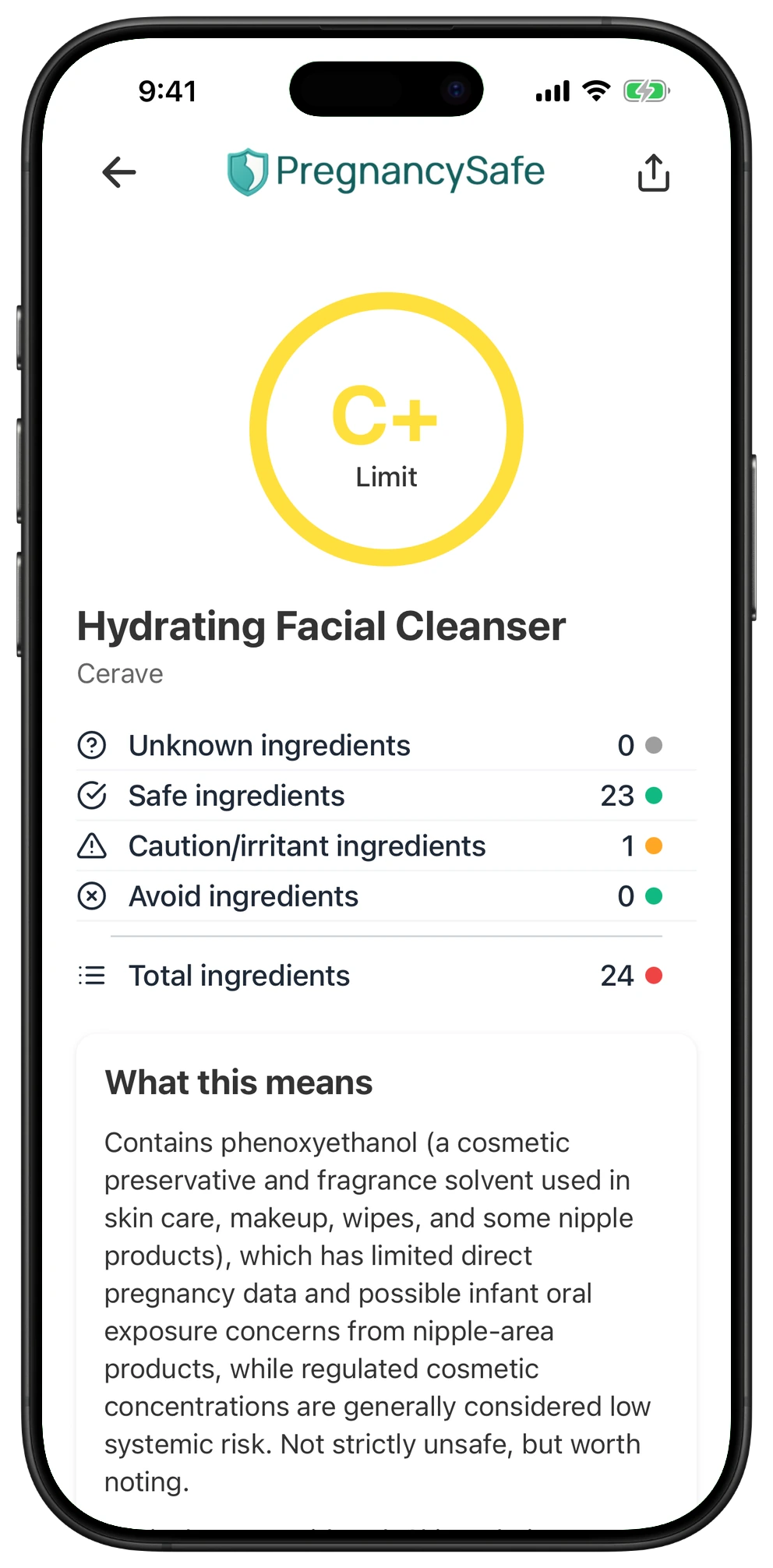
Phenoxyethanol is a preservative commonly used in cosmetics and skincare products to prevent microbial growth and extend shelf life.
Has limited direct pregnancy data and possible infant oral exposure concerns from nipple area products, while regulated cosmetic concentrations are generally considered low systemic risk.
This preservative helps protect facial cleansers from microbial growth. Direct pregnancy data are limited, but assessed cosmetic concentrations are considered acceptable; ordinary rinse off facial use is not equivalent to high dose animal exposure or infant ingestion from nipple cream.
Flagged in 372 of 863 products (43%)
fragrance
Caution
A fragrant substance used to add a pleasant aroma to products or environments.
Can hide product specific mixtures and has been associated with higher DEP metabolite exposure in some pregnancy studies; fragrance allergens and VOCs may also irritate sensitive skin or airways.
In facial cleanser, fragrance identifies a scent mixture whose individual components may not be disclosed. Choosing fragrance free can reduce irritation and optional scent exposure, but this label alone does not establish phthalate content or pregnancy harm.
Flagged in 188 of 863 products (22%)
salicylic acid
Caution
Salicylic acid is a beta hydroxy acid commonly used in skincare to exfoliate the skin, unclog pores, and treat acne.
Is generally low concern in directed low dose topical acne use during pregnancy but needs caution with high concentration peels, wart or callus removers, large area, occlusive, broken skin, or raw chemical exposure; oral salicylates are separate medication exposures.
This exfoliating acne ingredient is generally low concern with directed low dose topical use during pregnancy. Discuss concentrations above 2% with your dermatologist, and avoid prolonged, covered, large area, or broken skin application; oral salicylate warnings are a separate issue.
Flagged in 163 of 863 products (19%)
parfum
Caution
Parfum is a fragrant mixture of essential oils, aroma compounds, and solvents used to impart a pleasant scent.
Can hide product specific mixtures and has been associated with higher DEP metabolite exposure in some pregnancy studies; fragrance allergens and VOCs may also irritate sensitive skin or airways.
Parfum is another label term for fragrance, not a separate pregnancy hazard. In a facial cleanser, its clearest practical concern is sensitivity to the scent mixture; the term does not reveal whether phthalates are present.
Flagged in 96 of 863 products (11%)
chamomilla recutita flower extract
Caution
Chamomilla recutita flower extract is a soothing botanical ingredient known for its calming and anti inflammatory properties.
Warrants caution because pregnancy specific topical evidence is inadequate; assessed cosmetic concentrations appear to pose low systemic concern, but irritation or allergy is possible and concentrated or medicinal preparations are not well studied.
This German chamomile flower extract is a botanical used in skin care formulas. Pregnancy specific topical evidence is inadequate, and allergy or irritation is the clearest concern, especially with daisy family sensitivity; a rinse off extract should not be equated with oral chamomile or concentrated essential oil.
Flagged in 55 of 863 products (6%)
methylparaben
Caution
Methylparaben is a synthetic preservative commonly used in cosmetics and personal care products to inhibit microbial growth and extend shelf life.
Has mixed human pregnancy biomonitoring signals and weak endocrine activity, while regulated cosmetic levels are generally considered low concern.
This short chain paraben preserves facial cleanser formulas. Pregnancy biomonitoring findings are mixed and do not establish harm from a rinse off cleanser; assessed cosmetic preservative levels are considered acceptable despite weak endocrine activity.
Flagged in 50 of 863 products (6%)
parfum fragrance
Caution
A parfum fragrance is a concentrated aromatic blend designed to impart a pleasing and lasting scent when applied to the skin or clothing.
Can hide product specific mixtures and has been associated with higher DEP metabolite exposure in some pregnancy studies; fragrance allergens and VOCs may also irritate sensitive skin or airways.
This combined label wording refers to fragrance rather than identifying a distinct ingredient or proving a concentrated perfume exposure. In facial cleanser, consider scent sensitivity and incomplete mixture disclosure without assuming proven fetal harm.
Flagged in 38 of 863 products (4%)
propylparaben
Caution
Propylparaben is a synthetic preservative commonly used in cosmetics and personal care products to inhibit microbial growth and extend shelf life.
Has mixed pregnancy biomonitoring signals and weak endocrine activity, but regulated cosmetic concentrations are considered low concern by FDA, SCCS and CIR.
This longer chain paraben is used to preserve facial cleansers and other cosmetics. It has more endocrine concern than methylparaben, but pregnancy studies are mixed and do not consistently establish causal harm at cosmetic use levels; safety assessments support use within assessed limits.
Flagged in 35 of 863 products (4%)
How Do Facial Cleanser Products Stack Up?
Our catalog contains ratings for 863 facial cleanser products. These are database grades, not independent safety certifications.
These ratings describe cataloged ingredients, not clinical testing of every full formula. Formulas and pack sizes can differ. A low grade is not by itself a reason to stop a clinician-recommended acne treatment.
Best Pregnancy Safe Facial Cleanser
Popular options from our catalog, prioritizing A and B ingredient grades, with C grade options used to fill remaining places. Within each group, products are ordered by searches in Pregnancy Safe, not retail sales. Read the cautions and guidance above; grades do not verify a complete current label or guarantee pregnancy safety.
| Grade | Product | Brand |
|---|---|---|
| B+ | La Roche Posay Toleriane Purifying Facial Cleanser | La Roche Posay |
| B+ | Vanicream Unscented Gentle Facial Cleanser | Vanicream |
| B+ | La Roche-Posay Toleriane Hydrating Gentle Cleanser (Various Sizes | La Roche-Posay |
| B+ | La Roche Posay Toleriane Hydrating Facial Cleanser | La Roche Posay |
| B+ | La Roche-Posay Toleriane Purifying Foaming Cleanser (Various Sizes | La Roche-Posay |
Your Questions Answered
Is facial cleanser safe during pregnancy?
Gentle cleansing fits a simple pregnancy skin care routine. Start with a non medicated formula that does not irritate your skin, and use it according to its directions. Acne washes require a separate look at their active ingredients and concentrations. A rinse off cleanser should not be assessed as though it were an oral medicine or a strong leave on peel.
Can I use a salicylic acid face wash while pregnant?
Low dose topical salicylic acid is an option during pregnancy when needed for acne; it is not universally prohibited. Discuss concentrations above 2% and medicated products with your dermatologist. Follow the directions and avoid prolonged contact, covered application, large treatment areas, or broken skin. Warnings about oral salicylates do not automatically apply to a directed use facial wash.
Can I use a benzoyl peroxide acne cleanser during pregnancy?
Topical benzoyl peroxide is among the acne ingredients that can be used during pregnancy if needed. Because an acne cleanser is a treatment rather than just a basic wash, discuss the formulation and how often to use it with your dermatologist. Check its active ingredient panel and follow the labeled directions. A low catalog grade alone is not a reason to stop a clinician recommended acne treatment.
Do I need to avoid phenoxyethanol or parabens in face wash?
Their presence alone does not make a facial cleanser unsuitable for pregnancy. Phenoxyethanol has limited direct pregnancy data, while methylparaben and propylparaben have mixed observational findings that do not establish harm from a particular cleanser. Cosmetic safety assessments consider these preservatives acceptable within their assessed use limits. Concerns about high systemic doses or infant ingestion from nipple products should not be presented as evidence of harm from ordinary facial cleansing.
Are fragrance free or natural cleansers better choices?
Fragrance free is a practical preference if your skin reacts to scented products or you want to reduce unnecessary scent exposure. Fragrance labeling does not establish that a formula contains phthalates or causes pregnancy harm. Natural formulas can still contain fragrance, chamomile, or essential oils that trigger irritation or allergy. Choose by the actual formula and your skin's tolerance rather than the natural claim.
Does an A grade mean a cleanser is proven pregnancy safe?
No: our catalog contains 34 A rated products, but those ratings describe cataloged ingredients rather than clinical testing of each complete formula. They do not guarantee that every ingredient record is complete or current. A listed product has qualifications for its particular version and size, not every similarly named bottle. Likewise, a low grade or incomplete record is not proof that a cleanser is harmful.
How to Interpret These Ratings
Our ingredient and category rules generate letter grades from the information recorded in the catalog. Missing ingredients and broad category assignments can affect the result. These grades do not measure your dose, confirm a complete current label, or test a product for contamination.
A high grade is not a guarantee of pregnancy safety. A low grade is not, by itself, proof of harm from every use. Follow the product-specific guidance above, check the actual package, and ask your prenatal clinician about supplements, treatment decisions or uncertain exposures.
People Also Checked
References
- https://www.aad.org/public/everyday-care/skin-care-secrets/routine/pregnancy-skin-care
- https://mothertobaby.org/fact-sheets/topical-acne-treatments-pregnancy/
- https://health.ec.europa.eu/system/files/2021-08/sccs_o_195_0.pdf
- https://ec.europa.eu/growth/tools-databases/cosing/details/28157
- https://journals.sagepub.com/doi/10.3109/10915819009078737
- https://link.springer.com/article/10.1007/s00204-024-03938-5
- https://www.sfda.gov.sa/en/warnings/1156
- https://www.industrialchemicals.gov.au/sites/default/files/Ethanol%2C%202-phenoxy-_Human%20health%20tier%20II%20assessment.pdf
- https://hero.epa.gov/reference/2857875
- https://books.publisso.de/sites/default/files/documents/series/mak/dam/Vol2019/Iss1/Alt006/mb12299kske6319_w.pdf
- https://www.fda.gov/cosmetics/cosmetic-ingredients/fragrances-cosmetics
- https://www.fda.gov/cosmetics/cosmetic-ingredients/phthalates-cosmetics
- https://www.fda.gov/cosmetics/cosmetic-ingredients/allergens-cosmetics
- https://pmc.ncbi.nlm.nih.gov/articles/PMC3110684/
- https://pmc.ncbi.nlm.nih.gov/articles/PMC4016195/
- https://pmc.ncbi.nlm.nih.gov/articles/PMC4097177/
- https://pmc.ncbi.nlm.nih.gov/articles/PMC8453372/
- https://pmc.ncbi.nlm.nih.gov/articles/PMC10999525/
- https://www.epa.gov/indoor-air-quality-iaq/volatile-organic-compounds-impact-indoor-air-quality
- https://www.acog.org/womens-health/faqs/skin-conditions-during-pregnancy
- https://www.aad.org/public/diseases/acne/derm-treat/pregnancy
- https://pmc.ncbi.nlm.nih.gov/articles/PMC9823189/
- https://www.accessdata.fda.gov/drugsatfda_docs/omuf/Order/Final%20Administrative%20Order%20OTC000013_M006-Topical%20Acne%20drug%20products%20for%20OTC%20Human%20Use.pdf
- https://health.ec.europa.eu/system/files/2023-06/sccs_o_268.pdf
- https://www.fda.gov/drugs/drug-safety-and-availability/fda-recommends-avoiding-use-nsaids-pregnancy-20-weeks-or-later-because-they-can-result-low-amniotic
- https://www.accessdata.fda.gov/drugsatfda_docs/omuf/monographs/OTCMonograph_M028-WartRemoverDrugProductsforOTCHumanUse10012021.pdf
- https://www.ncbi.nlm.nih.gov/books/NBK582985/
- https://pmc.ncbi.nlm.nih.gov/articles/PMC3114665/
- https://pubmed.ncbi.nlm.nih.gov/9269866/
- https://pubmed.ncbi.nlm.nih.gov/10026401/
- https://pubmed.ncbi.nlm.nih.gov/24472429/
- https://www.ecfr.gov/current/title-21/chapter-I/subchapter-D/part-333/subpart-D/section-333.310
- https://pubmed.ncbi.nlm.nih.gov/38453786/
- https://www.accessdata.fda.gov/drugsatfda_docs/omuf/monographs/OTC%20Monograph_M006-Topical%20Acne%20drug%20products%20for%20OTC%20Human%20Use%2011.23.2021.pdf
- https://www.fda.gov/safety/medical-product-safety-information/nonsteroidal-anti-inflammatory-drugs-nsaids-drug-safety-communication-avoid-use-nsaids-pregnancy-20
- https://dermnetnz.org/topics/acne-in-pregnancy
- https://www.inchem.org/documents/icsc/icsc/eics0563.htm
- https://www.ncbi.nlm.nih.gov/books/NBK582985
- https://pubmed.ncbi.nlm.nih.gov/23914887
- https://www.fda.gov/drugs/drug-alerts-and-statements/fda-warns-against-purchasing-or-using-chemical-peel-skin-products-without-professional-supervision
- https://www.nccih.nih.gov/health/chamomile
- https://www.ema.europa.eu/en/documents/herbal-monograph/final-european-union-herbal-monograph-matricaria-recutita-l-flos-first-version_en.pdf
- https://www.ema.europa.eu/en/documents/herbal-monograph/final-community-herbal-monograph-chamaemelum-nobile-l-all-flos_en.pdf
- https://journals.sagepub.com/doi/10.1177/1091581818801814
- https://journals.sagepub.com/doi/10.1177/1091581817705620
- https://pubmed.ncbi.nlm.nih.gov/40314057/
- https://pubmed.ncbi.nlm.nih.gov/40374153/
- https://www.fda.gov/cosmetics/cosmetic-ingredients/parabens-cosmetics
- https://health.ec.europa.eu/system/files/2023-12/sccs_o_276_final.pdf
- https://pubmed.ncbi.nlm.nih.gov/19101832/
- https://pubmed.ncbi.nlm.nih.gov/32283359/
- https://pubmed.ncbi.nlm.nih.gov/33477047/
- https://pubmed.ncbi.nlm.nih.gov/36709902/
- https://pubmed.ncbi.nlm.nih.gov/40117576/
- https://pubmed.ncbi.nlm.nih.gov/27156397/
- https://health.ec.europa.eu/publications/propylparaben_en
- https://journals.sagepub.com/doi/10.1177/1091581820925001
- https://pubmed.ncbi.nlm.nih.gov/32279061/
- https://pubmed.ncbi.nlm.nih.gov/30412856/
- https://pubmed.ncbi.nlm.nih.gov/32521303/
- https://pubmed.ncbi.nlm.nih.gov/35487354/
- https://pubmed.ncbi.nlm.nih.gov/16097138/
- https://www.nccih.nih.gov/health/lavender
- https://www.mayoclinichealthsystem.org/hometown-health/speaking-of-health/essential-oils-and-pregnancy
- https://pubmed.ncbi.nlm.nih.gov/39685078/
- https://pubmed.ncbi.nlm.nih.gov/41192533/
- https://pubmed.ncbi.nlm.nih.gov/33673548/
- https://pubmed.ncbi.nlm.nih.gov/32147050/
- https://pubmed.ncbi.nlm.nih.gov/31393563/
- https://pubmed.ncbi.nlm.nih.gov/35663791/
- https://uktis.org/monographs/use-of-essential-oils-in-pregnancy/
- https://www.ema.europa.eu/en/medicines/herbal/rosmarini-aetheroleum
- https://www.ema.europa.eu/en/documents/herbal-report/final-assessment-report-rosmarinus-officinalis-l-aetheroleum-rosmarinus-officinalis-l-folium-revision-1_en.pdf
- https://www.cir-safety.org/sites/default/files/rosmar062014FR.pdf
- https://pmc.ncbi.nlm.nih.gov/articles/PMC7956842/
- https://pubmed.ncbi.nlm.nih.gov/8731353/
- https://www.hfpappexternal.fda.gov/scripts/fdcc/index.cfm?id=ROSEMARYOILROSEMARINUSOFFICINALIS&set=FoodSubstances