Is CeraVe Moisturizing Cream Safe During Pregnancy? (Updated 2026 Guide)
Updated September 9, 2026
CeraVe Moisturizing Cream
Cerave
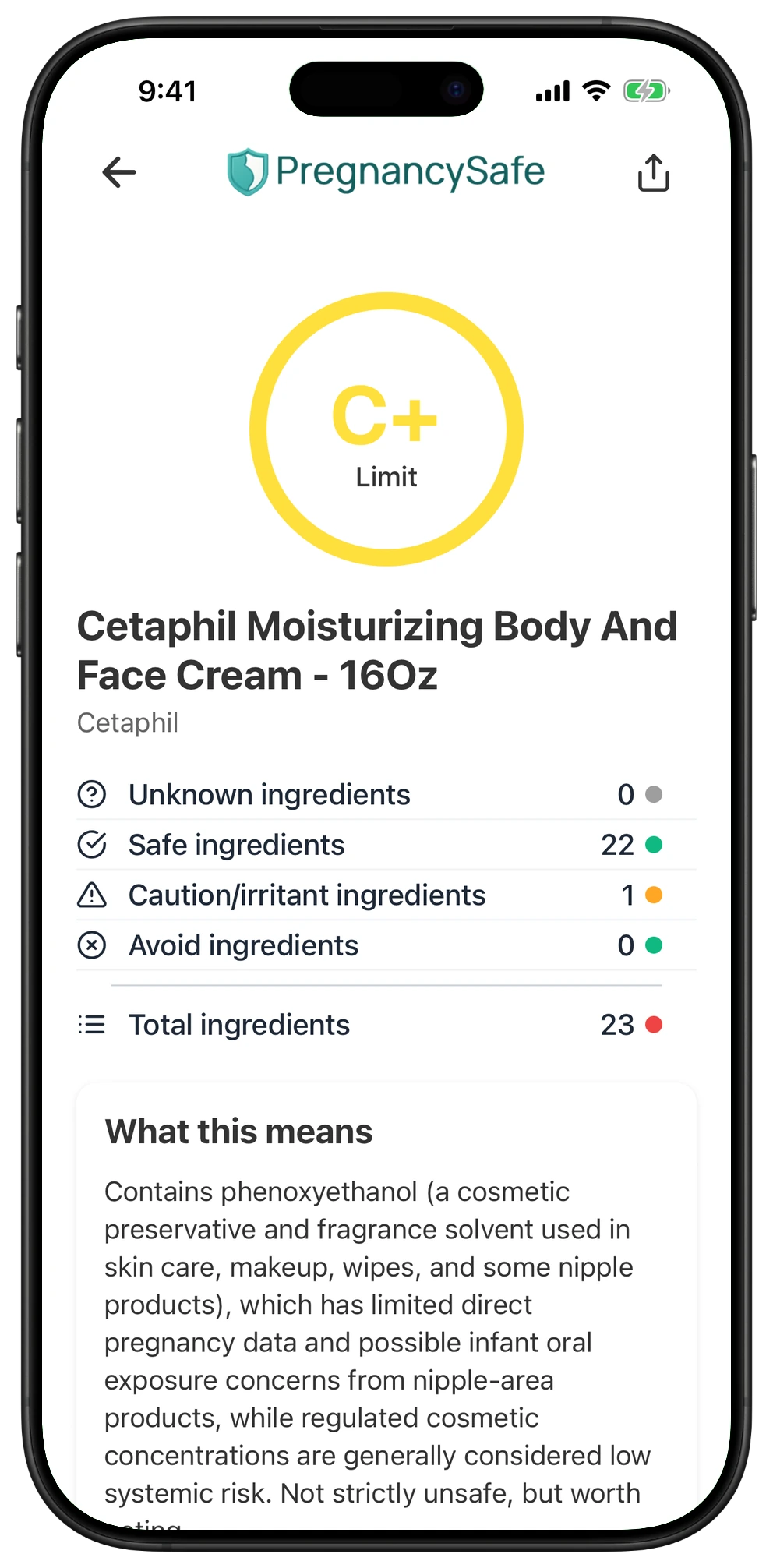
CeraVe Moisturizing Cream receives a C+ pregnancy grade, making it a use with caution option rather than an avoid product for ordinary topical use. The main caution is phenoxyethanol: direct pregnancy studies are limited, although cosmetic safety reviews consider regulated concentrations acceptable. This grade does not establish that normal skin application harms your baby.
You can use this, but maybe don't make it your everyday go to. Not the end of the world if you've used it. Consult your OBGYN or midwife if you have concerns.
Pregnancy Safe is 100% independent and research driven. No companies pay to promote or sponsor products.
Stress Less This Pregnancy
Check your moisturizer in the app

What Ingredients Are in CeraVe Moisturizing Cream?
CeraVe Moisturizing Cream has 24 ingredients. We flagged 1 ingredient to use with caution.
CAUTION
Phenoxyethanol is a preservative commonly used in cosmetics and skincare products to prevent microbial growth and extend shelf life. Regulated cosmetic concentrations are generally considered low systemic risk, but limited direct pregnancy data warrant caution and nipple area application can expose a nursing infant orally.
potassium phosphate
LIKELY SAFE
Potassium phosphate is a water soluble salt commonly used as a food additive, buffering agent, and fertilizer, providing essential potassium and phosphate nutrients. This ingredient is rated LIKELY_SAFE, but the evidence mainly concerns oral phosphate exposure rather than topical pregnancy use and does not justify transferring high dose oral warnings to this cream.
tocopherol
LIKELY SAFE
Tocopherol is a form of vitamin E commonly used as an antioxidant in skincare and cosmetic products. Normal topical vitamin E use is considered low concern in pregnancy because dermal absorption is minimal, and high dose oral supplement concerns should not be applied to ordinary cream use.
caprylic capric triglyceride
SAFE
Caprylic/Capric Triglyceride is a lightweight, skin conditioning oil derived from coconut oil and glycerin that helps moisturize and improve the texture of the skin. Normal topical use is compatible with pregnancy based on cosmetic safety evidence, although direct pregnancy studies are lacking and blood triglyceride warnings do not apply to skin application.
cholesterol
SAFE
Cholesterol is a waxy, fat like substance found in the blood and cells that is essential for hormone production and cell membrane integrity. Ordinary leave on cosmetic use is considered compatible with pregnancy based on route specific safety reviews, although direct studies in pregnant users are limited.
dimethicone
SAFE
Dimethicone is a silicone based polymer commonly used in skincare and cosmetic products to provide a smooth, silky feel and create a protective barrier on the skin. Normal topical use is expected to produce very low systemic exposure, supporting compatibility with pregnancy despite limited direct pregnancy outcome data.
dipotassium phosphate
SAFE
Dipotassium phosphate is a water soluble salt commonly used as a food additive and buffering agent to regulate pH levels. The pregnancy evidence concerns dietary phosphorus rather than skin application, so oral intake guidance does not establish a topical dose limit for this cream.
glycerin
SAFE
Glycerin is a colorless, odorless, and sweet tasting humectant commonly used in skincare products to attract and retain moisture in the skin. Normal topical cosmetic use is considered compatible with pregnancy, with low expected exposure from skin application.
sodium hyaluronate
SAFE
Sodium hyaluronate is a powerful hydrating agent that helps retain moisture in the skin, promoting plumpness and elasticity. Normal topical moisturizing use is considered compatible with pregnancy because systemic exposure is expected to be low, although direct pregnancy studies are limited.
aqua
SAFE
Aqua is the scientific term for water, commonly used as a solvent and base ingredient in various cosmetic and skincare products. Water is the formula's solvent and is not flagged here, but that alone does not establish the finished cream's pregnancy safety.
behentrimonium methosulfate
SAFE
Behentrimonium methosulfate is a gentle conditioning agent derived from natural oils that helps detangle and soften hair. This conditioning ingredient is not flagged here, but ingredient specific pregnancy evidence for topical use is not available in this assessment.
carbomer
SAFE
Carbomer is a synthetic, water soluble polymer used as a thickening, stabilizing, and emulsifying agent in cosmetic and pharmaceutical formulations. This thickener is not flagged here, but its unflagged status does not establish pregnancy safety for topical exposure.
ceramide ap
SAFE
Ceramide AP is a lipid molecule that helps strengthen and restore the skin's natural barrier, promoting hydration and overall skin health. This skin barrier lipid is not flagged here, although its moisturizing role does not itself establish pregnancy specific topical safety.
ceramide eop
SAFE
Ceramide EOP is a lipid molecule that helps restore and strengthen the skin's natural barrier, promoting hydration and protection. This barrier supporting lipid is not flagged here, but direct pregnancy evidence for its topical use is not available in this assessment.
ceramide np
SAFE
Ceramide NP is a lipid molecule that helps strengthen and restore the skin's natural barrier, providing hydration and protection against environmental stressors. This moisturizing skin lipid is not flagged here, without an ingredient specific pregnancy safety conclusion for topical use.
ceteareth 20
SAFE
This ingredient is unflagged, but no ingredient specific evidence is available here to draw a pregnancy safety conclusion for topical use.
cetearyl alcohol
SAFE
Cetearyl alcohol is a fatty alcohol commonly used as an emollient, emulsifier, and thickening agent in skincare and cosmetic products. This emollient fatty alcohol is not flagged here, but pregnancy specific evidence for topical use is not available in this assessment.
cetyl alcohol
SAFE
Cetyl alcohol is a fatty alcohol commonly used as an emollient, thickener, and emulsifier in skincare and cosmetic products. This fatty alcohol acts as an emollient and thickener, but its unflagged status is not a pregnancy specific topical safety review.
disodium edta
SAFE
Disodium EDTA is a chelating agent commonly used in cosmetics and food products to bind metal ions and improve stability. This formula stabilizing chelator is not flagged here, but pregnancy specific evidence for topical exposure is not available in this assessment.
ethylhexylglycerin
SAFE
Ethylhexylglycerin is a skin conditioning agent and preservative booster commonly used in cosmetics to enhance product stability and provide mild antimicrobial benefits. This preservative booster is not flagged here, without an ingredient specific pregnancy safety conclusion for topical use.
petrolatum
SAFE
Petrolatum is a semi solid, occlusive substance derived from petroleum that is commonly used to moisturize and protect the skin. This moisture sealing ingredient is not flagged here, but that status alone does not establish pregnancy specific topical safety.
phytosphingosine
SAFE
Phytosphingosine is a naturally occurring sphingolipid that helps to strengthen the skin's barrier and provide antimicrobial benefits. This barrier supporting lipid is not flagged here, but direct pregnancy evidence for topical use is not available in this assessment.
sodium lauroyl lactylate
SAFE
Sodium lauroyl lactylate is a gentle, biodegradable surfactant and emulsifier derived from lactic acid and fatty acids, commonly used in cosmetics and personal care products. This emulsifier is not flagged here, but its formulation role does not establish pregnancy specific safety for topical exposure.
xanthan gum
SAFE
Xanthan gum is a natural thickening and stabilizing agent derived from fermented sugars, commonly used in gluten free baking and food processing. This thickener is not flagged here, but its food use description does not establish pregnancy safety for skin application.
Answering Your Questions
How much CeraVe Moisturizing Cream is safe during pregnancy?
Apply enough to spread a thin layer over the dry skin you want to moisturize, following your package directions. No pregnancy specific quantity limit is established here; ask your clinician about use on extensively damaged skin or under dressings.
Can you use CeraVe Moisturizing Cream daily while pregnant?
Follow the package directions and reapply according to your skin's needs rather than adding unnecessary layers. No pregnancy specific maximum frequency is established, so the C+ grade should not be interpreted as a once daily or occasional use limit. Stop if the cream irritates your skin.
Why does CeraVe Moisturizing Cream receive a C+ grade?
The C+ comes from ingredient based scoring, with phenoxyethanol rated CAUTION and potassium phosphate and tocopherol rated LIKELY_SAFE. Phenoxyethanol's caution reflects limited direct pregnancy evidence, not demonstrated harm from normal cosmetic use. Tocopherol is low concern when applied normally to skin, while the phosphate evidence mainly concerns oral exposure and does not establish a topical pregnancy risk.
Can I use CeraVe Moisturizing Cream while breastfeeding?
Application away from your baby's mouth is a different exposure from using it as a nipple cream. Avoid applying it to the nipple or areola where your baby could ingest it, and ask your clinician for a product intended for that area. The phenoxyethanol related nursing warning concerned infant oral exposure to a nipple cream containing both phenoxyethanol and chlorphenesin, not this cream's ordinary use elsewhere on your skin.
What moisturizer could I choose instead during pregnancy?
Look for a moisturizer with a reviewed full ingredient list and fewer pregnancy related caution flags, rather than relying on the brand name alone. If you want to avoid this cream's main flagged ingredient, compare phenoxyethanol free formulas, but remember that removing one preservative does not automatically make the replacement safer.
Does CeraVe Moisturizing Cream contain retinol?
Retinol and other retinoids are not listed in this formula. Its C+ grade is therefore not a retinol warning. Check the ingredient list on your own package to make sure you are using the same formula.
Are the ceramides and hyaluronic acid a concern during pregnancy?
This formula contains ceramide AP, EOP and NP, which help support the skin barrier and are not flagged in this assessment; that is not the same as having direct pregnancy safety studies. Sodium hyaluronate, a form of hyaluronic acid, is considered compatible with normal topical cosmetic use because systemic exposure is expected to be low, although direct pregnancy studies remain limited. That assessment does not extend to injectable fillers.
Does the vitamin E in this cream carry the same risks as high dose supplements?
No tocopherol applied normally to skin is a different exposure from swallowing high dose vitamin E supplements. Cosmetic reviews indicate minimal dermal absorption and low concern for ordinary topical use, which supports its LIKELY_SAFE rating. Evidence is less direct for unusually extensive application, use under occlusive coverings or application to extensively damaged skin.
What Are Pregnancy Safe Alternatives to CeraVe Moisturizing Cream?
Here are some solid alternatives. Everything below has an A or B grade, meaning no flagged ingredients in our database.
| Grade | Product | Brand | Type |
|---|---|---|---|
| B+ | Byoma Moisturizing Rich Cream | Byoma | moisturizer |
| A | Byoma Gel Cream Moisturizer | Byoma | moisturizer |
| A | Daily Moisturizing Cream | Aveeno | moisturizer |
| A | Byoma Mini Gel Cream Moisturizer 0.68 Fl Oz | Byoma | moisturizer |
Are Other Cerave Products Safe During Pregnancy?
We looked at 18 other Cerave products. 0 are pregnancy safe (A or B grade), while 18 need a closer look.
| Grade | Product | Type |
|---|---|---|
| C | Cerave Daily Moisturizing Lotion | moisturizer |
| C | Cerave Foaming Facial Cleanser | facial cleanser |
| C | Cerave Hydrating Cream-To-Foam Cleanser With Amino Acids For Normal To Dry Skin 236Ml | facial cleanser |
| C | Cerave Sa Face Wash Salicylic Acid Cleanser With Hyaluronic Acid And Niacinamide | face wash |
How Does CeraVe Moisturizing Cream Compare to Other Moisturizers?
We graded 981 Moisturizers for pregnancy safety. Here's how they stack up:
CeraVe Moisturizing Cream earns a C+ grade, placing it among the majority of Moisturizers. Only 3% of products in this category get an A grade, so it pays to choose carefully.
How Do We Score Products for Pregnancy Safety?
We analyze each product's ingredients and category to flag known risks and provide cautionary notices for general category safety concerns.
A - Safe
Excellent choice! All ingredients are considered safe during pregnancy.
What to do: Use with confidence.
B - Likely Safe
Pretty much safe with very minimal risk. Some ingredients may have limited pregnancy studies, but no significant safety concerns have been identified.
What to do: Use with confidence.
C - Limit
Contains ingredients with some pregnancy considerations. Research shows these ingredients may have limited safety data, potential for minor hormonal effects, or require caution based on animal studies.
What to do: Use sparingly and consider safer alternatives when available.
D - Caution
Similar to C grade but contains multiple cautionary ingredients. The combination increases overall concern.
What to do: Try to avoid if that makes you feel better. If you've already used it, no need to panic.
F - Avoid
Contains an ingredient Pregnancy Safe recommends avoiding during pregnancy. This may reflect an established risk or a precaution based on limited evidence; check the ingredient guidance and exposure context.
What to do: Do not use during pregnancy. If you've already used it, don't worry - contact your OBGYN if concerned.
People Also Checked
Cerave Hydrating Face Wash With Hyaluronic Acid And Glycerin For Normal To Dry Skin
Cerave
Eltamd Uv Clear Broad-Spectrum Spf 46
Eltamd
Cerave Daily Moisturizing Lotion
Cerave
The Ordinary Natural Moisturizing Factors + Hyaluronic Acid Daily Moisturizer
The Ordinary
Byoma Moisturizing Rich Cream
Byoma
References
- https://health.ec.europa.eu/system/files/2021-08/sccs_o_195_0.pdf
- https://ec.europa.eu/growth/tools-databases/cosing/details/28157
- https://journals.sagepub.com/doi/10.3109/10915819009078737
- https://link.springer.com/article/10.1007/s00204-024-03938-5
- https://www.sfda.gov.sa/en/warnings/1156
- https://www.industrialchemicals.gov.au/sites/default/files/Ethanol%2C%202-phenoxy-_Human%20health%20tier%20II%20assessment.pdf
- https://hero.epa.gov/reference/2857875
- https://books.publisso.de/sites/default/files/documents/series/mak/dam/Vol2019/Iss1/Alt006/mb12299kske6319_w.pdf
- https://ods.od.nih.gov/factsheets/Phosphorus-HealthProfessional/
- https://ods.od.nih.gov/factsheets/Pregnancy-HealthProfessional/
- https://www.nationalacademies.org/read/5776/chapter/7
- https://hfpappexternal.fda.gov/scripts/fdcc/index.cfm?order=ASC&search=phosphate&set=FoodSubstances&sort=Sortterm_ID&startrow=1&type=basic
- https://pmc.ncbi.nlm.nih.gov/articles/PMC7009158/
- https://pmc.ncbi.nlm.nih.gov/articles/PMC13086773/
- https://www.kidney.org/news-stories/smart-eating-kidney-health-understanding-phosphorus-foods
- https://www.accessdata.fda.gov/drugsatfda_docs/label/2018/021892s014lbl.pdf
- https://cdnservices.industrialchemicals.gov.au/statements/EVA00103%20-%20Evaluation%20Statement%20-%2026%20June%202023.pdf
- https://journals.sagepub.com/doi/10.1177/1091581818794455
- https://pmc.ncbi.nlm.nih.gov/articles/PMC4154592/
- https://pubmed.ncbi.nlm.nih.gov/15868062/
- https://mothertobaby.org/fact-sheets/vitamin-e/
- https://www.cir-safety.org/sites/default/files/trygly122017FAR.pdf
- https://pubmed.ncbi.nlm.nih.gov/11800053/
- https://pubmed.ncbi.nlm.nih.gov/9441714/
- https://pubmed.ncbi.nlm.nih.gov/32542693/
- https://www.fda.gov/cosmetics/resources-consumers-cosmetics/cosmetics-pregnancy
- https://cosmileeurope.eu/inci/detail/2584/caprylic-capric-triglyceride/
- https://www.olay.com/products/olay-firming-hydrating-body-lotion-with-collagen
- https://nationaleczema.org/eczema-products/eczema-honey-oatmeal-hand-cream/
- https://pubmed.ncbi.nlm.nih.gov/40932360/
- https://doi.org/10.3109/10915818609141922
- https://doi.org/10.1080/10915810600964618
- https://pubmed.ncbi.nlm.nih.gov/22209282/
- https://pubmed.ncbi.nlm.nih.gov/34921679/
- https://www.medicinesinpregnancy.org/leaflets-a-z/dimethicone/
- https://uktis.org/monographs/use-of-head-lice-treatments-in-pregnancy/
- https://www.cir-safety.org/sites/default/files/FAR_Methicones_032022.pdf
- https://www.medicines.org.uk/emc/product/4860/smpc
- https://www.sps.nhs.uk/articles/treating-lice-during-breastfeeding/
- https://mothertobaby.org/fact-sheets/lice-scabies-pregnancy/
- https://www.ecfr.gov/current/title-21/chapter-I/subchapter-D/part-347/subpart-B/section-347.10
- https://www.ncbi.nlm.nih.gov/books/NBK109813/
- https://lpi.oregonstate.edu/mic/minerals/phosphorus
- https://www.hfpappexternal.fda.gov/scripts/fdcc/index.cfm?id=GLYCERIN&set=FoodSubstances
- https://pubmed.ncbi.nlm.nih.gov/31840548/
- https://pmc.ncbi.nlm.nih.gov/articles/PMC7009851/
- https://www.medicinesinpregnancy.org/leaflets-a-z/glycerin-suppositories/
- https://mothertobaby.org/pregnancy-breastfeeding-exposures/cosmetics/
- https://pubmed.ncbi.nlm.nih.gov/35309882/
- https://www.cir-safety.org/sites/default/files/TR_Hyaluronates_032023_1.pdf
- https://pubmed.ncbi.nlm.nih.gov/19636067/
- https://www.aad.org/public/everyday-care/skin-care-secrets/routine/pregnancy-skin-care
- https://www.fda.gov/medical-devices/aesthetic-cosmetic-devices/dermal-fillers-soft-tissue-fillers
- https://pubmed.ncbi.nlm.nih.gov/28492048/