Is Seaweed Safe During Pregnancy? (Updated 2026 Guide)
Updated September 9, 2026
The Answer
You can eat seaweed during pregnancy with attention to the type and amount: occasional modest portions of lower iodine nori or laver differ from high iodine kelp and concentrated supplements. Avoid hijiki and excessive brown seaweed intake; catalog grades do not establish a safe iodine dose.
Seaweed's main pregnancy consideration is highly variable iodine: you need iodine, but sustained excess can affect your thyroid and your baby's thyroid. Kelp and kombu can supply much more iodine than nori, while concentrated oral supplements and extracts need separate consideration from food portions. Hijiki raises a distinct inorganic arsenic concern; this does not mean all seaweed is contaminated.
Pregnancy Safe is 100% independent and research driven. No companies pay to promote or sponsor products.
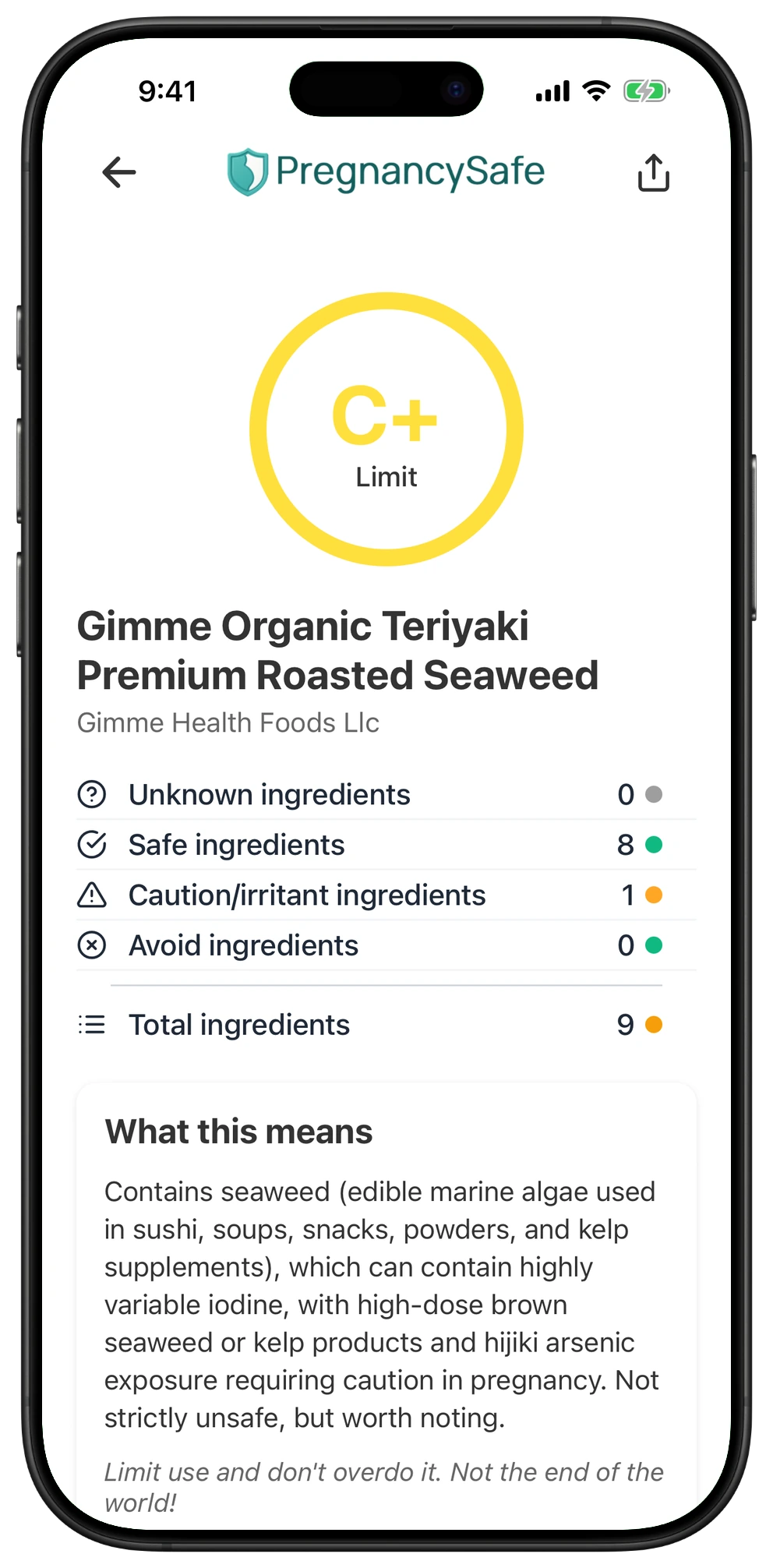
Stress Less This Pregnancy
Check your exact seaweed in the app

✓ What's Safe
- • Choose clearly identified nori or laver for occasional modest food portions rather than treating all seaweed types as interchangeable.
- • Check the serving size and iodine amount when available; an ingredient list alone cannot tell you the iodine dose.
- • Distinguish culinary sheets and snacks from capsules, powders and liquid extracts sold as supplements.
- • Ask the manufacturer which species a product contains if the label says only seaweed or sea vegetables.
- • Discuss your total iodine intake from food, prenatal vitamins and other supplements with your clinician if you eat seaweed frequently or have thyroid concerns.
✗ What to Avoid
- • Avoid hijiki, also spelled hiziki, because of its inorganic arsenic concern.
- • Avoid large or frequent portions of kelp or kombu, including habitual high iodine seaweed soups.
- • Do not start kelp, bladderwrack or other seaweed supplements without discussing the formulation and iodine dose with your clinician.
- • Avoid using a fixed number of sheets as a universal safe limit; species, sheet size and iodine content vary.
- • Do not assume organic or roasted seaweed has low iodine, or that an A grade measures iodine or metal content.
Most Common Ingredients in Seaweed Products
We analyzed 192 seaweed products. Here are the most common ingredients, ranked by how often they appear:
Ingredients to Watch Out For in Seaweed
These are the most common flagged ingredients across 192 seaweed products we analyzed.
seaweed
Caution
Seaweed is a nutrient rich marine plant commonly used in culinary dishes for its umami flavor and health benefits.
Can contain highly variable iodine, with high dose brown seaweed or kelp products and hijiki arsenic exposure requiring caution in pregnancy.
Flagged in 48 of 192 products (25%)
kelp
Caution
Kelp is a nutrient rich, brown seaweed commonly used as a savory, mineral dense ingredient in soups, salads, and health supplements.
Can contain highly variable iodine, with high dose brown seaweed or kelp products and hijiki arsenic exposure requiring caution in pregnancy.
Flagged in 13 of 192 products (7%)
organic seaweed
Caution
Organic seaweed is a nutrient rich, sustainably harvested marine plant known for its health benefits and versatile culinary uses.
Can contain highly variable iodine, with high dose brown seaweed or kelp products and hijiki arsenic exposure requiring caution in pregnancy.
Flagged in 12 of 192 products (6%)
dulse seaweed glycerite liquid extract
Caution
Can contain highly variable iodine, with high dose brown seaweed or kelp products and hijiki arsenic exposure requiring caution in pregnancy.
Flagged in 8 of 192 products (4%)
alcohol
Caution
Alcohol is a volatile, colorless liquid commonly used as a solvent, disinfectant, or intoxicating beverage.
No amount of Alcohol is considered safe. Avoid alcohol beverages entirely. Be extremely careful when using in cooking or even with small percentages.
Flagged in 5 of 192 products (3%)
red dulse seaweed leaf glycerite liquid extract
Caution
Can contain highly variable iodine, with high dose brown seaweed or kelp products and hijiki arsenic exposure requiring caution in pregnancy.
Flagged in 5 of 192 products (3%)
kombu
Caution
Kombu is a type of edible kelp seaweed commonly used in Japanese cuisine to add umami flavor and richness to broths and soups.
Can contain highly variable iodine, with high dose brown seaweed or kelp products and hijiki arsenic exposure requiring caution in pregnancy.
Flagged in 4 of 192 products (2%)
organic nori
Caution
Organic nori is a nutrient rich, dried seaweed used to add flavor and umami to dishes like sushi and rice bowls.
Can contain highly variable iodine, with high dose brown seaweed or kelp products and hijiki arsenic exposure requiring caution in pregnancy.
Flagged in 4 of 192 products (2%)
Types of Seaweed
Seaweed Products We've Analyzed
Our catalog contains ratings for 192 seaweed products. These are database grades, not independent safety certifications.
Grades are ingredient scores, not clinical verdicts or measurements of pathogens, dose, preparation or current package contents. Cohorts include unreviewed catalog records and counts are not independently verified safe-product totals.
Pregnancy Safe Seaweed Products
Popular options from our catalog, prioritizing A and B ingredient grades, with C grade options used to fill remaining places. Within each group, products are ordered by searches in Pregnancy Safe, not retail sales. Read the cautions and guidance above; grades do not verify a complete current label or guarantee pregnancy safety.
| Grade | Product | Brand |
|---|---|---|
| B+ | Sea Kelp | Good 'N Natural |
| A | Premium Roasted Seaweed Green Laver | Haio |
| A | Longevity Dehydrated Sea Grapes | Longevity |
| A | Maine Coast Nori, Wild Atlantic | Unknown |
| B+ | Kelp | Dc |
Your Questions Answered
Why can't you eat seaweed while pregnant?
Seaweed is not a blanket prohibition during pregnancy. The main concern is excessive iodine, particularly from brown seaweeds such as kelp or kombu and concentrated oral supplements. Occasional modest portions of lower iodine nori are a different exposure. Hijiki is a separate type to avoid because of inorganic arsenic.
Why is brown seaweed limited during pregnancy?
Brown seaweed can contain naturally high iodine levels, so a large or frequent intake may deliver too much. Excessive iodine exposure can affect maternal and infant thyroid function. This concern does not mean every nori or laver snack contains the same iodine amount as kelp. Check the species and any available iodine information before making seaweed a regular part of your diet.
Can I eat dried or roasted seaweed while pregnant?
Occasional modest portions of dried or roasted nori or laver can fit into your pregnancy diet. Drying or roasting alone does not establish the iodine content, so check which seaweed the product contains. A roasted snack is not the same exposure as a kelp capsule or concentrated extract. Neither a short ingredient list nor an organic label guarantees a low iodine dose.
How much seaweed can I eat during pregnancy?
There is no universal safe number of sheets or grams that applies to every seaweed product. Iodine varies widely by species and product, and your intake also includes other foods and supplements. Favor occasional modest portions of lower iodine types rather than large or frequent kelp or kombu servings. If you eat seaweed regularly, ask your clinician to help assess your overall iodine intake.
Are kelp supplements or dulse extracts equivalent to eating seaweed?
No: capsules and liquid extracts should be assessed by their actual formulation and dose, not treated as ordinary food portions. Kelp supplements can provide substantial iodine, while a dulse extract's name alone does not establish its iodine content or pregnancy safety. Discuss these products with your clinician before using them, especially alongside a prenatal vitamin. Do not use seaweed supplements to self treat a thyroid concern.
Does an A grade mean a seaweed product is pregnancy safe?
No. Our catalog contains 192 products, including 11 with an A ingredient grade, but those counts are not independently verified safe product totals. Grades do not measure iodine, metals, pathogens, preparation or your portion size. Even a listed product is not a pregnancy safety guarantee, so use the exact label and its qualifications rather than the grade alone.
How to Interpret These Ratings
Our ingredient and category rules generate letter grades from the information recorded in the catalog. Missing ingredients and broad category assignments can affect the result. These grades do not measure your dose, confirm a complete current label, or test a product for contamination.
A high grade is not a guarantee of pregnancy safety. A low grade is not, by itself, proof of harm from every use. Follow the product-specific guidance above, check the actual package, and ask your prenatal clinician about supplements, treatment decisions or uncertain exposures.
People Also Checked
References
- https://ods.od.nih.gov/factsheets/Pregnancy-HealthProfessional/
- https://www.foodstandards.gov.au/science-data/monitoring-safety/surveyofiodinelevels
- https://journals.sagepub.com/doi/10.1177/10507256261445624
- https://ods.od.nih.gov/factsheets/Iodine-HealthProfessional/
- https://www.foodstandards.gov.au/consumer/nutrition/pregnancy/iodine-and-pregnancy
- https://www.foodstandards.gov.au/consumer/prevention-of-foodborne-illness/arseniciodine
- https://inspection.canada.ca/en/food-safety-consumers/fact-sheets/specific-products-and-risks/chemical-hazards/inorganic-arsenic
- https://pubmed.ncbi.nlm.nih.gov/35947162/
- https://pubmed.ncbi.nlm.nih.gov/20919974/
- https://pubmed.ncbi.nlm.nih.gov/30632947/
- https://pmc.ncbi.nlm.nih.gov/articles/PMC8077470/