Is Dried Seaweed Safe During Pregnancy? (Updated 2026 Guide)
Updated September 9, 2026
The Answer
You can eat occasional modest portions of lower iodine dried seaweed such as nori during pregnancy, but kelp and kombu need more caution because their iodine content can be very high. Our catalog contains 5 products, all graded C+; these ingredient scores do not measure iodine or establish a safe serving size.
Your main consideration is iodine: pregnancy increases your needs, but sustained excessive intake can affect your thyroid and your baby's thyroid. Occasional culinary portions of nori differ from frequent kelp or kombu consumption and concentrated seaweed supplements. Hijiki raises a separate inorganic arsenic concern, and rinsing or soaking is not guaranteed to remove enough iodine.
Pregnancy Safe is 100% independent and research driven. No companies pay to promote or sponsor products.
Stress Less This Pregnancy
Check your exact dried seaweed in the app

✓ What's Safe
- • Choose packages that identify the seaweed type, rather than relying on a generic dried seaweed label.
- • Prefer lower iodine types such as nori or laver for occasional modest food portions instead of substituting kelp or kombu.
- • Check for iodine information per serving when available, and compare it with the amount you actually eat.
- • Consider iodine from both food and supplements before making seaweed a regular part of your diet.
- • Ask your clinician about regular seaweed intake if you have thyroid concerns or are considering seaweed supplements.
✗ What to Avoid
- • Avoid frequent or large portions of dried kelp or kombu, which can deliver very high iodine amounts.
- • Avoid hijiki, also spelled hiziki, because of its inorganic arsenic concern.
- • Do not start concentrated kelp or seaweed powders and capsules without discussing them with your clinician.
- • Do not assume a fixed number of sheets is safe across different species, brands and sheet sizes.
- • Do not rely on rinsing or soaking to make high iodine seaweed suitable for unrestricted eating.
Most Common Ingredients in Dried Seaweed Products
We analyzed 5 dried seaweed products. Here are the most common ingredients, ranked by how often they appear:
Ingredients to Watch Out For in Dried Seaweed
These are the most common flagged ingredients across 5 dried seaweed products we analyzed.
seaweed
Caution
Seaweed is a nutrient rich marine plant commonly used in culinary dishes for its umami flavor and health benefits.
Can contain highly variable iodine, with high dose brown seaweed or kelp products and hijiki arsenic exposure requiring caution in pregnancy.
Flagged in 3 of 5 products (60%)
dried kelp
Caution
Dried kelp is a nutrient rich, savory seaweed commonly used in soups, broths, and Asian cuisine for its umami flavor and health benefits.
Can contain highly variable iodine, with high dose brown seaweed or kelp products and hijiki arsenic exposure requiring caution in pregnancy.
Flagged in 1 of 5 products (20%)
dried seaweed
Caution
Dried seaweed is a nutrient rich, savory plant ingredient commonly used in soups, salads, and sushi.
Can contain highly variable iodine, with high dose brown seaweed or kelp products and hijiki arsenic exposure requiring caution in pregnancy.
Flagged in 1 of 5 products (20%)
Dried Seaweed Products We've Analyzed
Our catalog contains ratings for 5 dried seaweed products. These are database grades, not independent safety certifications.
Grades are ingredient scores, not clinical verdicts or measurements of pathogens, dose, preparation or current package contents. Cohorts include unreviewed catalog records and counts are not independently verified safe-product totals.
Pregnancy Safe Dried Seaweed Products
Popular options from our catalog, prioritizing A and B ingredient grades, with C grade options used to fill remaining places. Within each group, products are ordered by searches in Pregnancy Safe, not retail sales. Read the cautions and guidance above; grades do not verify a complete current label or guarantee pregnancy safety.
| Grade | Product | Brand |
|---|---|---|
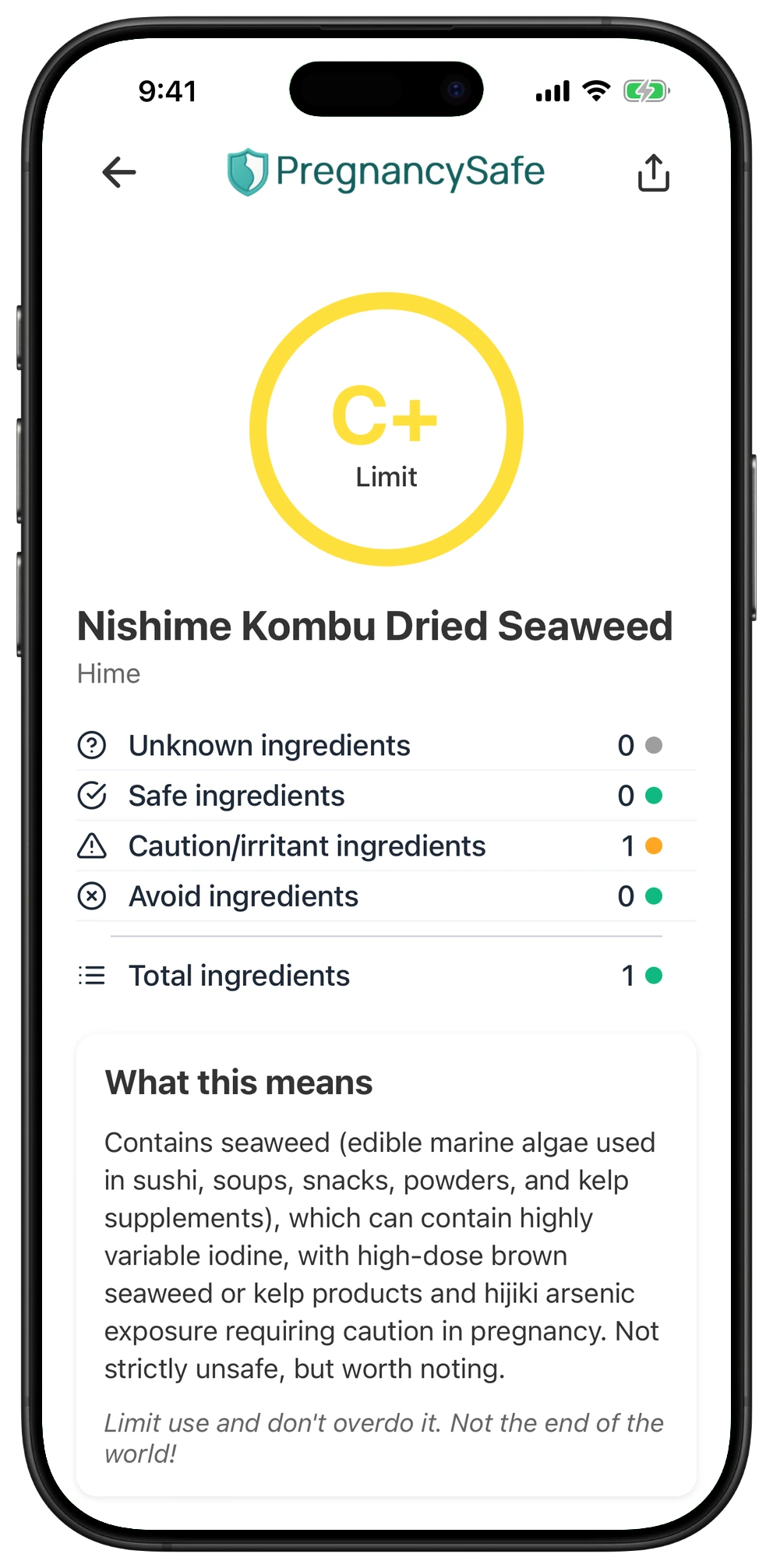
| C+ | Nishime Kombu Dried Seaweed Catalog caution flags: seaweed. Read the category guidance above. | Hime |
| C+ | Musubi Nori Dried Seaweed Catalog caution flags: dried seaweed. Read the category guidance above. | — |
| C+ | Dashi Kombu Dried Seaweed Catalog caution flags: seaweed. Read the category guidance above. | Welpac |
| C+ | Dried Kelps Catalog caution flags: dried kelp. Read the category guidance above. | Shirakiku |
| C+ | Dried Seaweed Catalog caution flags: seaweed. Read the category guidance above. | D.M.D. Bridge Brand |
Your Questions Answered
Can I have dried seaweed while pregnant?
Yes, occasional modest portions of lower iodine types such as nori are a different exposure from frequent kelp or kombu consumption. Check which seaweed you are eating because drying alone does not tell you its iodine content. Avoid hijiki because of its separate inorganic arsenic concern.
How much dried seaweed can I eat during pregnancy?
There is no universal pregnancy safe number of sheets. Iodine content varies greatly by seaweed type and product, so a sheet count cannot reliably describe your intake. Check serving specific iodine information when available, and discuss regular consumption with your clinician, particularly if you have thyroid concerns.
Are nori and kombu equally suitable during pregnancy?
No, they should not be treated as interchangeable. Nori or laver is generally a lower iodine choice, while brown seaweeds such as kombu or kelp can deliver very high amounts. An occasional modest nori portion does not justify the same amount or frequency of kombu.
Does soaking or rinsing dried seaweed remove the iodine risk?
Rinsing or soaking is not a guarantee of sufficient iodine removal. You cannot use either method to establish a safe serving size when the starting iodine content is unknown. Choose the species and amount carefully rather than treating preparation as permission for unlimited portions.
Can I take seaweed supplements instead of eating dried seaweed?
Do not treat kelp powders or seaweed capsules as equivalent to occasional food portions. Concentrated supplements can create a different iodine exposure, especially with daily use. Discuss them with your clinician rather than using them to meet pregnancy iodine needs on your own.
Does a C+ grade mean dried seaweed is unsafe?
No. Our catalog contains 5 dried seaweed products, all graded C+, but these are ingredient scores rather than clinical safety verdicts. They do not measure iodine, pathogens, preparation or current package contents, and the count is not an independently verified safety total. Your practical choice still depends on the seaweed type, amount and frequency.
How to Interpret These Ratings
Our ingredient and category rules generate letter grades from the information recorded in the catalog. Missing ingredients and broad category assignments can affect the result. These grades do not measure your dose, confirm a complete current label, or test a product for contamination.
A high grade is not a guarantee of pregnancy safety. A low grade is not, by itself, proof of harm from every use. Follow the product-specific guidance above, check the actual package, and ask your prenatal clinician about supplements, treatment decisions or uncertain exposures.
People Also Checked
See our full guide to seaweed during pregnancy.
References
- https://ods.od.nih.gov/factsheets/Pregnancy-HealthProfessional/
- https://www.foodstandards.gov.au/science-data/monitoring-safety/surveyofiodinelevels
- https://journals.sagepub.com/doi/10.1177/10507256261445624
- https://ods.od.nih.gov/factsheets/Iodine-HealthProfessional/
- https://www.foodstandards.gov.au/consumer/nutrition/pregnancy/iodine-and-pregnancy
- https://www.foodstandards.gov.au/consumer/prevention-of-foodborne-illness/arseniciodine
- https://inspection.canada.ca/en/food-safety-consumers/fact-sheets/specific-products-and-risks/chemical-hazards/inorganic-arsenic
- https://pubmed.ncbi.nlm.nih.gov/35947162/
- https://pubmed.ncbi.nlm.nih.gov/20919974/
- https://pubmed.ncbi.nlm.nih.gov/30632947/
- https://pmc.ncbi.nlm.nih.gov/articles/PMC8077470/