Is Sea Moss Safe During Pregnancy? (Updated 2026 Guide)
Updated September 9, 2026
The Answer
Sea moss is not established as safe for routine supplementation during pregnancy; discuss the exact product, iodine dose, and quality testing with your prenatal clinician before taking it. Our catalog contains grades from A to C, but those scores cannot establish pregnancy suitability.
Sea moss products vary in species, iodine content, and contaminant testing, so a spoonful of gel and a concentrated supplement are not interchangeable exposures. Excess iodine can affect thyroid function, but sea moss should not automatically be assigned the high iodine levels of brown kelp or assumed to contain heavy metals. Added spirulina or concentrated elderberry brings separate quality or pregnancy evidence concerns that need assessment alongside the sea moss itself.
Pregnancy Safe is 100% independent and research driven. No companies pay to promote or sponsor products.
Stress Less This Pregnancy
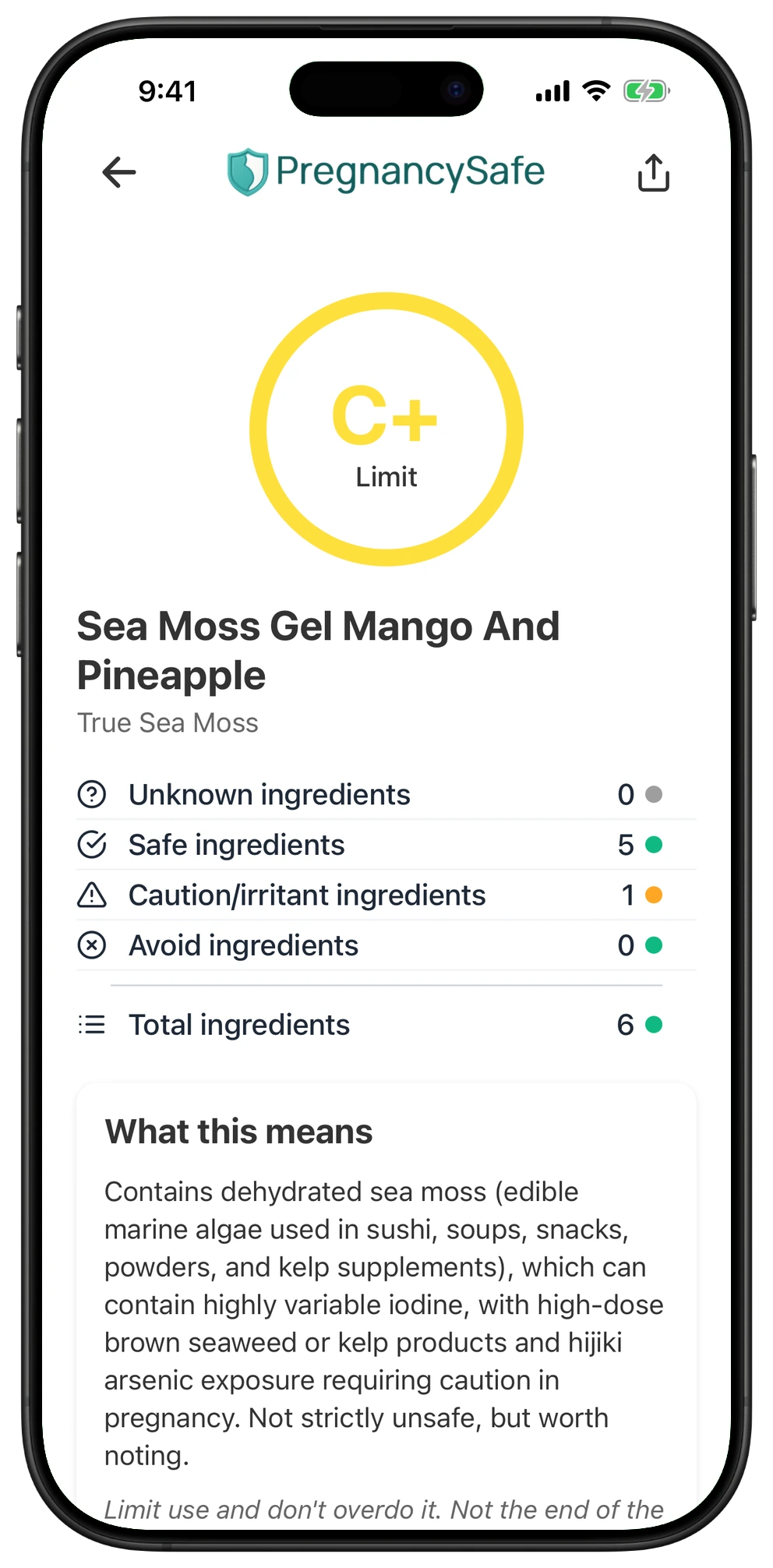
Check your exact sea moss in the app
✓ What's Safe
- • Check the iodine amount per serving and the intended frequency of use; bring both to your prenatal clinician.
- • Look for a clearly identified seaweed species rather than relying on the name sea moss alone.
- • Ask for testing information covering iodine and contaminants for the exact product or batch; testing is not a pregnancy safety certification.
- • Distinguish plain sea moss from blends containing other algae, herbs, or extracts, and review every added ingredient.
- • Review your prenatal supplement and other iodine sources with your clinician before adding sea moss, especially if you have thyroid disease.
✗ What to Avoid
- • Avoid starting a daily sea moss supplement when its iodine dose or quality information is unavailable.
- • Do not assume a tablespoon of gel, a gummy, and a capsule provide equivalent amounts or have equivalent risks.
- • Avoid treating organic, wildcrafted, raw, or sustainably harvested claims as proof of low iodine or freedom from contaminants.
- • Do not add sea moss to kelp or other iodine supplements without reviewing your total intake with your clinician.
- • Avoid choosing spirulina or concentrated elderberry blends for claimed pregnancy benefits without assessing their separate ingredients and doses.
- • Do not use sea moss to induce labor, treat anemia, or replace your prenatal supplement or prescribed iodine or iron.
Most Common Ingredients in Sea Moss Products
We analyzed 13 sea moss products. Here are the most common ingredients, ranked by how often they appear:
Ingredients to Watch Out For in Sea Moss
These are the most common flagged ingredients across 13 sea moss products we analyzed.
organic irish moss
Caution
Can contain highly variable iodine, with high dose brown seaweed or kelp products and hijiki arsenic exposure requiring caution in pregnancy.
Flagged in 2 of 13 products (15%)
sea moss
Caution
Sea moss is a nutrient rich marine algae known for its potential health benefits, including supporting digestion, immunity, and skin health.
Can contain highly variable iodine, with high dose brown seaweed or kelp products and hijiki arsenic exposure requiring caution in pregnancy.
Flagged in 2 of 13 products (15%)
certified organic spirulina powder
Caution
Has limited pregnancy safety data and product quality concerns because contaminated blue green algae supplements can contain microcystins, heavy metals, or pathogenic bacteria.
Flagged in 1 of 13 products (8%)
dehydrated sea moss
Caution
Dehydrated sea moss is a nutrient rich, dried marine algae known for its mineral content and health benefits.
Can contain highly variable iodine, with high dose brown seaweed or kelp products and hijiki arsenic exposure requiring caution in pregnancy.
Flagged in 1 of 13 products (8%)
Caution
Elderberry is a dark purple berry known for its immune boosting properties and rich antioxidant content.
Has little pregnancy specific safety data for supplement doses and can be toxic if raw, unripe, or made with leaves, stems, bark, or roots.
Flagged in 1 of 13 products (8%)
elderberry concentrate
Caution
Elderberry concentrate is a potent extract made from elderberries, known for its immune boosting and antioxidant properties.
Has little pregnancy specific safety data for supplement doses and can be toxic if raw, unripe, or made with leaves, stems, bark, or roots.
Flagged in 1 of 13 products (8%)
irish sea moss
Caution
Can contain highly variable iodine, with high dose brown seaweed or kelp products and hijiki arsenic exposure requiring caution in pregnancy.
Flagged in 1 of 13 products (8%)
organic irish moss powder
Caution
Can contain highly variable iodine, with high dose brown seaweed or kelp products and hijiki arsenic exposure requiring caution in pregnancy.
Flagged in 1 of 13 products (8%)
Sea Moss Products We've Analyzed
Our catalog contains ratings for 13 sea moss products. These are database grades, not independent safety certifications.
Scores do not measure iodine dose or contaminants, and mixed supplements are not equivalent to plain sea moss. An A grade cannot establish pregnancy suitability.
Your Questions Answered
Can I take sea moss instead of prenatals?
No. Sea moss is not a substitute for your prenatal supplement or prescribed iodine or iron. Its nutrient content varies, and a mineral rich label does not show that it meets your pregnancy needs. Keep following your prenatal care plan rather than replacing it with sea moss.
Can I take sea moss alongside my prenatal vitamins?
Ask your prenatal clinician before adding it. The assessment needs to include the iodine in your prenatal, other supplements, and diet, together with the sea moss serving size and frequency. If the product's iodine amount is unknown, you cannot reliably assess that combined intake. Having a prenatal supplement does not make an additional sea moss supplement necessary.
How much sea moss is safe during pregnancy?
There is no established pregnancy safe serving that applies across sea moss products. A spoonful of one gel may not provide the same iodine exposure as another gel, powder, or capsule. Do not treat a manufacturer's suggested serving as a pregnancy specific safety limit. Your clinician needs the product's iodine amount and quality information to assess its suitability.
Is sea moss gel safer than capsules or gummies?
The form alone does not establish safety. Gels, capsules, powders, and gummies can differ in seaweed content, iodine dose, and added ingredients. An occasional food exposure is different from repeated concentrated supplementation, but that distinction does not establish a safe gel serving. Compare the exact formulation and dose rather than choosing by texture or format.
Does sea moss contain too much iodine or heavy metals?
That cannot be determined from the name alone. Species, sourcing, and testing matter, and sea moss should not automatically be assigned the high iodine concentrations associated with brown kelp. Contamination is a quality concern, not proof that every sea moss product contains harmful levels of heavy metals. Testing can help characterize exposure, but it does not establish pregnancy safety.
Are sea moss blends with spirulina or elderberry safe?
These blends need a separate assessment rather than being treated as plain sea moss. Spirulina has limited pregnancy evidence, and poorly controlled blue green algae products can have contamination problems. Elderberry supplement doses also have limited pregnancy safety evidence; properly cooked ripe berries are a different exposure from raw or unripe berries and concentrated extracts. Ask your clinician to review the complete formulation and amounts.
Does an A grade mean sea moss is safe during pregnancy?
No. Our catalog contains 13 products, including 3 with an A grade, but these scores do not measure iodine dose or contaminants. An A grade is not a pregnancy safety guarantee, and a lower grade does not by itself prove a product is harmful. No sea moss supplement is recommended here for routine pregnancy use without dose, quality, and clinical assessment.
How to Interpret These Ratings
Our ingredient and category rules generate letter grades from the information recorded in the catalog. Missing ingredients and broad category assignments can affect the result. These grades do not measure your dose, confirm a complete current label, or test a product for contamination.
A high grade is not a guarantee of pregnancy safety. A low grade is not, by itself, proof of harm from every use. Follow the product-specific guidance above, check the actual package, and ask your prenatal clinician about supplements, treatment decisions or uncertain exposures.
People Also Checked
References
- https://ods.od.nih.gov/factsheets/Pregnancy-HealthProfessional/
- https://www.foodstandards.gov.au/science-data/monitoring-safety/surveyofiodinelevels
- https://journals.sagepub.com/doi/10.1177/10507256261445624
- https://ods.od.nih.gov/factsheets/Iodine-HealthProfessional/
- https://www.foodstandards.gov.au/consumer/nutrition/pregnancy/iodine-and-pregnancy
- https://www.foodstandards.gov.au/consumer/prevention-of-foodborne-illness/arseniciodine
- https://inspection.canada.ca/en/food-safety-consumers/fact-sheets/specific-products-and-risks/chemical-hazards/inorganic-arsenic
- https://pubmed.ncbi.nlm.nih.gov/35947162/
- https://pubmed.ncbi.nlm.nih.gov/20919974/
- https://pubmed.ncbi.nlm.nih.gov/30632947/
- https://pmc.ncbi.nlm.nih.gov/articles/PMC8077470/
- https://www.fda.gov/food/natural-toxins-food/blue-green-algae-products-and-microcystins
- https://www.ncbi.nlm.nih.gov/books/NBK548312/
- https://www.ncbi.nlm.nih.gov/books/NBK501849/
- https://pubmed.ncbi.nlm.nih.gov/21793723/
- https://journal.ugm.ac.id/v3/InaJBCS/article/view/23573
- https://doi.org/10.4236/ojog.2017.71016
- https://pubmed.ncbi.nlm.nih.gov/37317149/
- https://pubmed.ncbi.nlm.nih.gov/37368655/
- https://pubmed.ncbi.nlm.nih.gov/23036452/
- https://pubmed.ncbi.nlm.nih.gov/21842336/
- https://www.nccih.nih.gov/health/elderberry
- https://pmc.ncbi.nlm.nih.gov/articles/PMC3941201/
- https://pmc.ncbi.nlm.nih.gov/articles/PMC8026097/
- https://pmc.ncbi.nlm.nih.gov/articles/PMC7961730/
- https://www.cdc.gov/mmwr/preview/mmwrhtml/00000311.htm
- https://www.fda.gov/food/information-consumers-using-dietary-supplements/questions-and-answers-dietary-supplements
- https://pubmed.ncbi.nlm.nih.gov/11518905/
- https://infantrisk.com/content/management-cold-and-flu-during-pregnancy