Is Spirulina Safe During Pregnancy? (Updated 2026 Guide)
Updated September 9, 2026
The Answer
Spirulina supplements warrant caution during pregnancy: safety evidence is limited, so discuss the exact product and dose with your prenatal clinician before using one. A small amount used as food coloring is not the same exposure as a daily supplement.
The main considerations are limited pregnancy safety evidence and possible contamination with microcystins, heavy metals, or harmful bacteria. Cultivated spirulina is distinct from wild harvested AFA algae, and not all spirulina products are contaminated; quality testing helps assess contamination but does not establish pregnancy safety. Small studies suggesting benefits for anemia do not justify replacing prenatal iron or folic acid care.
Pregnancy Safe is 100% independent and research driven. No companies pay to promote or sponsor products.
Stress Less This Pregnancy
Check your exact spirulina in the app
✓ What's Safe
- • Discuss the exact powder, tablet, capsule, or extract and your intended daily amount with your prenatal clinician before starting.
- • Look for a clearly identified cultivated spirulina source rather than an unspecified or wild harvested blue green algae blend.
- • Ask for current batch quality results covering microcystins, heavy metals, and harmful bacteria not just a general purity claim.
- • Check the amount per serving and how many servings you would consume, including powder added to smoothies.
- • Distinguish a small amount used for food coloring from a concentrated extract or regular supplement dose.
✗ What to Avoid
- • Avoid starting a daily spirulina supplement or increasing its dose without discussing it with your prenatal clinician.
- • Avoid wild harvested or poorly tested blue green algae supplements with unclear sourcing.
- • Do not treat organic, natural, or blue spirulina labeling as proof of contaminant testing or pregnancy safety.
- • Do not replace prescribed iron, folic acid, or your prenatal supplement with spirulina.
- • Do not choose a supplement solely because of its catalog grade; grades do not measure contaminants or account for your dose.
Most Common Ingredients in Spirulina Products
We analyzed 74 spirulina products. Here are the most common ingredients, ranked by how often they appear:
Ingredients to Watch Out For in Spirulina
These are the most common flagged ingredients across 74 spirulina products we analyzed.
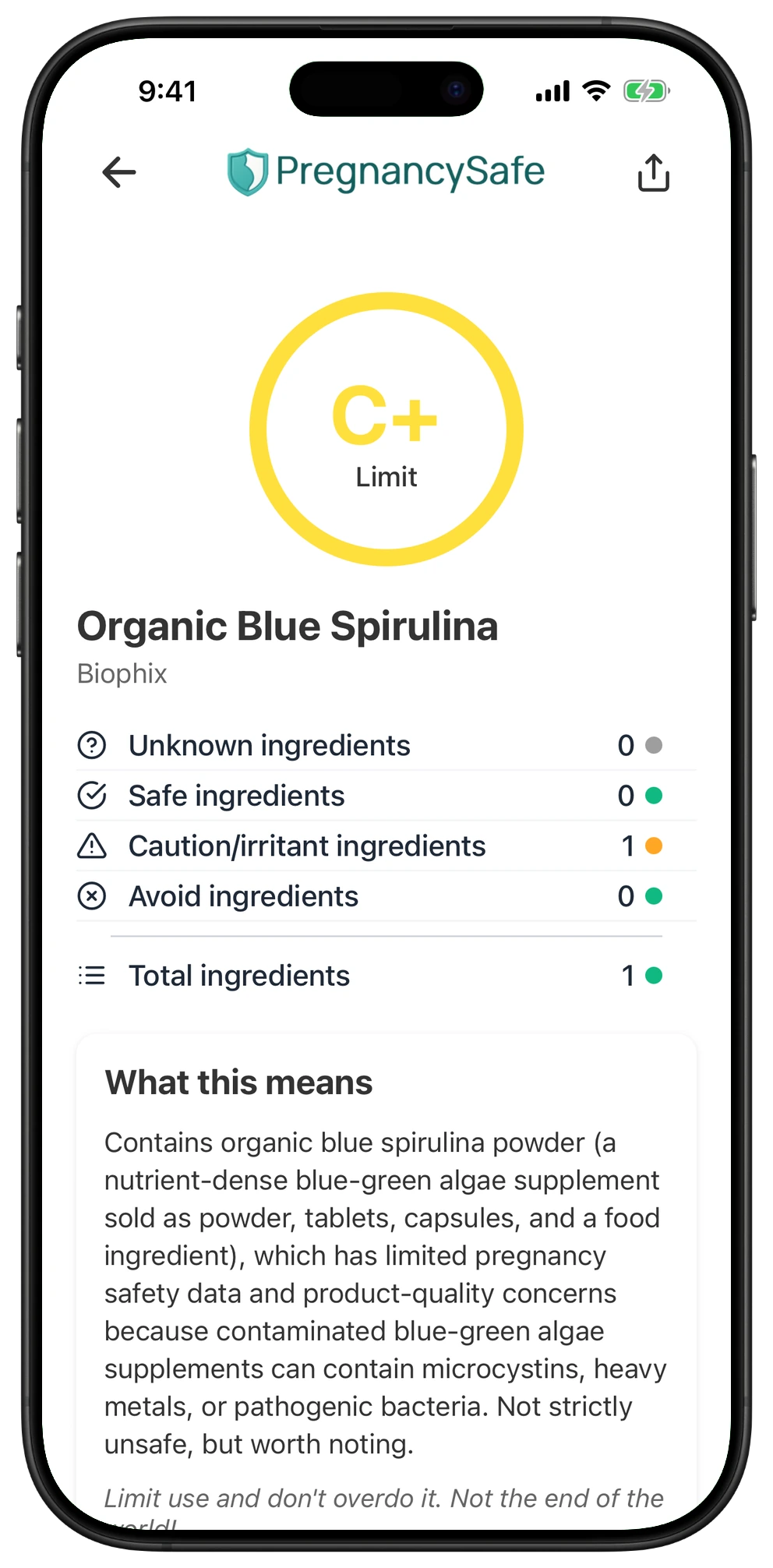
spirulina
Caution
Spirulina is a nutrient rich blue green algae known for its high protein, vitamin, and antioxidant content, often used as a dietary supplement.
Has limited pregnancy safety data and product quality concerns because contaminated blue green algae supplements can contain microcystins, heavy metals, or pathogenic bacteria.
Flagged in 29 of 74 products (39%)
organic spirulina powder
Caution
Organic spirulina powder is a nutrient dense, blue green algae supplement rich in protein, vitamins, and antioxidants, supporting overall health and energy.
Has limited pregnancy safety data and product quality concerns because contaminated blue green algae supplements can contain microcystins, heavy metals, or pathogenic bacteria.
Flagged in 12 of 74 products (16%)
organic spirulina
Caution
Organic spirulina is a nutrient dense blue green algae supplement rich in protein, vitamins, and antioxidants, supporting overall health and energy.
Has limited pregnancy safety data and product quality concerns because contaminated blue green algae supplements can contain microcystins, heavy metals, or pathogenic bacteria.
Flagged in 9 of 74 products (12%)
spirulina powder
Caution
Spirulina powder is a nutrient dense, blue green algae supplement rich in protein, vitamins, and antioxidants, often used to boost energy and support overall health.
Has limited pregnancy safety data and product quality concerns because contaminated blue green algae supplements can contain microcystins, heavy metals, or pathogenic bacteria.
Flagged in 8 of 74 products (11%)
trans fat
Caution
Trans fat is a type of unsaturated fat artificially created through hydrogenation, known to increase bad cholesterol levels and raise the risk of heart disease.
Mainly raise concern when partially hydrogenated and high in artificial trans fat; fully hydrogenated oils are mostly a saturated fat limit rather than the same trans fat issue.
Flagged in 6 of 74 products (8%)
arthrospira platensis
Caution
Has limited pregnancy safety data and product quality concerns because contaminated blue green algae supplements can contain microcystins, heavy metals, or pathogenic bacteria.
Flagged in 3 of 74 products (4%)
earthrise spirulina natural
Caution
Has limited pregnancy safety data and product quality concerns because contaminated blue green algae supplements can contain microcystins, heavy metals, or pathogenic bacteria.
Flagged in 3 of 74 products (4%)
certified organic spirulina extract
Caution
Has limited pregnancy safety data and product quality concerns because contaminated blue green algae supplements can contain microcystins, heavy metals, or pathogenic bacteria.
Flagged in 2 of 74 products (3%)
Spirulina Products We've Analyzed
Our catalog contains ratings for 74 spirulina products. These are database grades, not independent safety certifications.
Grades do not measure microcystins, metals or supplement dose. Nutrition-panel terms can appear among parsed names; this is not a count of independently verified safe supplements.
Your Questions Answered
Is blue spirulina safe for pregnancy?
Blue spirulina should not be assumed safe simply because of its color or marketing. A small amount used to color food is a different exposure from taking a concentrated powder or extract every day. Pregnancy safety evidence remains limited, and product quality matters. Discuss regular supplemental use, including the exact formulation and amount, with your prenatal clinician.
Who should not eat spirulina?
If you are pregnant, check with your healthcare provider before buying or using a spirulina supplement. This is a precaution based on limited pregnancy evidence and possible contamination, not proof that every spirulina product is harmful. Wild harvested or poorly tested blue green algae supplements are especially concerning. A small amount in food should not automatically be treated as equivalent to a daily supplement.
How much folic acid is in spirulina?
There is no single folic acid amount you can assume for all spirulina products or servings. Check the exact label for any declared folate or added folic acid rather than relying on a general nutrient claim. Spirulina is not a replacement for your recommended prenatal folic acid care, even if it contains some folate.
Can spirulina help with anemia during pregnancy?
Small pregnancy studies suggest quality controlled spirulina may improve hemoglobin in people with anemia. These findings do not establish routine supplement safety or show that any retail spirulina product will have the same effect. Do not replace prescribed iron or folic acid with spirulina. Ask your prenatal clinician about evaluating and treating anemia before adding a supplement.
How much spirulina is safe to take while pregnant?
The available evidence does not establish a routine pregnancy safe supplement dose. A serving size printed on the package is not a pregnancy specific safety recommendation. The exact formulation, amount, frequency, and batch quality all matter. Discuss those details with your prenatal clinician rather than choosing a daily dose yourself.
Does an A grade mean a spirulina supplement is safe during pregnancy?
No. Our catalog contains 74 products, including one graded A, but that is not a count of independently verified pregnancy safe supplements. Grades do not measure microcystins, heavy metals, or supplement dose, and nutrition panel terms can appear among recorded ingredient names. Neither a high grade nor an incomplete record establishes a clinical safety verdict; current batch quality evidence and your clinician's assessment remain important.
How to Interpret These Ratings
Our ingredient and category rules generate letter grades from the information recorded in the catalog. Missing ingredients and broad category assignments can affect the result. These grades do not measure your dose, confirm a complete current label, or test a product for contamination.
A high grade is not a guarantee of pregnancy safety. A low grade is not, by itself, proof of harm from every use. Follow the product-specific guidance above, check the actual package, and ask your prenatal clinician about supplements, treatment decisions or uncertain exposures.
People Also Checked
References
- https://www.fda.gov/food/natural-toxins-food/blue-green-algae-products-and-microcystins
- https://ods.od.nih.gov/factsheets/Pregnancy-HealthProfessional/
- https://www.ncbi.nlm.nih.gov/books/NBK548312/
- https://www.ncbi.nlm.nih.gov/books/NBK501849/
- https://pubmed.ncbi.nlm.nih.gov/21793723/
- https://journal.ugm.ac.id/v3/InaJBCS/article/view/23573
- https://doi.org/10.4236/ojog.2017.71016
- https://pubmed.ncbi.nlm.nih.gov/37317149/
- https://pubmed.ncbi.nlm.nih.gov/37368655/
- https://pubmed.ncbi.nlm.nih.gov/23036452/
- https://pubmed.ncbi.nlm.nih.gov/21842336/
- https://www.fda.gov/food/food-additives-petitions/trans-fat
- https://www.fda.gov/food/hfp-constituent-updates/fda-completes-final-administrative-actions-partially-hydrogenated-oils-foods
- https://www.federalregister.gov/documents/2013/11/08/2013-26854/tentative-determination-regarding-partially-hydrogenated-oils-request-for-comments-and-for
- https://www.who.int/news-room/fact-sheets/detail/trans-fat
- https://cdn.realfood.gov/DGA.pdf
- https://www.fda.gov/food/people-risk-foodborne-illness/dietary-advice-and-during-pregnancy
- https://www.rcpi.ie/Portals/0/Document%20Repository/Institute%20of%20Obstetricians%20and%20Gynaecologists/National%20Clinical%20Guidelines/IOG_National%20Clinical%20Guidelines_Nutrition%20in%20pregnancy%20Guideline_2019.pdf
- https://pmc.ncbi.nlm.nih.gov/articles/PMC8027310/
- https://pmc.ncbi.nlm.nih.gov/articles/PMC3192475/