Is Tylenol Extra Strength 500 mg Caplets Safe During Pregnancy? (Updated 2026 Guide)
Updated September 9, 2026
Tylenol Extra Strength 500 mg Caplets
Tylenol
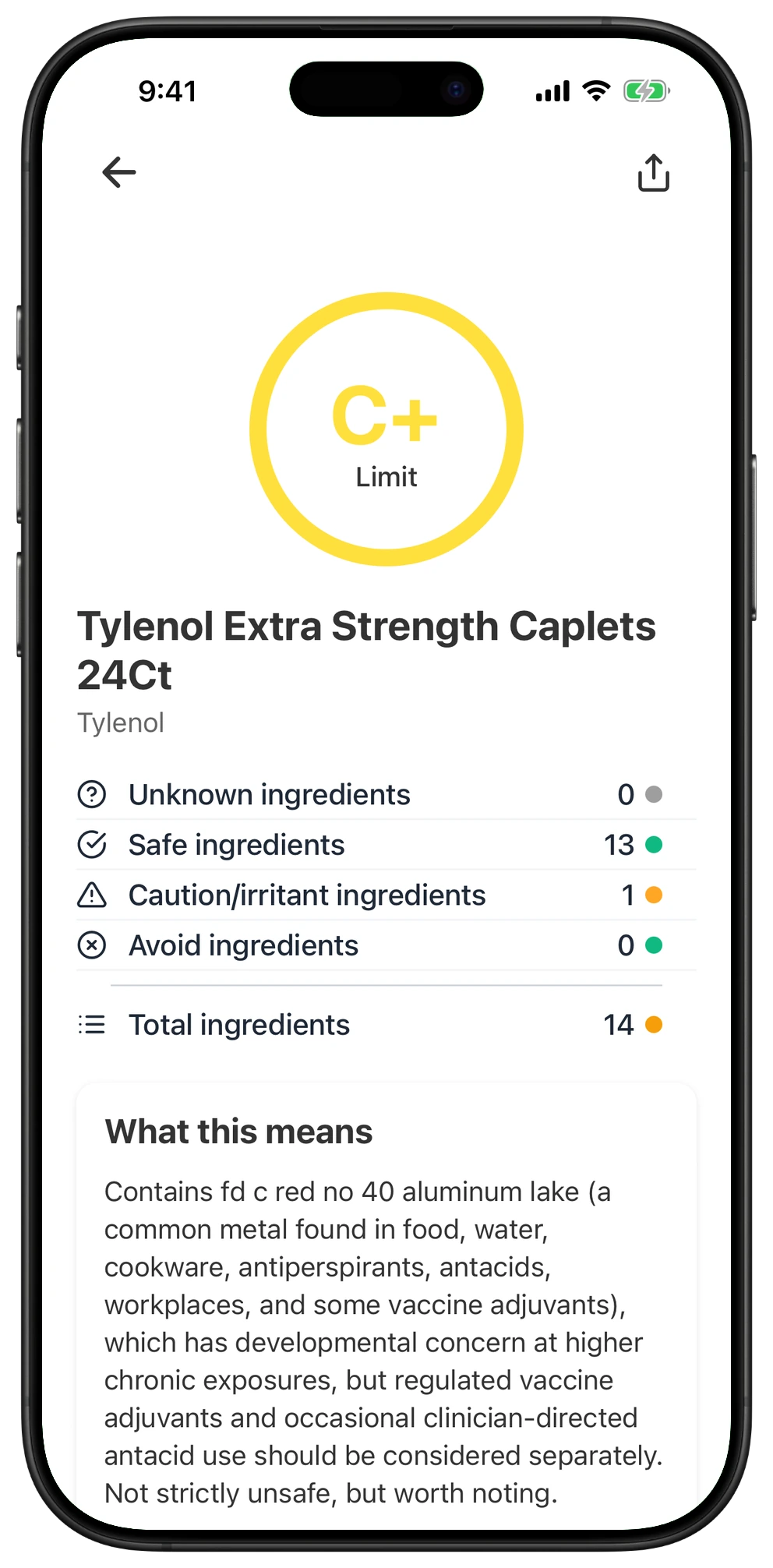
Tylenol Extra Strength 500 mg Caplets can be used during pregnancy when needed and as directed, but this formulation receives a C+ ingredient based grade. Acetaminophen remains a preferred medicine for pregnancy pain and fever; the formula also contains Red 40 aluminum lake, rated caution because pregnancy evidence is limited and concerns are largely indirect. Use the lowest effective dose for the shortest necessary time rather than leaving significant pain or fever untreated.
You can use this, but maybe don't make it your everyday go to. Not the end of the world if you've used it. Consult your OBGYN or midwife if you have concerns.
Pregnancy Safe is 100% independent and research driven. No companies pay to promote or sponsor products.
Stress Less This Pregnancy
Check your pain reliever in the app

What Ingredients Are in Tylenol Extra Strength 500 mg Caplets?
Tylenol Extra Strength 500 mg Caplets has 15 ingredients. We flagged 1 ingredient to use with caution.
red 40 aluminum lake
CAUTION
Red 40 Aluminum Lake is a synthetic red dye commonly used as a colorant in food, beverages, and cosmetics. Red 40 aluminum lake warrants caution because human pregnancy data are limited, but child behavior and high dose animal findings do not establish fetal harm from occasional oral caplet use.
acetaminophen
LIKELY SAFE
Acetaminophen is a common over the counter medication used to relieve pain and reduce fever. Acetaminophen remains a preferred pregnancy pain and fever medicine when needed at recommended oral doses, using the lowest effective dose for the shortest necessary time.
propylene glycol
LIKELY SAFE
Propylene glycol is a colorless, odorless, and tasteless synthetic liquid commonly used as a solvent, humectant, and carrier in food, pharmaceuticals, and cosmetic products. Propylene glycol is rated likely safe here; toxicity concerns involve high or repeated pharmaceutical exposure and cannot be assumed to apply to this unspecified caplet amount.
titanium dioxide
LIKELY SAFE
Titanium dioxide is a white, naturally occurring mineral commonly used as a pigment and whitening agent in cosmetics, paints, and food products. Titanium dioxide is rated likely safe here, though oral food additive uncertainty remains and does not establish pregnancy harm from this unspecified caplet amount.
microcrystalline cellulose
SAFE
Microcrystalline cellulose is a purified, insoluble form of cellulose used as a thickening, stabilizing, and bulking agent in pharmaceuticals and food products. Microcrystalline cellulose is poorly absorbed and generally low concern during pregnancy at ordinary oral tablet excipient amounts.
pregelatinized starch
SAFE
Pregelatinized starch is a processed starch that has been cooked, dried, and ground to enable quick thickening and binding in food and pharmaceutical applications. Pregelatinized starch is rated safe based on broader starch evidence, which is indirect rather than pregnancy research on this exact oral excipient.
sodium starch glycolate
SAFE
Sodium starch glycolate is a superdisintegrant commonly used in pharmaceutical tablets to promote rapid disintegration and dissolution. Sodium starch glycolate is rated safe through a broader starch match, not direct pregnancy evidence on this tablet disintegrant at its oral dose.
carnauba wax
SAFE
Carnauba wax is a natural plant based wax derived from the leaves of the Brazilian palm tree, commonly used as a food additive, cosmetic ingredient, and polishing agent. Carnauba wax is unflagged in this oral formulation, but that does not establish pregnancy safety at its unspecified caplet amount.
crospovidone
SAFE
Crospovidone is a pharmaceutical excipient used as a disintegrant to facilitate the breakup of tablets and capsules in the gastrointestinal tract. Crospovidone helps the caplet disintegrate, but being unflagged is not a pregnancy specific safety assessment of this oral exposure.
hypromellose
SAFE
Hypromellose is a semi synthetic, water soluble polymer commonly used as a thickening agent, film former, and controlled release agent in pharmaceuticals and food products. Hypromellose is an unflagged pharmaceutical excipient here, without a pregnancy specific assessment at the amount swallowed per caplet.
magnesium stearate
SAFE
Magnesium stearate is a white, odorless powder commonly used as a flow agent and lubricant in pharmaceutical and supplement manufacturing. Magnesium stearate serves as a manufacturing lubricant, but its unflagged status does not confirm pregnancy safety at this product’s unspecified oral dose.
polyethylene glycol
SAFE
Polyethylene glycol is a versatile, water soluble polymer commonly used as a laxative, solvent, or in pharmaceutical and cosmetic formulations. Polyethylene glycol is unflagged here, but its amount and pregnancy specific evidence for this oral formulation are not established.
povidone
SAFE
Povidone is a synthetic polymer used as a binder, stabilizer, and solubilizer in pharmaceuticals and medical applications. Povidone is an unflagged pharmaceutical binder here, not an ingredient with established pregnancy safety at this caplet’s unspecified oral amount.
shellac glaze
SAFE
Shellac glaze is a glossy, protective coating made from natural resin that enhances the appearance and durability of surfaces such as wood, ceramics, or artwork. Shellac glaze is unflagged in this oral product, but pregnancy specific safety at its caplet amount has not been established.
stearic acid
SAFE
Stearic acid is a naturally occurring saturated fatty acid commonly used as an emulsifier and thickening agent in cosmetics and skincare products. Stearic acid is unflagged here, but general cosmetic use information does not establish pregnancy safety for this unspecified oral caplet exposure.
Answering Your Questions
How much Tylenol Extra Strength 500 mg Caplets is safe during pregnancy?
Each caplet contains 500 mg of acetaminophen; follow your package directions and your pregnancy clinician’s advice, using the lowest effective dose. Count acetaminophen from all medicines you take, including cold, flu, and sleep products, and do not exceed the recommended total.
Can you use Tylenol Extra Strength 500 mg Caplets daily while pregnant?
Take it only when needed, following the interval on your package or your clinician’s instructions. If you need repeated doses or have persistent pain or fever, contact your pregnancy care team rather than continuing routinely.
Why does Tylenol Extra Strength receive a C+ grade?
The C+ comes from ingredient based scoring, not a finding that recommended acetaminophen use harms pregnancy. Red 40 aluminum lake is rated caution, while acetaminophen, propylene glycol, and titanium dioxide are rated likely safe. Dye concerns draw largely on studies in children and high dose animals, not evidence of fetal harm from an occasional caplet; the amounts of these inactive ingredients are not specified.
Can I take Tylenol Extra Strength while breastfeeding?
Acetaminophen is generally compatible with breastfeeding when taken as directed: milk levels are low, and reported adverse effects in exposed infants are rare. This evidence concerns acetaminophen, not a separate breastfeeding assessment of every inactive ingredient in this formula. MotherToBaby
Which Tylenol or alternative should I choose during pregnancy?
Look for a single active ingredient acetaminophen product at a strength that suits your clinician’s dosing advice. A dye free formulation can avoid Red 40, but check its full ingredient list rather than assuming it has a better reviewed grade. Do not switch to ibuprofen or another NSAID on your own, because these have clearer fetal risks later in pregnancy.
Can taking Tylenol during pregnancy affect my baby?
Recommended dose acetaminophen has not been shown to increase birth defects. Some observational studies report associations with autism or ADHD, but findings are inconsistent and do not establish that acetaminophen causes these outcomes; illness and family factors can influence the results. Discuss ongoing use with your clinician rather than stopping medically needed treatment because of these concerns. MotherToBaby
How much Tylenol Extra Strength can I take in the first trimester?
Each caplet contains 500 mg, but that strength alone does not determine your appropriate dose or daily limit. Follow the package directions and confirm your plan with your pregnancy clinician, especially if you need repeated doses or take other medicines. Use the lowest effective dose for the shortest necessary duration.
What counts as excessive Tylenol use during pregnancy?
Taking more than the recommended total, taking doses too close together, or combining medicines containing acetaminophen can lead to excessive exposure and serious liver toxicity. Frequent or prolonged use also deserves clinician review, even when you stay within label directions. If you may have taken too much, seek urgent medical or poison control advice rather than waiting for symptoms.
What Are Pregnancy Safe Alternatives to Tylenol Extra Strength 500 mg Caplets?
Here are some solid alternatives. Everything below has an A or B grade, meaning no flagged ingredients in our database.
| Grade | Product | Brand | Type |
|---|---|---|---|
| A | Period Relief Alcohol Free | Hawaii Pharm | pain reliever |
| A | Up Tylenol | — | pain reliever |
| A | Denticalm Extra Strength Roll-On Pain Reliever For Tmj And Jaw Pain | Denticalm | pain reliever |
| A | Headache Complex | Terravita | pain reliever |
Are Other Tylenol Products Safe During Pregnancy?
We looked at 10 other Tylenol products. 3 are pregnancy safe (A or B grade), while 7 need a closer look.
| Grade | Product | Type |
|---|---|---|
| B+ | Children'S Tylenol Cold + Cough + Sore Throat Oral Suspension | cold medicine |
| B+ | Tylenol 8 Hour Arthritis Pain Relief Extended Release Tablets 24Ct | pain reliever |
| B+ | Tylenol 8 Hr Arthritis Pain Relief Tablets | pain reliever |
| C | Children'S Tylenol Grape Oral Suspension - 4 Fl Oz | oral suspension |
How Does Tylenol Extra Strength 500 mg Caplets Compare to Other Pain Relievers?
We graded 201 Pain Relievers for pregnancy safety. Here's how they stack up:
Tylenol Extra Strength 500 mg Caplets earns a C+ grade, placing it among the top of Pain Relievers. Only 5% of products in this category get an A grade, so it pays to choose carefully.
How Do We Score Products for Pregnancy Safety?
We analyze each product's ingredients and category to flag known risks and provide cautionary notices for general category safety concerns.
A - Safe
Excellent choice! All ingredients are considered safe during pregnancy.
What to do: Use with confidence.
B - Likely Safe
Pretty much safe with very minimal risk. Some ingredients may have limited pregnancy studies, but no significant safety concerns have been identified.
What to do: Use with confidence.
C - Limit
Contains ingredients with some pregnancy considerations. Research shows these ingredients may have limited safety data, potential for minor hormonal effects, or require caution based on animal studies.
What to do: Use sparingly and consider safer alternatives when available.
D - Caution
Similar to C grade but contains multiple cautionary ingredients. The combination increases overall concern.
What to do: Try to avoid if that makes you feel better. If you've already used it, no need to panic.
F - Avoid
Contains an ingredient Pregnancy Safe recommends avoiding during pregnancy. This may reflect an established risk or a precaution based on limited evidence; check the ingredient guidance and exposure context.
What to do: Do not use during pregnancy. If you've already used it, don't worry - contact your OBGYN if concerned.
People Also Checked
Cerave Sa Face Wash Salicylic Acid Cleanser With Hyaluronic Acid And Niacinamide
Cerave
Laneige Lip Sleeping Mask - Berry (Original) 20G
Laneige
La Roche-Posay Toleriane Double Repair Face Moisturizer
La Roche Posay
Olly Essential Prenatal Multivitamin Gummies
Olly
Vanicream Moisturizing Cream
Vanicream
References
- https://www.acog.org/clinical/clinical-guidance/practice-advisory/articles/2025/09/acetaminophen-use-in-pregnancy-and-neurodevelopmental-outcomes
- https://www.fda.gov/news-events/press-announcements/fda-responds-evidence-possible-association-between-autism-and-acetaminophen-use-during-pregnancy
- https://www.fda.gov/drugs/safe-use-over-counter-pain-relievers-and-fever-reducers/acetaminophen
- https://mothertobaby.org/fact-sheets/acetaminophen-pregnancy/
- https://uktis.org/wp-content/uploads/2025/09/UKTIS-Poisition-Statement-Paracetamol-and-ASD-v2.pdf
- https://publications.smfm.org/publications/632-society-for-maternal-fetal-medicine-statement-acetaminophen-use/
- https://pubmed.ncbi.nlm.nih.gov/38592388/
- https://pubmed.ncbi.nlm.nih.gov/41207796/
- https://pubmed.ncbi.nlm.nih.gov/41062061/
- https://www.thelancet.com/journals/lanogw/article/PIIS3050-5038%2825%2900211-0/fulltext
- https://www.ecfr.gov/current/title-21/part-184/section-184.1666
- https://pmc.ncbi.nlm.nih.gov/articles/PMC7009459/
- https://pubmed.ncbi.nlm.nih.gov/15995735/
- https://pubmed.ncbi.nlm.nih.gov/23064775/
- https://www.ema.europa.eu/en/documents/scientific-guideline/questions-and-answers-propylene-glycol-used-excipient-medicinal-products-human-use_en.pdf
- https://pmc.ncbi.nlm.nih.gov/articles/PMC11867916/
- https://pubmed.ncbi.nlm.nih.gov/29281181/
- https://pubmed.ncbi.nlm.nih.gov/40234020/
- https://www.hfpappexternal.fda.gov/scripts/fdcc/index.cfm?id=FDCRed40&set=ColorAdditives
- https://www.ecfr.gov/current/title-21/chapter-I/subchapter-A/part-74/subpart-A/section-74.340
- https://www.fda.gov/food/color-additives-information-consumers/tracking-food-industry-pledges-remove-petroleum-based-food-dyes
- https://www.efsa.europa.eu/en/efsajournal/pub/1327
- https://www.efsa.europa.eu/en/efsajournal/pub/4007
- https://apps.who.int/food-additives-contaminants-jecfa-database/Home/Chemical/2361
- https://oehha.ca.gov/risk-assessment/report/health-effects-assessment-potential-neurobehavioral-effects-synthetic-food-dyes-children
- https://pubmed.ncbi.nlm.nih.gov/6636206/
- https://pubmed.ncbi.nlm.nih.gov/2613118/
- https://pubmed.ncbi.nlm.nih.gov/7940558/
- https://www.fda.gov/industry/color-additives/titanium-dioxide-color-additive-foods
- https://www.ecfr.gov/current/title-21/chapter-I/subchapter-A/part-73/subpart-A/section-73.575
- https://www.efsa.europa.eu/en/news/titanium-dioxide-e171-no-longer-considered-safe-when-used-food-additive
- https://ec.europa.eu/newsroom/sante/items/732079/en
- https://www.who.int/publications/m/item/jecfa-risk-assessment-of-titanium-dioxide-risk-released-background-information
- https://www.ecfr.gov/current/title-21/chapter-I/subchapter-D/part-352
- https://www.tga.gov.au/resources/publication/corporate-reports/literature-review-safety-titanium-dioxide-and-zinc-oxide-nanoparticles-sunscreens
- https://pubmed.ncbi.nlm.nih.gov/33023621/
- https://pmc.ncbi.nlm.nih.gov/articles/PMC7009359/
- https://apps.who.int/food-additives-contaminants-jecfa-database/Home/Chemical/251
- https://www.inchem.org/documents/jecfa/jeceval/jec_1653.htm
- https://hfpappexternal.fda.gov/scripts/fdcc/index.cfm?id=CELLULOSEMICROCRYSTALLINE&set=FoodSubstances
- https://apps.who.int/food-additives-contaminants-jecfa-database/chemical.aspx?chemID=609
- https://www.fda.gov/food/food-additives-and-gras-ingredients-information-consumers/understanding-how-fda-regulates-food-additives
- https://www.hfpappexternal.fda.gov/scripts/fdcc/index.cfm?id=STARCHFOODMODIFIED&set=FoodSubstances
- https://www.ecfr.gov/current/title-21/chapter-I/subchapter-B/part-172/subpart-I/section-172.892
- https://pubmed.ncbi.nlm.nih.gov/32625282/
- https://www.fda.gov/regulatory-information/search-fda-guidance-documents/cpg-sec-578100-starches-common-or-usual-names
- https://www.fda.gov/consumers/consumer-updates/flour-raw-food-and-other-safety-facts