Best Pregnancy Safe Cream Cheese (Updated 2026 Guide)
Updated September 9, 2026
The Answer
You can eat pasteurized cream cheese during pregnancy when it is properly refrigerated and handled. Choose a clearly labeled pasteurized version, avoid raw milk varieties, and follow use by and after opening instructions.
The main pregnancy consideration is foodborne infection, including Listeria, rather than cream cheese's soft texture: it is not a mold ripened brie or queso fresco type cheese. Pasteurization, refrigeration and handling matter more than an ingredient grade, which cannot detect contamination. Flavored versions may also contain added sugars, dyes or other ingredients whose relevance depends on the amount and form you eat.
Pregnancy Safe is 100% independent and research driven. No companies pay to promote or sponsor products.
Stress Less This Pregnancy
Check your exact cream cheese in the app

✓ What's Safe
- • Check the exact package for pasteurized milk and cream rather than relying on the brand name.
- • Choose a package with clear refrigeration, use by and after opening instructions you can follow.
- • Compare the actual flavor and size: similarly named cream cheeses can have different ingredient lists.
- • Consider an uncolored formulation if you want to reduce nonessential food dyes.
- • Compare added sugars per serving in sweetened spreads, especially if you have individualized carbohydrate guidance.
- • For cream cheese desserts or mixed dishes, check the other ingredients and preparation as well as the cheese.
✗ What to Avoid
- • Avoid cream cheese made with raw or unpasteurized milk; choose another option if pasteurization cannot be confirmed.
- • Avoid eating cream cheese that has not been stored according to its refrigeration or after opening directions.
- • Limit frequent intake of brightly colored spreads containing red 40, blue 1 or artificial color; occasional regulated food exposure is not established fetal harm.
- • Avoid making spreads high in added sugars, including high fructose corn syrup, your routine choice without considering serving size and your overall diet.
- • Avoid cream cheese desserts with added alcohol when the remaining amount is uncertain; a pasteurized cheese base does not settle the dessert's suitability.
Most Common Ingredients in Cream Cheese Products
We analyzed 872 cream cheese products. Here are the most common ingredients, ranked by how often they appear:
Ingredients to Watch Out For in Cream Cheese
These are the most common flagged ingredients across 872 cream cheese products we analyzed.
Caution
Red 40 is a synthetic food dye commonly used to add vibrant red color to candies, beverages, and processed foods.
Has limited human pregnancy data and is allowed at regulated food additive levels, but child neurobehavior concerns and high dose animal findings make frequent high dye intake worth limiting.
Red 40 is a synthetic red dye that may color flavored cream cheese. Human pregnancy data are limited; child behavior findings and high dose animal studies do not establish fetal harm from ordinary food amounts. Choosing an uncolored spread is a reasonable way to reduce frequent exposure, without treating an occasional serving as a major pregnancy hazard.
Flagged in 23 of 872 products (3%)
blue 1
Caution
Blue 1 is a synthetic blue dye commonly used to add vibrant color to foods, beverages, and cosmetics.
Has limited human pregnancy data; regulated food use is not shown to cause fetal harm, but high dose animal neurobehavior findings and child sensitivity concerns support minimizing frequent exposure.
Blue 1 is a synthetic blue food dye. Ordinary regulated food use has not been shown to cause fetal harm, although pregnancy specific evidence is very limited. High dose animal findings are not equivalent to eating a serving of cream cheese; an uncolored version can reduce nonessential exposure.
Flagged in 8 of 872 products (1%)
artificial color
Caution
Artificial color is a synthetic dye added to foods and products to enhance or alter their visual appearance.
Has limited pregnancy specific outcome data; regulated incidental exposure is generally low concern but some dyes have child behavior allergy or regulatory caveats.
Artificial color is a broad label description, not the identity of one particular dye. In cream cheese, check whether the package names the specific color, especially if you have a known sensitivity. Regulated incidental food exposure is generally low concern, but pregnancy outcome data are limited and a dye free formulation is an optional alternative.
Flagged in 7 of 872 products (1%)
high fructose corn syrup
Caution
High fructose corn syrup is a sweet, liquid sweetener made from corn starch, commonly used in processed foods and beverages.
Is not a known teratogen at occasional food amounts, but high added sugar intake can displace nutrients and raise gestational diabetes and metabolic concerns.
High fructose corn syrup is an added sweetener in some sweetened spreads. Occasional food amounts are not treated as a pregnancy teratogen; the practical issue is frequent high added sugar intake across your diet. Compare added sugars and serving sizes, and follow your care team's carbohydrate guidance if you have gestational diabetes.
Flagged in 4 of 872 products (0%)
horseradish
Caution
Horseradish is a pungent root vegetable known for its sharp, spicy flavor often used to add heat to sauces and condiments.
Is generally compatible at normal condiment amounts but should be avoided in medicinal products or large regular doses due to limited pregnancy data and possible uterine and irritant effects.
Horseradish adds a pungent flavor to savory cream cheese. Normal seasoning or condiment amounts are generally compatible with pregnancy and are different from medicinal preparations or large regular doses. Warnings about concentrated oral herbal products should not be presented as evidence that a normally flavored serving causes pregnancy harm.
Flagged in 3 of 872 products (0%)
sodium nitrite
Caution
Sodium nitrite is a chemical compound commonly used as a preservative and color fixative in processed meats.
Is regulated at low food additive levels, but frequent cured or processed meat intake has limited observational pregnancy concerns; cyanide antidote and contaminated water exposures are separate issues.
Sodium nitrite is a curing preservative that may accompany processed meat additions in a cream cheese product. Limited observational pregnancy findings about higher processed meat intake do not establish harm from an occasional regulated food additive exposure. Assess any meat addition's food safety requirements separately; the presence or absence of this preservative does not establish protection from Listeria.
Flagged in 3 of 872 products (0%)
alcohol
Caution
Alcohol is a volatile, colorless liquid commonly used as a solvent, disinfectant, or intoxicating beverage.
No amount of Alcohol is considered safe. Avoid alcohol beverages entirely. Be extremely careful when using in cooking or even with small percentages.
Alcohol in a cream cheese spread or dessert needs assessment of the recipe and amount remaining when eaten. Avoid alcoholic drinks during pregnancy, and choose desserts without added alcohol when the exposure is uncertain. An ingredient listing alone does not quantify the dose, and the cheese's pasteurization does not resolve this separate concern.
Flagged in 2 of 872 products (0%)
papaya
Caution
Papaya is a tropical fruit known for its sweet, orange flesh and rich supply of vitamins, enzymes, and antioxidants.
Is low concern as ripe well washed fruit but calls for avoiding unripe or green papaya and seed/latex/concentrated supplement forms because of animal or in vitro uterine evidence and limited human pregnancy data.
Papaya in a fruit flavored cream cheese should be distinguished from papaya latex, seeds or concentrated supplements. Ripe fruit in food amounts is the lower concern form; concerns about unripe fruit and concentrated preparations rely largely on animal or laboratory evidence, with sparse human pregnancy data. If the form is unclear, ask the manufacturer rather than assuming all papaya ingredients have the same risk.
Flagged in 2 of 872 products (0%)
How Do Cream Cheese Products Stack Up?
Our catalog contains ratings for 872 cream cheese products. These are database grades, not independent safety certifications.
Grades are catalog ingredient scores, not measurements of current labels, preparation, pathogens, dose or clinical pregnancy suitability. Unreviewed products remain in the aggregate counts.
Best Pregnancy Safe Cream Cheese
Popular options from our catalog, prioritizing A and B ingredient grades, with C grade options used to fill remaining places. Within each group, products are ordered by searches in Pregnancy Safe, not retail sales. Read the cautions and guidance above; grades do not verify a complete current label or guarantee pregnancy safety.
| Grade | Product | Brand |
|---|---|---|
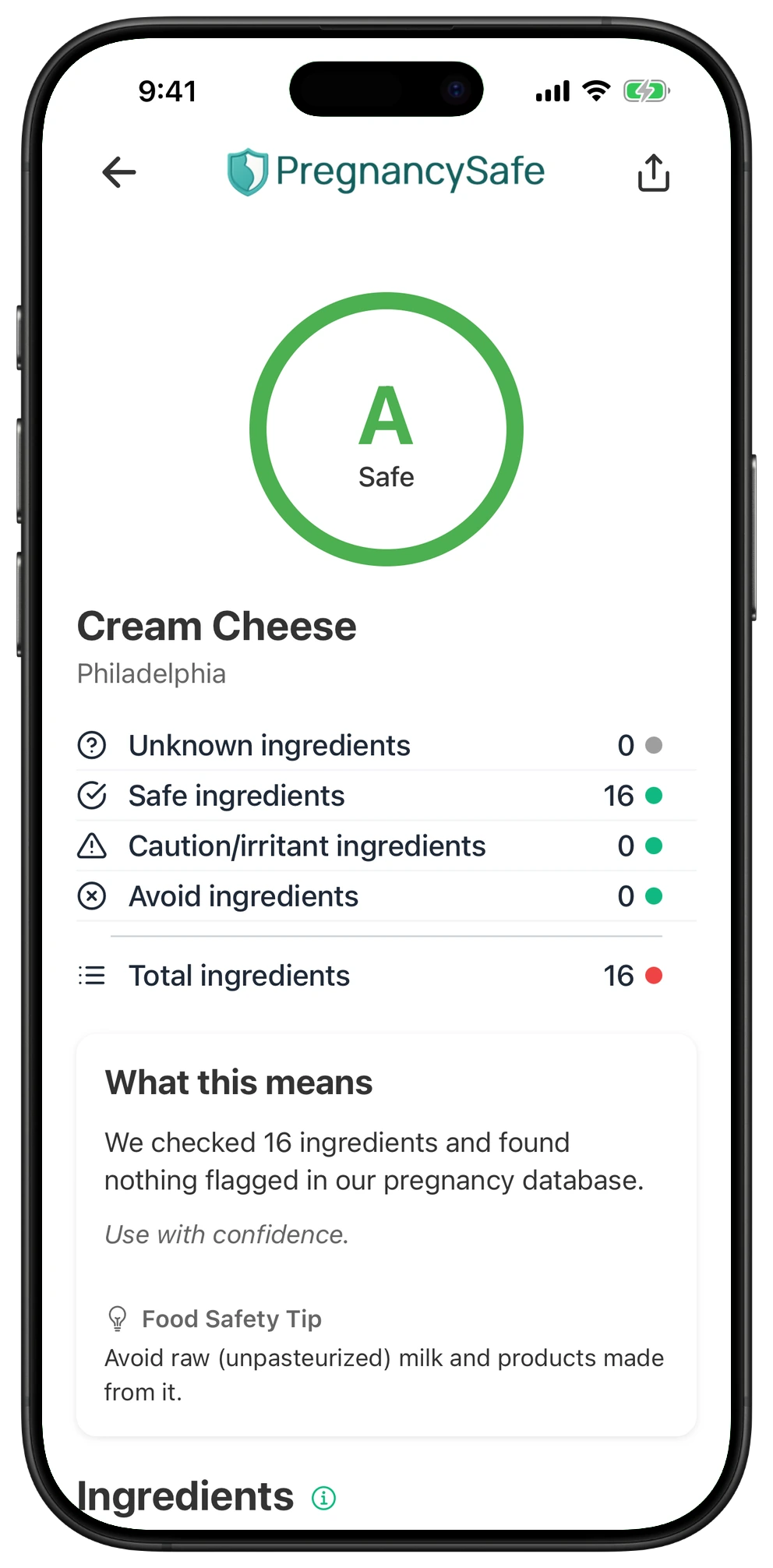
| B+ | Cream Cheese | Philadelphia |
| A | Philadelphia Original Cream Cheese Spread | Philadelphia |
| B+ | Philadelphia Chive & Onion Cream Cheese Spread | Philadelphia |
| B+ | Philadelphia 1/3 Less Fat Garden Vegetable Cream Cheese Spread | Kraft Philadelphia |
| A | Happy Farms Whipped Cream Cheese Spread | Happy Farms |
Your Questions Answered
Can you eat cream cheese when pregnant?
Yes, pasteurized cream cheese can be eaten during pregnancy with proper refrigeration and handling. Check the package for pasteurized milk and cream, and follow its use by and after opening directions. Its soft texture does not put it in the same category as mold ripened brie or queso fresco type cheese.
Can I eat a bagel with cream cheese while pregnant?
Yes, if the cream cheese is pasteurized and has been properly refrigerated and handled. At a bagel shop, ask about pasteurization and storage if you are unsure. Any additional toppings need their own pregnancy food safety check; the cream cheese does not make the entire meal suitable automatically.
How do I know whether cream cheese is pasteurized?
Look for pasteurized milk and cream on the exact package's ingredient list or labeling. Do not assume that every size, flavor or regional version has the same formulation. If the label is unclear, ask the manufacturer or seller, or choose an option that explicitly confirms pasteurization.
Does an A grade mean a cream cheese is guaranteed safe?
No. Our catalog contains 872 products, including 647 with an A ingredient score, but these are not counts of independently verified pregnancy safe products. Grades do not measure current labels, storage, pathogens, serving amounts or clinical suitability, and unreviewed products remain in the counts. A lower grade or incomplete record is not, by itself, proof that a product is harmful.
Are flavored cream cheeses suitable during pregnancy?
Start with the same pasteurization and refrigeration checks you would use for plain cream cheese. Then read the flavor's ingredient list: added sugar and food dyes are considerations for frequent intake, not proof that an occasional serving causes harm. Culinary horseradish amounts are different from medicinal doses, and dill weed is a culinary herb, not cannabis. Other additions may require separate food safety checks.
Can I eat cheesecake or cream cheese frosting during pregnancy?
Pasteurized cream cheese can be a suitable ingredient, but you need to assess the whole recipe. Check egg preparation and any added alcohol rather than assuming the cheese makes the dessert suitable. Follow the finished dessert's refrigeration and storage directions as well.
How to Interpret These Ratings
Our ingredient and category rules generate letter grades from the information recorded in the catalog. Missing ingredients and broad category assignments can affect the result. These grades do not measure your dose, confirm a complete current label, or test a product for contamination.
A high grade is not a guarantee of pregnancy safety. A low grade is not, by itself, proof of harm from every use. Follow the product-specific guidance above, check the actual package, and ask your prenatal clinician about supplements, treatment decisions or uncertain exposures.
People Also Checked
Feta Cheese
4 products
Goat Cheese
191 products
Mascarpone Cheese
14 products
Ricotta Cheese
194 products
String Cheese
340 products
Mozzarella Cheese
10 products
Cottage Cheese
1,036 products
Cheddar Cheese
184 products
See our full guide to cheese during pregnancy.
References
- https://www.cdc.gov/foodsafety/rawmilk/index.html
- https://www.cdc.gov/listeria/prevention/index.html
- https://www.nhs.uk/pregnancy/keeping-well/foods-to-avoid/
- https://www.hfpappexternal.fda.gov/scripts/fdcc/index.cfm?id=FDCRed40&set=ColorAdditives
- https://www.ecfr.gov/current/title-21/chapter-I/subchapter-A/part-74/subpart-A/section-74.340
- https://www.fda.gov/food/color-additives-information-consumers/tracking-food-industry-pledges-remove-petroleum-based-food-dyes
- https://www.efsa.europa.eu/en/efsajournal/pub/1327
- https://www.efsa.europa.eu/en/efsajournal/pub/4007
- https://apps.who.int/food-additives-contaminants-jecfa-database/Home/Chemical/2361
- https://oehha.ca.gov/risk-assessment/report/health-effects-assessment-potential-neurobehavioral-effects-synthetic-food-dyes-children
- https://pubmed.ncbi.nlm.nih.gov/6636206/
- https://pubmed.ncbi.nlm.nih.gov/2613118/
- https://pubmed.ncbi.nlm.nih.gov/7940558/
- https://www.hfpappexternal.fda.gov/scripts/fdcc/index.cfm?id=FDCBlue1&set=ColorAdditives
- https://www.ecfr.gov/current/title-21/chapter-I/subchapter-A/part-74
- https://efsa.onlinelibrary.wiley.com/doi/10.2903/j.efsa.2010.1853
- https://apps.who.int/food-additives-contaminants-jecfa-database/Home/Chemical/3309
- https://pubmed.ncbi.nlm.nih.gov/23208798/
- https://pubmed.ncbi.nlm.nih.gov/24257113/
- https://www.fda.gov/food/color-additives-information-consumers/color-additives-questions-and-answers-consumers
- https://www.fda.gov/food/food-ingredients-packaging/color-additives-information-consumers
- https://www.fda.gov/cosmetics/cosmetic-ingredient-names/color-additives-permitted-use-cosmetics
- https://www.fda.gov/industry/color-additives/fdc-red-no-3
- https://pubmed.ncbi.nlm.nih.gov/35233072/
- https://pubmed.ncbi.nlm.nih.gov/35484553/
- https://pubmed.ncbi.nlm.nih.gov/35106984/
- https://cdn.realfood.gov/DGA.pdf
- https://www.dietaryguidelines.gov/sites/default/files/2021-12/DGA_Pregnancy_FactSheet-508c.pdf
- https://www.acog.org/womens-health/faqs/healthy-eating-during-pregnancy
- https://www.cdc.gov/nutrition/php/data-research/added-sugars.html
- https://www.cdc.gov/diabetes/about/gestational-diabetes.html
- https://www.who.int/publications/i/item/9789241549028
- https://nesr.usda.gov/2025-dietary-guidelines-advisory-committee-systematic-reviews/dietary-patterns_gestational-diabetes
- https://webprod.hc-sc.gc.ca/nhpid-bdipsn/atReq?atid=horseradish.raifort&lang=eng
- https://inchem.org/documents/jecfa/jeceval/jec_71.htm
- https://hfpappexternal.fda.gov/scripts/fdcc/index.cfm?id=ALLYLISOTHIOCYANATE&set=FoodSubstances
- https://pmc.ncbi.nlm.nih.gov/articles/PMC13085108/
- https://pubmed.ncbi.nlm.nih.gov/22129740/
- https://www.drugs.com/npp/horseradish.html
- https://hfpappexternal.fda.gov/scripts/fdcc/index.cfm?id=SODIUMNITRITE&set=FoodSubstances
- https://www.ecfr.gov/current/title-9/section-424.21
- https://www.ecfr.gov/current/title-21/section-172.175
- https://www.efsa.europa.eu/en/press/news/170615
- https://www.inchem.org/documents/jecfa/jecmono/v50je07.htm
- https://pubmed.ncbi.nlm.nih.gov/41248583/
- https://www.cdc.gov/food-safety/foods/pregnant-women.html
- https://publications.iarc.who.int/Book-And-Report-Series/Iarc-Monographs-On-The-Identification-Of-Carcinogenic-Hazards-To-Humans/Red-Meat-And-Processed-Meat-2018
- https://dailymed.nlm.nih.gov/dailymed/drugInfo.cfm?setid=52f01c6e-172a-47a9-98a6-9eab7651a032
- https://www.atsdr.cdc.gov/toxprofiles/tp204.pdf
- https://pubmed.ncbi.nlm.nih.gov/12144723/
- https://pubmed.ncbi.nlm.nih.gov/10837984/
- https://pubmed.ncbi.nlm.nih.gov/14623029/
- https://pubmed.ncbi.nlm.nih.gov/34040647/
- https://www.fda.gov/food/people-risk-foodborne-illness/fruits-veggies-and-juices-food-safety-moms-be
- https://journals.sagepub.com/doi/10.1177/10507256261445624
- https://ods.od.nih.gov/factsheets/Iodine-HealthProfessional/
- https://www.foodstandards.gov.au/consumer/nutrition/pregnancy/iodine-and-pregnancy
- https://www.foodstandards.gov.au/consumer/prevention-of-foodborne-illness/arseniciodine
- https://inspection.canada.ca/en/food-safety-consumers/fact-sheets/specific-products-and-risks/chemical-hazards/inorganic-arsenic
- https://pubmed.ncbi.nlm.nih.gov/35947162/
- https://pubmed.ncbi.nlm.nih.gov/20919974/
- https://pubmed.ncbi.nlm.nih.gov/30632947/
- https://pmc.ncbi.nlm.nih.gov/articles/PMC8077470/