Is Black Tea Safe During Pregnancy? (Updated 2026 Guide)
Updated September 9, 2026
The Answer
Yes ordinary brewed black tea can fit into pregnancy, provided you keep total caffeine below 200 mg per day from all sources. Check serving size, brew strength and added herbs; decaffeinated tea is not necessarily caffeine free.
Caffeine is the main consideration: the amount you drink depends on the tea, preparation and portion size, not its ingredient grade. Black tea can also reduce non heme iron absorption when consumed with meals or iron supplements. Blends need extra attention, particularly those containing licorice root; added sugar is a nutrition consideration, not a pregnancy toxin.
Pregnancy Safe is 100% independent and research driven. No companies pay to promote or sponsor products.
Stress Less This Pregnancy
Check your exact black tea in the app

✓ What's Safe
- • Check caffeine information for the exact tea and the amount you actually drink, including the full bottle or mug.
- • Choose smaller servings that leave room below 200 mg daily for caffeine from coffee, chocolate, soda and other sources.
- • Consider decaffeinated black tea to reduce caffeine, while allowing for residual caffeine.
- • Read the full ingredient list on flavored or herbal black tea blends rather than relying on the flavor name.
- • Choose unsweetened tea when you want to limit added sugar; unsweetened does not mean caffeine free.
- • Drink tea between meals rather than with iron rich meals, and ask your pharmacist how to separate it from your iron supplement.
✗ What to Avoid
- • Avoid repeated large or strong servings without accounting for their contribution to your daily caffeine total.
- • Avoid treating concentrated black tea extract supplements as equivalent to an ordinary brewed cup.
- • Avoid licorice root teas and medicinal licorice extracts during pregnancy, especially regular or concentrated use.
- • Avoid assuming hibiscus containing blends are established as pregnancy safe; discuss regular medicinal strength use with your clinician.
- • Limit frequent heavily sweetened teas, including those with high fructose corn syrup, rather than treating occasional sugar exposure as toxic.
- • Avoid using an organic label, an A grade or an incomplete ingredient record as proof of caffeine content or pregnancy suitability.
Most Common Ingredients in Black Tea Products
We analyzed 382 black tea products. Here are the most common ingredients, ranked by how often they appear:
Ingredients to Watch Out For in Black Tea
These are the most common flagged ingredients across 382 black tea products we analyzed.
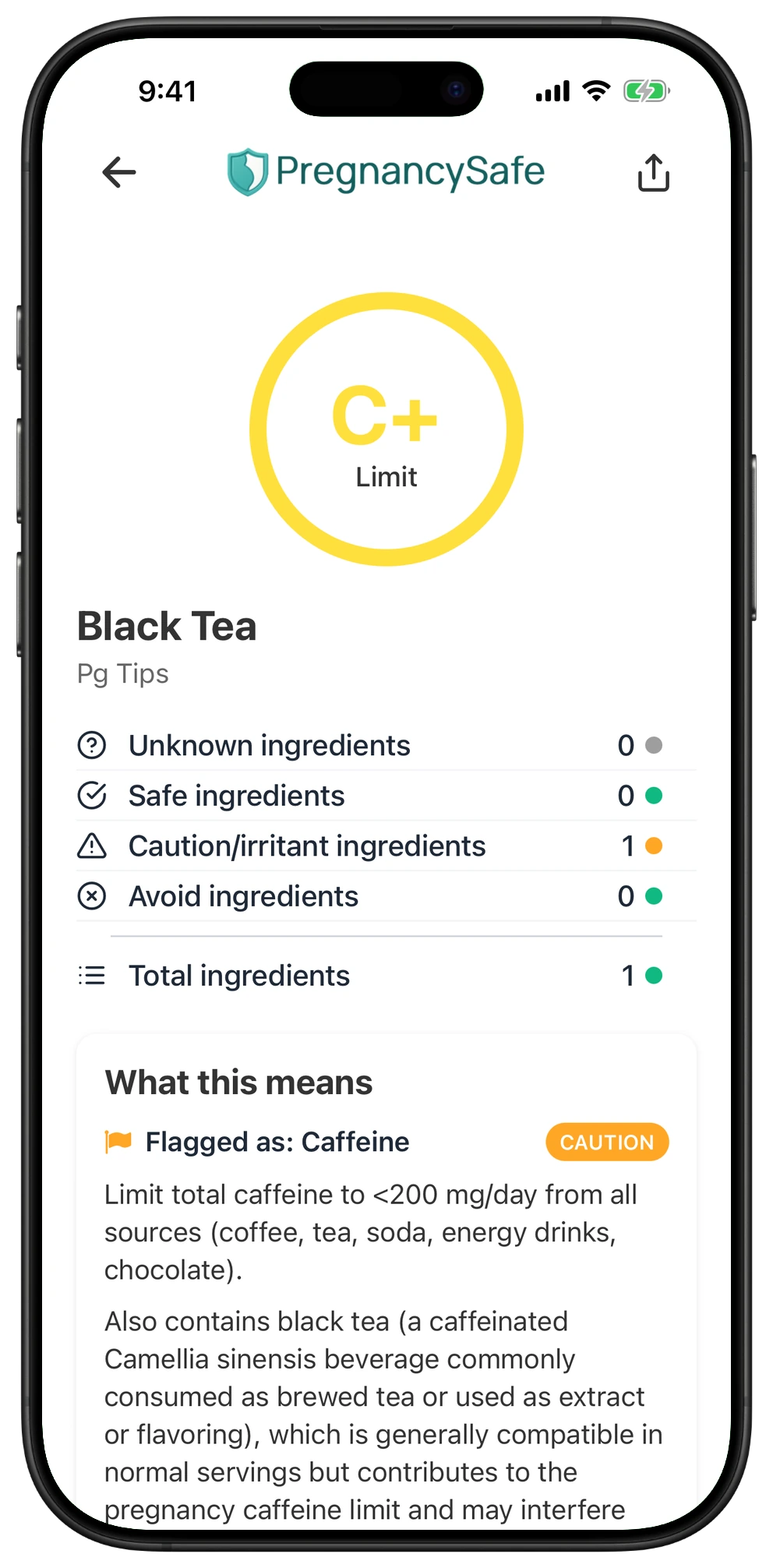
black tea
Caution
Black tea is a robust, oxidized tea known for its bold flavor and rich aroma.
Is generally compatible in normal servings but contributes to the pregnancy caffeine limit and may interfere with iron absorption if taken with meals or iron supplements.
Flagged in 136 of 382 products (36%)
organic black tea
Caution
Organic black tea is a naturally cultivated, antioxidant rich beverage made from fermented Camellia sinensis leaves, offering a bold and invigorating flavor.
Is generally compatible in normal servings but contributes to the pregnancy caffeine limit and may interfere with iron absorption if taken with meals or iron supplements.
Flagged in 44 of 382 products (12%)
decaffeinated black tea
Caution
Decaffeinated black tea is a rich, bold tea made from black tea leaves with most of the caffeine removed, offering the classic flavor without the stimulating effects.
Is generally compatible in normal servings but contributes to the pregnancy caffeine limit and may interfere with iron absorption if taken with meals or iron supplements.
Flagged in 20 of 382 products (5%)
brewed black tea
Caution
Brewed black tea is a rich, aromatic beverage made by steeping cured black tea leaves in hot water, offering a bold flavor and invigorating qualities.
Is generally compatible in normal servings but contributes to the pregnancy caffeine limit and may interfere with iron absorption if taken with meals or iron supplements.
Flagged in 15 of 382 products (4%)
licorice root
Avoid
Licorice root is a sweet, aromatic herb traditionally used for its soothing properties and distinctive flavor in herbal remedies and confections.
Should be avoided as a medicinal herb or frequent real licorice food during pregnancy because glycyrrhizin can raise blood pressure, lower potassium, and has observational links to shorter gestation and possible child development effects.
Flagged in 14 of 382 products (4%)
organic black tea leaves
Caution
Organic black tea leaves are sustainably grown, fully oxidized tea leaves known for their rich flavor and invigorating aroma.
Is generally compatible in normal servings but contributes to the pregnancy caffeine limit and may interfere with iron absorption if taken with meals or iron supplements.
Flagged in 12 of 382 products (3%)
black tea leaves
Caution
Black tea leaves are fermented tea leaves known for their bold flavor and rich, malty aroma.
Is generally compatible in normal servings but contributes to the pregnancy caffeine limit and may interfere with iron absorption if taken with meals or iron supplements.
Flagged in 11 of 382 products (3%)
Caution
Hibiscus is a vibrant, tart flavored flower often used to make teas, infusions, and natural remedies.
Has limited human pregnancy safety data; medicinal teas or supplements may lower blood pressure and uterine or menstrual effects are uncertain.
Flagged in 6 of 382 products (2%)
Black Tea Products We've Analyzed
Our catalog contains ratings for 382 black tea products. These are database grades, not independent safety certifications.
Catalog ingredient grades do not measure current-label completeness, pathogens, preparation, caffeine or clinical pregnancy suitability. These counts include unreviewed records and are not a percentage of independently verified safe products.
Pregnancy Safe Black Tea Products
Popular options from our catalog, prioritizing A and B ingredient grades, with C grade options used to fill remaining places. Within each group, products are ordered by searches in Pregnancy Safe, not retail sales. Read the cautions and guidance above; grades do not verify a complete current label or guarantee pregnancy safety.
| Grade | Product | Brand |
|---|---|---|
| A | Unsweetened Black Tea Original | Tejava |
| A | Lord Bergamot Full Leaf Black Tea | Steven Smith Teamaker |
| A | Saint James Organic Black Tea, Half & Half 16 Fz | Saint James |
| A | Peach Black Tea | — |
| A | Black Tea | Tetley, American Power Products Inc. |
Your Questions Answered
How much black tea can I drink during pregnancy?
Keep total caffeine below 200 mg per day from all sources rather than following a fixed cup allowance. An ordinary 8-ounce brewed black tea may contain roughly 47 mg, but that is an estimate, not a measurement of your tea. Strength, preparation and serving size can change the amount substantially. Check product specific information when available and include your other caffeine sources.
What teas are safe during pregnancy?
Plain brewed black tea can fit into pregnancy when its caffeine keeps your daily total below 200 mg. Decaffeinated black tea can help reduce that exposure, although it may still contain some caffeine. Herbal and flavored blends need their own ingredient check; caffeine free does not establish pregnancy safety. Choose based on the exact ingredients and serving amount rather than a pregnancy themed label.
What tea to not drink during pregnancy?
Avoid licorice root tea and medicinal licorice preparations, particularly frequent or concentrated use. Glycyrrhizin can raise blood pressure and lower potassium, and heavy oral intake has observational links to pregnancy and child development concerns. Hibiscus has limited human pregnancy evidence, so regular medicinal strength use deserves caution rather than a claim of proven harm. Plain black tea is not automatically off limits, but servings that push total caffeine to 200 mg or more do not fit the recommended limit.
Is decaffeinated black tea safe during pregnancy?
Decaffeinated black tea can be a practical way to lower your caffeine intake during pregnancy. Decaffeination removes most caffeine, not necessarily all of it, so check information for your exact tea when available. Added herbs still need separate consideration. Decaf also should not be assumed to eliminate tea's effects on iron absorption.
Can I drink black tea with my prenatal vitamin or iron supplement?
It is better not to take an iron containing prenatal vitamin or iron supplement with black tea. Tea polyphenols can reduce non heme iron absorption when consumed at the same time. Have tea between meals and ask your pharmacist or pregnancy care team about spacing it around your specific supplement. This is an absorption concern, not evidence that an occasional cup causes iron deficiency.
Is bottled or iced black tea safer than hot black tea?
Neither bottled nor iced tea is automatically lower in caffeine than hot tea. Check the caffeine information and serving size for the exact version, since a bottle may contain more than one serving. Unsweetened versions help limit added sugar but are not necessarily caffeine free. Ordinary brewed beverages also should not be treated as equivalent to concentrated tea extract supplements.
Does an A grade mean black tea is pregnancy safe?
No an A grade is not a caffeine measurement or a clinical pregnancy endorsement. Our catalog contains 382 black tea products, including 52 with an A grade, but these are not counts of independently verified safe products. Ingredient grades do not establish current label completeness, preparation safety or caffeine content, and a low grade does not automatically prove harm. The product list does not verify today's package, so read the current label and follow the caffeine precautions.
How to Interpret These Ratings
Our ingredient and category rules generate letter grades from the information recorded in the catalog. Missing ingredients and broad category assignments can affect the result. These grades do not measure your dose, confirm a complete current label, or test a product for contamination.
A high grade is not a guarantee of pregnancy safety. A low grade is not, by itself, proof of harm from every use. Follow the product-specific guidance above, check the actual package, and ask your prenatal clinician about supplements, treatment decisions or uncertain exposures.
People Also Checked
See our full guide to tea during pregnancy.
References
- https://www.acog.org/womens-health/experts-and-stories/ask-acog/how-much-coffee-can-i-drink-while-pregnant
- https://www.acog.org/clinical/clinical-guidance/committee-opinion/articles/2010/08/moderate-caffeine-consumption-during-pregnancy
- https://www.nhs.uk/pregnancy/keeping-well/foods-to-avoid/
- https://journals.sagepub.com/doi/10.1177/1091581819889914
- https://one.oecd.org/document/ENV/JM/MONO(2020)17/en/pdf
- https://pubmed.ncbi.nlm.nih.gov/38474530/
- https://pubmed.ncbi.nlm.nih.gov/19694736/
- https://mothertobaby.org/fact-sheets/caffeine-pregnancy/
- https://www.fda.gov/consumers/consumer-updates/spilling-beans-how-much-caffeine-too-much
- https://www.nhsinform.scot/ready-steady-baby/pregnancy/looking-after-yourself-and-your-baby/eating-well-in-pregnancy/
- https://www.mayoclinic.org/healthy-lifestyle/pregnancy-week-by-week/in-depth/pregnancy-nutrition/art-20043844
- https://pubmed.ncbi.nlm.nih.gov/10999016/
- https://pmc.ncbi.nlm.nih.gov/articles/PMC5998341/
- https://www.nccih.nih.gov/health/licorice-root
- https://webprod.hc-sc.gc.ca/nhpid-bdipsn/dbImages/mono_licorice_english.pdf
- https://www.ema.europa.eu/en/medicines/herbal/liquiritiae-radix
- https://www.medsafe.govt.nz/profs/PUArticles/December2019/Liquorice-side-effects-interactions.htm
- https://www.bfr.bund.de/cm/349/does-the-consumption-of-liquorice-by-pregnant-women-impair-the-mental-and-physical-development-of-children.pdf
- https://pubmed.ncbi.nlm.nih.gov/28158597/
- https://pubmed.ncbi.nlm.nih.gov/11390327/
- https://mothertobaby.org/fact-sheets/herbal-products-pregnancy/
- https://www.ncbi.nlm.nih.gov/books/NBK501882/
- https://pubmed.ncbi.nlm.nih.gov/19434218/
- https://pubmed.ncbi.nlm.nih.gov/18066103/
- https://pmc.ncbi.nlm.nih.gov/articles/PMC9086798/
- https://www.nccih.nih.gov/health/hypertension-high-blood-pressure
- https://www.ffhdj.com/index.php/ffhd/article/view/1768
- https://cdn.realfood.gov/DGA.pdf
- https://www.dietaryguidelines.gov/sites/default/files/2021-12/DGA_Pregnancy_FactSheet-508c.pdf
- https://www.acog.org/womens-health/faqs/healthy-eating-during-pregnancy
- https://www.cdc.gov/nutrition/php/data-research/added-sugars.html
- https://www.cdc.gov/diabetes/about/gestational-diabetes.html
- https://www.who.int/publications/i/item/9789241549028
- https://nesr.usda.gov/2025-dietary-guidelines-advisory-committee-systematic-reviews/dietary-patterns_gestational-diabetes