Is Chai Tea Safe During Pregnancy? (Updated 2026 Guide)
Updated September 9, 2026
The Answer
Chai tea can generally fit into pregnancy if you keep total caffeine below 200 mg per day from all sources. Check your drink’s serving size and caffeine content; decaf does not necessarily mean caffeine free.
The main pregnancy consideration is caffeine from black tea, whether it appears as leaves, powder, essence or extract in a prepared drink. Strength, preparation and portion size affect your intake, so an ingredient list or catalog grade cannot establish a drink’s caffeine amount. Sweetened chai lattes also warrant attention to added sugar, while tea taken with meals or iron supplements can reduce non heme iron absorption.
Pregnancy Safe is 100% independent and research driven. No companies pay to promote or sponsor products.
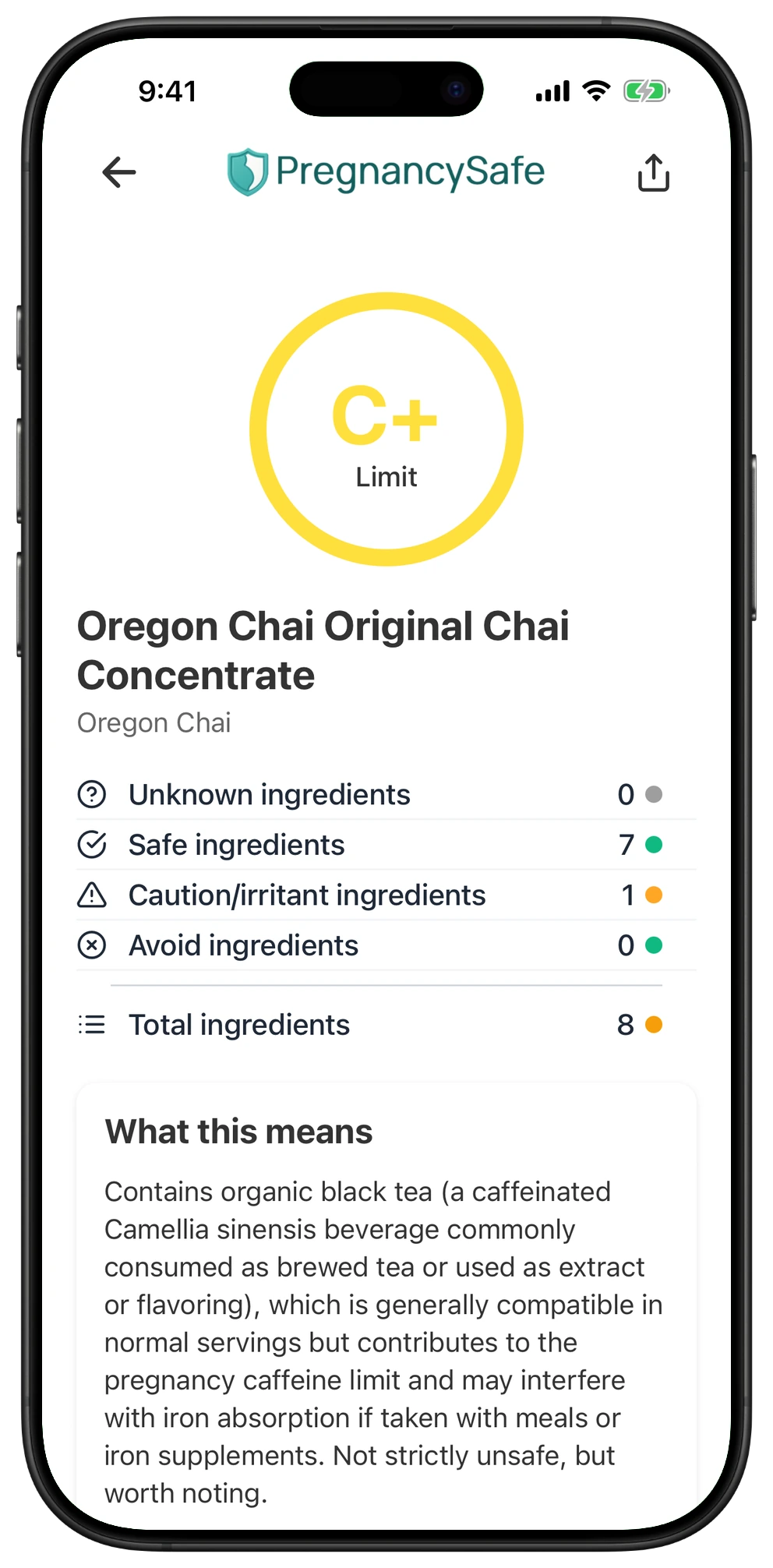
Stress Less This Pregnancy
Check your exact chai tea in the app

✓ What's Safe
- • Check caffeine information for the exact drink and serving size, including caffeine from everything else you consume that day.
- • Choose smaller portions or decaffeinated chai when you want to reduce caffeine, without assuming decaf contains none.
- • Measure chai concentrate or powder according to its preparation instructions rather than adding extra for strength.
- • Read the full label to distinguish brewed tea, sweetened instant latte mixes and herbal chai blends.
- • Compare added sugar per prepared serving if chai lattes are a regular habit; sugar is a nutrition consideration, not a pregnancy toxin.
✗ What to Avoid
- • Avoid portions or repeated servings that bring your total daily caffeine to 200 mg or more.
- • Avoid estimating a concentrate or instant latte’s caffeine from a generic cup of brewed black tea.
- • Do not assume organic black tea, black tea powder or black tea essence is caffeine free because of its label wording.
- • Avoid taking black tea chai alongside iron supplements or iron rich meals; choose another time for your tea.
- • Avoid treating an A grade, a caffeine free claim or an incomplete ingredient record as a pregnancy safety guarantee.
Most Common Ingredients in Chai Tea Products
We analyzed 53 chai tea products. Here are the most common ingredients, ranked by how often they appear:
Ingredients to Watch Out For in Chai Tea
These are the most common flagged ingredients across 53 chai tea products we analyzed.
black tea
Caution
Black tea is a robust, oxidized tea known for its bold flavor and rich aroma.
Is generally compatible in normal servings but contributes to the pregnancy caffeine limit and may interfere with iron absorption if taken with meals or iron supplements.
Flagged in 12 of 53 products (23%)
black tea powder
Caution
Black tea powder is a finely ground form of fermented black tea leaves, offering a rich, robust flavor and deep color.
Is generally compatible in normal servings but contributes to the pregnancy caffeine limit and may interfere with iron absorption if taken with meals or iron supplements.
Flagged in 5 of 53 products (9%)
organic black tea
Caution
Organic black tea is a naturally cultivated, antioxidant rich beverage made from fermented Camellia sinensis leaves, offering a bold and invigorating flavor.
Is generally compatible in normal servings but contributes to the pregnancy caffeine limit and may interfere with iron absorption if taken with meals or iron supplements.
Flagged in 4 of 53 products (8%)
organic fair trade black tea
Caution
A rich, aromatic black tea sourced from fair trade organic farms, offering a smooth and ethically crafted beverage experience.
Is generally compatible in normal servings but contributes to the pregnancy caffeine limit and may interfere with iron absorption if taken with meals or iron supplements.
Flagged in 3 of 53 products (6%)
decaf black tea
Caution
Decaf black tea is a rich, full bodied tea with the bold flavor of traditional black tea, but with most of its caffeine removed.
Is generally compatible in normal servings but contributes to the pregnancy caffeine limit and may interfere with iron absorption if taken with meals or iron supplements.
Flagged in 2 of 53 products (4%)
decaffeinated black tea powder
Caution
Decaffeinated black tea powder is a finely ground form of black tea that has had most of its caffeine removed, offering the rich flavor and antioxidants of black tea without the stimulating effects.
Is generally compatible in normal servings but contributes to the pregnancy caffeine limit and may interfere with iron absorption if taken with meals or iron supplements.
Flagged in 2 of 53 products (4%)
decaffeinated organic fair trade black tea
Caution
A smooth, ethically sourced black tea with rich flavor, naturally decaffeinated for a gentle, caffeine free experience.
Is generally compatible in normal servings but contributes to the pregnancy caffeine limit and may interfere with iron absorption if taken with meals or iron supplements.
Flagged in 2 of 53 products (4%)
hydrogenated coconut oil
Caution
Hydrogenated coconut oil is a processed form of coconut oil that has been chemically altered to become solid at room temperature, often used in baking and processed foods.
Mainly raise concern when partially hydrogenated and high in artificial trans fat; fully hydrogenated oils are mostly a saturated fat limit rather than the same trans fat issue.
Flagged in 2 of 53 products (4%)
Chai Tea Products We've Analyzed
Our catalog contains ratings for 53 chai tea products. These are database grades, not independent safety certifications.
Catalog ingredient grades do not measure current-label completeness, pathogens, preparation, caffeine or clinical pregnancy suitability. These counts include unreviewed records and are not a percentage of independently verified safe products.
Pregnancy Safe Chai Tea Products
Popular options from our catalog, prioritizing A and B ingredient grades, with C grade options used to fill remaining places. Within each group, products are ordered by searches in Pregnancy Safe, not retail sales. Read the cautions and guidance above; grades do not verify a complete current label or guarantee pregnancy safety.
| Grade | Product | Brand |
|---|---|---|
| A | Gold Peak Chai Tea Latte Bottle | — |
| A | Gold Emblem, Select Chai Latte | Gold Emblem |
| A | Chai Latte | Great Value |
| A | Chamba Chai Spiced Chai Latte Drink Mix Resealable Bag | Chamba Chai |
| A | Golden Turmeric, Ginger, Honey Organic Chai Concentrate, Golden | Say When |
Your Questions Answered
Can I drink tea at 4 weeks pregnant?
Chai tea can generally fit into early pregnancy when total caffeine stays below 200 mg per day. Count caffeine from coffee, other tea, soda, energy drinks and chocolate as well. Check the amount for your actual serving rather than assuming every cup of chai has the same caffeine content.
What teas should I avoid while pregnant?
Avoid caffeinated tea amounts that would bring your daily total to 200 mg or more. Black tea chai is not automatically off limits; portion size and preparation matter. Herbal chai blends need a separate ingredient check, because caffeine free does not establish that every herb is suitable for pregnancy. Do not apply ordinary brewed tea guidance to high dose extract supplements.
How much chai tea can I drink during pregnancy?
There is no single cup limit that works for every chai. Brew strength, concentrate quantity and serving size can change the caffeine amount. Use information for the exact preparation and keep your total from all sources below 200 mg per day. If the amount is unavailable, do not assume a large serving fits within that limit.
Is decaf chai tea safe during pregnancy?
Decaf chai can help reduce your caffeine intake, but decaffeination does not necessarily remove all caffeine. Check the full blend and any available caffeine information for your serving. A decaf black tea ingredient should not be assigned the typical caffeine amount of regular black tea merely because both are tea.
Can I have a chai tea latte while pregnant?
A chai tea latte can generally fit when its caffeine contribution keeps your daily total below 200 mg. Milk does not remove the caffeine already present in the tea or concentrate. Check the prepared serving size and added sugar, particularly with sweetened instant mixes. Added sugar is a nutrition consideration, not evidence that the drink is a pregnancy toxin.
Does an A grade mean a chai drink is caffeine free or guaranteed safe?
No. Our catalog contains 53 chai products, including 6 with an A ingredient grade, but those grades do not measure caffeine or establish clinical pregnancy suitability. The counts include unreviewed records and do not verify current labels, preparation or food handling. Check your actual package for milk, sweeteners and caffeine information; the product list does not establish the amount of caffeine per serving.
How to Interpret These Ratings
Our ingredient and category rules generate letter grades from the information recorded in the catalog. Missing ingredients and broad category assignments can affect the result. These grades do not measure your dose, confirm a complete current label, or test a product for contamination.
A high grade is not a guarantee of pregnancy safety. A low grade is not, by itself, proof of harm from every use. Follow the product-specific guidance above, check the actual package, and ask your prenatal clinician about supplements, treatment decisions or uncertain exposures.
People Also Checked
See our full guide to tea during pregnancy.
References
- https://www.acog.org/womens-health/experts-and-stories/ask-acog/how-much-coffee-can-i-drink-while-pregnant
- https://www.acog.org/clinical/clinical-guidance/committee-opinion/articles/2010/08/moderate-caffeine-consumption-during-pregnancy
- https://www.nhs.uk/pregnancy/keeping-well/foods-to-avoid/
- https://www.fda.gov/consumers/consumer-updates/spilling-beans-how-much-caffeine-too-much
- https://www.nhsinform.scot/ready-steady-baby/pregnancy/looking-after-yourself-and-your-baby/eating-well-in-pregnancy/
- https://www.mayoclinic.org/healthy-lifestyle/pregnancy-week-by-week/in-depth/pregnancy-nutrition/art-20043844
- https://pubmed.ncbi.nlm.nih.gov/10999016/
- https://pmc.ncbi.nlm.nih.gov/articles/PMC5998341/
- https://www.fda.gov/food/food-additives-petitions/trans-fat
- https://www.fda.gov/food/hfp-constituent-updates/fda-completes-final-administrative-actions-partially-hydrogenated-oils-foods
- https://www.federalregister.gov/documents/2013/11/08/2013-26854/tentative-determination-regarding-partially-hydrogenated-oils-request-for-comments-and-for
- https://www.who.int/news-room/fact-sheets/detail/trans-fat
- https://cdn.realfood.gov/DGA.pdf
- https://www.fda.gov/food/people-risk-foodborne-illness/dietary-advice-and-during-pregnancy
- https://www.rcpi.ie/Portals/0/Document%20Repository/Institute%20of%20Obstetricians%20and%20Gynaecologists/National%20Clinical%20Guidelines/IOG_National%20Clinical%20Guidelines_Nutrition%20in%20pregnancy%20Guideline_2019.pdf
- https://pmc.ncbi.nlm.nih.gov/articles/PMC8027310/
- https://pmc.ncbi.nlm.nih.gov/articles/PMC3192475/