Is McDonald's Chicken McNuggets Safe During Pregnancy? (Updated 2026 Guide)
Updated September 9, 2026
McDonald's Chicken McNuggets
Mcdonalds
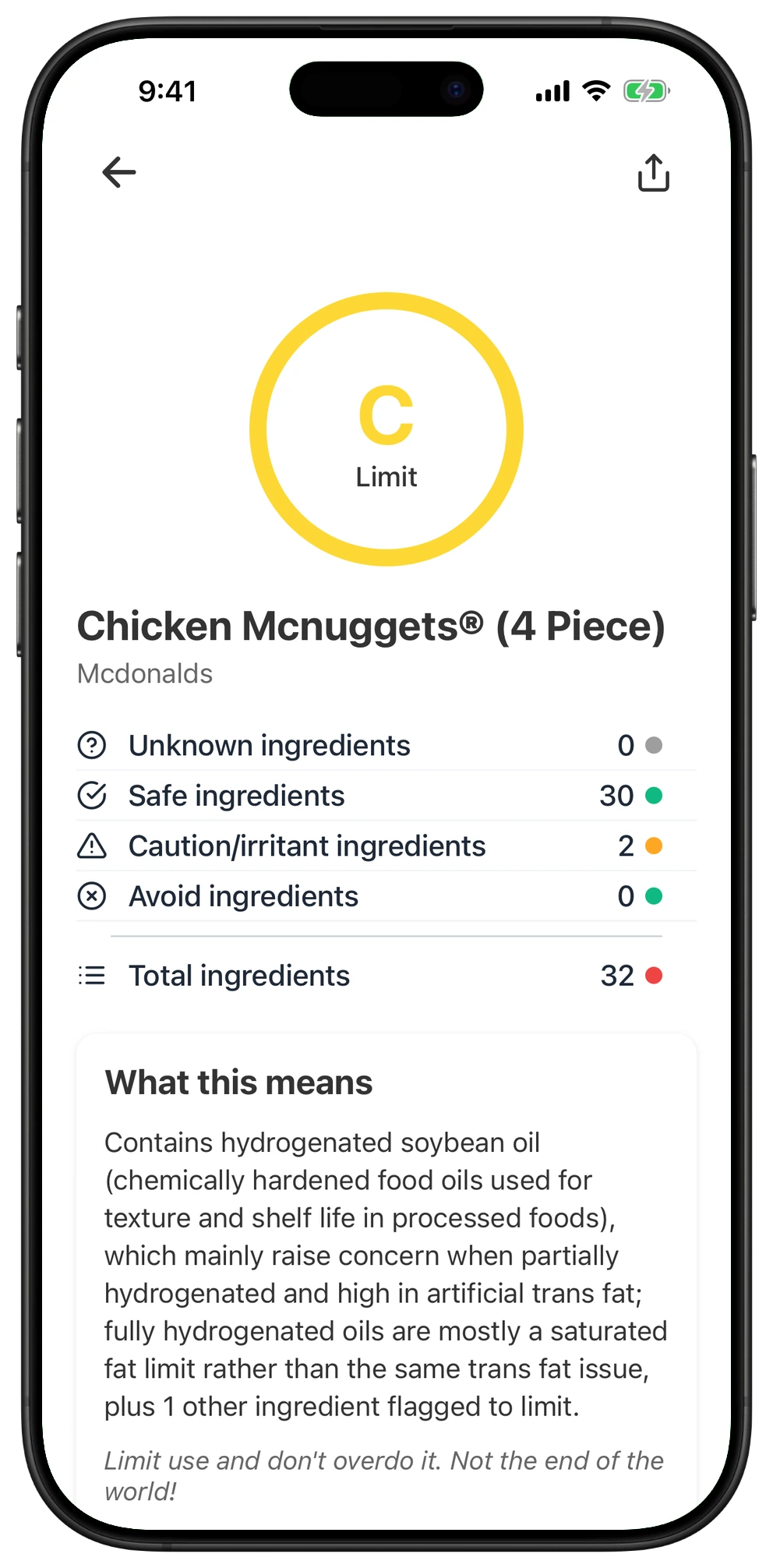
McDonald's Chicken McNuggets are a cautious, occasional choice during pregnancy, with a C grade from ingredient based scoring. The main flags are hydrogenated soybean oil and sodium aluminum phosphate, but the evidence does not establish that an occasional serving harms your baby. Choose fully cooked nuggets served hot rather than making them an everyday staple.
You can use this, but maybe don't make it your everyday go to. Not the end of the world if you've used it. Consult your OBGYN or midwife if you have concerns.
Pregnancy Safe is 100% independent and research driven. No companies pay to promote or sponsor products.
Stress Less This Pregnancy
Check your chicken nuggets in the app

What Ingredients Are in McDonald's Chicken McNuggets?
McDonald's Chicken McNuggets has 32 ingredients. We flagged 2 ingredients to use with caution.
hydrogenated soybean oil
CAUTION
Hydrogenated soybean oil is a processed vegetable oil that has been chemically altered to become solid at room temperature, often used in processed foods to improve texture and shelf life. During pregnancy, partially hydrogenated oil raises trans fat concerns and fully hydrogenated oil mainly raises saturated fat considerations, but this ingredient name does not specify which form is present.
sodium aluminum phosphate
CAUTION
Sodium aluminum phosphate is a leavening agent commonly used in baked goods to produce carbon dioxide and help the dough or batter rise. The pregnancy caution for sodium aluminum phosphate draws on indirect evidence about higher aluminum exposures, not demonstrated harm from an occasional serving of nuggets.
baking soda
LIKELY SAFE
Baking soda is a fine white powder used as a leavening agent in baking to help dough and batter rise. Baking soda used in ordinary food amounts is low concern during pregnancy; repeated antacid use or high dose home remedies are different exposures.
sodium acid pyrophosphate
LIKELY SAFE
Sodium acid pyrophosphate is a leavening agent commonly used in baked goods to help them rise and maintain their texture. Sodium acid pyrophosphate is low concern at ordinary food additive amounts during pregnancy, with higher total phosphate exposure or kidney disease warranting individualized guidance.
calcium lactate
SAFE
Calcium lactate is a food additive used as a firming agent, acidity regulator, and calcium supplement in various culinary applications. Calcium lactate at ordinary food amounts is compatible with pregnancy; concerns about excessive calcium primarily involve high supplemental intake.
corn
SAFE
Corn is a versatile cereal grain known for its sweet flavor and starchy texture, widely used in cooking and food production worldwide. Pregnancy dietary guidance does not identify corn as a food to avoid, but topical corn ingredient safety evidence does not establish dietary safety.
corn oil
SAFE
Corn oil is a light, mild tasting vegetable oil derived from the germ of corn kernels, commonly used for frying and baking. Corn oil is compatible with pregnancy at normal food amounts, with freshness and repeated overheating being separate considerations.
dextrose
SAFE
Dextrose is a simple sugar, also known as glucose, commonly used as a sweetener and energy source in food and beverages. Dextrose at ordinary food amounts is not a pregnancy ingredient to avoid, though gestational diabetes requires attention to overall carbohydrate intake.
enriched flour
SAFE
Enriched flour is refined wheat flour that has been fortified with added nutrients such as iron and B vitamins to restore some of the vitamins lost during processing. Cooked enriched flour is compatible with pregnancy and may contribute folic acid, while raw flour can carry foodborne pathogens.
folic acid
SAFE
Folic acid is a synthetic form of vitamin B9 essential for DNA synthesis and cell growth. Folic acid at normal food fortification amounts is compatible with pregnancy, but this product should not replace your recommended prenatal supplement.
iron
SAFE
Iron is a vital mineral essential for the formation of hemoglobin and the transport of oxygen throughout the body. Iron at normal food amounts supports pregnancy needs, unlike high dose supplements that require attention to side effects and individual medical needs.
modified corn
SAFE
Modified corn is a genetically or chemically altered form of corn designed to enhance its traits such as yield, pest resistance, or processing qualities. The corn evidence is largely about topical ingredients and does not directly assess eating modified corn during pregnancy.
monocalcium phosphate
SAFE
Monocalcium phosphate is a white, crystalline powder commonly used as a leavening agent and a source of calcium and phosphorus in food and feed products. Monocalcium phosphate at normal food amounts is compatible with pregnancy, with total phosphate intake needing individual guidance if you have kidney disease.
niacin
SAFE
Niacin, also known as vitamin B3, is a water soluble vitamin essential for energy metabolism and maintaining healthy skin and nerves. Niacin at ordinary food fortification amounts is compatible with pregnancy; high dose therapeutic supplements are a different exposure.
riboflavin
SAFE
Riboflavin is a water soluble B vitamin (vitamin B2) essential for energy production and the metabolism of fats, proteins, and carbohydrates. Riboflavin at normal food or fortification amounts is compatible with pregnancy and helps meet your vitamin B2 needs.
salt
SAFE
Salt is a mineral essential for flavor enhancement and preserving food. Salt is compatible with pregnancy in normal dietary amounts, while overall intake may need individualized guidance for hypertension or kidney disease.
soybean oil
SAFE
Soybean oil is a versatile, plant based oil extracted from soybeans, commonly used for cooking, frying, and as an ingredient in processed foods. Soybean oil at normal food amounts is compatible with pregnancy, with freshness and individual allergy considerations remaining relevant.
thiamine mononitrate
SAFE
Thiamine mononitrate is a synthetic form of vitamin B1 used as a dietary supplement and food additive to support energy metabolism. Thiamine mononitrate at normal food fortification amounts is compatible with pregnancy and contributes essential vitamin B1.
vegetable starch
SAFE
Vegetable starch is a natural carbohydrate extracted from plants like corn, potatoes, or tapioca, used as a thickening agent in cooking and food production. Vegetable starch at normal food amounts is compatible with pregnancy, with overall carbohydrate intake and ingredient sources relevant to diabetes or allergies.
water
SAFE
Water is a clear, tasteless, and essential liquid that sustains all known forms of life. Water used in food is compatible with pregnancy when it comes from a safe source; contamination is a separate concern.
wheat flour
SAFE
Wheat flour is a finely ground powder made from milling wheat grains, commonly used as a primary ingredient in baking and cooking. Wheat flour is compatible with pregnancy once cooked, while raw flour can carry foodborne pathogens.
yellow corn flour
SAFE
Yellow corn flour is a finely ground powder made from dried yellow corn, commonly used in baking and cooking to add flavor and texture. Cooked yellow corn flour is compatible with pregnancy, while raw flour presents a separate foodborne illness concern.
canola oil
SAFE
Canola oil is a light, mild tasting vegetable oil derived from the seeds of the canola plant, commonly used for cooking and baking. Canola oil is unflagged here, but that status does not establish a pregnancy specific safety review of its use in this food.
lemon juice solids
SAFE
Lemon juice solids are the concentrated, dehydrated components of lemon juice that retain the lemon's flavor and aroma. Lemon juice solids are unflagged as a food ingredient here, but pregnancy specific evidence is not established in this assessment.
natural flavors
SAFE
Natural flavors are derived from plant or animal sources and used to enhance the taste of food and beverages. Natural flavors are unflagged here, but the broad label does not identify individual flavorings for a pregnancy specific assessment.
pea
SAFE
A small, round green legume known for its sweet flavor and versatility in various dishes. Pea is unflagged as a food ingredient here, rather than individually established as safe by pregnancy specific evidence.
rice
SAFE
Rice is a versatile staple grain that serves as a primary source of carbohydrates in many cuisines worldwide. Rice is unflagged as a food ingredient here, but this does not represent a pregnancy specific assessment of its amount or contaminants.
spices
SAFE
Spices are aromatic plant derived seasonings used to enhance the flavor and aroma of dishes. Spices are unflagged here, but this unspecified blend does not allow an ingredient by ingredient pregnancy assessment.
vegetable oil
SAFE
Vegetable oil is a versatile, plant derived oil commonly used for cooking, frying, and baking. Vegetable oil is unflagged here, but the generic name alone does not establish the oil type or a pregnancy specific safety review.
wheat
SAFE
Wheat is a cereal grain widely cultivated for its edible seeds, which are a primary source of flour used in baking and food production. Wheat is unflagged here, but that status is not an individual pregnancy safety assessment or confirmation of suitability for your dietary restrictions.
white boneless chicken
SAFE
White boneless chicken is tender, lean meat from the chicken's breast or thigh, commonly used in a variety of savory dishes. White boneless chicken is unflagged here, but during pregnancy its ingredient status does not replace checking that your meal is fully cooked and properly handled.
yeast extract
SAFE
Yeast extract is a savory, umami rich ingredient made from the concentrated extract of yeast cells, commonly used to enhance flavor in various dishes. Yeast extract is unflagged as a food flavoring here, but pregnancy specific safety evidence is not established in this assessment.
Answering Your Questions
How much McDonald's Chicken McNuggets is safe during pregnancy?
A four piece order is a practical smaller portion, not a medically established pregnancy safety limit. Pair it with vegetables or fruit rather than automatically increasing the nugget portion, and consider your whole meal when choosing sauces and sides.
Can you use McDonald's Chicken McNuggets daily while pregnant?
Keep McNuggets occasional rather than a daily protein source, rotating with less processed meals. There is no established pregnancy specific serving frequency for these ingredients, so a precise weekly limit would imply more certainty than the evidence supports.
Why do McDonald's Chicken McNuggets receive a C grade?
The C grade comes from ingredient based scoring, with caution flags for hydrogenated soybean oil and sodium aluminum phosphate. The oil's concern depends on whether it is partially or fully hydrogenated, which the ingredient name does not specify; the aluminum evidence concerns higher exposures and is indirect for an occasional nugget serving. Baking soda and sodium acid pyrophosphate are rated likely safe at ordinary food amounts.
Are McDonald's Chicken McNuggets fully cooked?
McDonald's describes partially frying and freezing the nuggets before fully frying them in its restaurants. Choose nuggets served hot and fully cooked; the ingredient grade does not assess an individual meal's cooking or handling. McDonald's preparation FAQ
Can I eat Chicken McNuggets while breastfeeding?
An occasional serving can generally fit into a varied breastfeeding diet. The pregnancy C grade is not a separate breastfeeding assessment, and CDC says breastfeeding mothers generally do not need to avoid specific foods unless there is an individual reason. CDC breastfeeding diet guidance
What alternatives should I choose during pregnancy?
Consider fully cooked baked or grilled chicken, or homemade baked nuggets where you control the oil and seasoning. For packaged nuggets, compare labels for hydrogenated oils and sodium aluminum phosphate, while also considering salt and saturated fat rather than assuming a shorter ingredient list guarantees safety.
Should I worry if I already ate Chicken McNuggets while pregnant?
An occasional serving is not evidence that you have harmed your baby. The caution flags reflect ingredient concerns and uncertainty, not demonstrated harm from one four piece order; focus on variety in your usual eating pattern.
Does hydrogenated soybean oil mean these nuggets contain trans fat?
Not necessarily: the ingredient name does not tell you whether the oil is partially or fully hydrogenated. Partially hydrogenated oils raise industrial trans fat concerns, while fully hydrogenated oils contain little or trace trans fat and mainly call for attention to saturated fat intake.
What Are Pregnancy Safe Alternatives to McDonald's Chicken McNuggets?
Here are some solid alternatives. Everything below has an A or B grade, meaning no flagged ingredients in our database.
| Grade | Product | Brand | Type |
|---|---|---|---|
| A | Chicken Nuggets | Caulipower | chicken nugget |
| A | Chicken Nuggets Golden Breaded Minion Shaped White Meat Chicken Patties | John Soules Foods | chicken nugget |
| A | Organic Chicken Nuggets | Good & Gather | chicken nugget |
| A | Tyson, Chicken Nuggets | — | chicken nugget |
Are Other Mcdonalds Products Safe During Pregnancy?
We looked at 12 other Mcdonalds products. 5 are pregnancy safe (A or B grade), while 7 need a closer look.
| Grade | Product | Type |
|---|---|---|
| C+ | Big Mac | sandwich |
| C+ | McDonald's Cheeseburger | sandwich |
| A | Apple Slices | fruit |
| A | Bacon Double Cheeseburger New York | sandwich |
How Does McDonald's Chicken McNuggets Compare to Other Chicken Nuggets?
We graded 120 Chicken Nuggets for pregnancy safety. Here's how they stack up:
McDonald's Chicken McNuggets earns a C grade, placing it among the top of Chicken Nuggets. About 75% of products in this category get an A or B grade.
How Do We Score Products for Pregnancy Safety?
We analyze each product's ingredients and category to flag known risks and provide cautionary notices for general category safety concerns.
A - Safe
Excellent choice! All ingredients are considered safe during pregnancy.
What to do: Use with confidence.
B - Likely Safe
Pretty much safe with very minimal risk. Some ingredients may have limited pregnancy studies, but no significant safety concerns have been identified.
What to do: Use with confidence.
C - Limit
Contains ingredients with some pregnancy considerations. Research shows these ingredients may have limited safety data, potential for minor hormonal effects, or require caution based on animal studies.
What to do: Use sparingly and consider safer alternatives when available.
D - Caution
Similar to C grade but contains multiple cautionary ingredients. The combination increases overall concern.
What to do: Try to avoid if that makes you feel better. If you've already used it, no need to panic.
F - Avoid
Contains an ingredient Pregnancy Safe recommends avoiding during pregnancy. This may reflect an established risk or a precaution based on limited evidence; check the ingredient guidance and exposure context.
What to do: Do not use during pregnancy. If you've already used it, don't worry - contact your OBGYN if concerned.
People Also Checked
Premier Protein High Protein Shake, Chocolate
Premier Protein
Diet Pepsi Cola Soda - 6Pk/16.9 Fl Oz Bottles
Diet Pepsi
Cerave Hydrating Face Wash With Hyaluronic Acid And Glycerin For Normal To Dry Skin
Cerave
Miralax Polyethylene Glycol 3350 Laxative Powder Unflavored
Miralax
Athenos Traditional Feta Cheese Crumbles
Athenos
References
- https://cks.nice.org.uk/topics/dyspepsia-pregnancy-associated/management/management/
- https://pmc.ncbi.nlm.nih.gov/articles/PMC9066781/
- https://www.ncbi.nlm.nih.gov/books/NBK559139/
- https://www.govinfo.gov/content/pkg/FR-1994-02-02/html/94-2264.htm
- https://pmc.ncbi.nlm.nih.gov/articles/PMC5032930/
- https://www.fda.gov/media/127971/download
- https://www.nhs.uk/medicines/antacids/
- https://www.fda.gov/food/food-additives-petitions/trans-fat
- https://www.fda.gov/food/hfp-constituent-updates/fda-completes-final-administrative-actions-partially-hydrogenated-oils-foods
- https://www.federalregister.gov/documents/2013/11/08/2013-26854/tentative-determination-regarding-partially-hydrogenated-oils-request-for-comments-and-for
- https://www.who.int/news-room/fact-sheets/detail/trans-fat
- https://cdn.realfood.gov/DGA.pdf
- https://www.fda.gov/food/people-risk-foodborne-illness/dietary-advice-and-during-pregnancy
- https://www.rcpi.ie/Portals/0/Document%20Repository/Institute%20of%20Obstetricians%20and%20Gynaecologists/National%20Clinical%20Guidelines/IOG_National%20Clinical%20Guidelines_Nutrition%20in%20pregnancy%20Guideline_2019.pdf
- https://pmc.ncbi.nlm.nih.gov/articles/PMC8027310/
- https://pmc.ncbi.nlm.nih.gov/articles/PMC3192475/
- https://efsa.onlinelibrary.wiley.com/doi/10.2903/j.efsa.2019.5674
- https://www.efsa.europa.eu/en/press/news/190612
- https://www.ecfr.gov/current/title-21/chapter-I/subchapter-B/part-182
- https://inchem.org/documents/jecfa/jecmono/v48aje11.htm
- https://ods.od.nih.gov/factsheets/Pregnancy-HealthProfessional/
- https://www.ncbi.nlm.nih.gov/books/NBK109813/
- https://www.ncbi.nlm.nih.gov/books/NBK601526/
- https://pubmed.ncbi.nlm.nih.gov/33371609/
- https://wwwn.cdc.gov/TSP/ToxProfiles/ToxProfiles.aspx?id=191&tid=34
- https://pmc.ncbi.nlm.nih.gov/articles/PMC9681673/
- https://pmc.ncbi.nlm.nih.gov/articles/PMC10809980/
- https://www.cdc.gov/vaccine-safety/about/adjuvants.html
- https://www.fda.gov/vaccines-blood-biologics/safety-availability-biologics/common-ingredients-fda-approved-vaccines
- https://www.acog.org/womens-health/infographics/vaccines-during-pregnancy
- https://www.acog.org/womens-health/faqs/healthy-eating-during-pregnancy
- https://ods.od.nih.gov/factsheets/Calcium-HealthProfessional/
- https://ods.od.nih.gov/factsheets/Iron-HealthProfessional/
- https://www.who.int/tools/elena/interventions/calcium-pregnancy
- https://www.ncbi.nlm.nih.gov/books/NBK56056/
- https://www.cochrane.org/evidence/CD001059_taking-calcium-supplements-during-pregnancy-effective-way-prevent-blood-pressure-disorders-and
- https://journals.sagepub.com/doi/pdf/10.1177/1091581811403832
- https://pubmed.ncbi.nlm.nih.gov/21772025/
- https://www.cir-safety.org/ingredient/zea-mays-corn-starch
- https://www.ecfr.gov/current/title-21/chapter-I/subchapter-D/part-347
- https://www.hfpappexternal.fda.gov/scripts/fdcc/index.cfm?id=CORNSTARCH&set=FoodSubstances
- https://pubmed.ncbi.nlm.nih.gov/40984809/
- https://cfsanappsexternal.fda.gov/scripts/fdcc/?id=704&set=GRASNotices
- https://www.fda.gov/media/143744/download
- https://ods.od.nih.gov/factsheets/Omega3FattyAcids-HealthProfessional/
- https://pmc.ncbi.nlm.nih.gov/articles/PMC11397513/
- https://www.ncbi.nlm.nih.gov/books/NBK560599/
- https://www.nationalacademies.org/read/25841/chapter/3
- https://www.acog.org/womens-health/faqs/gestational-diabetes
- https://diabetesjournals.org/care/article/49/Supplement_1/S321/163918/15-Management-of-Diabetes-in-Pregnancy-Standards
- https://www.cdc.gov/diabetes/about/gestational-diabetes.html
- https://diabetes.org/living-with-diabetes/hypoglycemia-low-blood-glucose/symptoms-treatment
- https://www.fda.gov/consumers/consumer-updates/flour-raw-food-and-other-safety-facts
- https://www.cdc.gov/food-safety/foods/no-raw-dough.html
- https://www.fda.gov/food/food-additives-petitions/fortifying-corn-masa-flour-products-folic-acid
- https://www.cdc.gov/mmwr/preview/mmwrhtml/mm5931a2.htm
- https://www.uspreventiveservicestaskforce.org/uspstf/recommendation/folic-acid-for-the-prevention-of-neural-tube-defects-preventive-medication
- https://www.cdc.gov/folic-acid/about/intake-and-sources.html
- https://www.cdc.gov/folic-acid/hcp/clinical-overview/index.html
- https://ods.od.nih.gov/factsheets/Folate-HealthProfessional/
- https://www.who.int/tools/elena/interventions/folate-periconceptional
- https://www.who.int/tools/elena/interventions/daily-iron-pregnancy
- https://www.cdc.gov/mmwr/preview/mmwrhtml/00051880.htm
- https://www.uspreventiveservicestaskforce.org/uspstf/document/RecommendationStatementFinal/iron-deficiency-anemia-in-pregnant-women-screening-and-supplementation
- https://ods.od.nih.gov/factsheets/Phosphorus-HealthProfessional/
- https://lpi.oregonstate.edu/mic/minerals/phosphorus
- https://ods.od.nih.gov/factsheets/Niacin-HealthProfessional/
- https://ods.od.nih.gov/factsheets/Niacin-Consumer/
- https://www.ncbi.nlm.nih.gov/books/NBK114304/
- https://www.ncbi.nlm.nih.gov/books/NBK548176/
- https://www.ncbi.nlm.nih.gov/books/NBK557728/
- https://ods.od.nih.gov/factsheets/Riboflavin-HealthProfessional/
- https://ods.od.nih.gov/factsheets/Riboflavin-Consumer/
- https://www.ncbi.nlm.nih.gov/books/NBK114322/
- https://www.ncbi.nlm.nih.gov/books/NBK114310/
- https://pmc.ncbi.nlm.nih.gov/articles/PMC11270530/
- https://pmc.ncbi.nlm.nih.gov/articles/PMC6946899/
- https://www.who.int/publications/i/item/9789241504836
- https://www.ncbi.nlm.nih.gov/books/NBK610895/
- https://hfpappexternal.fda.gov/scripts/fdcc/index.cfm?id=SOYBEANOILHYDROGENATED&set=FoodSubstances
- https://lpi.oregonstate.edu/mic/other-nutrients/essential-fatty-acids
- https://pmc.ncbi.nlm.nih.gov/articles/PMC2621042/
- https://ods.od.nih.gov/factsheets/Thiamin-HealthProfessional/
- https://www.ncbi.nlm.nih.gov/books/NBK482360/
- https://pmc.ncbi.nlm.nih.gov/articles/PMC10158844/
- https://www.hfpappexternal.fda.gov/scripts/fdcc/index.cfm?id=STARCHFOODMODIFIED&set=FoodSubstances
- https://www.ecfr.gov/current/title-21/chapter-I/subchapter-B/part-172/subpart-I/section-172.892
- https://pubmed.ncbi.nlm.nih.gov/32625282/
- https://www.fda.gov/regulatory-information/search-fda-guidance-documents/cpg-sec-578100-starches-common-or-usual-names
- https://www.acog.org/womens-health/experts-and-stories/ask-acog/how-much-water-should-i-drink-during-pregnancy
- https://www.cdc.gov/healthy-weight-growth/water-healthy-drinks/index.html
- https://www.cdc.gov/heat-health/hcp/clinical-overview/heat-and-pregnant-women.html
- https://www.cdc.gov/drinking-water/about/index.html
- https://www.cdc.gov/yellow-book/hcp/family-travel/pregnant-travelers.html
- https://www.epa.gov/privatewells/protect-your-homes-water
- https://www.fda.gov/consumers/consumer-updates/bottled-water-everywhere-keeping-it-safe
- https://www.nationalacademies.org/read/10925/chapter/6