Is ILIA Super Serum Skin Tint SPF 40 Safe During Pregnancy? (Updated 2026 Guide)
Updated September 9, 2026
ILIA Super Serum Skin Tint SPF 40
Ilia
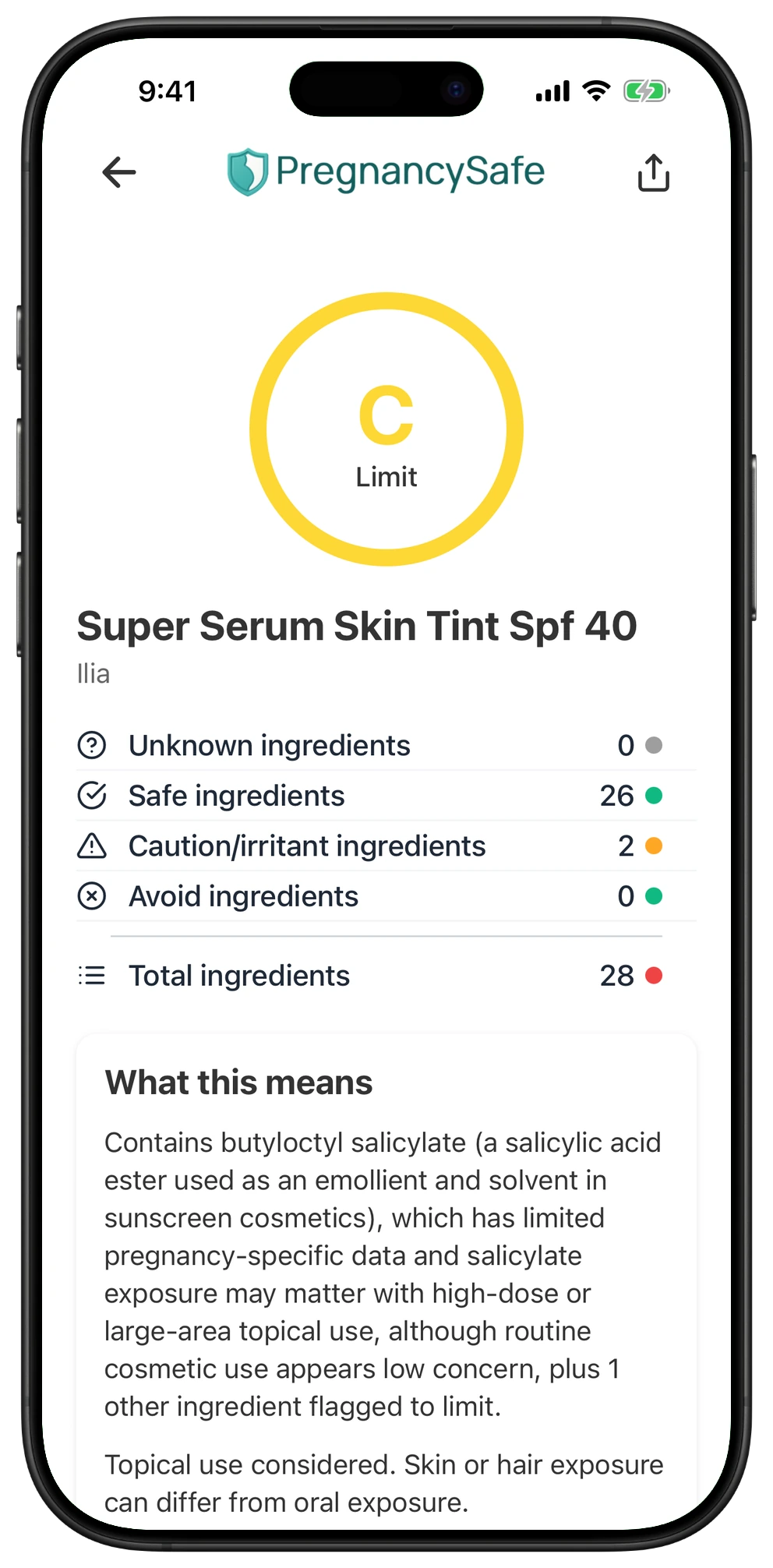
ILIA Super Serum Skin Tint SPF 40 receives a C grade, making it a caution rated rather than an unqualified pregnancy safe choice. Its ingredient based score includes caution flags for butyloctyl salicylate and aluminum hydroxide, although limited pregnancy data and oral antacid evidence do not establish harm from ordinary facial application.
You can use this, but maybe don't make it your everyday go to. Not the end of the world if you've used it. Consult your OBGYN or midwife if you have concerns.
Pregnancy Safe is 100% independent and research driven. No companies pay to promote or sponsor products.
Stress Less This Pregnancy
Check your tinted moisturizer in the app

What Ingredients Are in ILIA Super Serum Skin Tint SPF 40?
ILIA Super Serum Skin Tint SPF 40 has 30 ingredients. We flagged 2 ingredients to use with caution.
aluminum hydroxide
CAUTION
Aluminum hydroxide is a compound commonly used as an antacid to neutralize stomach acid and as an adjuvant in vaccines. Aluminum hydroxide retains a caution rating, but the evidence mainly concerns oral antacid doses and does not establish pregnancy harm from ordinary facial application.
butyloctyl salicylate
CAUTION
Butyloctyl salicylate is a lightweight, skin friendly ester used in cosmetics and sunscreens to enhance SPF protection and improve product spreadability. Direct human pregnancy studies are lacking, so caution is appropriate despite low concern for routine cosmetic use, especially with large area or broken skin exposure.
aloe barbadensis leaf juice powder
LIKELY SAFE
Aloe Barbadensis Leaf Juice Powder is a concentrated, dehydrated form of aloe vera known for its soothing, hydrating, and skin calming properties. Aloe is considered low concern in normal topical cosmetics during pregnancy, while swallowed aloe preparations are a different exposure and skin irritation remains possible.
ci 77891
LIKELY SAFE
Titanium dioxide (CI 77891) is a white, opaque pigment commonly used in cosmetics and skincare products to provide whiteness and opacity. Titanium dioxide is low concern in ordinary topical cosmetics during pregnancy, distinct from oral food additive uncertainty or inhalation of powders and sprays.
propanediol
LIKELY SAFE
Propanediol is a versatile, plant derived humectant and solvent commonly used in skincare and cosmetic formulations to retain moisture and improve product texture. Propanediol is rated likely safe for normal topical use, although the supporting assessment concerns propylene glycol and high dose medication cautions are a separate exposure.
silica
LIKELY SAFE
Silica is a mineral composed of silicon dioxide, commonly used in skincare for its pore refining and oil absorbing properties. Silica is rated likely safe, but its supporting evidence chiefly concerns food additive exposure rather than direct pregnancy studies of topical skin tint.
sodium myristoyl glutamate
LIKELY SAFE
This ingredient is rated likely safe, but dietary glutamate evidence does not directly establish pregnancy safety for this specific topical ingredient.
tetrasodium glutamate diacetate
LIKELY SAFE
Tetrasodium glutamate diacetate is a versatile, water soluble chelating agent and stabilizer used in cleaning and personal care products to enhance efficacy and stability. This ingredient is rated likely safe, but dietary glutamate evidence does not directly establish pregnancy safety for this specific topical ingredient.
zinc oxide
LIKELY SAFE
Zinc oxide is a white, powdery mineral commonly used in sunscreens, skincare products, and ointments for its protective and soothing properties. Zinc oxide is low concern during pregnancy in conventional topical use on intact skin, while inhaled powders and high dose experimental exposures are different situations.
aqua water eau
SAFE
Aqua, water, or eau is a clear, tasteless, and odorless liquid essential for life and commonly used as a solvent in various applications. Water used as a topical cosmetic base is not a pregnancy concern, although the complete formula and microbial quality still matter.
hydrolyzed sodium hyaluronate
SAFE
Hydrolyzed sodium hyaluronate is a lightweight, water soluble form of hyaluronic acid that deeply hydrates and plumps the skin by attracting and retaining moisture. Normal topical use is considered compatible with pregnancy because systemic exposure is expected to be low, although direct pregnancy outcome studies are limited.
lecithin
SAFE
Lecithin is a natural phospholipid commonly used as an emulsifier to blend fats and liquids in food and pharmaceutical products. Lecithin is low concern in normal topical cosmetic use during pregnancy, based on cosmetic and dermal evidence rather than direct studies in pregnant users.
SAFE
Niacinamide is a versatile skincare ingredient known for its ability to improve skin elasticity, enhance the barrier function, and reduce the appearance of blemishes and uneven skin tone. Niacinamide is generally considered safe in normal topical cosmetics during pregnancy, unlike the separate exposure from high dose oral supplements.
sodium chloride
SAFE
Sodium chloride is a common mineral known as table salt, used to enhance the flavor of food and as a preservative. The pregnancy evidence concerns dietary salt, so dietary intake and blood pressure cautions should not be applied to sodium chloride in this topical skin tint.
sodium hyaluronate
SAFE
Sodium hyaluronate is a powerful hydrating agent that helps retain moisture in the skin, promoting plumpness and elasticity. Sodium hyaluronate is considered compatible with normal topical cosmetic use during pregnancy because systemic exposure is expected to be low.
allantoin
SAFE
Allantoin is a soothing compound known for its skin calming, moisturizing, and healing properties. Allantoin is unflagged in this formula, but that does not establish pregnancy safety for normal topical use.
bisabolol
SAFE
Bisabolol is a natural, soothing compound derived from chamomile that is commonly used in skincare for its anti inflammatory and calming properties. Bisabolol is unflagged in this formula, but pregnancy specific safety for normal topical use is not established by its soothing properties.
caprylyl glycol
SAFE
Caprylyl glycol is a versatile moisturizing agent and skin conditioner commonly used in skincare products for its humectant and antimicrobial properties. Caprylyl glycol is unflagged in this formula rather than confirmed safe by pregnancy specific topical evidence.
ci 77491
SAFE
CI 77491 is a vibrant red iron oxide pigment commonly used in cosmetics and skincare products for coloring purposes. This red iron oxide pigment is unflagged, but that is not a pregnancy specific safety finding for topical use.
ci 77492
SAFE
CI 77492 is a vibrant yellow iron oxide pigment commonly used in cosmetics to provide warm, yellow toned color. This yellow iron oxide pigment is unflagged, but that is not a pregnancy specific safety finding for topical use.
ci 77499
SAFE
CI 77499 is a black iron oxide pigment commonly used in cosmetics and skincare products for its coloring properties. This black iron oxide pigment is unflagged, but that is not a pregnancy specific safety finding for topical use.
isoamyl laurate
SAFE
Isoamyl laurate is a versatile ester used in cosmetics and personal care products for its emollient, conditioning, and fragrance enhancing properties. Isoamyl laurate is unflagged in this formula, without a pregnancy specific safety conclusion for normal topical exposure.
isopropyl isostearate
SAFE
Isopropyl isostearate is a lightweight, skin conditioning ester used in cosmetics and skincare products to provide smoothness and improve texture. Isopropyl isostearate is unflagged in this formula rather than established safe through pregnancy specific topical studies.
methylpropanediol
SAFE
Methylpropanediol is a versatile, water soluble solvent and humectant commonly used in skincare and cosmetic formulations to enhance moisture retention and product stability. Methylpropanediol is unflagged, but its role as a topical humectant does not establish pregnancy specific safety.
phenylpropanol
SAFE
Phenylpropanol is a fragrant aromatic alcohol commonly used in perfumes and flavorings for its sweet, floral scent. Phenylpropanol is unflagged in this formula, without a pregnancy specific safety conclusion for ordinary topical use.
polyglyceryl 3 diisostearate
SAFE
This ingredient is unflagged, but pregnancy specific evidence for its topical use is not established in this assessment.
polyglyceryl 3 ricinoleate
SAFE
This ingredient is unflagged, but pregnancy specific evidence for its topical use is not established in this assessment.
polyhydroxystearic acid
SAFE
Polyhydroxystearic acid is a versatile, water soluble thickening and stabilizing agent commonly used in cosmetic and skincare formulations. Polyhydroxystearic acid is unflagged rather than confirmed safe by pregnancy specific evidence for topical cosmetics.
shea butter ethyl esters
SAFE
Shea butter ethyl esters are a lightweight, skin softening emollient derived from shea butter that helps moisturize and improve skin elasticity. Shea butter ethyl esters are unflagged, but their moisturizing function does not establish pregnancy safety for normal topical use.
squalane
SAFE
Squalane is a lightweight, stable, and moisturizing oil derived from plant sources or shark liver that helps hydrate and protect the skin. Squalane is unflagged in this formula, but its moisturizing properties are not pregnancy specific evidence of topical safety.
Answering Your Questions
How much ILIA Super Serum Skin Tint SPF 40 is safe during pregnancy?
If you choose to use it, follow the label’s application amount on intact skin rather than spreading it over large body areas or broken skin. Do not apply less than directed to reduce exposure while expecting the labeled SPF protection; choose another sunscreen if the ingredient uncertainties concern you.
Can you use ILIA Super Serum Skin Tint SPF 40 daily while pregnant?
Follow the label’s application and sunscreen reapplication directions; there is no established pregnancy specific frequency limit for this formula. For daily use, consider reviewing the caution flagged ingredients with your clinician rather than assuming occasional use has a proven safety advantage.
Why does ILIA Super Serum Skin Tint SPF 40 receive a C grade?
The C grade comes from ingredient based scoring, with butyloctyl salicylate and aluminum hydroxide rated caution and several other ingredients rated likely safe. Butyloctyl salicylate lacks direct human pregnancy studies, while the aluminum hydroxide evidence mainly concerns swallowed antacids not skin tint. This is a cautionary screening grade, not evidence that ordinary facial use causes pregnancy harm.
Can I use this skin tint while breastfeeding?
A breastfeeding specific safety assessment for the complete formula is not established here, and its pregnancy grade does not automatically determine nursing safety. If you use it on your face, keep it away from the nipple and areas your baby may lick, and ask your clinician if you need an individual recommendation.
What alternatives should I look for during pregnancy?
Look for a tinted sunscreen lotion or cream with zinc oxide or titanium dioxide and a complete ingredient review with fewer caution flags. If you want to avoid the uncertainties behind this product’s grade, check for butyloctyl salicylate and aluminum hydroxide rather than relying on a mineral or clean label alone.
Can I use tinted sunscreen while pregnant?
Yes tint itself is not a reason to avoid sunscreen during pregnancy. Zinc oxide and titanium dioxide are low concern in ordinary topical lotions and creams, but the rest of the formula still matters; powder inhalation and oral exposure are different situations.
Does this grade mean all ILIA makeup needs the same caution?
No. This C grade applies specifically to Super Serum Skin Tint SPF 40 and its reviewed ingredient list. Other ILIA products need their own formula assessment, and a brand wide pregnancy claim does not resolve ingredient specific uncertainties.
Are the niacinamide and hyaluronic acid ingredients a pregnancy concern?
Niacinamide, sodium hyaluronate, and hydrolyzed sodium hyaluronate are considered compatible with normal topical cosmetic use during pregnancy, although direct pregnancy studies are limited. They are not the caution flagged ingredients driving this product’s assessment, and this reassurance does not extend to high dose oral supplements or injectable fillers.
Are Other Ilia Products Safe During Pregnancy?
We looked at 10 other Ilia products. 7 are pregnancy safe (A or B grade), while 3 need a closer look.
| Grade | Product | Type |
|---|---|---|
| B+ | Barrier Build Skin Protectant Cream Colloidal Oatmeal 1.69 Fl Oz | skin protectant cream |
| B+ | Eye Stylus Shadow Stick | eye shadow |
| B+ | Eye Stylus Shadow Stick Adorn 0.05 Oz | eye shadow |
| B+ | Fullest Volumizing Mascara | mascara |
How Does ILIA Super Serum Skin Tint SPF 40 Compare to Other Tinted Moisturizers?
We graded 82 Tinted Moisturizers for pregnancy safety. Here's how they stack up:
ILIA Super Serum Skin Tint SPF 40 earns a C grade, placing it among the majority of Tinted Moisturizers. Only 0% of products in this category get an A grade, so it pays to choose carefully.
How Do We Score Products for Pregnancy Safety?
We analyze each product's ingredients and category to flag known risks and provide cautionary notices for general category safety concerns.
A - Safe
Excellent choice! All ingredients are considered safe during pregnancy.
What to do: Use with confidence.
B - Likely Safe
Pretty much safe with very minimal risk. Some ingredients may have limited pregnancy studies, but no significant safety concerns have been identified.
What to do: Use with confidence.
C - Limit
Contains ingredients with some pregnancy considerations. Research shows these ingredients may have limited safety data, potential for minor hormonal effects, or require caution based on animal studies.
What to do: Use sparingly and consider safer alternatives when available.
D - Caution
Similar to C grade but contains multiple cautionary ingredients. The combination increases overall concern.
What to do: Try to avoid if that makes you feel better. If you've already used it, no need to panic.
F - Avoid
Contains an ingredient Pregnancy Safe recommends avoiding during pregnancy. This may reflect an established risk or a precaution based on limited evidence; check the ingredient guidance and exposure context.
What to do: Do not use during pregnancy. If you've already used it, don't worry - contact your OBGYN if concerned.
People Also Checked
Dove Beauty Nourishing Body Wash Soap For Dry Skin - Deep Moisture - Travel Size
Dove Beauty
Eos Shea Better Moisture Body Lotion - Vanilla Cashmere
Eos
Cheetos Crunchy Xxtra Flamin' Hot Chips
Cheetos
Daily Mineral Sunscreen With Zinc Oxide, Spf 30
Badger
True Belly Serum
8 Sheep Organics
References
- https://www.nccih.nih.gov/health/aloe-vera
- https://journals.sagepub.com/doi/10.1080/10915810701351186
- https://pubmed.ncbi.nlm.nih.gov/28139161/
- https://pubmed.ncbi.nlm.nih.gov/28521546/
- https://webprod.hc-sc.gc.ca/nhpid-bdipsn/ingredReq?id=14944&wbdisable=true
- https://www.niehs.nih.gov/health/topics/agents/aloe
- https://www.ncbi.nlm.nih.gov/books/NBK573943/
- https://pmc.ncbi.nlm.nih.gov/articles/PMC9439837/
- https://pmc.ncbi.nlm.nih.gov/articles/PMC2821234/
- https://dailymed.nlm.nih.gov/dailymed/drugInfo.cfm?setid=27848ae0-3b2f-4bfe-8856-4b8de419091e
- https://pubmed.ncbi.nlm.nih.gov/39249590/
- https://pubmed.ncbi.nlm.nih.gov/7565498/
- https://www.ncbi.nlm.nih.gov/books/NBK526049/
- https://www.cir-safety.org/sites/default/files/salicy042019FAR.pdf
- https://pubmed.ncbi.nlm.nih.gov/41243163/
- https://pubmed.ncbi.nlm.nih.gov/38539266/
- https://health.ec.europa.eu/system/files/2023-06/sccs_o_268.pdf
- https://www.ncbi.nlm.nih.gov/books/NBK582985/
- https://www.fda.gov/drugs/drug-safety-and-availability/fda-recommends-avoiding-use-nsaids-pregnancy-20-weeks-or-later-because-they-can-result-low-amniotic
- https://webprod.hc-sc.gc.ca/nhpid-bdipsn/ingredReq?id=11175
- https://www.fda.gov/industry/color-additives/titanium-dioxide-color-additive-foods
- https://www.ecfr.gov/current/title-21/chapter-I/subchapter-A/part-73/subpart-A/section-73.575
- https://www.efsa.europa.eu/en/news/titanium-dioxide-e171-no-longer-considered-safe-when-used-food-additive
- https://ec.europa.eu/newsroom/sante/items/732079/en
- https://www.who.int/publications/m/item/jecfa-risk-assessment-of-titanium-dioxide-risk-released-background-information
- https://www.ecfr.gov/current/title-21/chapter-I/subchapter-D/part-352
- https://www.tga.gov.au/resources/publication/corporate-reports/literature-review-safety-titanium-dioxide-and-zinc-oxide-nanoparticles-sunscreens
- https://pubmed.ncbi.nlm.nih.gov/33023621/
- https://www.ecfr.gov/current/title-21/part-184/section-184.1666
- https://pmc.ncbi.nlm.nih.gov/articles/PMC7009459/
- https://pubmed.ncbi.nlm.nih.gov/15995735/
- https://pubmed.ncbi.nlm.nih.gov/23064775/
- https://www.ema.europa.eu/en/documents/scientific-guideline/questions-and-answers-propylene-glycol-used-excipient-medicinal-products-human-use_en.pdf
- https://pmc.ncbi.nlm.nih.gov/articles/PMC11867916/
- https://pubmed.ncbi.nlm.nih.gov/29281181/
- https://pubmed.ncbi.nlm.nih.gov/40234020/
- https://www.cfsanappsexternal.fda.gov/scripts/fdcc/index.cfm?id=SILICONDIOXIDE&set=FoodSubstances
- https://efsa.onlinelibrary.wiley.com/doi/10.2903/j.efsa.2024.8880
- https://www.efsa.europa.eu/en/plain-language-summary/re-evaluation-silicon-dioxide-e-551-food-additive-foods-infants-below-16
- https://www.fda.gov/science-research/fda-science-forum/analysis-silicon-dioxide-food-additives
- https://pmc.ncbi.nlm.nih.gov/articles/PMC7009582/
- https://www.fda.gov/food/food-additives-petitions/questions-and-answers-monosodium-glutamate-msg
- https://efsa.onlinelibrary.wiley.com/doi/10.2903/j.efsa.2017.4910
- https://pubmed.ncbi.nlm.nih.gov/32625571/
- https://pmc.ncbi.nlm.nih.gov/articles/PMC6952072/
- https://pmc.ncbi.nlm.nih.gov/articles/PMC10104942/
- https://www.fda.gov/drugs/understanding-over-counter-medicines/questions-and-answers-fda-posts-deemed-final-order-and-proposed-order-over-counter-sunscreen
- https://pmc.ncbi.nlm.nih.gov/articles/PMC11984416/
- https://mothertobaby.org/baby-blog/screening-your-sunscreen-during-pregnancy/
- https://pmc.ncbi.nlm.nih.gov/articles/PMC7607677/
- https://pmc.ncbi.nlm.nih.gov/articles/PMC4279755/
- https://www.personalcarecouncil.org/wp-content/uploads/2022/03/INCINomenclatureConventionsReferenceInformation2022_v1.pdf
- https://www.seslhd.health.nsw.gov.au/sites/default/files/groups/Royal_Hospital_for_Women/Mothersafe/documents/skinhaircareandcosmetictreatmentsapril2021.pdf
- https://www.nhs.uk/pregnancy/complications/itching-and-intrahepatic-cholestasis/
- https://www.fda.gov/cosmetics/resources-consumers-cosmetics/cosmetics-pregnancy
- https://www.fda.gov/cosmetics/cosmetics-guidance-documents/good-manufacturing-practice-gmp-guidelinesinspection-checklist-cosmetics
- https://www.fda.gov/cosmetics/potential-contaminants-cosmetics/microbiological-safety-and-cosmetics
- https://pubmed.ncbi.nlm.nih.gov/25153208/
- https://pubmed.ncbi.nlm.nih.gov/35309882/
- https://www.cir-safety.org/sites/default/files/TR_Hyaluronates_032023_1.pdf
- https://pubmed.ncbi.nlm.nih.gov/19636067/
- https://www.aad.org/public/everyday-care/skin-care-secrets/routine/pregnancy-skin-care
- https://www.fda.gov/medical-devices/aesthetic-cosmetic-devices/dermal-fillers-soft-tissue-fillers
- https://pubmed.ncbi.nlm.nih.gov/28492048/
- https://doi.org/10.1177/1091581820953123
- https://pubmed.ncbi.nlm.nih.gov/32165223/
- https://pubmed.ncbi.nlm.nih.gov/8722607/
- https://efsa.onlinelibrary.wiley.com/doi/10.2903/j.efsa.2017.4742
- https://precision.fda.gov/ginas/app/ui/substances/834K0WOS5G
- https://pubmed.ncbi.nlm.nih.gov/41944999/
- https://jintegrativederm.org/doi/10.64550/joid.97jp5737
- https://pubmed.ncbi.nlm.nih.gov/16596767/
- https://ods.od.nih.gov/factsheets/Niacin-HealthProfessional/
- https://pubmed.ncbi.nlm.nih.gov/25399625/
- https://www.acog.org/womens-health/faqs/healthy-eating-during-pregnancy
- https://pmc.ncbi.nlm.nih.gov/articles/PMC11270530/
- https://pmc.ncbi.nlm.nih.gov/articles/PMC6946899/
- https://www.who.int/publications/i/item/9789241504836
- https://www.ncbi.nlm.nih.gov/books/NBK610895/