Is Gatorade Fruit Punch Safe During Pregnancy? (Updated 2026 Guide)
Updated September 9, 2026
Gatorade Fruit Punch
Gatorade
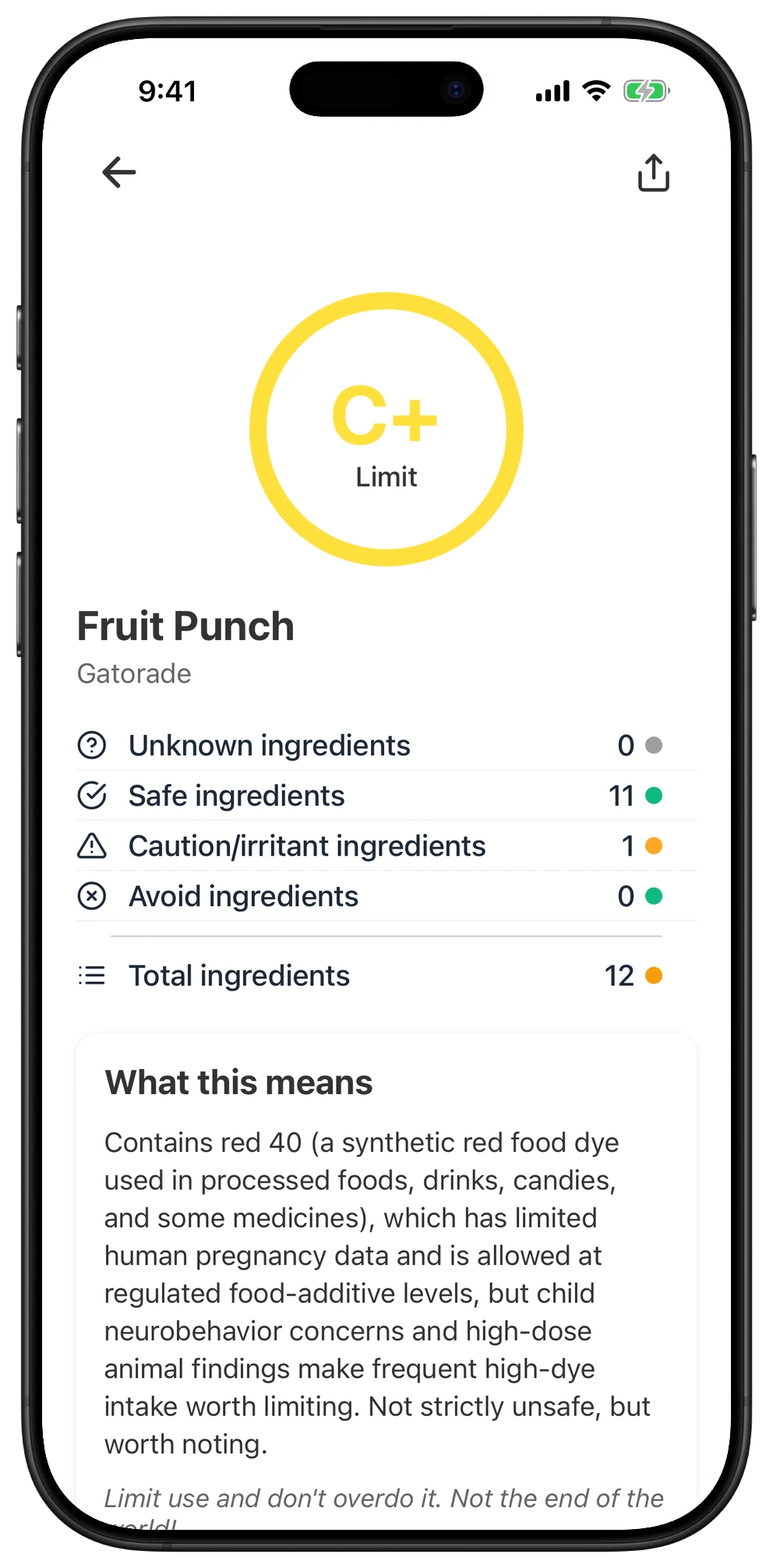
Gatorade Fruit Punch is a use with caution choice during pregnancy, with a C+ grade driven by Red 40. Occasional consumption at regulated food additive levels is unlikely to be a major pregnancy hazard, but human pregnancy data on the dye are limited, and frequent intake is worth limiting. Its added sugars also matter for your overall diet and blood glucose.
You can use this, but maybe don't make it your everyday go to. Not the end of the world if you've used it. Consult your OBGYN or midwife if you have concerns.
Pregnancy Safe is 100% independent and research driven. No companies pay to promote or sponsor products.
Stress Less This Pregnancy
Check your sports drink in the app

What Ingredients Are in Gatorade Fruit Punch?
Gatorade Fruit Punch has 12 ingredients. We flagged 1 ingredient to use with caution.
CAUTION
Red 40 is a synthetic food dye commonly used to add vibrant red color to candies, beverages, and processed foods. Occasional Red 40 exposure at regulated food levels is unlikely to be a major pregnancy hazard, but limited human pregnancy data and indirect child and high dose animal findings support limiting frequent intake.
citric acid
SAFE
Citric acid is a natural organic acid commonly used as a preservative and flavor enhancer in food and beverages. Citric acid at normal food additive amounts is generally compatible with pregnancy, though acidic drinks may aggravate reflux or dental irritation.
dextrose
SAFE
Dextrose is a simple sugar, also known as glucose, commonly used as a sweetener and energy source in food and beverages. Dextrose is compatible with pregnancy at ordinary food amounts, but its added sugar contribution needs individualized attention if you have diabetes.
glycerol ester of rosin
SAFE
Glycerol ester of rosin is a synthetic compound used as a tackifier in adhesives and sealants to enhance adhesion and flexibility. The supporting assessment concerns glycerol rather than glycerol ester of rosin itself, so it provides only indirect support for pregnancy safety at beverage amounts.
modified food starch
SAFE
Modified food starch is a processed starch used as a thickening, stabilizing, or gelling agent in various food products. Modified food starch is generally compatible with pregnancy at regulated food additive amounts, with source related precautions if you have relevant allergies or gluten restrictions.
monopotassium phosphate
SAFE
Monopotassium phosphate is a water soluble salt commonly used as a fertilizer, food additive, and buffering agent to maintain pH stability. The phosphate component is generally compatible with pregnancy at normal dietary amounts, while high dose phosphate exposure or kidney disease requires individualized guidance.
salt
SAFE
Salt is a mineral essential for flavor enhancement and preserving food. Salt is compatible with pregnancy at normal dietary amounts, but your overall sodium intake may need individualized guidance for hypertension, kidney disease, or heart disease.
sodium citrate
SAFE
Sodium citrate is a salt commonly used as a food additive and buffering agent to regulate acidity and stabilize emulsions. Sodium citrate is generally compatible with pregnancy at normal food additive amounts, based on the assessment of citric acid and related citrate salts.
sugar
SAFE
Sugar is a sweet, crystalline substance derived from plants like sugarcane or sugar beets, commonly used to sweeten and enhance the flavor of foods and beverages. Sugar is compatible with pregnancy at ordinary food amounts, but frequent sugary drinks can contribute to excess added sugar intake and blood glucose concerns.
water
SAFE
Water is a clear, tasteless, and essential liquid that sustains all known forms of life. Water from a safe treated source is recommended for normal pregnancy hydration.
caramel color
SAFE
Caramel color is a widely used food additive that imparts a rich, brown hue to beverages and processed foods. Caramel color is unflagged in this drink, but that does not establish pregnancy specific safety at its beverage exposure level.
natural flavor
SAFE
Natural flavor refers to flavoring agents derived from natural sources such as plants, fruits, or spices, used to enhance the taste of food and beverages. Natural flavor is unflagged, but its unspecified composition does not support a pregnancy specific safety conclusion at this drink's exposure level.
Answering Your Questions
How much Gatorade Fruit Punch is safe during pregnancy?
Pour a small portion rather than automatically finishing a large bottle, and check the label for serving size and added sugars. No product specific pregnancy limit is established here; if you have gestational diabetes, follow your care team's carbohydrate guidance.
Can you use Gatorade Fruit Punch daily while pregnant?
Keep it occasional rather than making it your everyday hydration drink. Choose water for routine hydration to reduce repeated exposure to Red 40 and added sugars.
Why does Gatorade Fruit Punch receive a C+ grade?
The C+ comes from ingredient based scoring, with Red 40 as the scoring relevant caution ingredient. Human pregnancy data are limited; concerns involve effects observed in some children and largely high dose animal findings, not proven fetal harm from occasional drinking. Sugar is a separate dietary consideration, not the ingredient driving this grade.
Can I drink Gatorade Fruit Punch in the first trimester?
There is no established first trimester specific safety conclusion for this drink. The same cautious approach applies throughout pregnancy: keep consumption occasional, rather than treating the C+ grade as either proof of harm or a guarantee of safety.
Can I drink Gatorade Fruit Punch every day while pregnant?
It is better kept occasional because daily use adds repeated Red 40 exposure and added sugars. Water is the preferred routine hydration choice; needing extra fluids does not necessarily mean you need a sugary sports drink.
Can I drink it if I have gestational diabetes?
This formula contains sugar and dextrose, which count toward your carbohydrate intake and can affect blood glucose. Check the nutrition label and your individualized carbohydrate plan before drinking it; its pregnancy grade does not establish whether it fits your diabetes management.
What can I choose instead of Gatorade Fruit Punch?
Choose water for everyday hydration. If you want an electrolyte drink, compare options without synthetic dyes and with less added sugar, while checking the full ingredient list rather than assuming another Gatorade flavor or a zero sugar label guarantees pregnancy suitability.
Can I drink Gatorade Fruit Punch while breastfeeding?
The pregnancy grade does not establish breastfeeding safety, and this ingredient assessment does not provide a breast milk exposure evaluation for Red 40. Keep sugary drinks occasional and use water for routine hydration; ask your clinician if you need advice specific to your nursing infant.
What Are Pregnancy Safe Alternatives to Gatorade Fruit Punch?
Here are some solid alternatives. Everything below has an A or B grade, meaning no flagged ingredients in our database.
| Grade | Product | Brand | Type |
|---|---|---|---|
| A | Gatorade Zero Sugar Thirst Quencher Berry | Gatorade | sports drink |
| A | Gatorlyte Rapid Rehydration Electrolyte Beverage Cherry Lime | Gatorlyte | sports drink |
| A | Gatorade Frost Thirst Quencher Glacier Cherry | Gatorade | sports drink |
| A | Glacier Cherry Flavored Zero Sugar Thirst Quencher, Glacier Cherry | Gatorade | sports drink |
Are Other Gatorade Products Safe During Pregnancy?
We looked at 11 other Gatorade products. 8 are pregnancy safe (A or B grade), while 3 need a closer look.
| Grade | Product | Type |
|---|---|---|
| A | Gatorade Zero Sugar Thirst Quencher Berry | sports drink |
| A | Apple Blast Thirst Quencher Concentrate, Apple Blast | sports drink |
| A | Apple Pear Flavored Energy Gel, Apple Pear | energy gel |
| A | Apple Raspberry Flavored Juice Based Sports Drink From Concentrate, Apple Raspberry | sports drink |
How Does Gatorade Fruit Punch Compare to Other Sports Drinks?
We graded 1,124 Sports Drinks for pregnancy safety. Here's how they stack up:
Gatorade Fruit Punch earns a C+ grade, placing it among the top of Sports Drinks. Only 23% of products in this category get an A grade, so it pays to choose carefully.
How Do We Score Products for Pregnancy Safety?
We analyze each product's ingredients and category to flag known risks and provide cautionary notices for general category safety concerns.
A - Safe
Excellent choice! All ingredients are considered safe during pregnancy.
What to do: Use with confidence.
B - Likely Safe
Pretty much safe with very minimal risk. Some ingredients may have limited pregnancy studies, but no significant safety concerns have been identified.
What to do: Use with confidence.
C - Limit
Contains ingredients with some pregnancy considerations. Research shows these ingredients may have limited safety data, potential for minor hormonal effects, or require caution based on animal studies.
What to do: Use sparingly and consider safer alternatives when available.
D - Caution
Similar to C grade but contains multiple cautionary ingredients. The combination increases overall concern.
What to do: Try to avoid if that makes you feel better. If you've already used it, no need to panic.
F - Avoid
Contains an ingredient Pregnancy Safe recommends avoiding during pregnancy. This may reflect an established risk or a precaution based on limited evidence; check the ingredient guidance and exposure context.
What to do: Do not use during pregnancy. If you've already used it, don't worry - contact your OBGYN if concerned.
People Also Checked
Gatorade Zero Sugar Thirst Quencher Berry
Gatorade
Cheetos Crunchy Flamin' Hot Cheese Flavored Snacks
Cheetos
Spindrift Cranberry Raspberry Sparkling Water
Spindrift
La Roche Posay Toleriane Face Moisturizer Sunscreen With Ceramide And Niacinamide - Spf 30
La Roche Posay
Aveeno Daily Moisturizing Body Wash With Soothing Oat
Aveeno
References
- https://www.hfpappexternal.fda.gov/scripts/fdcc/index.cfm?id=FDCRed40&set=ColorAdditives
- https://www.ecfr.gov/current/title-21/chapter-I/subchapter-A/part-74/subpart-A/section-74.340
- https://www.fda.gov/food/color-additives-information-consumers/tracking-food-industry-pledges-remove-petroleum-based-food-dyes
- https://www.efsa.europa.eu/en/efsajournal/pub/1327
- https://www.efsa.europa.eu/en/efsajournal/pub/4007
- https://apps.who.int/food-additives-contaminants-jecfa-database/Home/Chemical/2361
- https://oehha.ca.gov/risk-assessment/report/health-effects-assessment-potential-neurobehavioral-effects-synthetic-food-dyes-children
- https://pubmed.ncbi.nlm.nih.gov/6636206/
- https://pubmed.ncbi.nlm.nih.gov/2613118/
- https://pubmed.ncbi.nlm.nih.gov/7940558/
- https://hfpappexternal.fda.gov/scripts/fdcc/index.cfm?id=CITRICACID&set=FoodSubstances
- https://www.ecfr.gov/current/title-21/chapter-I/subchapter-B/part-184/subpart-B/section-184.1033
- https://apps.who.int/food-additives-contaminants-jecfa-database/chemical.aspx?chemID=3594
- https://www.inchem.org/documents/jecfa/jeceval/jec_436.htm
- https://pmc.ncbi.nlm.nih.gov/articles/PMC7448088/
- https://www.fao.org/fileadmin/user_upload/jecfa_additives/docs/monograph16/additive-135-m16.pdf
- https://www.ncbi.nlm.nih.gov/books/NBK560599/
- https://www.nationalacademies.org/read/25841/chapter/3
- https://www.acog.org/womens-health/faqs/healthy-eating-during-pregnancy
- https://www.acog.org/womens-health/faqs/gestational-diabetes
- https://diabetesjournals.org/care/article/49/Supplement_1/S321/163918/15-Management-of-Diabetes-in-Pregnancy-Standards
- https://www.cdc.gov/diabetes/about/gestational-diabetes.html
- https://diabetes.org/living-with-diabetes/hypoglycemia-low-blood-glucose/symptoms-treatment
- https://cdn.realfood.gov/DGA.pdf
- https://www.hfpappexternal.fda.gov/scripts/fdcc/index.cfm?id=GLYCERIN&set=FoodSubstances
- https://pubmed.ncbi.nlm.nih.gov/31840548/
- https://pmc.ncbi.nlm.nih.gov/articles/PMC7009851/
- https://www.medicinesinpregnancy.org/leaflets-a-z/glycerin-suppositories/
- https://mothertobaby.org/pregnancy-breastfeeding-exposures/cosmetics/
- https://www.hfpappexternal.fda.gov/scripts/fdcc/index.cfm?id=STARCHFOODMODIFIED&set=FoodSubstances
- https://www.ecfr.gov/current/title-21/chapter-I/subchapter-B/part-172/subpart-I/section-172.892
- https://pubmed.ncbi.nlm.nih.gov/32625282/
- https://www.fda.gov/regulatory-information/search-fda-guidance-documents/cpg-sec-578100-starches-common-or-usual-names
- https://www.fda.gov/consumers/consumer-updates/flour-raw-food-and-other-safety-facts
- https://ods.od.nih.gov/factsheets/Phosphorus-HealthProfessional/
- https://ods.od.nih.gov/factsheets/Pregnancy-HealthProfessional/
- https://www.ncbi.nlm.nih.gov/books/NBK109813/
- https://lpi.oregonstate.edu/mic/minerals/phosphorus
- https://pmc.ncbi.nlm.nih.gov/articles/PMC11270530/
- https://pmc.ncbi.nlm.nih.gov/articles/PMC6946899/
- https://www.who.int/publications/i/item/9789241504836
- https://www.ncbi.nlm.nih.gov/books/NBK610895/
- https://www.ecfr.gov/current/title-21/chapter-I/subchapter-B/part-184/subpart-B/section-184.1854
- https://www.fda.gov/files/food/published/Guidance-for-Industry--Ingredients-Declared-as-Evaporated-Cane-Juice-%28PDF%29.pdf
- https://www.cdc.gov/maternal-infant-health/pregnancy-diabetes/index.html
- https://pubmed.ncbi.nlm.nih.gov/30501650/
- https://pubmed.ncbi.nlm.nih.gov/35483873/
- https://pubmed.ncbi.nlm.nih.gov/34666569/
- https://www.acog.org/womens-health/experts-and-stories/ask-acog/how-much-water-should-i-drink-during-pregnancy
- https://www.cdc.gov/healthy-weight-growth/water-healthy-drinks/index.html
- https://www.cdc.gov/heat-health/hcp/clinical-overview/heat-and-pregnant-women.html
- https://www.cdc.gov/drinking-water/about/index.html
- https://www.cdc.gov/yellow-book/hcp/family-travel/pregnant-travelers.html
- https://www.epa.gov/privatewells/protect-your-homes-water
- https://www.fda.gov/consumers/consumer-updates/bottled-water-everywhere-keeping-it-safe
- https://www.nationalacademies.org/read/10925/chapter/6