Is Gatorade Zero Sugar Berry Safe During Pregnancy? (Updated 2026 Guide)
Updated September 9, 2026
Gatorade Zero Sugar Berry
Gatorade
Gatorade Zero Sugar Berry receives an A grade, making it a generally compatible pregnancy option in ordinary beverage amounts under its ingredient based assessment. No ingredients were flagged for caution or avoidance, but the grade does not mean every ingredient has direct pregnancy safety evidence or that unlimited intake is recommended.
Go ahead and use it. Nothing to worry about here.
Pregnancy Safe is 100% independent and research driven. No companies pay to promote or sponsor products.
Stress Less This Pregnancy
Check your sports drink in the app

What Ingredients Are in Gatorade Zero Sugar Berry?
Gatorade Zero Sugar Berry has 11 ingredients. All 11 ingredients are considered safe for pregnancy.
acesulfame potassium
SAFE
Acesulfame potassium is a calorie free artificial sweetener commonly used to enhance the sweetness of food and beverages. The supporting pregnancy evidence concerns ordinary dietary potassium, not acesulfame potassium itself, so it does not directly establish this sweetener's safety at beverage amounts.
citric acid
SAFE
Citric acid is a natural organic acid commonly used as a preservative and flavor enhancer in food and beverages. Citric acid is generally compatible with pregnancy at normal food additive amounts, though acidic drinks may worsen reflux or dental irritation.
glycerol ester of rosin
SAFE
Glycerol ester of rosin is a synthetic compound used as a tackifier in adhesives and sealants to enhance adhesion and flexibility. The supporting pregnancy information concerns glycerol rather than glycerol ester of rosin, so it does not directly establish this ingredient's safety at beverage amounts.
modified food starch
SAFE
Modified food starch is a processed starch used as a thickening, stabilizing, or gelling agent in various food products. Modified food starch is compatible with pregnancy at normal regulated food use amounts, with source specific considerations if you have food allergies.
monopotassium phosphate
SAFE
Monopotassium phosphate is a water soluble salt commonly used as a fertilizer, food additive, and buffering agent to maintain pH stability. Phosphate at ordinary dietary amounts is generally compatible with pregnancy, while high dose phosphate exposure or kidney disease requires individualized guidance.
salt
SAFE
Salt is a mineral essential for flavor enhancement and preserving food. Salt is compatible with pregnancy in normal dietary amounts, but this drink's sodium should fit any individualized blood pressure, kidney, or heart related guidance.
sodium citrate
SAFE
Sodium citrate is a salt commonly used as a food additive and buffering agent to regulate acidity and stabilize emulsions. Evidence covering citric acid and citrate salts supports low pregnancy concern at ordinary food additive amounts.
water
SAFE
Water is a clear, tasteless, and essential liquid that sustains all known forms of life. Water from a safe treated source is recommended for normal pregnancy hydration, while contamination and rapid excessive intake pose separate risks.
natural flavor
SAFE
Natural flavor refers to flavoring agents derived from natural sources such as plants, fruits, or spices, used to enhance the taste of food and beverages. Natural flavor is unflagged in this drink, but its unspecified composition and lack of ingredient specific pregnancy evidence do not establish reviewed safety.
sucralose
SAFE
Sucralose is a calorie free artificial sweetener commonly used to sweeten foods and beverages without adding sugar. Sucralose is unflagged in this drink, but no ingredient specific pregnancy evidence or intake limit is established by its assessment.
vegetable juice concentrate
SAFE
A concentrated liquid made from blended and processed vegetables, used to add flavor and nutrients to dishes and beverages. Vegetable juice concentrate is unflagged in this drink, but it has no ingredient specific pregnancy safety review in this assessment.
Answering Your Questions
How much Gatorade Zero Sugar Berry is safe during pregnancy?
Use the serving size on your bottle as a portion guide, not a pregnancy specific safety limit. Keep plain water as your main drink, and account for the sodium in this beverage if your clinician has given you dietary restrictions.
Can you use Gatorade Zero Sugar Berry daily while pregnant?
Choose it occasionally for variety rather than replacing all your daily water with it. If you have kidney disease or a prescribed fluid or electrolyte restriction, ask your clinician how it fits your plan.
Why does Gatorade Zero Sugar Berry receive an A grade?
Its A grade comes from simple ingredient based scoring, with no ingredients flagged for caution or avoidance. That is not the same as a complete pregnancy study of the drink: some ingredients are unflagged rather than individually reviewed, and some supporting evidence concerns related substances rather than the exact ingredient.
Can I drink Gatorade Zero Sugar Berry every day while pregnant?
The assessment does not establish a pregnancy specific daily amount or frequency. Keep water as your main hydration source, and consider the drink's sodium alongside the rest of your diet rather than treating its A grade as a reason to drink it without limits.
Are the artificial sweeteners in Gatorade Zero reviewed for pregnancy?
This drink contains sucralose and acesulfame potassium, and neither is flagged in its assessment. However, sucralose has no ingredient specific pregnancy review here, and the evidence associated with acesulfame potassium concerns dietary potassium rather than the sweetener itself; neither should be described as conclusively reviewed safe on that basis.
Which Gatorade flavor is best during pregnancy?
There is no established best flavor from this assessment. Choose a flavor you tolerate, check the exact formula, and do not assume other flavors or Gatorade varieties share this Berry product's grade.
What are alternatives to Gatorade Zero Sugar Berry during pregnancy?
Plain drinking water from a safe source is the simplest everyday alternative. If you prefer an electrolyte drink, compare sodium, sugar, sweeteners, and the exact ingredient assessment rather than assuming every zero sugar product is equivalent.
Can I drink Gatorade Zero Sugar Berry while breastfeeding?
Its A grade is a pregnancy ingredient assessment, not a breastfeeding specific verdict. The ingredient information does not establish a breastfeeding intake limit; keep water as your main drink and seek individualized guidance if you need to restrict fluids or electrolytes.
What Are Pregnancy Safe Alternatives to Gatorade Zero Sugar Berry?
Here are some solid alternatives. Everything below has an A or B grade, meaning no flagged ingredients in our database.
| Grade | Product | Brand | Type |
|---|---|---|---|
| A | Gatorlyte Rapid Rehydration Electrolyte Beverage Cherry Lime | Gatorlyte | sports drink |
| A | Gatorade Frost Thirst Quencher Glacier Cherry | Gatorade | sports drink |
| A | Glacier Cherry Flavored Zero Sugar Thirst Quencher, Glacier Cherry | Gatorade | sports drink |
| A | Gatorade Zero | Gatorade | sports drink |
Are Other Gatorade Products Safe During Pregnancy?
We looked at 11 other Gatorade products. 7 are pregnancy safe (A or B grade), while 4 need a closer look.
| Grade | Product | Type |
|---|---|---|
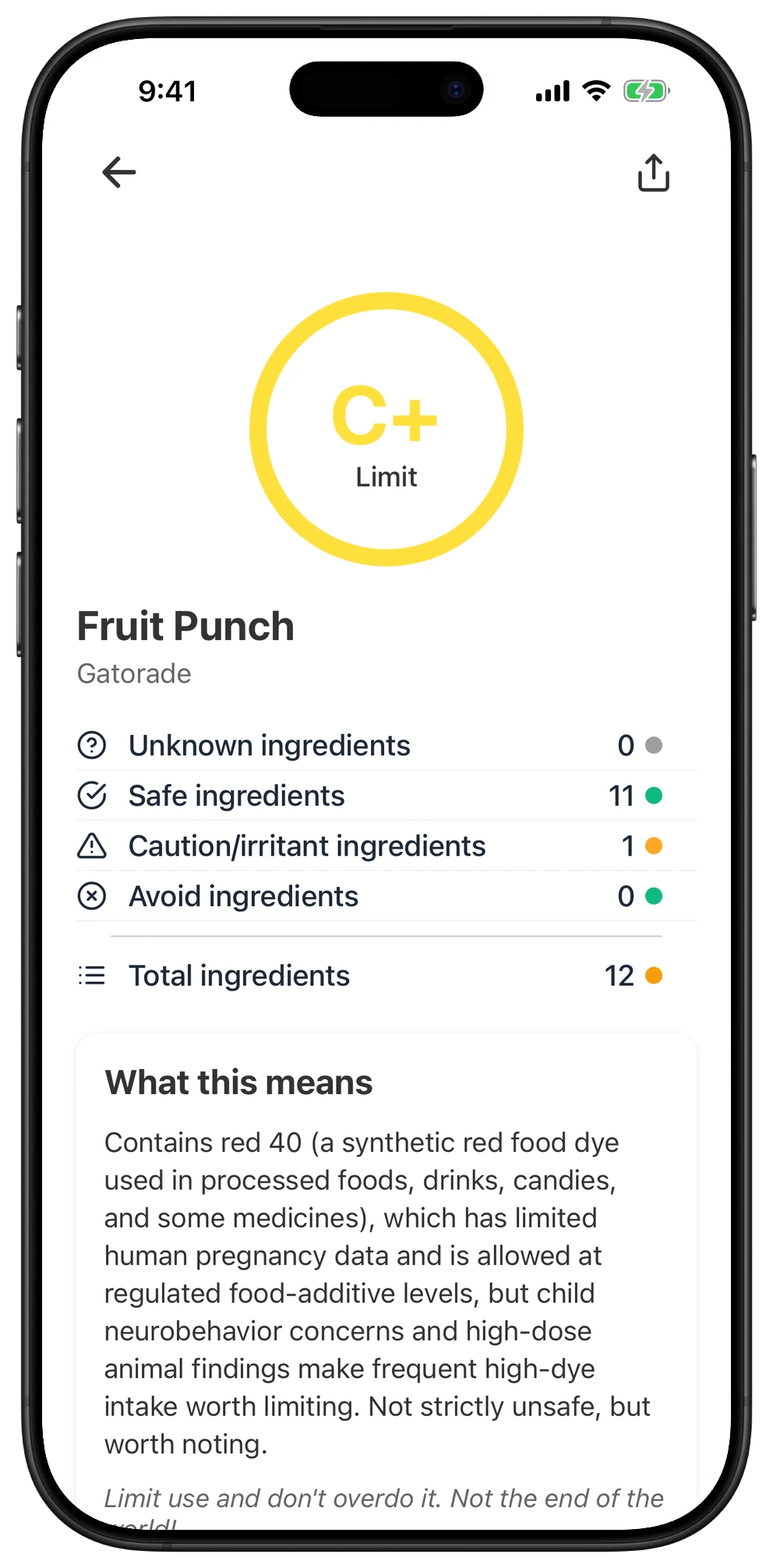
| C+ | Fruit Punch | sports drink |
| A | Apple Blast Thirst Quencher Concentrate, Apple Blast | sports drink |
| A | Apple Pear Flavored Energy Gel, Apple Pear | energy gel |
| A | Apple Raspberry Flavored Juice Based Sports Drink From Concentrate, Apple Raspberry | sports drink |
How Does Gatorade Zero Sugar Berry Compare to Other Sports Drinks?
We graded 1,124 Sports Drinks for pregnancy safety. Here's how they stack up:
Gatorade Zero Sugar Berry earns a A grade, placing it among the top of Sports Drinks. Only 23% of products in this category get an A grade, so it pays to choose carefully.
How Do We Score Products for Pregnancy Safety?
We analyze each product's ingredients and category to flag known risks and provide cautionary notices for general category safety concerns.
A - Safe
Excellent choice! All ingredients are considered safe during pregnancy.
What to do: Use with confidence.
B - Likely Safe
Pretty much safe with very minimal risk. Some ingredients may have limited pregnancy studies, but no significant safety concerns have been identified.
What to do: Use with confidence.
C - Limit
Contains ingredients with some pregnancy considerations. Research shows these ingredients may have limited safety data, potential for minor hormonal effects, or require caution based on animal studies.
What to do: Use sparingly and consider safer alternatives when available.
D - Caution
Similar to C grade but contains multiple cautionary ingredients. The combination increases overall concern.
What to do: Try to avoid if that makes you feel better. If you've already used it, no need to panic.
F - Avoid
Contains an ingredient Pregnancy Safe recommends avoiding during pregnancy. This may reflect an established risk or a precaution based on limited evidence; check the ingredient guidance and exposure context.
What to do: Do not use during pregnancy. If you've already used it, don't worry - contact your OBGYN if concerned.
People Also Checked
References
- https://ods.od.nih.gov/factsheets/Potassium-HealthProfessional/
- https://www.ncbi.nlm.nih.gov/books/NBK545428/
- https://wicworks.fns.usda.gov/resources/eye-nutrition-potassium
- https://www.fda.gov/food/nutrition-facts-label/daily-value-nutrition-and-supplement-facts-labels
- https://dailymed.nlm.nih.gov/dailymed/lookup.cfm?setid=41ff55cf-4af3-487e-bd78-09703d310780
- https://www.kidney.org/kidney-topics/hyperkalemia-high-potassium
- https://hfpappexternal.fda.gov/scripts/fdcc/index.cfm?id=CITRICACID&set=FoodSubstances
- https://www.ecfr.gov/current/title-21/chapter-I/subchapter-B/part-184/subpart-B/section-184.1033
- https://apps.who.int/food-additives-contaminants-jecfa-database/chemical.aspx?chemID=3594
- https://www.inchem.org/documents/jecfa/jeceval/jec_436.htm
- https://pmc.ncbi.nlm.nih.gov/articles/PMC7448088/
- https://www.fao.org/fileadmin/user_upload/jecfa_additives/docs/monograph16/additive-135-m16.pdf
- https://www.hfpappexternal.fda.gov/scripts/fdcc/index.cfm?id=GLYCERIN&set=FoodSubstances
- https://pubmed.ncbi.nlm.nih.gov/31840548/
- https://pmc.ncbi.nlm.nih.gov/articles/PMC7009851/
- https://www.medicinesinpregnancy.org/leaflets-a-z/glycerin-suppositories/
- https://mothertobaby.org/pregnancy-breastfeeding-exposures/cosmetics/
- https://www.hfpappexternal.fda.gov/scripts/fdcc/index.cfm?id=STARCHFOODMODIFIED&set=FoodSubstances
- https://www.ecfr.gov/current/title-21/chapter-I/subchapter-B/part-172/subpart-I/section-172.892
- https://pubmed.ncbi.nlm.nih.gov/32625282/
- https://www.fda.gov/regulatory-information/search-fda-guidance-documents/cpg-sec-578100-starches-common-or-usual-names
- https://www.fda.gov/consumers/consumer-updates/flour-raw-food-and-other-safety-facts
- https://ods.od.nih.gov/factsheets/Phosphorus-HealthProfessional/
- https://ods.od.nih.gov/factsheets/Pregnancy-HealthProfessional/
- https://www.ncbi.nlm.nih.gov/books/NBK109813/
- https://lpi.oregonstate.edu/mic/minerals/phosphorus
- https://www.acog.org/womens-health/faqs/healthy-eating-during-pregnancy
- https://pmc.ncbi.nlm.nih.gov/articles/PMC11270530/
- https://pmc.ncbi.nlm.nih.gov/articles/PMC6946899/
- https://www.who.int/publications/i/item/9789241504836
- https://www.ncbi.nlm.nih.gov/books/NBK610895/
- https://www.acog.org/womens-health/experts-and-stories/ask-acog/how-much-water-should-i-drink-during-pregnancy
- https://www.cdc.gov/healthy-weight-growth/water-healthy-drinks/index.html
- https://www.cdc.gov/heat-health/hcp/clinical-overview/heat-and-pregnant-women.html
- https://www.cdc.gov/drinking-water/about/index.html
- https://www.cdc.gov/yellow-book/hcp/family-travel/pregnant-travelers.html
- https://www.epa.gov/privatewells/protect-your-homes-water
- https://www.fda.gov/consumers/consumer-updates/bottled-water-everywhere-keeping-it-safe
- https://www.nationalacademies.org/read/10925/chapter/6